States of matter
 Call Kai
 Learn
Learn Practice Test
 Spaced Repetition
 Match
Match Flashcards
 Knowt Play
1/17

There's no tags or description
Looks like no tags are added yet.
Name | Mastery | Learn | Test | Matching | Spaced | Call with Kai | Chat |
|---|
No analytics yet
Send a link to your students to track their progress
18 Terms
Properties of an ideal gas
1) The volume of gas molecules is negligible
2) Intermolecular FOA is negligible
3) Moves rapidly and randomly
4) Collisions between molecules are elastic
5) When in a container, they exert pressure
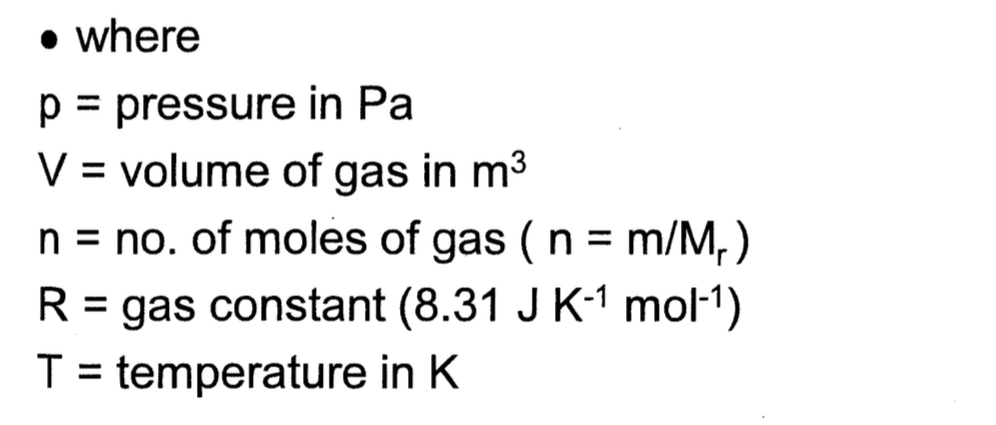
Properties of a real gas (pV = nRT)
At low pressures:
1) Volume is negligible (widely spaced)
2) Intermolecular FOA negligible (also at high temp)
At high pressures:
1) Gas molecules are closely packed together, so volume cannot be negligible
2) Intermolecular FOA becomes significant
Equation of fixed mass of an ideal gas (+ at constant temperature and pressure)
1) pV/T = constant
2) pV = constant
3) V/T = constant
Equations of relative molecular mass in gases
1) pV = nRT / Mr
2) Mr = mRT / pV
Structure of ionic solids
Lattice particles: positive and negative ions
Lattice forces: ionic bonds
Consists of positive and negative ions arranged alternatively in a crystal lattice held together by strong ionic bonds
E.g: NaCl, Mg2O
Properties of ionic solids
1) Hard, strong FOA
2) Brittle, possible to displace one layer of ions relative to the next
3) High MP
4) Good conductor of electricity when molten, mobile ions
Structure of metallic solids
Lattice particles: metal cations
Lattice forces: metallic bonds
A lattice of metal ions in a sea of delocalised electrons
Properties of metallic solids
1) High MP and BP
2) Good conductors of electricity
3) Strong but malleable and ductile, atoms can slide over each other without breaking bonds
Structure of simple molecular solids
Lattice particles: molecules
Lattice forces: intermolecular forces
A lattice of molecules held together by weak intermolecular forces
Eg. Iodine
Properties of simple molecular solids
1) Low MP and BP
2) Non-conductor of electricity when solid, liquid or aqueous
3) Soft, intermolecular forces are weak
4) Solid iodine is soluble in non-polar solvents (hexane)
Structure of ice
Lattice particles: Water molecules
Lattice forces: Hydrogen bonds
Simple molecular structure consisting of a lattice of water molecules held together by hydrogen bonds
Structure of giant molecular solids (mainly allotropes of carbon)
Lattice particles: Atoms
Lattice forces: Covalent bonds
A macromolecular structure consisting of a lattice of atoms held together by strong covalent bonds
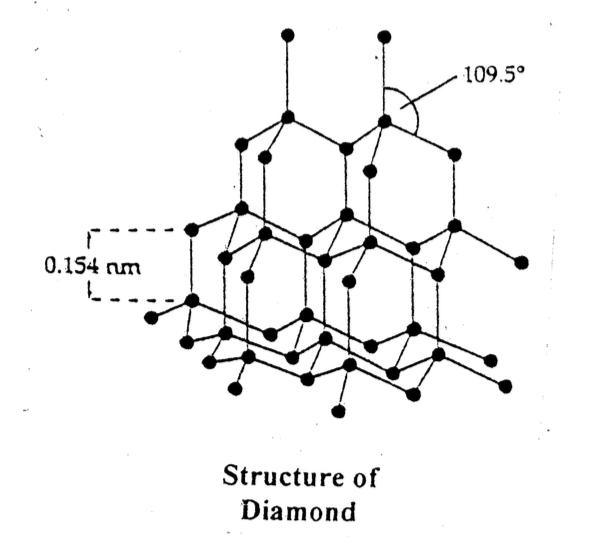
Structure of diamond
Lattice particles: carbon atoms
Lattice forces: strong covalent bond’s
A macromolecular structure consisting of each C atom bonded to 4 other C atom in a continuous tetrahedral arrangement.
Properties of diamond
1) Very high MP and BP
2) Non-conductor of heat and electricity
3) Insoluble
4) Very hard
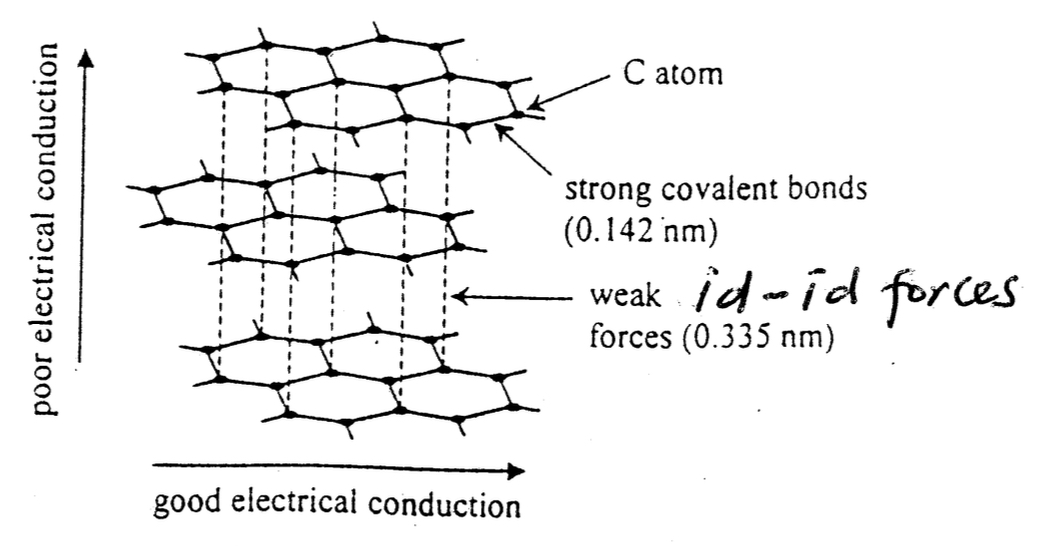
Structure of graphite
Lattice particles: carbon atoms
Lattice forces: covalent bonds within layer, weak id-id forces between layers
Within each layer, a carbon atom is covalently bonded to three other carbon atoms
Properties of graphite
1) High MP
2) Good conductor of electricity due to delocalised electrons between layers
3) Insoluble
4) Slippery and has lubricating properties, layers slide over each other
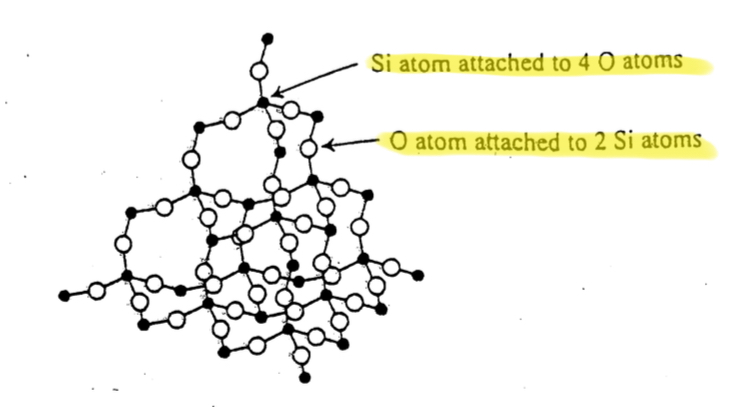
Structure of silicon oxide
Lattice particles: silicon atoms and oxygen atoms
Lattice forces: strong covalent bonds
Each Si covalently bonds to four O atoms
Each O atom bonded to two Si
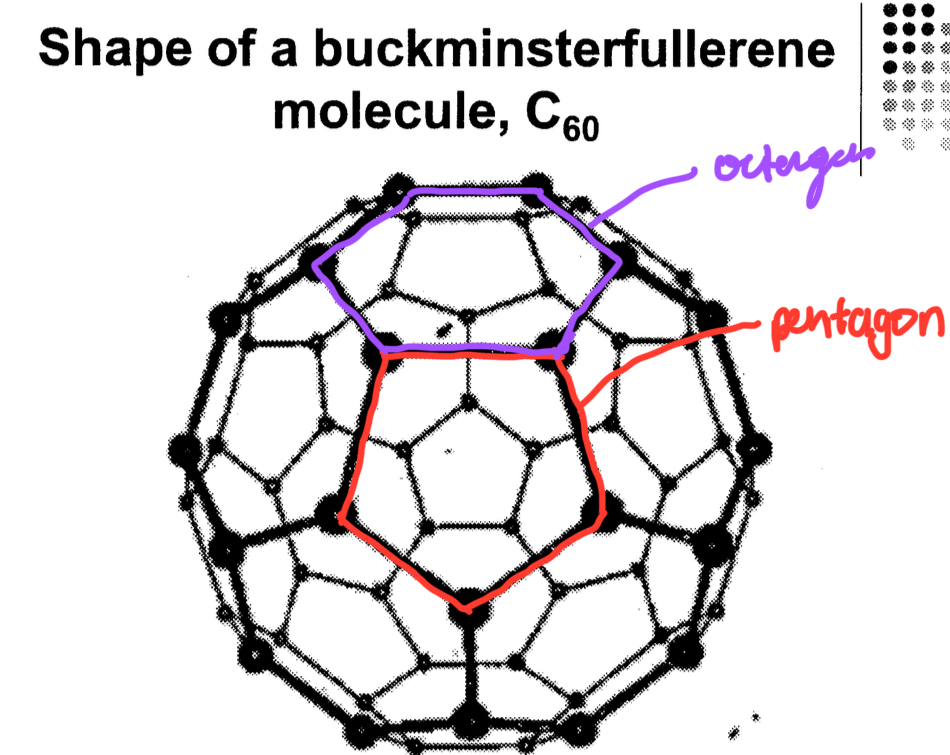
Structure and properties of buckminsterfullerene
Allotrope of carbon (60)
Relatively soft, does not require much energy to overcome intermolecular forces
Poor conductor of electricity but is able to also along with heat
Only soluble in carbon disulfide and methylbenzene