Radical Reactions: Allyl's & Stability
 Call Kai
 Learn
Learn Practice Test
 Spaced Repetition
 Match
Match Flashcards
 Knowt Play
1/15

There's no tags or description
Looks like no tags are added yet.
Name | Mastery | Learn | Test | Matching | Spaced | Call with Kai | Chat |
|---|
No analytics yet
Send a link to your students to track their progress
16 Terms
Radicals occur in
3 stages:
Initiation
Propagation
Termination
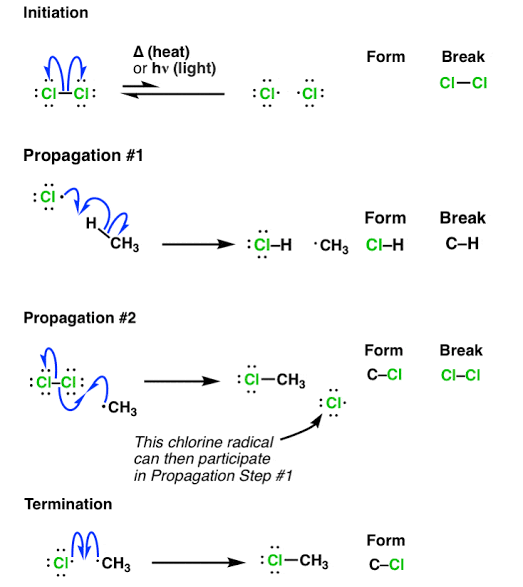
Initiation
Makes radicals.
Radical Initiators
Things that START radicals:
Heat
Light (hv): using light as an energy source
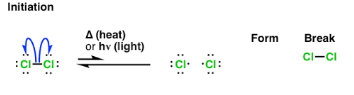
Peroxides (RO-OR)
hv
using light as an energy source
Peroxides
RO-OR, The O-O bond is weak, Breaks easily. Makes radicals.
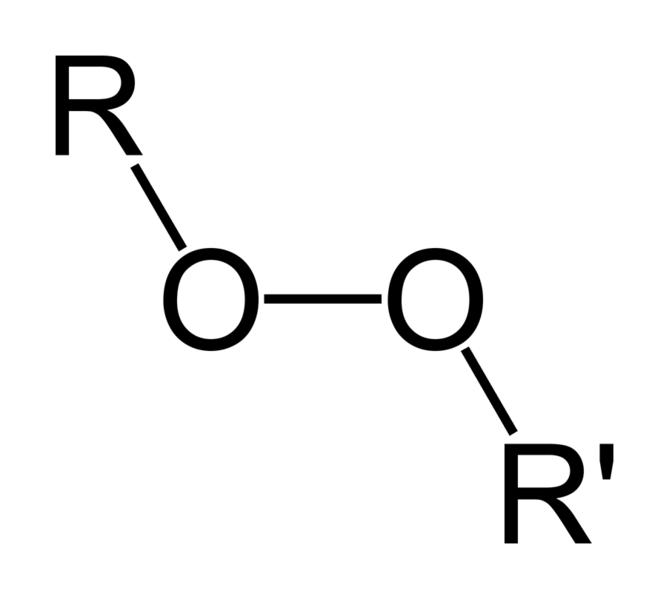
Propagation Steps
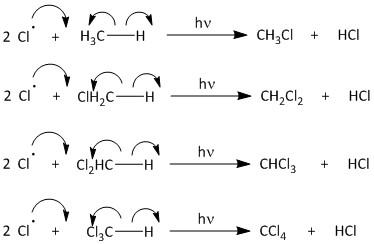
This is where the chain reaction happens. The chain-reaction stage is where radicals continuously react with stable molecules to produce new radicals, keeping the reaction going. Every propagation step consumes one radical and creates a new one, meaning the total number of radicals remains constant until they are eventually removed during termination (The reaction can continue (chain reaction) as there are many available C-H bonds in this example).
Termination
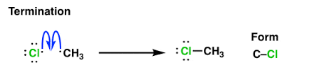
Reaction stops, Two radicals combine, No radicals remain. Reaction ends.
Radical Stability
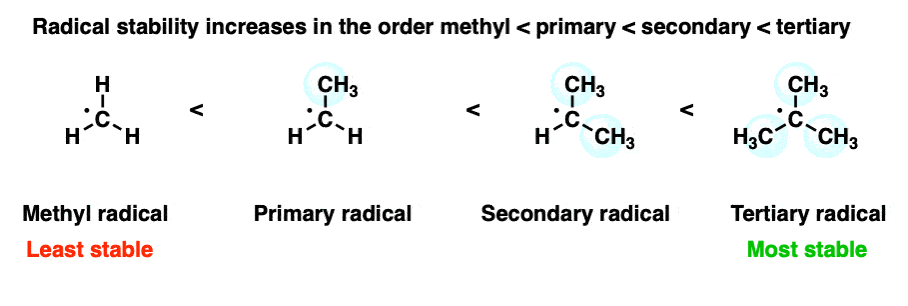
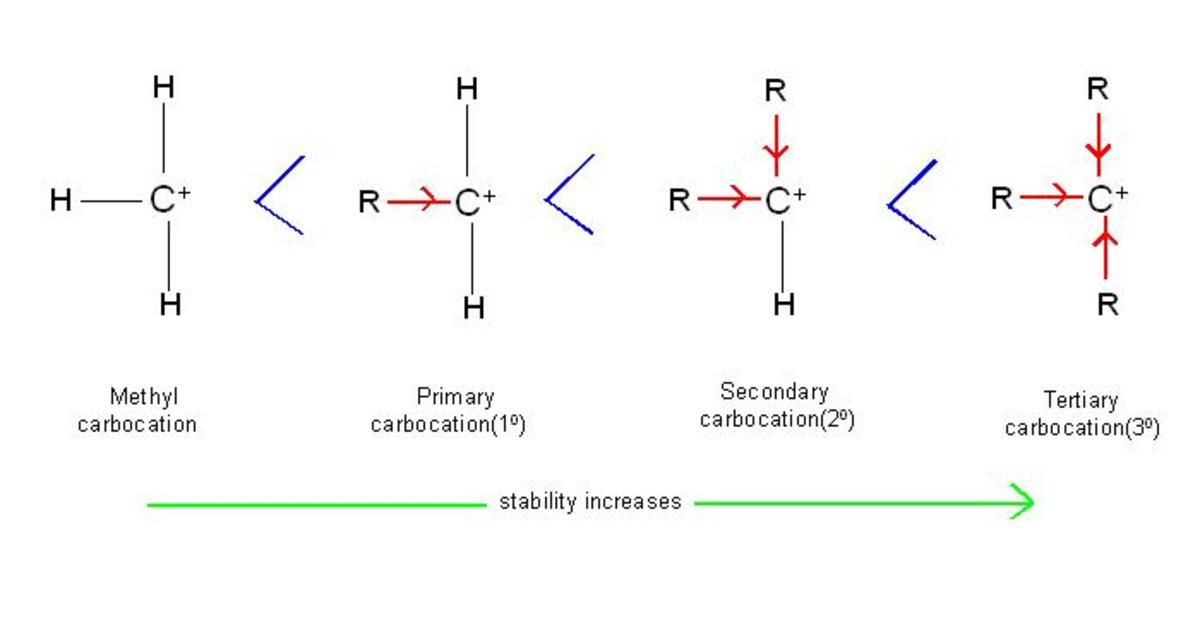
More Carbons attached, more stable (Remember Stability Order for Primary-Tertiary Carbons, it applies the same for Radical Stability). see image
Radical Resonance
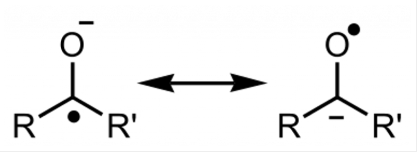
Resonance means electrons are shared over multiple atoms instead of staying on one atom. This makes molecules more stable. Radical resonance structures are alternative ways to draw a molecule where an unpaired electron (a free radical) is delocalized over multiple atoms. By spreading out this "radical character," the molecule becomes much more stable.
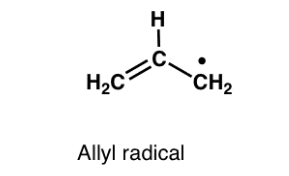
Alyll Radical
a structure with an unpaired electron (the radical) sitting on the carbon atom directly next to a carbon-carbon double bond.
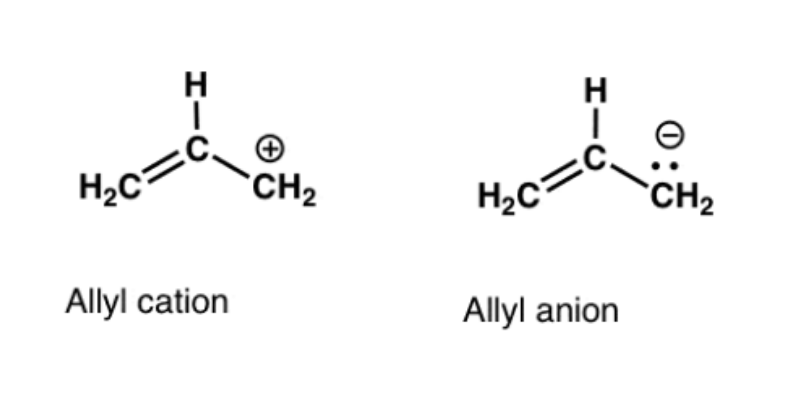
Allyl Cation
Positive charge next to double bond. Also stabilized by resonance. You can also have a Allyl Anion, which is the same thing just with a negative charge.
Resonance Effect
Resonance is when electrons are spread out over two or more atoms instead of being stuck on one atom. If electrons or charges can be spread over several atoms, the molecule becomes more stable. EX: The negative charge is shared between two oxygens. Instead of one oxygen holding all the negative charge, both oxygens share it. Much more stable.
Inductive Effect
Instead of sharing electrons, atoms simply pull or push electron density through single bonds. Electronegative Atoms Pull Electrons
Atoms like:
Fluorine
Chlorine
Bromine
Oxygen
Nitrogen
pull electron density toward themselves. Carbon chains (alkyl groups) do the opposite. They gently push electron density toward nearby carbons. This helps stabilize positive charges. A tertiary carbocation has three alkyl groups donating electron density, making the positive carbon less electron-poor. Electron-withdrawing atoms pull electrons. Alkyl groups donate electrons.
Destabilizing Effect
Destabilizing means raising the energy, making an intermediate less likely to form. Something leaves a charge or radical without support, Charge stays on one atom, No resonance, No electron donation, Higher energy, Less stable
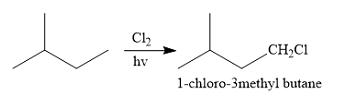
Monochlorination
a chemical substitution reaction where exactly one hydrogen atom in an organic molecule (typically an alkane) is replaced by a chlorine atom. This is a radical substitution reaction. Not every hydrogen is equally easy to remove, Some hydrogens form more stable radicals. The more stable the radical, the easier it is to form (the major product is favored)
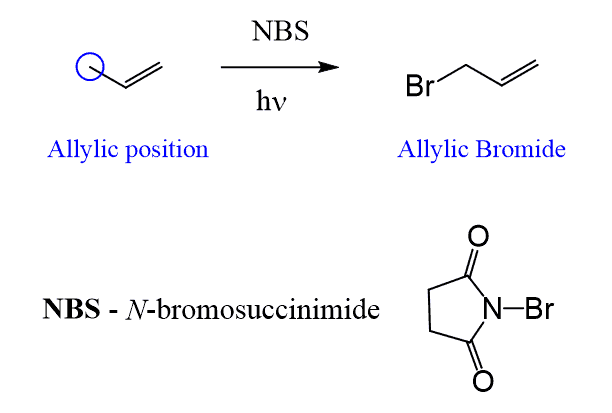
NBS
N-Bromosuccinimide: Purpose: Adds Br ONLY to allylic carbons. NOT across double bonds. Need: NBS & Light or peroxide Makes: allylic bromides. NBS (N-bromosuccinimide) needs radical conditions to work. That usually means light (hν) or a radical initiator such as a peroxide (ROOR).