Chapter 2 - The Components of Matter
 Call Kai
 Learn
Learn Practice Test
 Spaced Repetition
 Match
Match Flashcards
 Knowt Play
1/26

There's no tags or description
Looks like no tags are added yet.
Name | Mastery | Learn | Test | Matching | Spaced | Call with Kai | Chat |
|---|
No analytics yet
Send a link to your students to track their progress
27 Terms
What is the difference between a substance and a mixture?
A substance is matter with a fixed composition. A mixture has two or more substances that are physically connected with a variable composition.
EX: Water is pure substance because it has a fixed chemical composition. Saltwater is a mixture because it includes two substances (NaCl and H2O).
What is an element? Can it contain multiple atoms?
It is a pure substance that cannot be broken down.
An element CAN contain multiple atoms (e.g., O2).
What is the difference between an element and a molecule?
An element is a pure substance that cannot be broken down. A molecule is formed with two or more atoms bind together. (like H2O).
NOT all molecules are elements.
How is a molecule different from a compound?
A molecule is when two or more elements bind together. A compound is when two or more DIFFERENT elements bind together.
Can a compound be broken down into simpler substances? What about an element?
If it can, explain how!
A compound is able to be broken down because it includes two different elements. An element CANNOT be broken down.
Any sort of breaking down is done through chemical changes. EX: an electric current will break down molten NaCl into metallic sodium and chlorine gas.
In mixtures, are substances (elements/compounds) physically or chemically intermingled?
physically!
How is a mixture different from a compound in terms of a separation method?
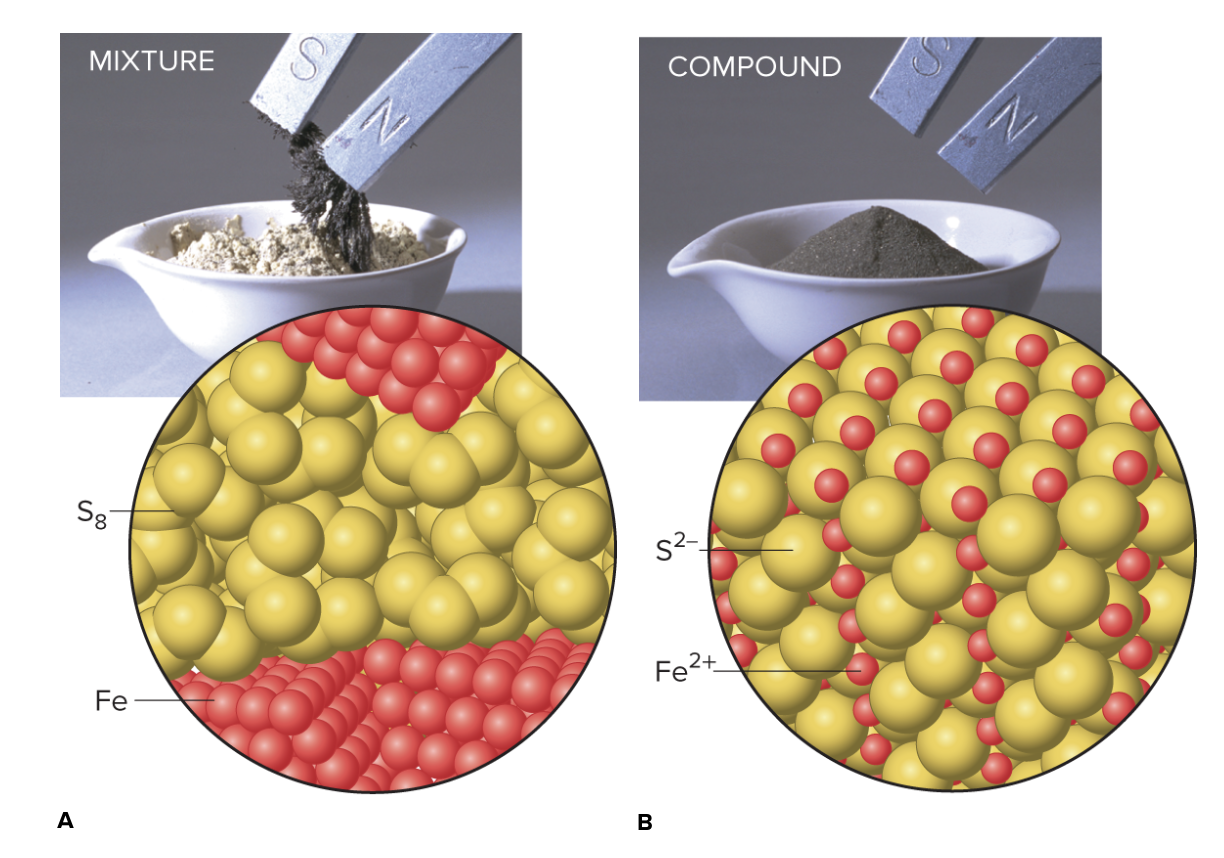
In a mixture, the composition of a solution can change like in salt water. The ratio could be TONS of salt and a little water or vice versa—it’s still a mixture.
Mixtures can be separated by their components using physical changes. Chemical changes ARE NOT needed (but could work). Compounds have to be separated by chemical changes.
Look at the image for a great example!
What are the four most common ways of separating a mixture? REMEMBER, this is a (physical/chemical) ← answer first.
Also, give definitions of each process!
Hint: distillation has two types!
physical;
Filtration - Separates particles based on their size and helps to separate a solid from a liquid, which will flow through tiny holes in filter paper. (or vacuum filtration)
Crystallization - This separates particles based on solubility (amount of mixture that dissolves in a fixed amount of solvent). Usually uses hot and cold, since solubility increases with temperature.
Distillation - This separates particles through differences in volatility (tendensy of a substance to become a gas). Simple distillation with separate components with large differences in volatility (think of boiling!) Fractional distillation uses vaportization-condensation to separate components with small volatility differences.
Chromatography - Separates particles through differences in their solubility.
Describe how chromatography separates substances…
Then, describe GLC and HPLC
First, the mixture you want to separate is dissolved in a gas/liquid called the mobile phase. After, this new solution will flow through a solid (or liquid) called the stationary phase. Components with LOWER solubility will move through the solid/liquid faster.
GLC (Gas-liquid Chromatography) uses a gas as the mobile phase, like helium. As the stationary phase continues, the components reach a detector separately.
HPLC (high pressure liquid chromatography) is similar to GLC, but the mixture does not need to be vaporized into a gas since the mobile phase is a liquid. This relies more on heat-sensitive components.
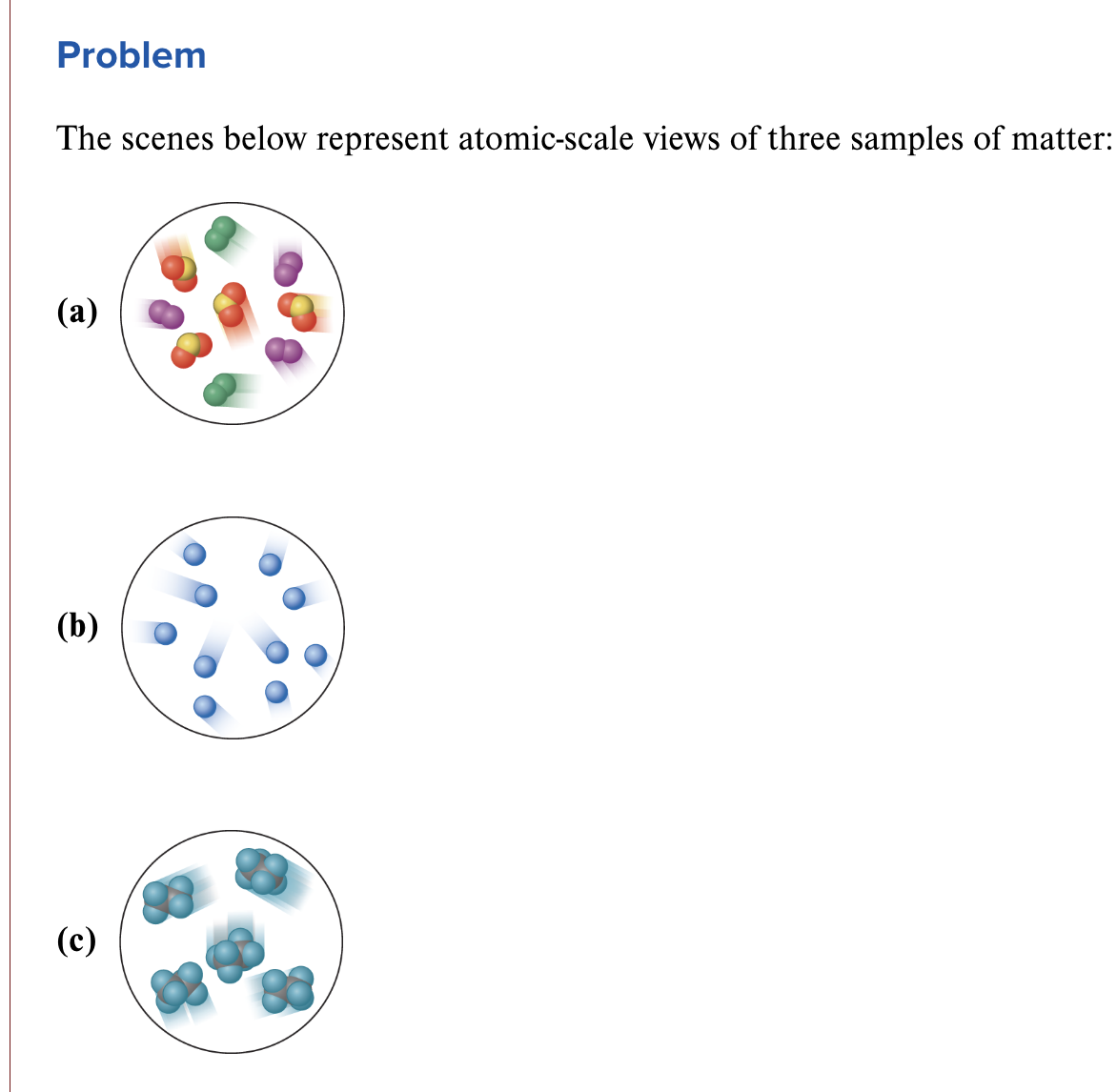
The scenes in the image represent atomic-scale views of three samples. Describe each sample as an element, compound, or mixture. Which sample(s) can be separated into its (their) components by a physical change?
A. mixture; can be separated by physical change
B. Element; cannot be separated! it’s in its purest form
C. Compound; can be separated through chemical change.
What is the law of mass conservation? Why is it important?
This law says that the TOTAL mass of a substance does not change during a chemical reaction. This is important because it tells us matter cannot be created or destroyed!
We know from the ______ that there is a fixed proportion of elements in a compound. That proportion can be expressed in two ways: (also give definition)
law of mass conservation;
The first way is mass fraction which is the ratio of the mass of each element to the total mass of the compound. AKA, fraction of oxygen in CO2. Mass Fraction = mass of element X in A / mass of compound A
The second way is mass percent, which is the percentage of the mass fraction. Literally the % of oxygen in CO2 for example.

Find the mass fraction and percent of each element.
8.0/20.0 = 0.40 or 40% of calcium (NEED SIG FIGS!)
2.4./20.0 = 0.12 or 12% of chlorine
9.6/20.0 = 0.48 or 48% oxygen.
NOTICE: this is unitless because the grams cancel out.
What is the law of definite composition? Why is it important?
This law says that no matter the sample, a particular compound is composed of the same elemnts in the same fractions by mass.
Essentially a 20 gram sample of CO2 will contain the same fraction of oxygen as an 800 g sample.
Pitchblende is the most important compound in uranium. Mass analysis of an 84.2-g sample of pitchblend shows that it contains 71.4 g of uranium, with oxygen the only other element. How many grams of uranium and of oxygen are in 102kg of pitchblend?
Turn the kg into g. 1000 g = 1kg, so 102 kg * 1000 g/1kg = 102000 g.
Find the mass percent of each in the known sample: 71.4 g / 84.2 g = 0.848 uranium. 12.8 g / 84.2 g = 0.152
Simply do 102000 × 0.848 = 86496 g of Uranium, then 102000 × 0.152 = 15504 g of oxygen
What is the law of multiple proportions? Why is it important?
This law says that when two elements combine to form more than one compound, the masses of one element that combine with a fixed mass of hte other are always in ratios of small numbers (EX: in CO vs CO2 the oxygen ratio is 1:2).
you dont need to know this definition, just know the concept.
Look at picture


Solve this problem
The mass conservation and definite composition is represented. For mass conservation that’s a duh; there are 7 purple and 9 green atoms.
The compound formed has one purple and two green atoms, so it has definite composition. ONLY ONE compound forms, so the law of multiple proportions DOES NOT apply here.
What is the notion for a proton, neutron, and electron? (very very bad thing you have to know)
Proton p+
Electron: e-
Neutron: n0

Fill out the blanks, going from the left half (top to bottom) then the right half. ALL YOU ARE ANSWER IS THE A, Z, then X
Mass number (p+ + n0)
Atomic number (p+)
Atomic Symbol

Identify this element and its characteristics
It contains 235 protons + neutrons for its mass number.
It contains 92 protons in the atomic number
Its atomic symbol aligns with U—uranium.
What is an isotope?
This is an element (atoms) that have a different number of neutrons and therefore a different mass number.
EX: carbon-12, carbon-13, carbon-14
look at screenshot


Look at the problem and solve:
In 28, Si has 14 protons, 14 neutrons.
in 29, Si has 14 protons, 15 neutrons
in 30, Si has 14 protons, 16 neutrons.
electrons and protons will stay the same! (i was lazy)
What is mass spectrometry? Give the process of it too!
ALSO, say what it can be used for (think AMU)!
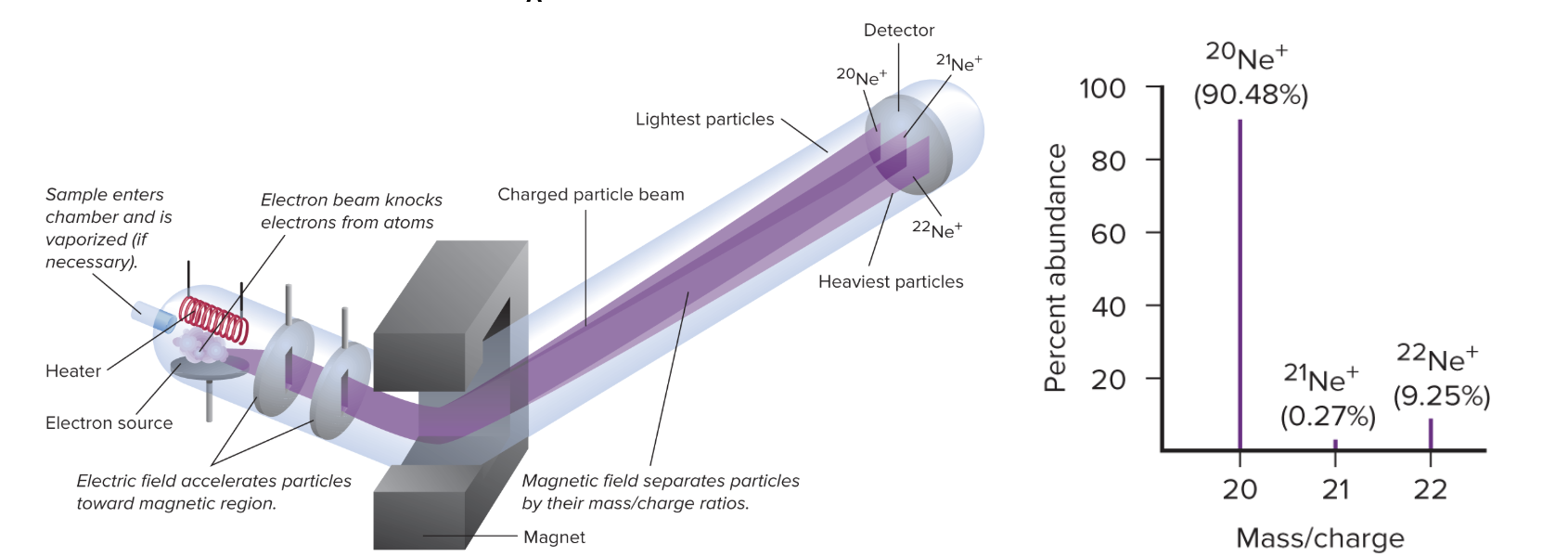
Mass spec is a way to separate an element based on relative masses and abundances of atom-scale particles.
Essentially, you’ll take the substance and vaporize it into a gas so atoms can move more freely. Afterards, a high-energy electron beam will knock off the electrons, converting the molecules into positive ions (cations). Then, an electric field will accelerate the cations into high speed. Finally, they will be deflected. Ions with a lower mass will deflect more. They will all slam into a dector, which records the impact location and converts it into a graph/table.
The table generated can be used to find the average AMU! This is ez math btw
Look at image
What are periods and groups?
The periods of the periodic table are horizontal rows, while the groups are vertical columns.
Which side contains the metals? Non-metals?
The left side (group 1-2); groups 13-18
look at picture


Answer this (difficult)
For this question, we know that calculating AMU is like (known mass)*percentage + (another known mass)*percentage).
For the first one, we know some things: 120.90*x + 122.90*(1-x) = 121.76 (on periodic table).
So then we solve for x here, which is 0.57.
Then you simply plug this into the equation to find the abundance of each one, so the first one would be x = 0.57, then the second would be 1-x = 0.57 (AKA 0.43)
JUST REMEMBER TO MAKE THESE PERCENTAGES!

Answer this:
distillation; distill