YR 11 CHEM Term 3 Assessment - Prelims Content
 Call Kai
 Learn
Learn Practice Test
 Spaced Repetition
 Match
Match Flashcards
 Knowt Play
1/38

There's no tags or description
Looks like no tags are added yet.
Name | Mastery | Learn | Test | Matching | Spaced | Call with Kai | Chat |
|---|
No analytics yet
Send a link to your students to track their progress
39 Terms
Boyle’s Law
P1V1=P2V2
Pressure is inversely proportional to volume
Charle’s Law
V1/T1=V2/T2
Direct relationship between volume and absolute temeprature
Gay Lussac Law
P1/T1=P2/T2
Direct relationship between pressure and absolute temperature
Avogadro’s Law
V1/n1=V2/n2
Direct relationship between volume and moles
Combined gas law
(P1V1)/T1=(P2V2)/T2
Compares one gas at two states
Ideal gas law
PV=nRT
(T is Kelvin, kPa, litres, R=8.314)
Pure substance
fixed composition/properties, can't be separated by physical means
Mixture
– variable composition, can be separated physically
Element
– simplest pure substance, one type of atom
Compound
– 2+ elements chemically bonded, fixed ratio
Homogeneous mixture
uniform composition throughout
Heterogeneous mixture
– composition varies, parts visibly different
Solution
homogeneous mixture, particles too small to see/settle
Solute and solvent
Solute = substance being dissolved
Solvent - dissolving
Suspension
heterogeneous, particles settle over time
Colloid
small particle clusters, evenly dispersed, doesn't settle
Miscible
liquids that mix completely
Sieving
separates SOLIDS (solid from solid) by particle size
Filtration
separates insoluble solid from liquid (solid stays on paper, liquid passes through)
Sedimentation and decantation
solid settles to bottom of container (then pour out non solid liquid)
process of carefully pouring out liquid leaving solid
Evaporation
vaporises liquid (low bp), leaves solid residue (used for dissolved solids)
Distillation
boils + condenses liquid to separate from mixture; big difference in boiling points needed
Fractional distillation
separates miscible liquids with close boiling points (<40–50°C apart), e.g. crude oil, ethanol from fermentation
Separating funnel
separates immiscible liquids by density (layers)
Solvent separation (dissolve + filter)
dissolves one component, filters off insoluble, evaporates solvent to recover soluble solid
Gas separation
uses differences in boiling point or solubility in water
Ionic (structure, solubility, conductivity, hardness, brittleness, density)
Structure – lattice of alternating +/– ions, held by strong electrostatic forces of attraction (efa)
Solubility – usually soluble in water; water molecules pull ions apart (solute-solvent attraction beats lattice attraction)
Conductivity – does NOT conduct as solid (ions fixed in place); DOES conduct when molten or dissolved (ions free to move and carry charge)
MP/BP – high; strong efa between ions needs lots of energy to break
Hardness – hard; strong efa holds ions firmly in place
Brittle – yes, brittle; force shifts lattice, lines up like charges, they repel and crystal shatters
Density – generally high; ions packed tightly in a rigid lattice
Covalent molecular (structure, solubility, conductivity, hardness, brittleness, density)
Structure – small molecules, strong covalent bonds within each molecule, weak intermolecular forces (imf) between molecules
Solubility – often insoluble/variable; depends on whether solute-solvent forces can overcome the weak imf
Conductivity – does NOT conduct (no ions or free electrons available)
MP/BP – low; only weak imf need breaking (covalent bonds within molecule stay intact)
Hardness – soft; weak imf lets molecules slide apart easily
Brittle – NOT brittle; molecules just separate, or substance is already liquid/gas
covalent network (structure, solubility, conductivity, hardness, brittleness, density)
Covalent Network (e.g. Diamond, SiO₂)
Structure – giant 3D network, every atom covalently bonded to neighbours
Solubility – insoluble; would require breaking strong covalent bonds
Conductivity – does NOT conduct (all electrons locked in covalent bonds, none free)
MP/BP – very high; strong covalent bonds throughout entire structure must be broken
Hardness – very hard; rigid strong-bonded network
Brittle – NOT brittle; resists deformation entirely rather than sliding
Metal (structure, solubility, conductivity, hardness, brittleness, density)
Metallic (e.g. Mg, Cu, Fe)
Structure – lattice of positive metal ions surrounded by a "sea" of delocalised (free-moving) electrons
Solubility – insoluble; no solvent can overcome metallic bonding
Conductivity – DOES conduct, in both solid and molten state; delocalised electrons are free to move and carry charge
MP/BP – high; strong efa between positive ions and delocalised electron sea
Hardness – hard; strong attraction throughout electron sea
Brittle – NOT brittle; malleable/ductile — layers of ions slide over each other while electron sea keeps attracting them, so it bends rather than shatters
Element notation with mass number and atomic number

Stability of isotopes
n:p ratio
Stable light element (Z:1-20) - 1:1
Stable heavy elements (Z:73-83) - 1.5:1
Radioactive particle emmissions
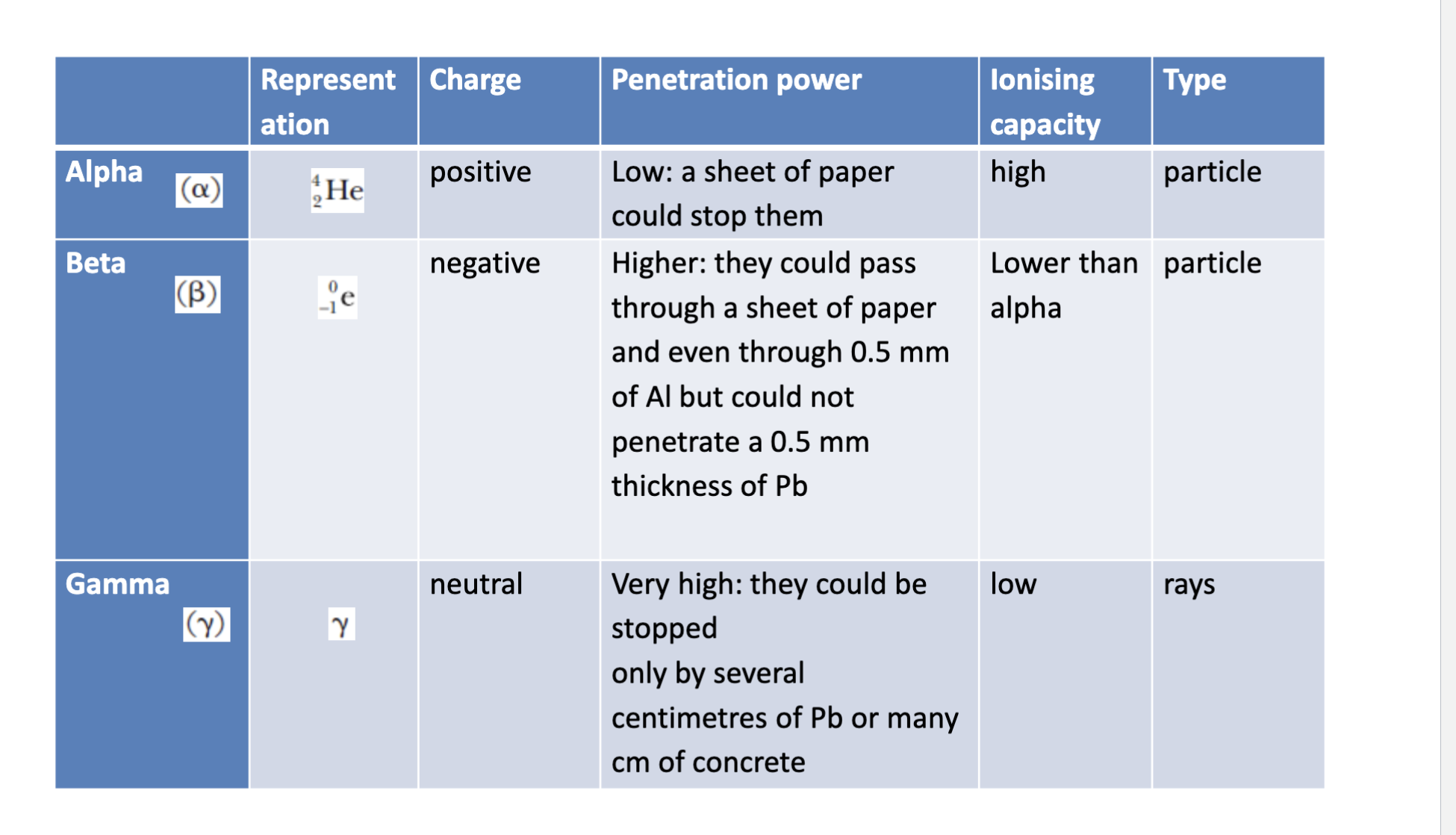
(for beta, neutron is turned into proton which stays and electron)
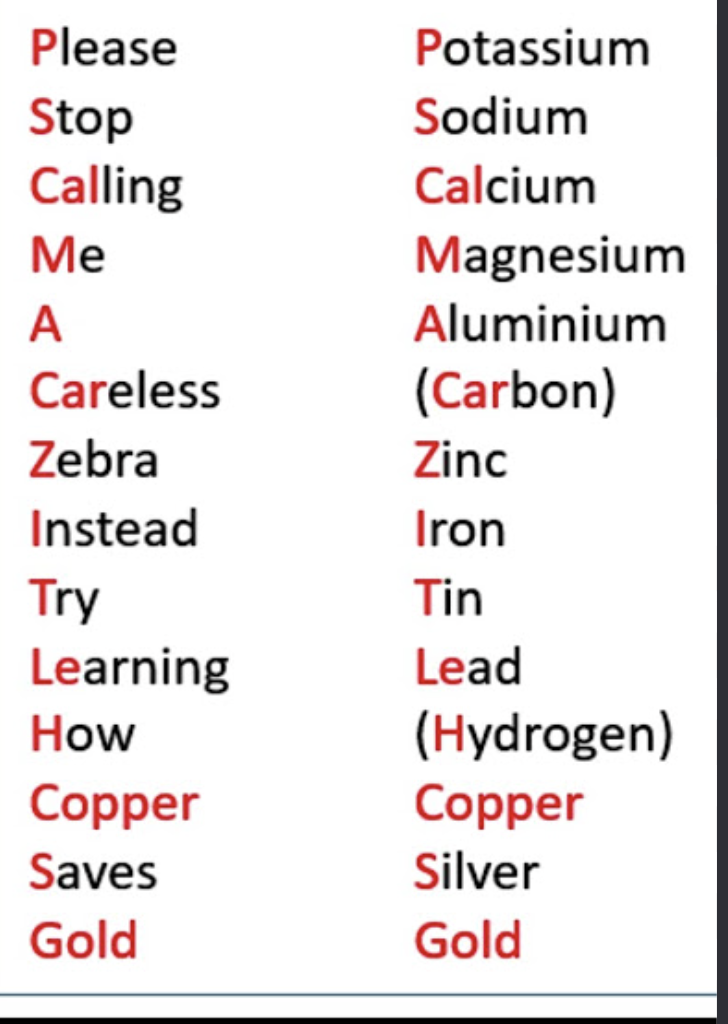
Reactivity series
what technique to use to separate what
Particle size → sieving
Solid vs liquid → filtration
Big bp difference → distillation
Small bp difference → fractional distillation
Soluble vs insoluble → solvent + filtration
Immiscible liquids → separating funnel
Polyatomic ions
