Topic 2.3-2.4: Neuromuscular - Drug agonists and antagonists
 Call Kai
 Learn
Learn Practice Test
 Spaced Repetition
 Match
Match Flashcards
 Knowt Play
1/38

There's no tags or description
Looks like no tags are added yet.
Name | Mastery | Learn | Test | Matching | Spaced | Call with Kai | Chat |
|---|
No analytics yet
Send a link to your students to track their progress
39 Terms
Pharmacological principles - meaning
what drugs do to the body, the mechanisms of action and dose-response relationship
Pharmacokinetics - def
what body does to drug
factors affecting ligand binding - summary list (3)
receptor ligand concentration
occupation → governed by affinity and receptor occupancy
action → governed by efficacy
ligand affinity - def
measure of attraction of a ligand for a biological target
high affinity ligands bind to target rapidly and for longer
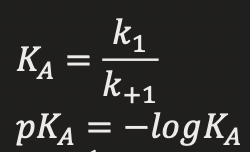
ligand affinity - equilibrium constant
receptor occupancy and Law of Mass Action
rate of reaction is proportional to the concentration of its reactants
at equilibrium: forward rate = backwards rate and KA = k-1/k+1
fractional receptor occupancy: [AR]/[R]t = [A]/(KA+[A])
when [A] = KA, fractional receptor occupancy is 0.5
ligand efficacy - def (3)
likelihood/ tendency of bound ligand to activate a receptor
Depends on ability of agonist to induce receptor activation (intrinsic efficacy) + stimulus-response coupling from receptor activation to tissue response
Drug with zero efficacy = no ability to activate a receptor -> antagonist
receptor binbindingdign and receptor activation
binding ≠ activation
Eg. antagonists bind to receptor and prevent activation of downstream signalling
dose-response relationship
Dose determines the benefits and harms of a drug
limitation of drug concentration-effect cruves
cannot be used to measure the affinity of agonists -> response is not directly proportional to receptor occupancy
dose-response relationship - Emax
maximal response drug can produce -> can differ for the same agonist in different tissues due to receptor density and or coupling
Intrinsic efficacy = drug-dependent component of efficacy
potency - meaning
drug concentration required to elicit a given effect -> typically 50% of max effect (EC50)
Partial agonist can have higher, equal to lower potency compared to full agonist
receptor reserve - meaing
system has spare receptors
receptor reserve - full vs partial agonists
full agonists: receptor pool is larger than needed for full response -> system has receptor reserve
partial agonists: all receptors occupied -> system has no receptor reserve
desensitization vs tolerance
Effect of drug can gradually diminish upon continuous or repeated administration
Desensitization (tachyphylaxis) = minutes or less
Tolerance = hours to days or weeks
causes of desensitization/ tolerance - list (4)
Receptor internalisation
Change in receptor expression
Exhaustion of mediators
Physiological adaptation
features of good therapeutic agonists (2)
Often high affinity/ potency/ efficacy but not alway→ eg sometimes partial agonists are preferred over full agonists
High selectivity to prevent adverse side effects -> affinity at target receptor vs non-target receptors
features of good therapeutic agonists - examples of partial agonists preferred (3)
Salbutamol (ß2-adrenoreceptors) to treat asthma -> no desensitisation of target receptors
Sumatriptan (5-HT1A receptors) to treat asthma -> no heart attacks as effective vasoconstriction of coronary arteries is less likely
Buprenorphine (μ-opioid receptors) to treat pain -> less euphoric and addictive effects
antagonist - def
molecule that interferes with interaction of an agonist and a receptor protein or a molecule that blocks constitutive elevated basal response of a physiological system
types of antagonists - branch diagram (6)
receptor or non-receptor antagonists
receptor antagonists can bind to orthosteric or allosteric site and be reversible or irreversible
non-receptor antagonists can be chemical or functional
reversible competitive antagonists - summary (6)
most common and most important type of antagonism in lab and clinic -> high potency and selectivity can be achieved
Binds to agonist binding site (orthosteric site) without activating receptor and prevents agonist from binding to that site
Does not stay bound to receptor -> dissociates and rebounds continuously
Addition of competitive antagonist shifts effect v agonist concentration curve to the right -> apparent potency of agonist is reduced
Antagonism can be overcome with enough agonist -> surmountable
Antagonism quantified by KB -> sometimes KD
reversible competitive antagonists - example
naloxone (opioid receptor antagonist) -> rapid reverse effects of morphine and other opioids and used to treat opioid overdose
reversible competitive antagonists - factors affecting competition (2)
Concentration of agonist vs antagonist
Receptor affinity of agonist vs antagonist
reversible competitive antagonists - partial agonists
Partial agonists can act as antagonists by altering response of an agonist with higher efficacy that binds to the same site -> acts like a reversible competitive antagonist
Decreased potency and higher EC50 + surmountable
reversible competitive antagonists - IC50 value meaning
concentration of antagonist required to reduce a response to a fixed concentration of agonist by 50%
dependent on concentration of agonist -> more agonist requires more antagonist for the same about of inhibition
limitation of inhibition curves
says nothing about type of inhibition
irreversible competitive antagonist - summary (6)
Binds to agonist binding site (orthosteric site) covalently without activating receptor or dissociates very slowly→ prevents agonist from binding to that site
Affects numbers of available receptors at a given time point
At high enough concentration: irreversible competitive antagonists cannot be outcompeted -> insurmountable inhibition
Insurmountable when maximum effect of agonist is reduced -> may not show reduced max if receptor reserve exists
Decreases potency and increases EC50
Mainly used as experimental tool -> few drugs used clinically
irreversible competitive antagonist - example
phenoxybenzamine covalently binds to alpha-adrenoreceptors and blocks effect of catecholamines
treatment of phaeochromocytoma (tumour in adrenal medulla)
non-competitive antagonist - summary (2)
Binds to same receptor but has a different binding site to the agonist
Influences receptor function by changing conformation of receptor
non-competitive antagonist - effects of binding (3)
Increase/ decrease affinity of agonist to orthosteric site
Increase/ decrease efficacy of agonist
Can skew coupling of receptor towards different intracellular signalling pathways -> biased agonism
non-competitive antagonist - example
benzodiazepines = positive allosteric modulators of GABAA receptor
potentiates effects of inhibitory transmitter GABA to cause anxiolytic, sedative anticonvulsant effects
chemical antagonist - summary (3)
Antagonising molecule directly binds to or destroys the ligand -> ligand can no longer bind to its target
Uncommon among small molecule drugs
Common for therapeutic antibodies
chemical antagonist - small molecule drug example
protamine = cationic peptide that neutralises and antagonises heparin which is anionic
used in cardiac and vascular surgery
chemical antagonist - therapeutic antibody example
mepolizumab = anti-IL-5 antibody that prevents IL-5 from binding to its receptor
reduces recruitment and survival of eosinophils for anti-asthma effects
chemical antagonist - PROTACS summary (2)
proteolysis-targeting chimeras for "drugging the undruggable"
Bifunctional small molecules that can bind to receptor and induce ubiquitin-mediated degradation of target proteins via recruiting E3
functional (physiological) antagonists - summary
Oppose biological effects of an agonist by acting at a different receptor as an agonist
functional (physiological) antagonists - example
salbutamol is an agonist at ß2-adrenoreceptors that causes airway smooth muscle relaxation
antagonises effects of endogenous contractile agonists that act at different receptor → eg. acetylcholine at muscarinic receptors and leukotrienes at LTC4 receptors
features of good therapeutic antagonists
Generally high affinity and high selectivity -> binds to target and doesn't bind to non-targets
All drugs have more than one action so increasing concentration will reduce selectivity
principles of pharmacodynamics to understand - list (7)
Affinity
Efficacy
Potency
Receptor density
Receptor reserve
Selectivity
Types of antagonism