3.3 Membrane Transport
 Call Kai
 Learn
Learn Practice Test
 Spaced Repetition
 Match
Match Flashcards
 Knowt Play
1/15

There's no tags or description
Looks like no tags are added yet.
Name | Mastery | Learn | Test | Matching | Spaced | Call with Kai | Chat |
|---|
No analytics yet
Send a link to your students to track their progress
16 Terms
Selectively permeable
The plasma membrane is selectively permeable - it does this through passive or active mechanisms
Passive Mechanism
Require no ATP from the cell
Filtration
Diffusion
Osmosis
Active Mechanisms
Consume ATP
Active transport or Vesicular transport
Carrier-mediated mechanisms use membrane protein to transport substances from one side to the other
Filtration
Physical pressure forces fluid through a selectively permeable membrane such as a coffee filter
Body example is blood capillaries
This is how water, salt, nutrients, and solutes are transferred from bloodstream to tissue and how kidneys filter out blood cell and proteins
Simple Diffusion
Net movement of particles from place of high concentration to low concentration from constant, spontaneous movement
Substances move down their concentration gradient
Some factor that contribute to how fast something goes through diffusion
temperature - when warmer, moves faster
molecular weight - light particles are faster
Steepness of concentration gradient - the steeper the gradient, the more quickly they diffuse
Membrane surface area - apical surface of cells special in absorption
Membrane permeability - how permeable something is
Osmosis
Net flow of water from one side of a selectively permeable membrane to another
Imbalance in osmosis can cause diarrhea, constipation, hypertension and edema
Osmolarity
Osmotic concentration of body fluids effect cellular function that is important to understand the units which is is measured - milliosmoles per liter
Tonicity
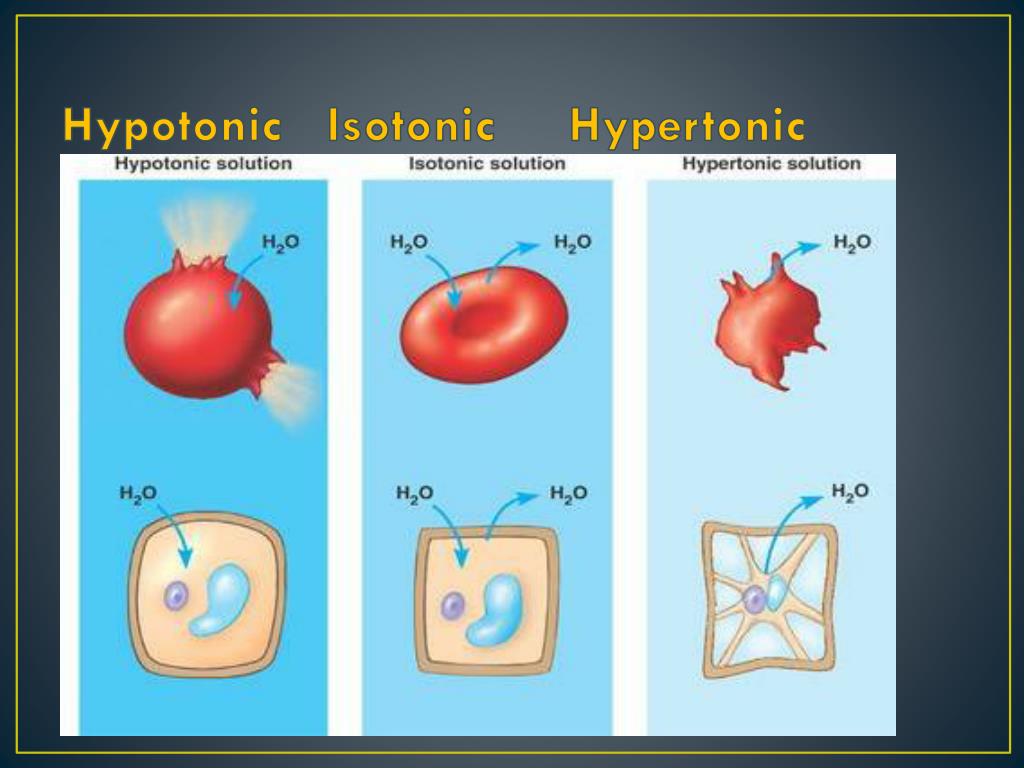
Ability of a solution to affect the fluid volume and pressure in a cell
Solute cannot pass through a plasmamembrane, remaining more concentrated on one side thant the other, causing osmosis
Hypotonic / hypertonic / isotonic
Lower concentration of non-permeating solutes than the intracellular fluid (ICF). Absorb water, swell, and may burst - hypo
Higher concentration of nonpermeating solutes than the ICF, cells may lose water and shrivel, they can then die of torn membranes - hyper
Total concentration of nonpermeating solutes is same as ICF - no change in cell shape or volume - isotonic
Carrier-mediated Transport
Solutes bind to carrier into plasma membrane, changes shape and releases solute onto the other side
Carriers act like enzymes in that the solute is a ligand that binds to a specific receptor site on the carrier
Carries have specificity
Carriers can have saturation, as solute concentration rises the rate of transport increases only up to a point, when all are full the solute cannot be added
Types of transport
Uniport - carries only one type of soulte
Cotransport - move two or more solutes through the membrane in the same direction (carrier protein who does this is symport)
Countertransport - two or more solutes in opposite directions (carrier protein is antiport)
Mechanisms of Carrier Mediated Transport
Facilitated diffusion: carrier mediated transport of a solute through a membrane down its concentration gradient, doe not use ATP
Primary active transport: carrier moves through a substance through a cell membrane up its concentration gradient using ATP
Secondary active transport: require energy input, and uses ATP as a secondary source of energy
Sodium potassium Pumps Na+-K+ Pump
Primary active transport
Extremely important - the body can exchange 30 million sodium ions and 20 million potassium ions per second!!!
Its functions include
1) Secondary active transport: maintains steep Na+ gradient across membranes
2) Regulates cell volume: some anions “fixed anion” are confined to cells and cannot penetrate plasma membrane, they attract and maintain cations. If this went unchecked, osmotic swelling would occur. Cell swelling causes Na-K pumps to activate and each cycle is part of a negative feedback loop removing 1 extra anion then it brings in thus reducing/preventing cell swelling
3) Maintenance of membrane potential: the inside of the membrane is more negatively charges and the outside is more positively charged. The unequal distribution of ions on either side of the membrane is maintained by the Na-K pump and is important for excitability for nerve and muscle cells
4) heat production: thyroid hormones stimulate cells to produce more Na-K pumps, as they consume ATP they release heat, which helps when it is cold outside and we lose body heat
Vesicular transport
Moves large particles, fluid, or many molecules at once through membrane contained in bubble like vesicles
Endocytosis (phagocytosis, pinocytosis, and receptor mediated endocytosis)
Vesicular transport bringing matter into the cell using motor proteins that use ATP
Phagocytosis - “cell eating” process of engulfing partiles like bacteria, dust, and cellular debris using phagosomes. Macophages phagocytize 25% of their own volume per hour. Occurs only in some cells
Pinocytosis - cell drinking process of taking in droplet of EFC containing molecules the cell can use. Occurs in all cells.
Receptor mediated endocytosis - Selective form of phago or pino cytosis. Cells can take in specific molecules from the ECF with minimum of unneeded matter.
Exocytosis
Releasing matter from the cell (EXIT) using motor proteins that use ATP