advanced precalc quiz 1
 Call Kai
 Learn
Learn Practice Test
 Spaced Repetition
 Match
Match Flashcards
 Knowt Play
1/27

There's no tags or description
Looks like no tags are added yet.
Name | Mastery | Learn | Test | Matching | Spaced | Call with Kai | Chat |
|---|
No analytics yet
Send a link to your students to track their progress
28 Terms
What is the quadratic formula?
x=2a−b±b2−4ac.
Definition of the imaginary unit i
The imaginary unit i is defined as the √-1, where i2=−1.
Basic powers of i (i0,i 1 , i2, i3, i4)
The basic powers of the imaginary unit i represent cyclic values: i0=1, i1=i, i2=−1, i3=−i, and i4=1, with negative powers indicating reciprocals of the positive powers. They repeat every four.
Procedure to evaluate high positive powers of i (e.g., in)
To evaluate high positive powers of i, subtract the highest multiple of 4 you can from the exponent, n, and then evaluate that imaginary number.
Standard form of a complex number
a+bi, where a is the real part and b is the imaginary part, with i as the imaginary unit.
Definition and product of complex conjugates
Conjugates: a + bi and a - bi. Product: (a + bi)(a - bi) = a2 + b2
Procedure to rationalize a complex quotient (e.g., a + bi/c+di)
Multiply both the numerator and the denominator by the complex conjugate of the denominator (c - di). Eliminates the imaginary part from the denominator.
Three main equations/forms of quadratic functions
Standard form: ax2+bx+c
Vertex form: y=a(x−h)2+k
Factored form: y=a(x−x1)(x−x2)
Axis of symmetry formula for Standard Form (ax2+bx+c):
x=−2ab
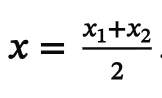
Axis of symmetry formula for Factored Form(y=a(x−x1)(x−x2)):
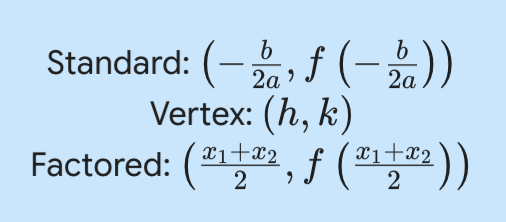
Vertex coordinates for standard, vertex, and factored forms
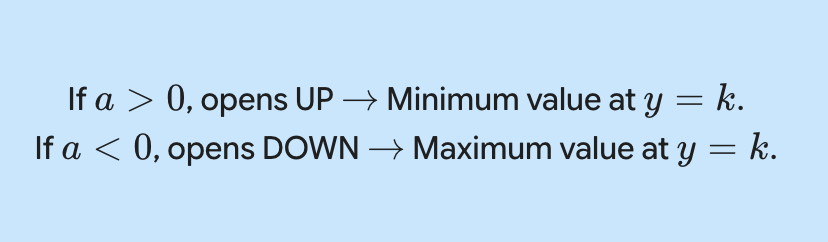
Determining minimum vs. maximum value of a parabola
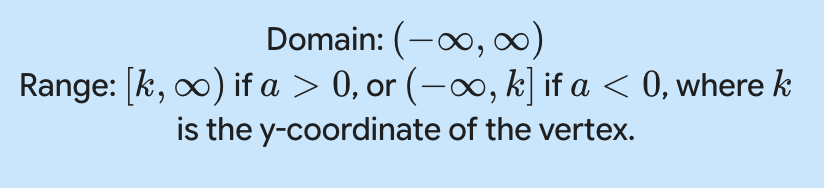
Domain and Range of a quadratic function
Zero-product property
If ab = 0, then a = 0, b = 0, or both equal 0
Steps to solve by completing the square

Characteristics of a system with 1 solution (classification, graph appearance, algebraically)
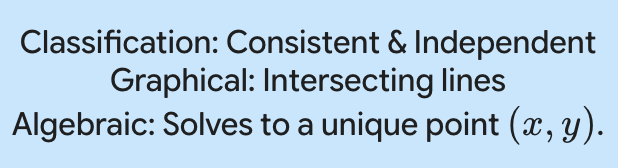
Characteristics of a system with infinite solutions (classification, graph appearance, algebraically)

Characteristics of a system with no solution (classification, graph appearance, algebraically)
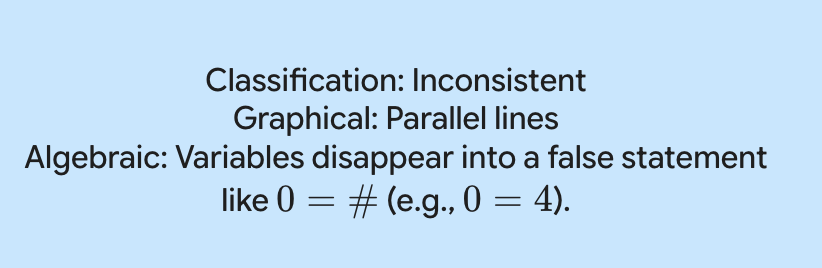
What does it mean to solve quadratic equations?
It means finding the x-intercepts, because the equation is set equal to 0, making it so the solutions have the y coordinate of 0.
Definition of Principle Square Root
The non-negative (positive) square root of a number, denoted by x.
How do you graph inequalities?
Graph boundary lines (solid for ≤ or ≥, dashed for < or >) and then shade the region satisfying each inequality, and find the overlapping shaded area. Where you shade follows the direction indicated by the inequality signs.
How do you factor by grouping?
It is a method for factoring polynomials where terms are grouped in pairs, and a common factor is extracted from each pair. This technique is often used when dealing with four-term polynomials.
What is a discriminant and what does it do?
The discriminant is a value obtained from the coefficients of a quadratic equation, represented as D=b2−4ac . It indicates the nature of the roots: if D > 0 , there are two real solutions; if D=0, there is one real solution; and if D < 0, there are two complex solutions.
What does the location of the max/min refer to?
It refers to the x-coordinate of the vertex
What does the value of the max/min refer to?
It refers to the y-coordinate of the vertex
What is the difference of cubes formula and how do you use it?
The difference of cubes formula is given by a3−b3=(a−b)(a2+ab+b2). It is used to factor expressions where one cube is subtracted from another.
What is the perfect square formula and how do you use it?
The perfect square formula is given by a2±2ab+b2=(a±b)2. It is used to factor expressions that are perfect squares.
When do you substitute u into equations?
You substitute u into equations when simplifying integrals or solving equations, using a substitution method to make the integral easier to evaluate.