Ch 18-20, 22, 24-26, 28
0.0(0)
Studied by 5 people0%Exam Mastery
Build your Mastery score
 AP Practice
Supplemental Materials Call Kai
Call KaiCard Sorting
1/193

Earn XP
Last updated 10:20 AM on 12/1/22
Name | Mastery | Learn | Test | Matching | Spaced | Call with Kai | Chat |
|---|
No analytics yet
Send a link to your students to track their progress
194 Terms
1
New cards
what is the business cycle
short-run fluctuations in economy
2
New cards
3 major goals of macro
1. maintain employment of human resources @high levels
2. maintain prices @stable level
3. achieve high rate of economic growth aka growth in output per person over time
2. maintain prices @stable level
3. achieve high rate of economic growth aka growth in output per person over time
3
New cards
what is RGDP
real gross domestic product
total value of all final goods & services produced in a given period
total value of all final goods & services produced in a given period

4
New cards
what is RGDP used to measure
output/production
5
New cards
what does "real" mean
adjusted for inflation
6
New cards
lower unemployment leads to higher/lower stock prices
higher w
7
New cards
what is the unemployment rate
% of population 16+ willing to work but can’t obtain a job

8
New cards
what is the labor force
# of people 16+ able to work (employed/unemployed)
9
New cards
recession is when there's high/low unemployment
expansionary period is when there's high/low unemployment
expansionary period is when there's high/low unemployment
high
low
low
10
New cards
unemployment stats don't include (2 things)
1. discouraged workers: able to work but gave up
2. part-timers looking for full-time
2. part-timers looking for full-time
11
New cards
4 main categories of unemployed
job loser, job leaver, reentrant, new entrant
12
New cards
what is a job loser
temporarily laid off/fired (50% of unemployed)
13
New cards
what is the short run costs of reducing unemployment
higher rate of inflation
underemployment (worker too skilled for job)
underemployment (worker too skilled for job)
14
New cards
marginally attached worker
neither working nor looking BUT they want + available and have looked in past 12 months
15
New cards
discouraged worker
subset of marginally attached. job-market-related reason for not looking
16
New cards
frictional unemployment
transitioning between jobs
17
New cards
structural unemployment
mismatch between worker skills & requirement of jobc
18
New cards
cyclical unemployment
unemployment due to downturns in business cycle; recession (worst!!!)n
19
New cards
natural rate of unemployment
frictional + structural at it's max?
20
New cards
unemployment > NRU
unemployment < NRU
unemployment < NRU
cyclical
frictional & structural
frictional & structural
21
New cards
at natural rate of unemployment... potential output
all resources fully employed & no cyclical unemployment
resources = labor land capital
resources = labor land capital
22
New cards
obstacles that prevent wages from adjusting (why unemployment exist)
1. minimum wages
2. unions
3. efficiency wage theory
2. unions
3. efficiency wage theory
23
New cards
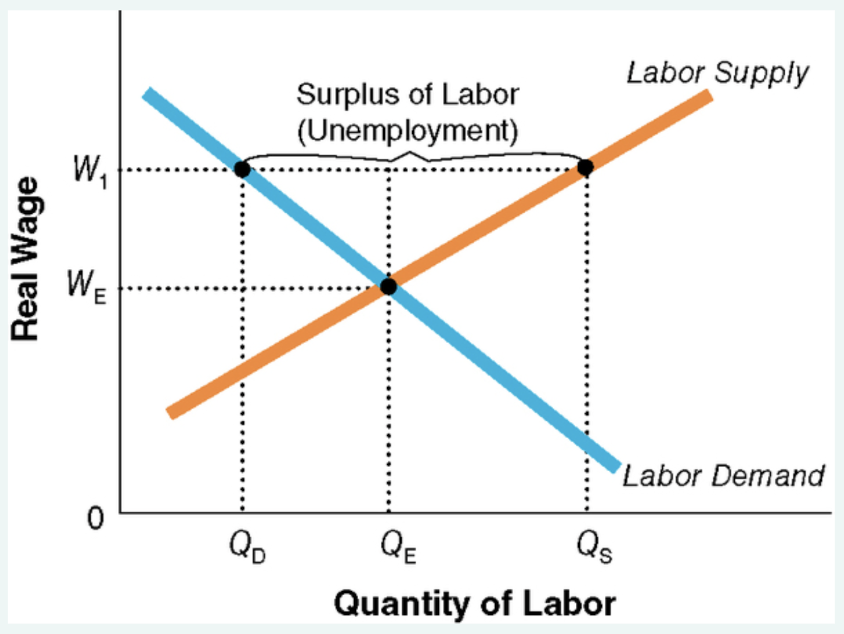
how does min wage affect unemployment
quantity of labor demanded decreases because employers find it unprofitable to hire low-skilled workers @higher wage
demand for labor is inelastic
minimum wage > market wage = unemployment
demand for labor is inelastic
minimum wage > market wage = unemployment
24
New cards
how do labor unions affect unemployment
wage increase after unions negotiate wages --> wage > equilibrium = higher unemployment
25
New cards
how does efficiency wage theory affect unemployment and what is it
def: theory that higher wages --> greater productivity
wage > equilibrium = higher unemploymentwh
wage > equilibrium = higher unemploymentwh
26
New cards
issue w/ unemployment insurance
people not motivated to see new employment = lowers opportunity cost of unemployment
prolonged periods of unemploymentg
prolonged periods of unemploymentg
27
New cards
good thing about unemployment insurance
better benefits & more job security
28
New cards
unemployment rate is higher/lower in U.S. compared to Europe
lower
29
New cards
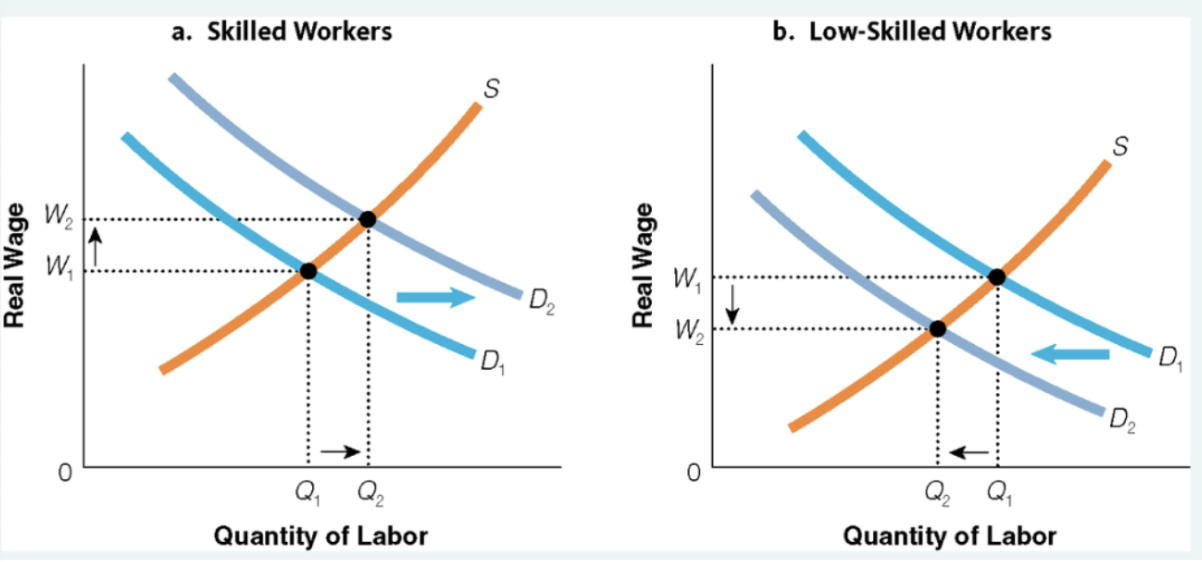
how new technology affects unemployment
may replace workers but also create new opportunities
new machines --> higher demand for skilled workers to use it while demand for low-skilled workers decrease
new machines --> higher demand for skilled workers to use it while demand for low-skilled workers decrease
30
New cards
what is price level
average level of prices in economy
31
New cards
inflation rate?
% change in price level from one year to next
32
New cards
disinflation vs deflation
disinflation is when inflation reduces (slowing down)
deflation is when there's a decrease in overall price level
deflation is when there's a decrease in overall price level
33
New cards
when there's a decrease in overall price level (deflation) then the purchasing power of money ____
increases
34
New cards
what is price index and what's it used for
measure of change in prices for certain group of goods & services (market basket?) over given period
used to measure inflation
used to measure inflation

35
New cards
what is CPI
consumer price index: measure of average change over time in prices paid by consumers for market basket of consumer goods
36
New cards
GDP deflator?
helps measure average price level
(nominal/RGDP) x 100
(nominal/RGDP) x 100
37
New cards
issues w/ CPI
difficult to measure changes in CPI
inflationary bias
if not measured correctly important things get distorted (ex. Social Security)
inflationary bias
if not measured correctly important things get distorted (ex. Social Security)
38
New cards
reason for inflationary bias (CPI's overstatement of inflationary rate)
1. substitution bias
2. quality bias
3. new outlet bias
4. new product bias
2. quality bias
3. new outlet bias
4. new product bias
39
New cards
substitution bias
CPI assumes consumers by fixed basket of goods & services (same things)
doesn't include savings changed in response to price changes
price changes don't change proportionately
doesn't include savings changed in response to price changes
price changes don't change proportionately
40
New cards
quality bias
increase in price may be cuz better quality (which is hard to measure)
41
New cards
new outlet bias
ignores price changes that occur when customers shop at discount stores like Costco
42
New cards
new product bias
new products not introduced into index until they are commonplace items
43
New cards
producer price index?
measure of cost of goods & services bought by firms
CPI for producers
CPI for producers
44
New cards
GDP deflator vs CPI
GDP deflator measures goods & services produced domestically
CPI measures goods & services bought by consumers
CPI measures goods & services bought by consumers
45
New cards
losers in inflation
anything fixed is bad
ex) fixed rate loan from bank... inflation --> borrower is paying back less than they should because dollars now have less purchasing power and it's not adjusted to inflation
ex) business that sells something w/ a fixed price
lenders = losers
ex) fixed rate loan from bank... inflation --> borrower is paying back less than they should because dollars now have less purchasing power and it's not adjusted to inflation
ex) business that sells something w/ a fixed price
lenders = losers
46
New cards
winners
people who borrow & corporations that can quickly raise price of goods
47
New cards
unanticipated inflation distort price signals how?
consumer doesn't know why good became more expensive (due to better scarcity?? don't know!) --> less good decision making
48
New cards
unanticipated inflation --> firm costs why??
menu costs: costs for changing listed price (ex. restaurant makes dish more expensive cuz inflation)
49
New cards
higher inflation rates --> higher/lower nominal interest rate and higher/lower real interest rate
higher nominal; lower real
50
New cards
real interest rate formula
nominal interest rate - interest rate
51
New cards
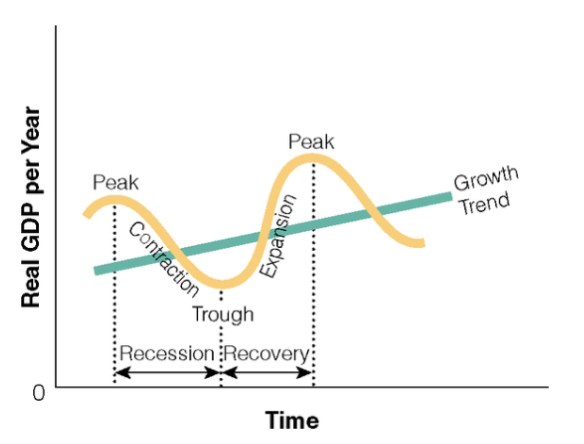
4 phases of business cycle
1. Expansion: output (real GDP) rising significantly
2. Peak: expansion comes to end; output @highest point
3. Contraction: economy slowing down
4. Trough: output stops declining; business activity @lowest point
2. Peak: expansion comes to end; output @highest point
3. Contraction: economy slowing down
4. Trough: output stops declining; business activity @lowest point
52
New cards
depression vs recession
depression is a prolonged recession
53
New cards
unemployment rates can be affected by the season: T/F?
true! ex) summer is when more students work = unemployment rates are higher than shown
54
New cards
3 main categories of business cycle indicators
1. leading economic indicators
2. coincident economic indicators
3. lagging economic indicators
2. coincident economic indicators
3. lagging economic indicators
55
New cards
leading economic indicators
things that change before changes in economic activity
ex) stock market (goes down before recession)
ex) stock market (goes down before recession)
56
New cards
coincident
things that change with RGDP
57
New cards
lagging
things that change after (ex. interest rates, CPI, unemployment rate)
58
New cards
what is GDP
gross domestic product: measure of economic performance based on value of FINAL goods & services produced domestically w/in given period
59
New cards
what are final & intermediate goods/services
final: ready to use
intermediate: inputs/resources; stuff used to produce
intermediate: inputs/resources; stuff used to produce
60
New cards
GDP includes 2nd hand goods: T/F
FALSE only current/new production
61
New cards
what is double counting
counting intermediate goods/services in GDP
62
New cards
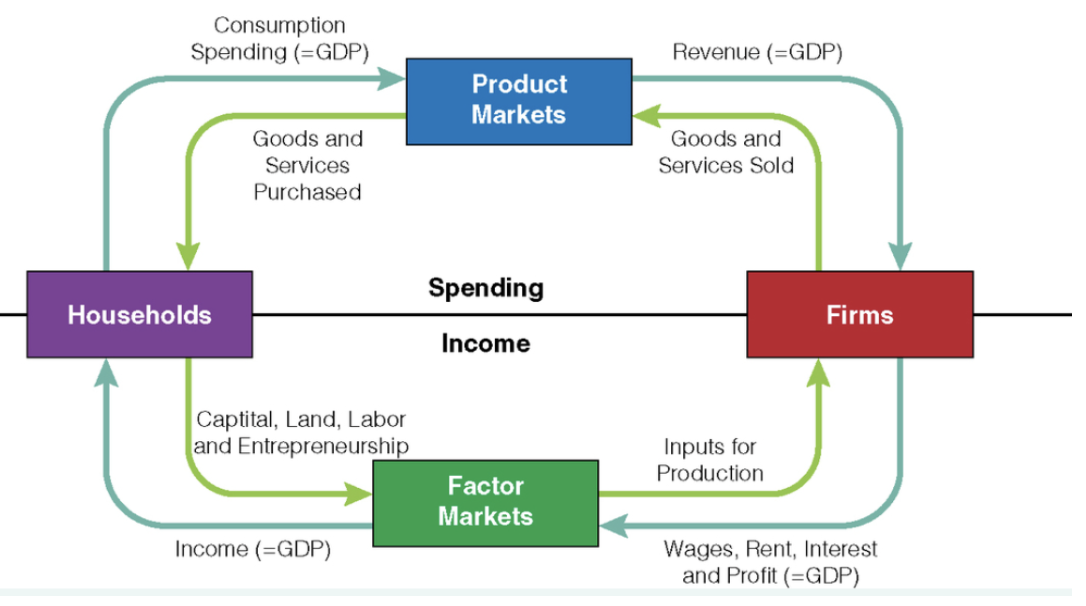
circular flow model shows that
consumer $ spent = producer $ earned
money spent = income
e
BUT income not always spent (gov taxes & savings)
money spent = income
e
BUT income not always spent (gov taxes & savings)
63
New cards
expenditure approach of measure GDP
C I G (X-M)
64
New cards
nondurable goods & durable goods reflect consumer behavior. how?
durable good spending increase when economy expanding & vice versa
nondurables are inelastic so they don't say much
nondurables are inelastic so they don't say much
65
New cards
stock market investments count in GDP: T/F
FALSE
66
New cards
investment vs fixed investment vs inventory investment
investment: creation of capital goods used for future production (ex. inputs like machines & tools)
fixed investment: new spending by producers on capital goods aka things used to produce (ex. machinery, buildings, etc.)
inventory investment: business purchases that add to inventory - goods that have bene produced but not sold (stock of goods kept to meet customer demands)
fixed investment: new spending by producers on capital goods aka things used to produce (ex. machinery, buildings, etc.)
inventory investment: business purchases that add to inventory - goods that have bene produced but not sold (stock of goods kept to meet customer demands)
67
New cards
what aspect of GDP fluctuates the most & why's it so important?
investment
directly tied to nation's future production capabilities
directly tied to nation's future production capabilities
68
New cards
transfer payments are/arent included in gov purchases
NO because it's tax money
69
New cards
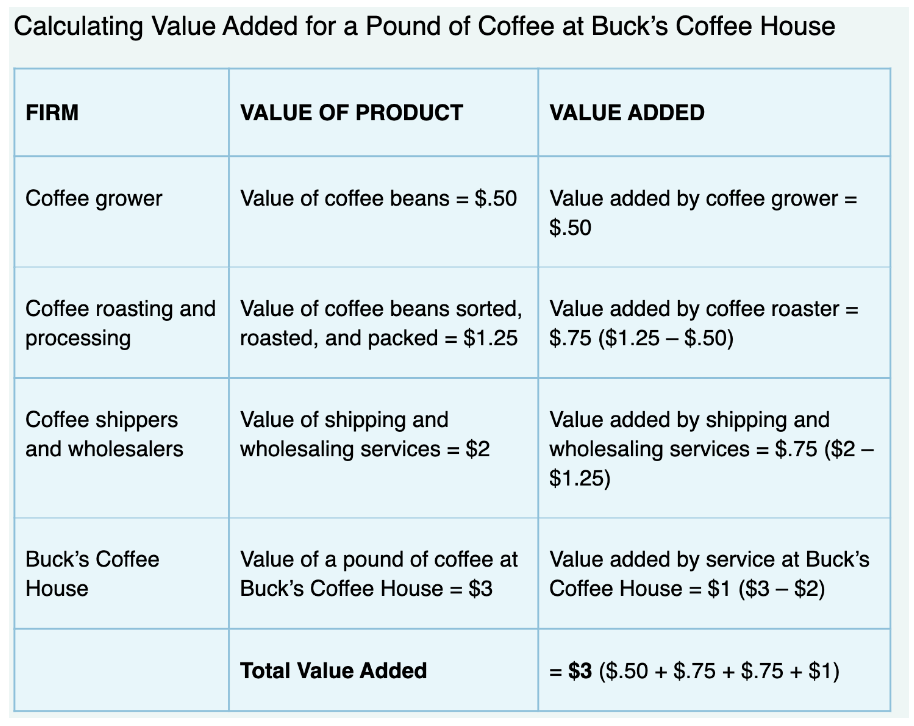
value-added aka production approach
price sold - price paid for intermediate goods
added value to product (ex. service, shipping, machinery)
added value to product (ex. service, shipping, machinery)
70
New cards
gross national product
net income of foreigners - GDP
71
New cards
WRIP approach (income approach) for calculating GDP
adding up factor payments:
Wages + Rent + Interest + Profits
for accuracy deduce depreciation & business taxes
Wages + Rent + Interest + Profits
for accuracy deduce depreciation & business taxes
72
New cards
a higher RGDP per capita means....
higher economic welfare
73
New cards
why GDP isn't an accurate measure of economic welfare
doesn't include:
- non-market transactions
- underground economy (unreported income)
- value of leisure (GDP can go down but standard of living doesn't have to)
- positive/negative externalities
- quality of goods
- non-market transactions
- underground economy (unreported income)
- value of leisure (GDP can go down but standard of living doesn't have to)
- positive/negative externalities
- quality of goods
74
New cards
production possibilities curve (PPC) can shift outward w/ improvements in:
land, labor, capital, entrepreneurship
75
New cards
what is the rule of 70
growth rate/70
how many years till nation doubles output @diff growth rates
ex) 3.5% --> 70/3.5 = output doubles every 20 years
even a small growth rate is good because long run effects
how many years till nation doubles output @diff growth rates
ex) 3.5% --> 70/3.5 = output doubles every 20 years
even a small growth rate is good because long run effects
76
New cards
what is growth rate?
GDP per capita
77
New cards
physical capital
goods like tools, machinery, factories
investment --> higher labor productivity
investment --> higher labor productivity
78
New cards
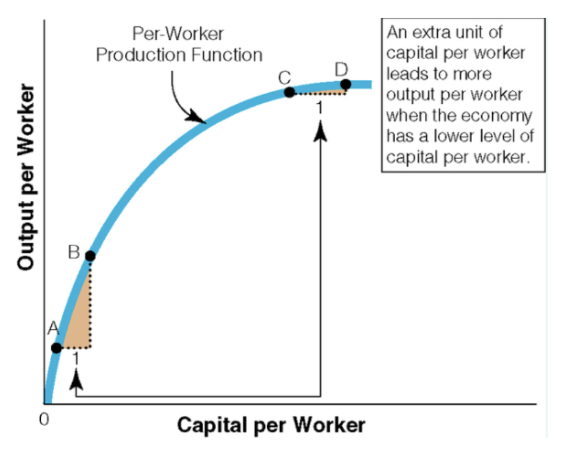
as quantity of capital per worker increases, so does output per worker at a ___________ rate
per-worker production function
per-worker production function
diminishing
79
New cards
catch-up effect?
increase in capital investment has a bigger effect in developing countries w/ little capital
80
New cards
human capital includes
training, education, health
improvements --> long run economic growth & productivity
improvements --> long run economic growth & productivity
81
New cards
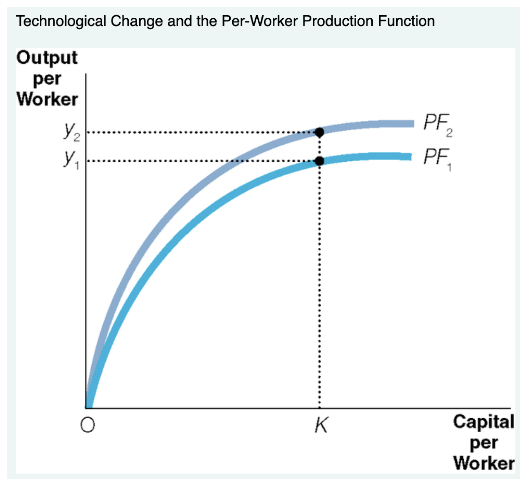
technological advancement effects
drives productivity, saves labor & natural resources
82
New cards
what is the new growth theory?
economic growth can continue as long as we come up new ideas MEANING innovation @a rate that offsets diminishing returns
83
New cards
economic growth rates are higher/lower when gov enforces property rights
higher
84
New cards
free trade --> greater output because ____
principle of comparative advantage - both parties benefit & total output increase
85
New cards
what is fiscal policy
deliberate use of gov purchases & taxes to stabilize economy
86
New cards
automatic stabilizers vs discretionary
automatic - gov purchases & taxes that change w/ business cycle
discretionary - gov takes action to change purchases & taxes (deliberate)
discretionary - gov takes action to change purchases & taxes (deliberate)
87
New cards
how fiscal policies affect short run vs long run
short: aggregate demand of goods & services
long: influence saving, investment, and economic growth ex
long: influence saving, investment, and economic growth ex
88
New cards
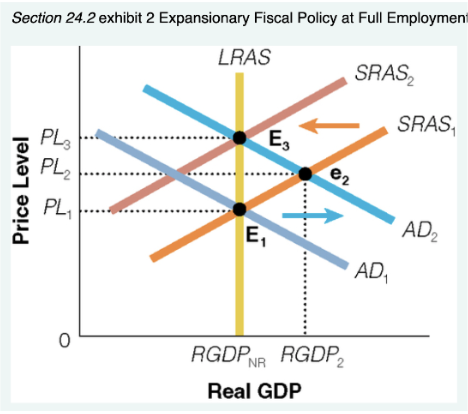
increase in gov spending & cutting taxes increase/decrease AD
increase
89
New cards
why does SRAS shift left w/ expansionary fiscal policy
workers & suppliers realize price levels increasing faster than wages + input prices --> demand higher wages & higher prices for inputs
90
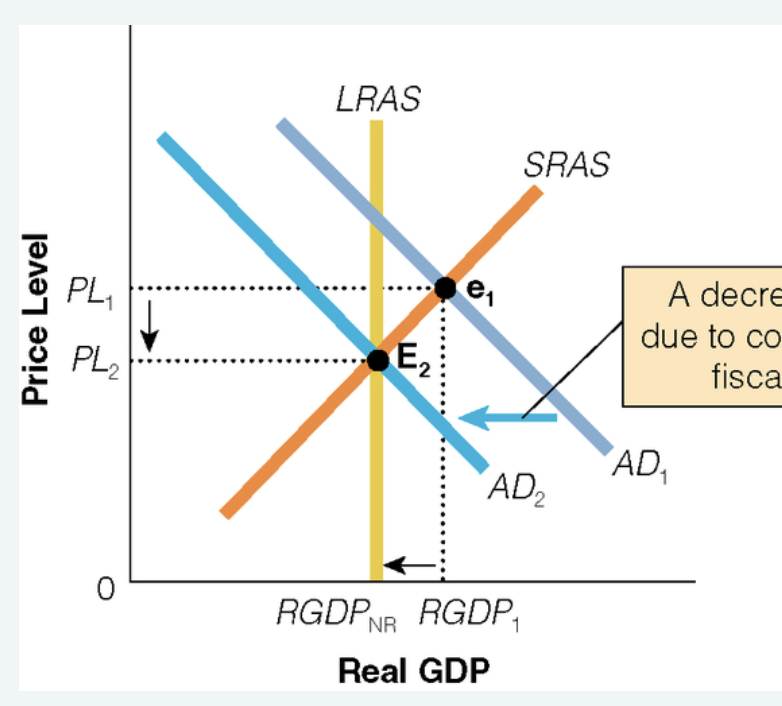
New cards
contractionary fiscal policy decrease/increase AD
decrease because gov purchases decrease & taxes increase
91
New cards
contractionary fiscal policy is dangerous because
reducing aggregate demand may lead to higher unemployment... monetary policy better option
92
New cards
what is the multiplier effect & how does it happen
chain reaction of additional income & purchases result in total purchases > initial increase in purchases
ex) gov spending increase --> higher income for people --> consumption spending increases SO total purchases higher than initial increase in gov spending
ex) gov spending increase --> higher income for people --> consumption spending increases SO total purchases higher than initial increase in gov spending
93
New cards
what is marginal propensity to consume? (MPC)
fraction of disposable/ADDITIONAL income (after tax) household spends rather than save;
change in consumption spending/change in disposable income
change in consumption spending/change in disposable income
94
New cards
the added income from multiplier effect get smaller/bigger through each pass
SMALLER because MPC is a %
95
New cards
how to calculate multiplier
1/(1-MPC)
96
New cards
if MPC is 2/3 and the initial purchase was $10 billion.... what is the multiplier? what is the total purchase increased and additional consumption?
1/(1-2/3) = 1/(1/3) = multiplier is 3
3 x $10 bil = $30 billion in total purchase increase
$20 bil in additional consumption
3 x $10 bil = $30 billion in total purchase increase
$20 bil in additional consumption
97
New cards
larger MPC = larger/smaller multiplier effect
larger
do the math
do the math
98
New cards
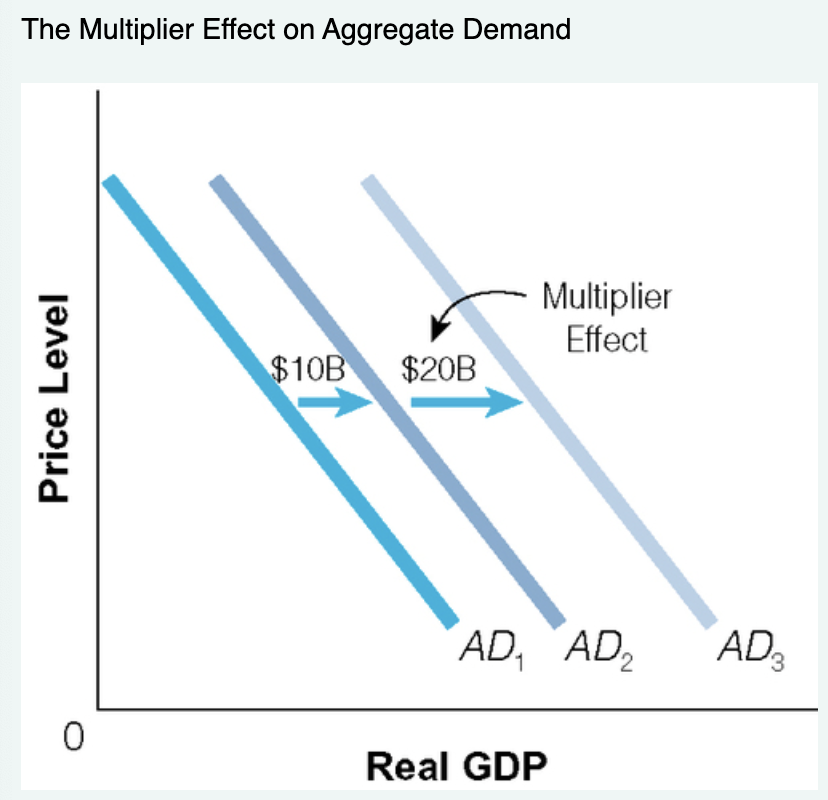
multiplier effect increase/decrease aggregate demand
increase (duh)
99
New cards
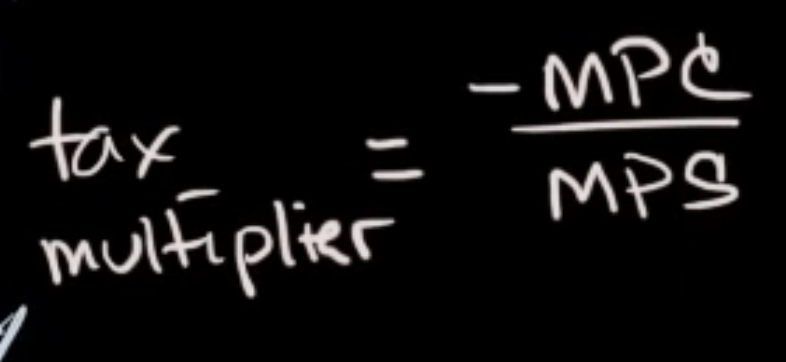
tax cut or tax multiplier is bigger/smaller than the government multiplier and why?
smaller because indirect impact on AD while gov purchases have direct impact on AD
100
New cards
3 factors that reduce the size of the multiplier
time lags, savings, and imports