MAE488 Quiz 2
 Call Kai
 Learn
Learn Practice Test
 Spaced Repetition
 Match
Match Flashcards
 Knowt Play
1/38

There's no tags or description
Looks like no tags are added yet.
Name | Mastery | Learn | Test | Matching | Spaced | Call with Kai | Chat |
|---|
No analytics yet
Send a link to your students to track their progress
39 Terms
Transfer Function
A transfer function is the Laplace transform of the output divided by the laplace transform of the input, assuming the initial conditions are equal to zero.
order
highest derivative
response of a system
output/s of a system in response to an initial condition or input
free response
part of the response that is due to the initial condition. If the initial conditions are zero, there is no free response
Forced response
the part of the response due to the forcing function (input). If the input is zero there is no forced response
steady state response
the part of the response that remains with time
transient response
part of the response that disappears with time
complete response
the sum of the free and forced response. also the sum of the steady state and transient response
damping ratio
the ratio between damping in a system and the critical damping value of the system
critically damped
damping value equal to the critical damping value
fastest possible without exceeding the final steady state value
zeta = 1
over damped
damping value greater than the critical damping value and will not oscillate
underdamped
damping alue that is less than the critical damping value and will oscillate
Stability
characteristic of a system that has a bounded output for any bounded input. The free response of a stable system approaches zero
equilibrium
a state of the system that will not change except if disturbed from the state by an input
dominant roots (of a stable system)
those that result in the longest lasting terms in the transient responsse
impulse
a mathematical function designed to represent an input that is applied for an infinitesimal time
ration function
any function that can be defined as a ratio of polynomials
proper transfer function
is a transfer function in which the degree of the numerator is less thatn or equal to the degree of the denominator
strictly proper transfer function
a transfer function in which the degree (order) of the numerator is strictly less than the degree of the denominator
normal form of a transfer function
the form in which the coefficient of the highest power of s in the denominator is one
the characteristic polynomial
the denominator of the transfer function
characteristic equation
results from setting the characteristic polynomial to zero
homogeneous v nonhomogeneous
right hand side is equal to 0 is homogeneous
four ways of solving odes
direct integration, separation of variables, trial-solution, laplace transform
Final Value Theorem
limit of x(t) as t approaches infinity = limit of sX(s) as s approaches 0
FVT tells us the final steady state value
only valid if both xt and dxdt have laplace transforms and xt approaches a s constant value as t approaches infinity
laplace transform steps
Take the laplace transform of both sides of the ode
solve for the dependent variable as a function of s
take the inverse laplace transform of the result
natural frequency of a system
w_n = sqrt(k/m)
k = spring constant
m = mass
unit: rad/sec
damped natural frequency
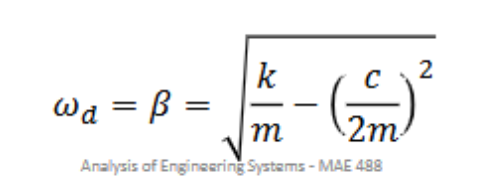
c=0
no damping
c >= 2sqrt(mk)
wd = zero or imaginary
critical damping value
c >= 2sqrt(mk)
damping ratio/factor
zeta can be used to determine wheter or not a system is stable
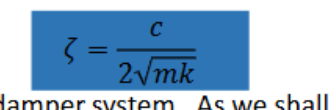
globally stable
stable for any initial condition
locally stable
only stable for some initial conditions
marginally stable
will oscillate about an equilibrium point
characteristic equation
mx’’ + cx’ + kx =0
ms²+cs+k=0
pure sinosoid
damping ratio, zeta, = 0
unstable at what value
damping ratio is less than 0
damped sinusoid
zeta between 0 and 1