Bio 2000 Chapter 4 Flashcards
 Call Kai
 Learn
Learn Practice Test
 Spaced Repetition
 Match
Match Flashcards
 Knowt Play
1/74

There's no tags or description
Looks like no tags are added yet.
Name | Mastery | Learn | Test | Matching | Spaced | Call with Kai | Chat |
|---|
No analytics yet
Send a link to your students to track their progress
75 Terms
Resolution
Ability to observe two adjacent objects as distinct
from one another
Contrast
How different one structure looks from another
Contrast can be enhanced by special dyes to reveal
cellular structure.
Magnification
Ratio between the size of an image produced by a
microscope and its actual size
Light microscope
• Uses light for illumination
• Resolution 0.2 micrometer
Electron microscope
• Uses a beam of electrons for illumination
• Resolution 2 nanometer (100 times better)
What are the three types of light microscopy?
Standard (bright field), Phase Contrast, Differential interference contrast (DIC or Nomarski microscopy)
Types of Electron microscopes
Transmission electron microscopy and Scanning electron microscopy
Standard (bright field) Light Microscopy
Light is focused with glass lenses
Light passes directly through sample
Phase contrast light microscopy
Microscope amplifies differences in phase of light transmitted or
reflected by sample
Improved contrast of denser structures
Differential interference contrast (DIC or
Nomarski light microscopy)
Another method using optics to improve contrast
Good for internal cellular structures
Transmission electron microscopy
(TEM)
Beam of electrons transmitted
through sample
Thin slices stained with heavy metals
Some electrons are scattered while
others pass through to form an
image
Scanning electron microscopy (SEM)
Sample coated with heavy metal
Beam scans surface to make 3D
image
Two primary categories of life
Prokaryotes and Eukaryotes
Prokaryotes
Cell structures without nucleus
Eukaryotes
More complex cells
DNA enclosed within membrane-bound nucleus
Internal membranes form organelles
Two types of Prokaryotic Cells
Bacteria and Archaea
Bacteria
Small cells, 1 micrometer to 10 micrometer in diameter
Very abundant in environment and our bodies
Vast majority are not harmful to humans
Some species cause disease
Archaea
Also small cells, 1 micrometer to 10 micrometer in
diameter
Less common
Often found in extreme environments
What is included inside the typical bacterial cell
Cytoplasm, Nucleoid region, Ribosomes
What is included outside the plasma membrane
Cell wall, Glycocalyx, Appendages
Cytoplasm
contained within plasma membrane
Nucleoid region
where DNA is located
Ribosomes
synthesize proteins
Cell wall
provides support and
protection
Glycocalyx
traps water, gives protection,
help evade immune system
Image of typical bacterial cell

Appendages
pilli (attachment), flagella
(movement)
Eukaryotic Cells Characteristics
DNA is housed inside membrane-
bound nucleus
• Compartmentalized functions
• Organelles
Membrane-bound compartments
Each has a unique structure and
function
• Variety
Shape, size, and organization of cells
vary considerably
Differences between species
Differences between specialized cell
types
Image of animal cell
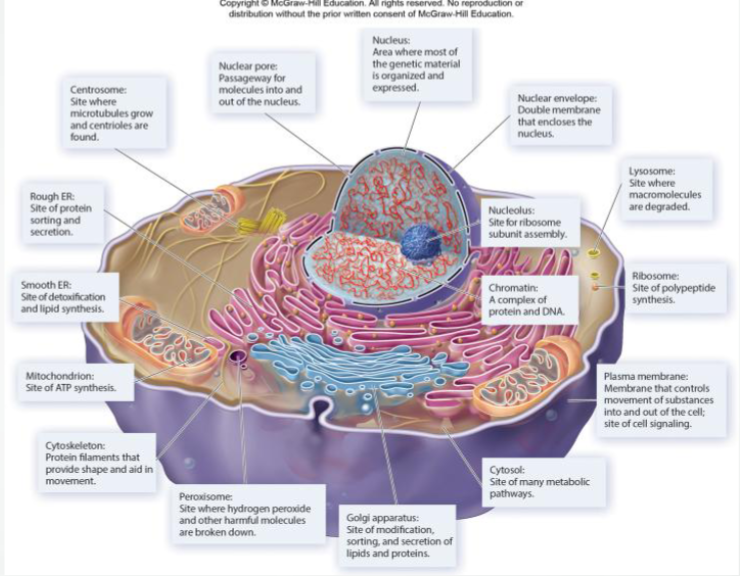
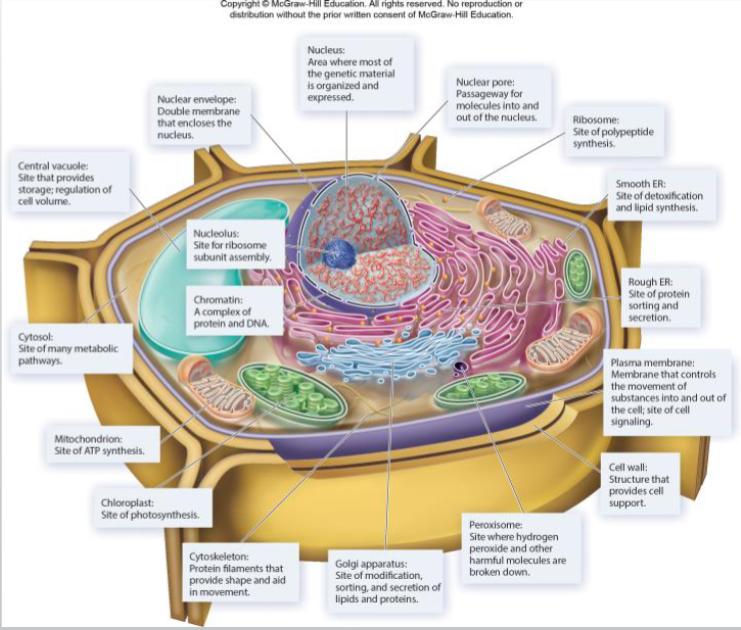
Image of plant cell
How does a single organism produce different types of cells?
The DNA in different cells is identical — but they have different
proteomes
As cells get larger,
the surface area-to-volume
ratio gets smaller.
What is the Cytosol
Region of an eukaryotic cell that
is outside the cell organelles but
inside the plasma membrane
Cytoplasm includes everything
inside the plasma membrane
Cytosol
Endomembrane system
Semiautonomous organelles
Catabolism
Breakdown of a molecule into smaller components
Anabolism
Synthesis of cellular molecules and macromolecules
Cytoskeleton consists of three types of protein filaments
A network of protein fibers that extend throughout the cytoplasm to provide structure for the eukaryotic cells. Microtubules, Intermediate filaments, and Actin filaments.
Microtubules
Long, hollow cylindrical
structures
Dynamic instability
Intermediate filaments
Intermediate in size
Form twisted, ropelike
structure
Actin filaments
Also known as microfilaments
Long, thin fibers
Motor Proteins
Use ATP as a source of energy for movement
What are the three domains of motor proteins?
The head, hinge and tail
What are the three kinds of movements for motor proteins
Motor proteins carries cargo along the filament
Motor protein remains in place, the filament
moves
Motor protein and filament both restrained – action of the motor protein exerts a force that bends the filament
Flagella
Usually longer than cilia
Present singly or in pairs
9 + 2 microtubule array
Cilia
Often shorter than flagella
Tend to cover all or part of the cell
surface
Also a 9 + 2 microtubule array
Network of membranes
enclosing the nucleus, endoplasmic reticulum, Golgi apparatus, lysosomes, and vacuoles
Also includes plasma membrane
Also includes plasma membrane
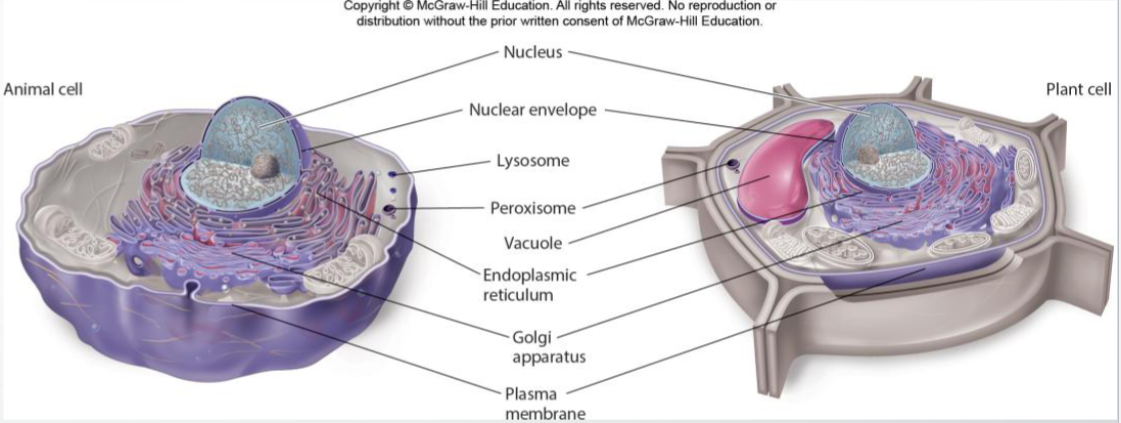
Image of the nucleus and membrane system
What is included within the nuclear envelope?
Double-membrane structure
enclosing nucleus, Outer membrane of the nuclear
envelope is continuous with the ER
membrane and Nuclear pores provide passageways
Nucleus
Chromosomes
Composed of DNA and proteins = chromatin
• Nuclear matrix
Filamentous network
Organizes chromosomes
• Ribosome assembly occurs in the nucleolus
Chromatin
Composed of DNA and Proteins
Endoplasmic Reticulum
Network of membranes that form
flattened, fluid-filled tubules or cisternae
ER lumen
Where the ER membrane closes in a single compartment
Rough endoplasmic reticulum (rough ER)
Studded with ribosomes
Involved in protein synthesis and sorting
Smooth endoplasmic reticulum (smooth
ER)
Lacks ribosomes
Detoxification, carbohydrate
metabolism, calcium balance, synthesis,
and modification of lipids
Golgi apparatus
• Stack of flattened, membrane-
bounded compartments
• Vesicles transport materials
between stacks
What are the three overlapping functions of golgi apparatus
Secretion, processing, and protein sorting
Lysosomes
Membrane bound organelles that helps to remove waste in animal cells.Contain acid hydrolases that perform hydrolysis
Autophagy
Recycling of worn-out organelles through endocytosis
Central Vacuoles
in plants for storage and support
Contractile Vacuoles
in protists for expelling excess water
Peroxisomes
Catalyze certain reactions that break down molecules by removing
hydrogen or adding oxygen
What is a byproduct of peroxisomes catalyzing
Hydrogen Peroxide (H2O2)
Catalase
Breaks down dangerous H2O2 into water and oxygen
Plasma membrane
Boundary between the cell
and the extracellular
environment
Functions of Plasma membrane
Membrane transport in and out
of cell, with selective permeability
Cell signaling using receptors
Cell adhesion
Mitochondria and chloroplasts
Grow and divide to reproduce
themselves (endosymbiotic relationship)
• Contain their own DNA, divide by
binary fission
Mitochondria and Chloroplasts are semiautonomous organelles because
They are not completely autonomous
because they depend on the cell for
synthesis of internal components
Mitochondria
Primary function is to produce ATP
Also involved in the synthesis, modification, and breakdown of several types of cellular molecules
Photosynthesis
Capture light energy and use some of that energy to synthesize organic molecules such as glucose.
Found in nearly all species of plants
and algae.
Inner mebrane of chloroplast is called
Intermembrane space
Outer membrane of chloroplast is called
Thylakoid membrane
What process do both mitochondria and chloroplast go through?
Endosymbiosis
What kind of endosymbiosis does mitochondria go through?
Modern mitochondria were
derived from purple bacteria,
also called α proteobacteria
What kind of endosymbiosis does chloroplast o through?
Similarly, chloroplasts were
derived from cyanobacteria (a
photosynthetic blue-green
bacteria)
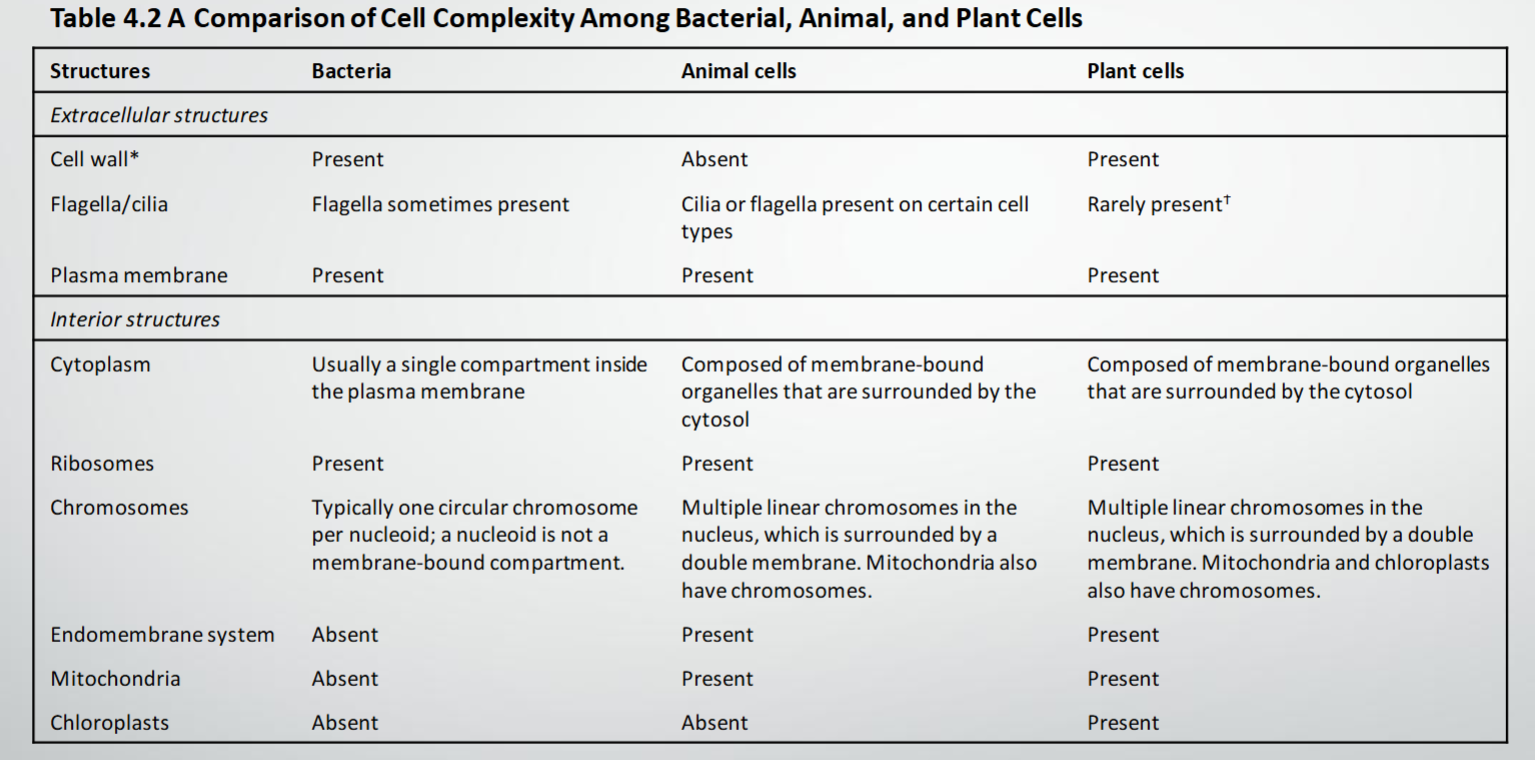
Important table to look at: A Comparison of Cell Complexity Among Bacterial, Animal, and Plant Cells