APAH Test 09/23/2026
 Call Kai
 Learn
Learn Practice Test
 Spaced Repetition
 Match
Match Flashcards
 Knowt Play
 Podcast
1/69

There's no tags or description
Looks like no tags are added yet.
Name | Mastery | Learn | Test | Matching | Spaced | Call with Kai | Chat |
|---|
No analytics yet
Send a link to your students to track their progress
70 Terms

Lakshmana Temple
Khajuraho, India; c. 930–950 CE
Hinduism; Chandella dynasty
Patron: Yashovarman
Sandstone temple dedicated to Vishnu
Mountain-like towers = Mt. Meru
Dense exterior sculptures, including erotic imagery
Used for individual worship, not congregational worship
Worshippers could circumambulate the sacred center

Shiva as Lord of Dance (Nataraja)
Tamil Nadu, India; Chola dynasty; c. 11th century CE
Hinduism; bronze
Shiva performing the cosmic dance
Ring of fire = cosmic cycle
Drum = creation/time
Fire = destruction
Dwarf = ignorance
Raised hand = protection
Chola bronzes could be carried in religious processions

Great Stupa at Sanchi
Madhya Pradesh, India; c. 300 BCE–100 CE
Buddhism
Originally commissioned by Ashoka
Stone masonry/sandstone
Contains/commemorates sacred Buddhist relics
Worshippers circumambulate clockwise
4 carved toranas (gateways)
Early Buddhist imagery often represents Buddha symbolically rather than as a human
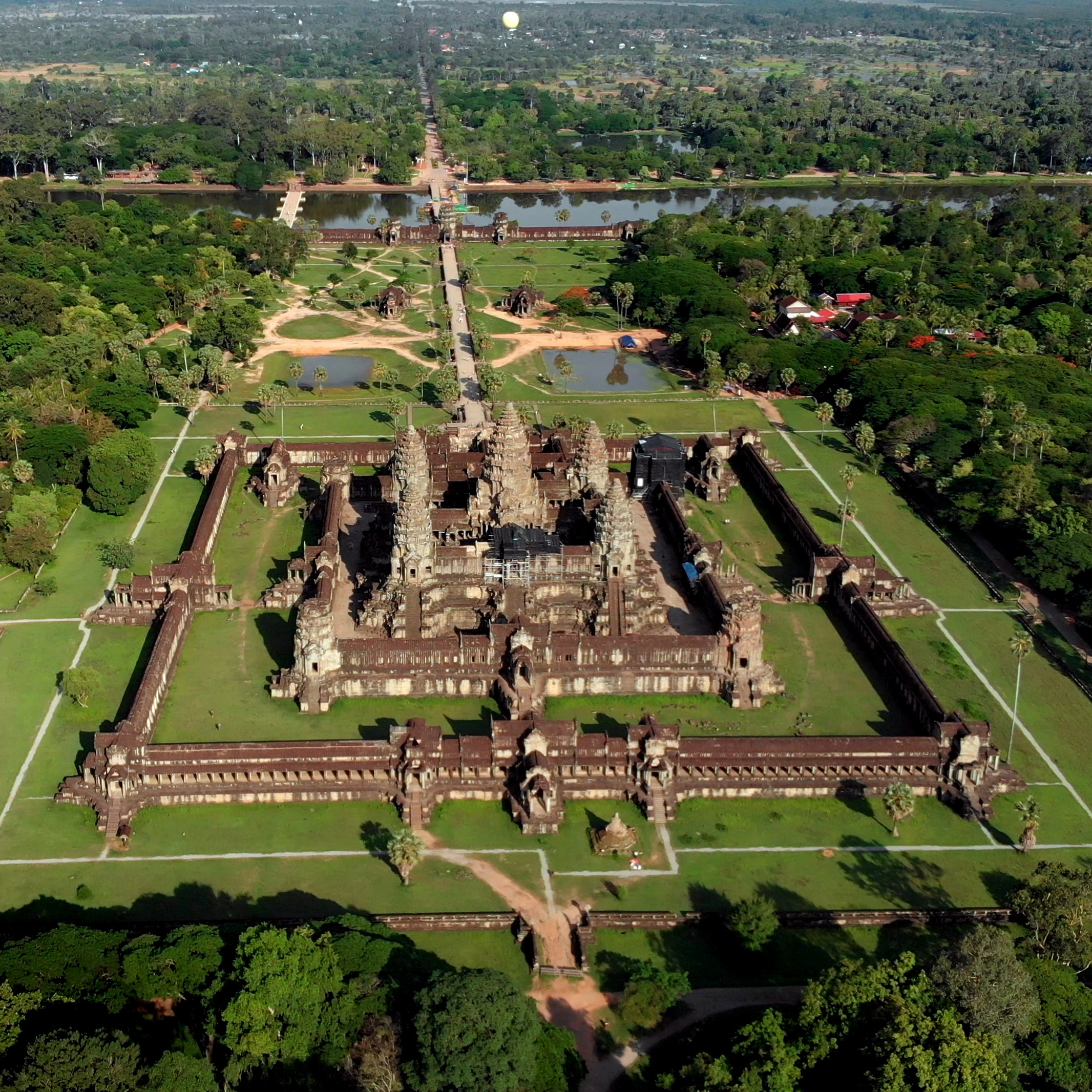
Angkor Wat
Angkor, Cambodia; c. 1120–1150 CE
Hinduism; Khmer Empire
Patron: Suryavarman II
Dedicated to Vishnu
5 towers = peaks of Mt. Meru
Moat = cosmic waters
Monumental scale demonstrates royal power
Combines religious and political authority

City of Angkor Thom
Angkor, Cambodia; c. 1200 CE
Buddhism; Khmer Empire
Patron: Jayavarman VII
Includes Bayon
Famous for enormous serene stone faces
Combines Buddhist imagery with royal authority
Remember: Angkor Wat = Hindu/Suryavarman II; Angkor Thom = Buddhist/Jayavarman VII

Borobudur
Central Java, Indonesia; c. 750–842 CE
Buddhism; Sailendra dynasty
Volcanic-stone masonry
Buddhist pilgrimage monument
Functions like a 3-D mandala
Worshippers ascend + circumambulate
Square lower levels → circular/open upper levels
Journey upward symbolizes movement toward enlightenment

Jowo Rinpoche
Jokhang Temple, Lhasa, Tibet; believed brought to Tibet in 641 CE
Buddhism
Sacred image of Shakyamuni Buddha
Gilt metals, gemstones, pearls, paint
Important pilgrimage/devotional image
Worshippers give clothing, jewels, and other offerings
Treated as a powerful sacred presence

Bamiyan Buddhas
Bamiyan, Afghanistan; c. 400–800 CE
Buddhism
Monumental standing Buddhas carved into cliff niches
Rock + plaster + polychrome paint
Located along the Silk Road
Show spread of Buddhism and artistic influences
Destroyed by the Taliban in 2001

Longmen Caves
Luoyang, China; c. 493–1127 CE
Buddhism
Rock-cut Buddhist cave complex
Huge Buddha + thousands of smaller figures
Associated with imperial patronage, especially Empress Wu
Shows Buddhism becoming embedded in Chinese culture
Religious devotion + imperial authority

Terracotta Warriors
Mausoleum of Qin Shi Huangdi, China; c. 221–209 BCE
Qin dynasty
Painted terracotta
Thousands of life-sized soldiers
Made to protect/serve emperor in afterlife
Different faces, ranks, hairstyles, clothing, and poses
Shows Qin Shi Huangdi's military power and centralized authority

Funeral Banner of Lady Dai
China; c. 180 BCE
Han dynasty
Painted silk; T-shaped
Found in tomb of Lady Dai (Xin Zhui)
Shows earthly + heavenly/cosmic realms
Connected to soul's journey after death
Demonstrates elite Han funerary beliefs and wealth

Travelers Among Mountains and Streams
Fan Kuan; China; c. 1000 CE
Song dynasty
Ink and colors on silk
Monumental Chinese landscape
Tiny humans dwarfed by enormous mountains
Nature is more powerful/important than humans
Encourages contemplation of humanity's relationship with nature

David Vases
China; 1351 CE
Yuan dynasty
Blue-and-white porcelain
Cobalt underglaze
Dragon decoration
Made as a temple/religious donation
Cobalt connects work to international trade
Shows sophistication of Chinese porcelain

Forbidden City
Beijing, China; 15th century CE and later
Ming dynasty
Imperial palace + administrative/ritual center
Symmetrical north-south axis
Red walls + yellow roofs
Courtyards and increasingly restricted spaces
Architecture emphasizes hierarchy, order, and emperor's authority

Chairman Mao en Route to Anyuan
Liu Chunhua; China; 1967
Cultural Revolution
Socialist Realism
Oil on canvas
Young Mao walks through dramatic landscape carrying umbrella
Idealizes Mao as heroic revolutionary leader
Political propaganda
Refers to 1922 Anyuan miners' strike

Gold and Jade Crown
Silla Kingdom, Korea; 5th–6th century CE
Gold + jade
Royal/funerary object
Branching/tree-like forms
Dangling jade ornaments
May symbolize connection between heaven and earth
Demonstrates wealth and royal authority
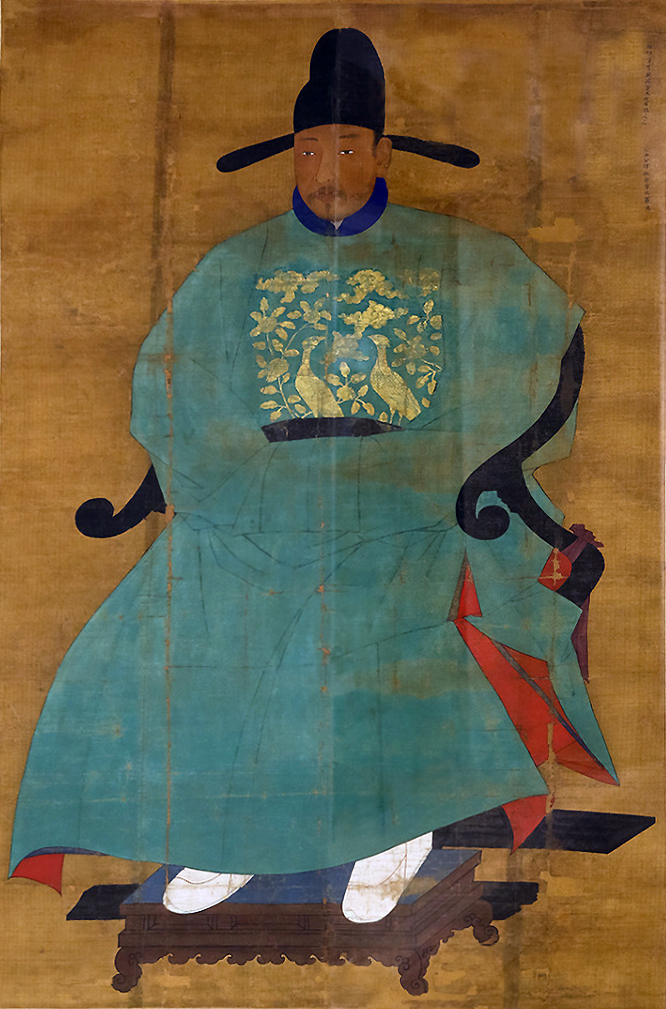
Portrait of Sin Sukju
Korea; c. 15th century
Joseon dynasty
Hanging scroll; ink + color on silk
Formal portrait of government official
Black hat + official robe + rank badge
Connected to ancestor veneration
Emphasizes Confucian hierarchy, status, and order

Tōdai-ji
Nara, Japan; originally 8th century CE
Buddhism
Associated with Emperor Shōmu
Monumental wooden temple
Contains monumental Buddha
Imperial patronage
Buddhism used to reinforce state/imperial authority

Ryōan-ji
Kyoto, Japan; c. 1480 CE
Zen Buddhism
Dry rock garden
Rocks + raked gravel
Minimalism, asymmetry, empty space
Used for meditation/contemplation
Reflects Zen emphasis on simplicity and introspection
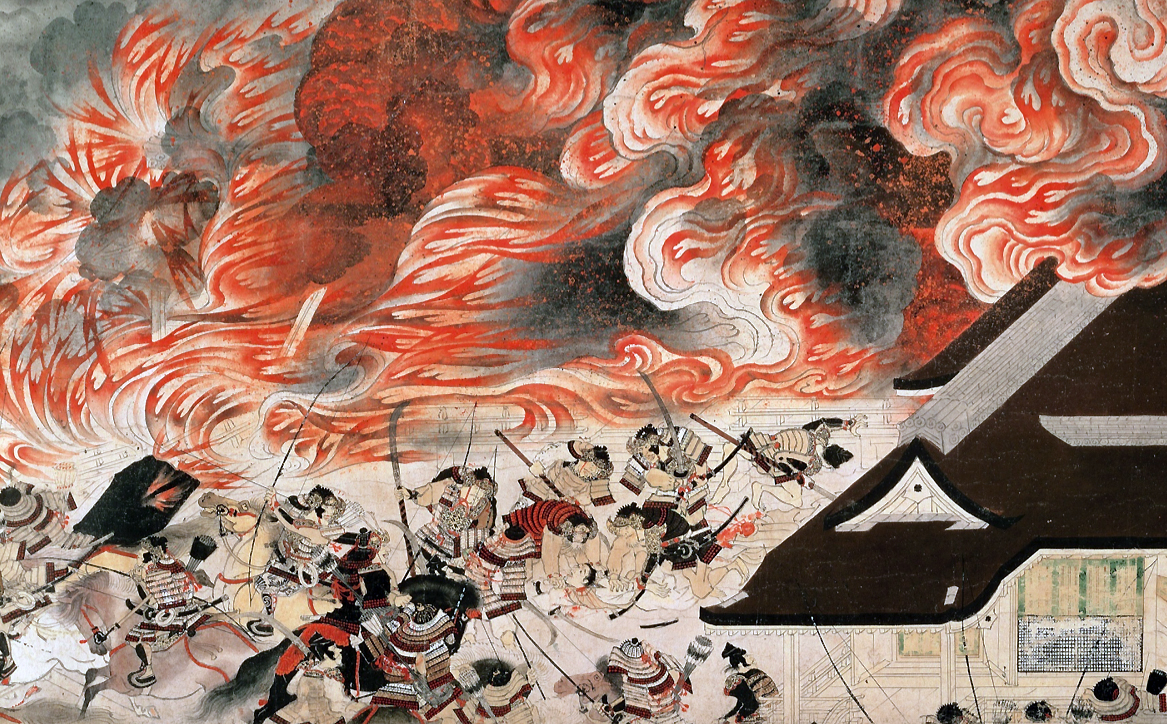
Night Attack on the Sanjō Palace
Japan; c. 1250–1300 CE
Kamakura period
Yamato-e
Handscroll; ink + color on paper
Continuous narrative
Diagonal movement, horses, warriors, architecture, fire
Dramatic depiction of warfare
Reflects growing importance of warrior/samurai culture

White and Red Plum Blossoms
Ogata Kōrin; Japan; c. 1710–1716 CE
Edo period; Rinpa school
Pair of folding screens
Ink, watercolor + gold leaf on paper
Plum trees separated by stylized stream
Asymmetry + flattened forms + abstraction
Decorative screens also divide interior space

Under the Wave off Kanagawa (The Great Wave)
Katsushika Hokusai; Japan; c. 1830–1832 CE
Edo period; ukiyo-e
Polychrome woodblock print
From Thirty-six Views of Mount Fuji
Giant wave + boats + small distant Mt. Fuji
Uses imported Prussian blue
Western influence includes perspective
Japanese prints later influenced European artists (Japonisme)
Circumambulation
Ritual movement around a sacred object/structure; usually clockwise in Buddhist worship. Important at Sanchi and Borobudur.
Mt. Meru
Sacred cosmic mountain at the center of the universe; symbolized by mountain-like temple architecture, especially Angkor Wat.
Axis mundi
Symbolic axis connecting earthly and heavenly/cosmic realms.
Mandala
Sacred diagram representing the cosmos/universe; Borobudur functions like a 3-D mandala.
Stupa
Buddhist mound-shaped sacred monument associated with relics, pilgrimage, worship, and circumambulation.
Mudra
Symbolic hand gesture in Buddhist/Hindu art that communicates a specific meaning.
Bodhisattva
Enlightened or near-enlightened being who helps others progress toward enlightenment.
Nirvana
Buddhist liberation from suffering and the cycle of rebirth.
Shakyamuni Buddha
The historical Buddha, Siddhartha Gautama.
Gandhara style
Buddhist artistic tradition influenced by Greco-Roman/Hellenistic art; often naturalistic bodies, faces, and drapery.
Daoism
Chinese philosophy/religion emphasizing harmony with nature, simplicity, flexibility, and following the Dao (“the Way”).
Yin and Yang
Complementary opposing forces that work together to create harmony and balance.
Confucianism
Chinese philosophy emphasizing social order, proper relationships, hierarchy, education, duty, and moral behavior.
Zen Buddhism
Buddhist tradition emphasizing meditation, introspection, simplicity, and direct experience.
Ukiyo-e
Japanese “pictures of the floating world”; Edo-period woodblock prints depicting landscapes, entertainment, and everyday life.
Rinpa
Japanese decorative style/school emphasizing nature, rich materials, stylized forms, flattened space, and elegant design.
Yamato-e
Traditional Japanese painting style often used for Japanese subjects and narrative scenes.
Socialist Realism
Clear, idealized art used to promote socialist political ideology; style of Chairman Mao en Route to Anyuan.
Continuous narrative
Multiple moments of a story shown within one continuous composition; used in Night Attack on the Sanjō Palace.
Horror vacui
“Fear of empty space”; tendency to fill nearly the entire surface with decoration.
Syncretism
Blending of different religious, cultural, or artistic traditions.
Kaolin
Fine clay important for producing high-quality porcelain.
Porcelain
Refined, high-fired ceramic valued for hardness, smoothness, and sometimes translucency.
Woodblock print
Print made by carving an image into wood, applying ink/color, and transferring the image to paper.
Torana
Monumental carved gateway associated with Buddhist stupas; four appear at the Great Stupa at Sanchi.
Pagoda
East Asian multistory tower with repeated levels; developed from Buddhist sacred architecture.
Mausoleum
Monumental tomb/burial complex; Qin Shi Huangdi's mausoleum contains the Terracotta Warriors.
Cultural Revolution
Chinese political/social movement associated with Mao; historical context for Chairman Mao en Route to Anyuan.
What are the three major Hindu gods and their roles?
Brahma = creator; Vishnu = preserver/protector; Shiva = destroyer/regenerator.
Why are Hindu gods often shown with multiple arms?
Multiple arms indicate supernatural/divine power and allow the deity to hold multiple symbolic objects or perform gestures.
What is darshan?
The sacred act of seeing and being seen by a deity; viewing the divine image is an important part of Hindu worship.
What is a Hindu temple understood to be?
The residence of a deity and a sacred place where an individual worshipper can encounter the divine; not primarily a congregational worship space.
Why do Hindu temples resemble mountains?
Their rising towers evoke Mt. Meru, the sacred cosmic mountain at the center of the Hindu universe.
What four sights caused Siddhartha to confront suffering?
An old man, a sick person, a corpse, and a religious ascetic.
What did Siddhartha discover about extreme asceticism?
Extreme self-denial did not produce enlightenment, so he rejected it and followed a more moderate path.
Where did Buddha achieve enlightenment?
While meditating beneath the Bodhi tree.
How does Theravada Buddhism generally understand the historical Buddha?
Primarily as an enlightened human teacher who discovered and taught the path toward liberation.
How does Mahayana Buddhism differ in its conception of Buddha?
It developed more transcendent understandings of Buddhas and emphasized beings who can assist others toward enlightenment.
What are the important priorities/practices of Hinduism, and how does the art reflect them?
Hinduism emphasizes devotion to deities, karma/reincarnation, the cyclical nature of existence, and a sacred cosmic order. Hindu art makes these abstract beliefs visible through symbolic images and architecture.
Best evidence:
Nataraja: Shiva's cosmic dance represents the cycle of creation and destruction. His drum represents creation/time, fire represents destruction, and the dwarf represents ignorance.
Lakshmana Temple: The temple is a residence for the deity and supports individual worship and circumambulation. Its rising architecture evokes Mt. Meru, connecting earthly worship with the Hindu cosmos.
Angkor Wat: Its five towers represent Mt. Meru, while the surrounding moat evokes cosmic waters. It was dedicated to Vishnu, the preserver.
What are the important priorities/practices of Buddhism, and how does the art reflect them?
Buddhism focuses on recognizing and overcoming suffering and attachment in order to achieve enlightenment and escape the cycle of rebirth. Meditation, pilgrimage, devotion, and circumambulation can help practitioners progress spiritually.
Best evidence:
Great Stupa at Sanchi: Contains/commemorates sacred relics and allows pilgrims to circumambulate clockwise. Buddha can be represented aniconically through symbols such as the wheel, Bodhi tree, footprints, or empty throne.
Borobudur: The worshipper circumambulates and physically ascends the monument. The transition from dense square galleries to open circular terraces symbolizes progression away from worldly attachment toward enlightenment.
Ryōan-ji: Minimal rocks, raked gravel, asymmetry, and empty space encourage Zen meditation and introspection.
How did religion become a legitimizing force in Asia?
Asian rulers could strengthen their authority by associating themselves with important religions. By sponsoring monumental religious art and architecture, rulers presented themselves as protectors of religion and participants in sacred or cosmic order.
Best evidence:
Ashoka + Great Stupa at Sanchi: Ashoka's Buddhist patronage helped spread Buddhism while connecting his rule with Buddhist values and institutions.
Suryavarman II + Angkor Wat: Suryavarman II commissioned an enormous Hindu temple dedicated to Vishnu. Its Mt. Meru symbolism and monumental scale connected his kingship with the Hindu cosmos.
Jayavarman VII + Angkor Thom: His Buddhist building program connected his authority with Buddhism; Bayon's monumental faces helped create an overwhelming sacred/royal presence.
Emperor Shōmu + Tōdai-ji: Imperial support of monumental Buddhism helped connect religion with the authority and unity of the Japanese state.
As Buddhism spread from India → Southeast/East Asia → Japan, what continuity can be seen over time?
Although Buddhist art changed as it entered different cultures, artists continually used art and architecture to promote Buddhist teaching, sacred presence, pilgrimage, meditation, and the pursuit of enlightenment.
Evidence:
Sanchi: relics + circumambulation + symbolic representation of Buddha.
Borobudur: circumambulation remains important, but the entire monument becomes a physical journey toward enlightenment.
Bamiyan/Longmen: Buddha becomes monumental and anthropomorphic as Buddhism spreads into Central and East Asia.
Jowo Rinpoche: Buddha image becomes an intensely sacred devotional presence receiving offerings.
Tōdai-ji: Monumental Buddha worship becomes connected with the Japanese state.
Ryōan-ji: Zen Buddhism emphasizes meditation, simplicity, and introspection.
What artworks demonstrate legitimacy for a ruler, reign, or religion?
Monumental art can establish legitimacy by demonstrating a ruler's wealth, control of labor, military power, religious devotion, or connection to sacred authority.
Best examples:
Angkor Wat — Suryavarman II
Massive resources/labor
Hindu cosmology
Dedicated to Vishnu
Connects king to sacred order
Terracotta Warriors — Qin Shi Huangdi
Thousands of figures demonstrate extraordinary centralized resources
Army represents his military authority
His power symbolically continues into afterlife
Forbidden City — Ming emperors
Monumental scale
Axial symmetry
Restricted access
Hierarchical spaces
Emperor associated with cosmic/political order
Longmen Caves — Empress Wu
Monumental Buddhist patronage
Religion + imperial authority
Tōdai-ji — Emperor Shōmu
State-sponsored Buddhism
Monumental Buddha
Religion helps support political unity
How did historical context shape Asian art and architecture through religion, trade, wealth, the Silk Road, and innovation?
Asian art developed through constant interaction between religious expansion, political wealth, trade networks, and technological innovation, allowing both ideas and materials to move between regions.
Best evidence #1 — Bamiyan Buddhas
Afghanistan
Located along major Silk Road networks
Buddhism moved across Asia through trade and travel
Artistic features demonstrate cross-cultural influence.
Best evidence #2 — David Vases
Yuan China
Chinese porcelain technology
Cobalt connected to western Asian/Iranian trade
Shows international exchange affecting the appearance/materials of Chinese art.
Best evidence #3 — Great Wave
Hokusai used Prussian blue, a foreign pigment.
Western/Dutch artistic ideas contributed to perspective and spatial effects.
Later, Japanese prints traveled in the opposite direction and influenced European artists through Japonisme.
What is the importance of the scroll format?
The handscroll format allows an artist to control how a story unfolds through both space and time, because the viewer gradually unrolls the work rather than seeing the entire composition simultaneously.
Night Attack:
Read/unrolled right to left
Continuous narrative
Different moments appear sequentially
Begins with developing action
Builds toward chaotic climax of fighting/fire
Continues toward aftermath
Diagonals, horses, warriors, flames, and architecture increase movement
What artworks demonstrate form and function coexisting?
BEST ANSWER: Borobudur
Form: Stepped monument with pathways, relief-covered lower galleries, circular upper terraces and stupas.
Function: Buddhist pilgrimage and spiritual progression.
Connection: The pilgrim literally moves upward through the architecture, so the form makes the spiritual journey toward enlightenment physical.
Another excellent answer: Sanchi
Form: Circular stupa surrounded by circumambulatory pathways and gateways.
Function: Buddhist pilgrimage/worship.
Connection: Its circular architecture physically directs worshippers around the sacred relics.
What formal characteristics/adjectives can describe Asian artworks?
EXCESSIVE / DENSE
Lakshmana Temple
Dense
Elaborate
Repetitive
Highly ornamented
Horror vacui
Because almost every exterior surface contains sculptural decoration.
MINIMALIST
Ryōan-ji
Minimalist
Restrained
Asymmetrical
Meditative
Empty
Its gravel and limited rocks make negative space important.
What is aniconism?
Representing a sacred figure through symbols rather than directly depicting the figure in human form.