NSG 548 Quiz 2 Study Guide: Child Development and Health
 Call Kai
 Learn
Learn Practice Test
 Spaced Repetition
 Match
Match Flashcards
 Knowt Play
1/86

There's no tags or description
Looks like no tags are added yet.
Name | Mastery | Learn | Test | Matching | Spaced | Call with Kai | Chat |
|---|
No analytics yet
Send a link to your students to track their progress
87 Terms
What is the most common concern parents have regarding their child's health?
Sleep patterns during childhood.
Why is sleep essential for children?
It is essential for optimal health and growth, associated with improved memory, attention, learning, behavior, emotional regulation, immune function, and overall health outcomes.
What are some signs or symptoms of sleep disturbance in children?
Snoring, restless sleep, insomnia, bedwetting, troubles waking up, daytime sleepiness, inattention, learning problems, depression/anxiety, and chronic headaches.
How many hours of sleep do children need at different ages?
4-12 months: 12-16 hours; 1-2 years: 11-14 hours; 3-5 years: 10-13 hours; 6-12 years: 9-12 hours; 13-18 years: 8-10 hours.
Who is at risk for disturbed sleep?
Children with Down syndrome, craniofacial anomalies, cerebral palsy, muscular dystrophy, obesity, snoring, inattention, and hyperactivity.
What is role modeling in child development?
Parents shape their children's attitudes, behaviors, and development through their actions and interactions.
How do parent-child interactions influence a child's future experiences?
Interactions related to books and play activities model the types of interactions a child will later experience in school.
Why is normal physical activity important for children?
It promotes cardiovascular and respiratory fitness, improves bone strength, and has various health benefits including reducing asthma and lowering blood pressure.
What is the recommended amount of physical activity for children?
60 minutes of moderate-vigorous activity per day and strength training 3 times per week.
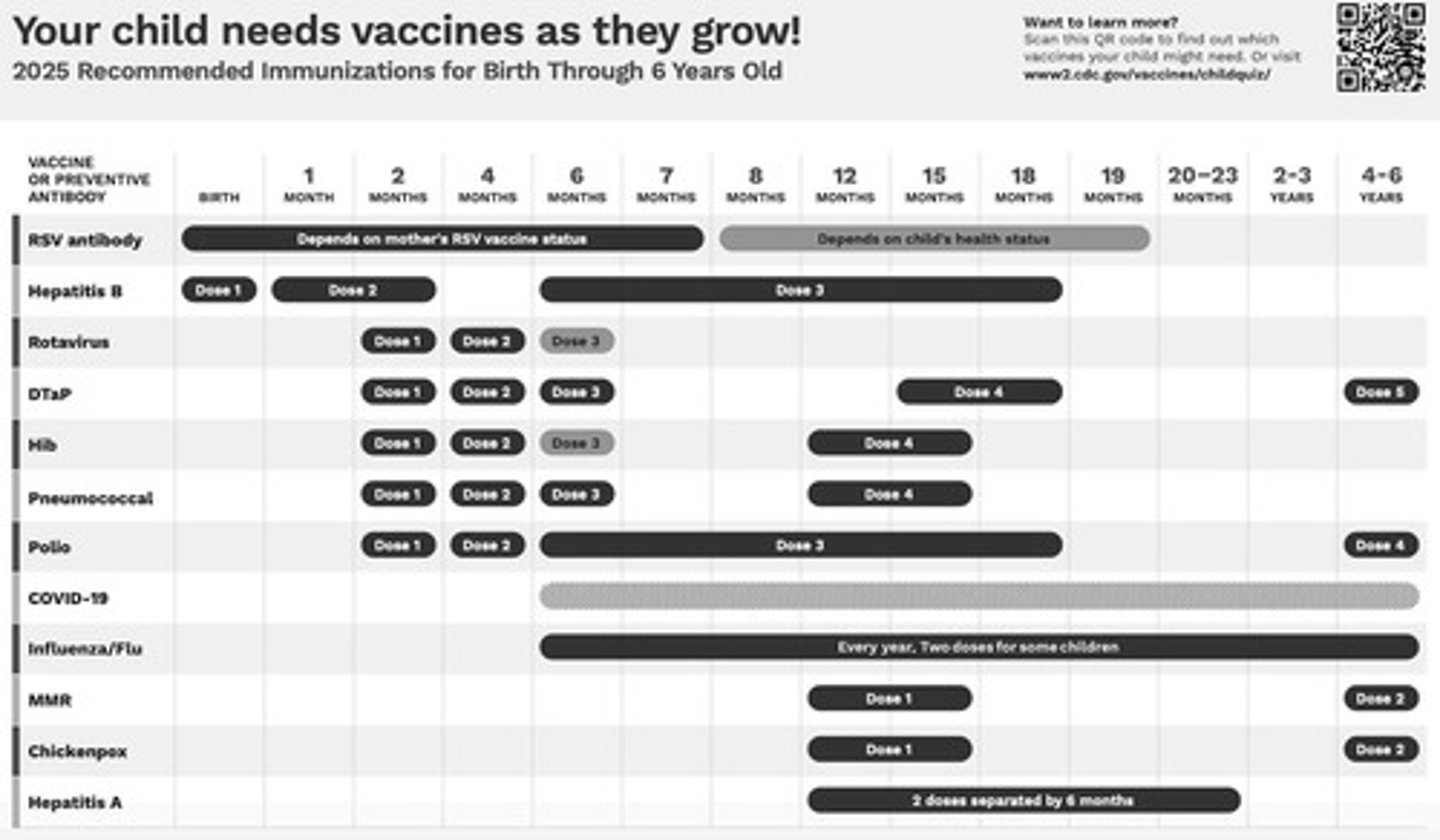
What vaccines are given at birth?
Hepatitis B (IM) within 24 hours of birth.
Which vaccines are administered at 2 months?
Hepatitis B (Dose 2), Rotavirus (Dose 1), DTaP (Dose 1), Hib (Dose 1), Pneumococcal (Dose 1), Polio (Dose 1).
What vaccines are given at 12 months?
Measles, mumps, rubella (MMR), Varicella (Chickenpox), Pneumococcal (Dose 4), Hepatitis A (Dose 1).
What is the significance of the prefrontal cortex in adolescent brain development?
It grows rapidly and controls abstract thinking, reasoning, judgment, and emotions.
At what age is the adolescent brain fully developed?
The brain is not fully developed until age 24.
What are the recommended vaccines for children aged 4-6 years?
DTaP (Dose 4), Polio (Dose 4), MMR (Dose 1), Varicella (Dose 2), and annual influenza vaccine.
What is the role of exercise in managing health conditions in children?
Exercise improves asthma, exercise capacity, decreases airway inflammation, lowers blood pressure in hypertension, and reduces the risk for metabolic syndrome and cardiovascular disease.
What is the importance of modeling appropriate language for preschoolers?
Preschoolers are great imitators, so parents should model appropriate language and avoid swearing.
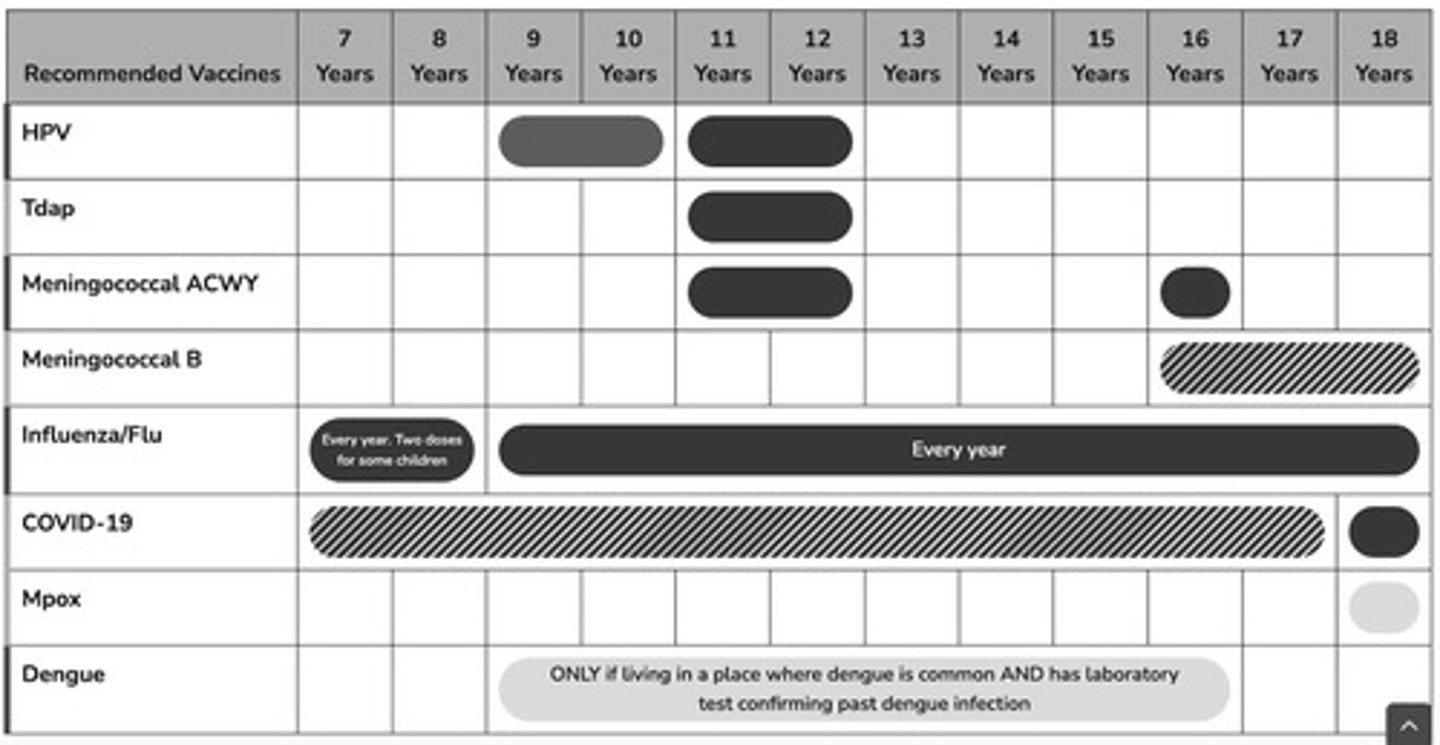
What is the recommended vaccination schedule for HPV?
Administered in 2 doses separated by 6 months, starting at ages 11-12.
What are the vaccines given during childhood for meningococcal disease?
Meningococcal ACWY and Meningococcal B.
What is the recommended frequency for the influenza vaccine?
Every year, with two doses for some children.
What additional vaccines are recommended for adolescents?
Tdap, Meningococcal ACWY, Meningococcal B, and COVID-19.
What factors influence a child's need for the RSV antibody?
Depends on the mother's RSV vaccine status.
What part of the brain is responsible for logical thinking and emotional regulation?
The pre-frontal cortex.
At what age is the pre-frontal cortex fully developed?
24 years.
What brain structure is involved in the fight-or-flight response?
The amygdala.
What is the role of the limbic system in emotional processing?
It controls impulses and is the emotional hub of the brain.
What are the developmental goals during adolescence?
Independence, self-sufficiency, transition to adulthood, and sense of belonging to groups.
What is oxytocin known as and what effects does it have?
The bonding hormone; it causes self-consciousness, reward-based risk taking, intense desire for social connections, and mood disturbances.
What behavioral effects does testosterone have?
It causes intense feelings of anger or fear, volatile behavior, and stimulates the production of white matter.
How do estrogen and progesterone influence health?
They control mood, influence learning and memory, and can be used for vaginal adhesions.
What does unequal radial vs femoral pulse indicate?
Coarctation of the aorta.
What are the signs of bounding pulses?
Patent Ductus Arteriosus (PDA) or aortic insufficiency.
What does a weak/thready pulse suggest?
Congestive Heart Failure (CHF) or obstruction (severe aortic stenosis).
What is the normal hearing threshold in pure tone audiometry?
Between 0-20 dB.
What are some red flags for hearing loss in children?
Delayed/unclear speech, difficulty following instructions, teacher concerns, and frequently asking 'what' or 'huh'.
What is the recommended age for scoliosis screening?
By age 8 or 9.
What are abnormal findings in scoliosis screening?
Lateral curvature of the spine, rib prominence, uneven waistline, and hamstring tightness.
At what age does bone growth typically complete?
About age 20 years.
When is peak bone mass reached?
About 35 years in both genders.
What is the growth spurt timeline for girls and boys during puberty?
Girls experience a growth spurt around Tanner stage 2 (9-11 years), while boys around Tanner stage 3 (13 years).
What is Russell's sign and what does it indicate?
Bruised knuckles from self-induced vomiting, often associated with anorexia or bulimia.
What dietary deficiencies might a vegan diet have?
Protein, Vitamin B12, Iron, Calcium, Zinc, riboflavin, and Vitamin D.
What screening tool is used for emotional and behavioral problems in children aged 4-16?
Pediatric Symptom Checklist.
What is the HEADS assessment used for?
To evaluate adolescents independently on home environment, education, activities, drugs, and social/sexual issues.
What marks the end of skeletal growth?
Bone growth ends when the epiphyses closes.
At what Tanner stages do skeletal growth spurts begin for girls and boys?
Girls: Tanner stage 2 (9-11 years); Boys: Tanner stage 3 (13 years).
What is the first step in assessing a concussion?
Baseline neurocognitive testing done before the season.
Why is serial assessment important after a concussion?
It is necessary to compare any sideline assessments after injury.
What should be done if a concussion is suspected?
Remove the player from the game.
Who should carry out concussion assessments and reassessments?
A certified trainer or healthcare provider (HCP).
What tools are used for concussion assessment?
The sports concussion assessment tool, SCAT5, or concussion reg tool version 5.
What type of rest is recommended after a concussion diagnosis?
Both physical and cognitive rest.
What are some red flags indicating a serious concussion?
Neck pain, double vision, weakness or tingling in limbs, severe headache, seizure, loss of consciousness, vomiting, increased restlessness.
What is croup and how is it transmitted?
Croup is a viral-mediated condition transmitted by inhalation via the nasopharynx.
What age group is most at risk for developing croup?
Children aged 6 months to 3 years.
What are the initial symptoms of croup?
Rhinorrhea, pharyngitis, low-grade fever, and cough over 12-48 hours.
What characterizes the barking cough associated with croup?
Gradual development of barking cough, hoarseness, and varying inspiratory stridor.
What is the Westley Croup Severity Score used for?
To assess the severity of croup based on clinical features.
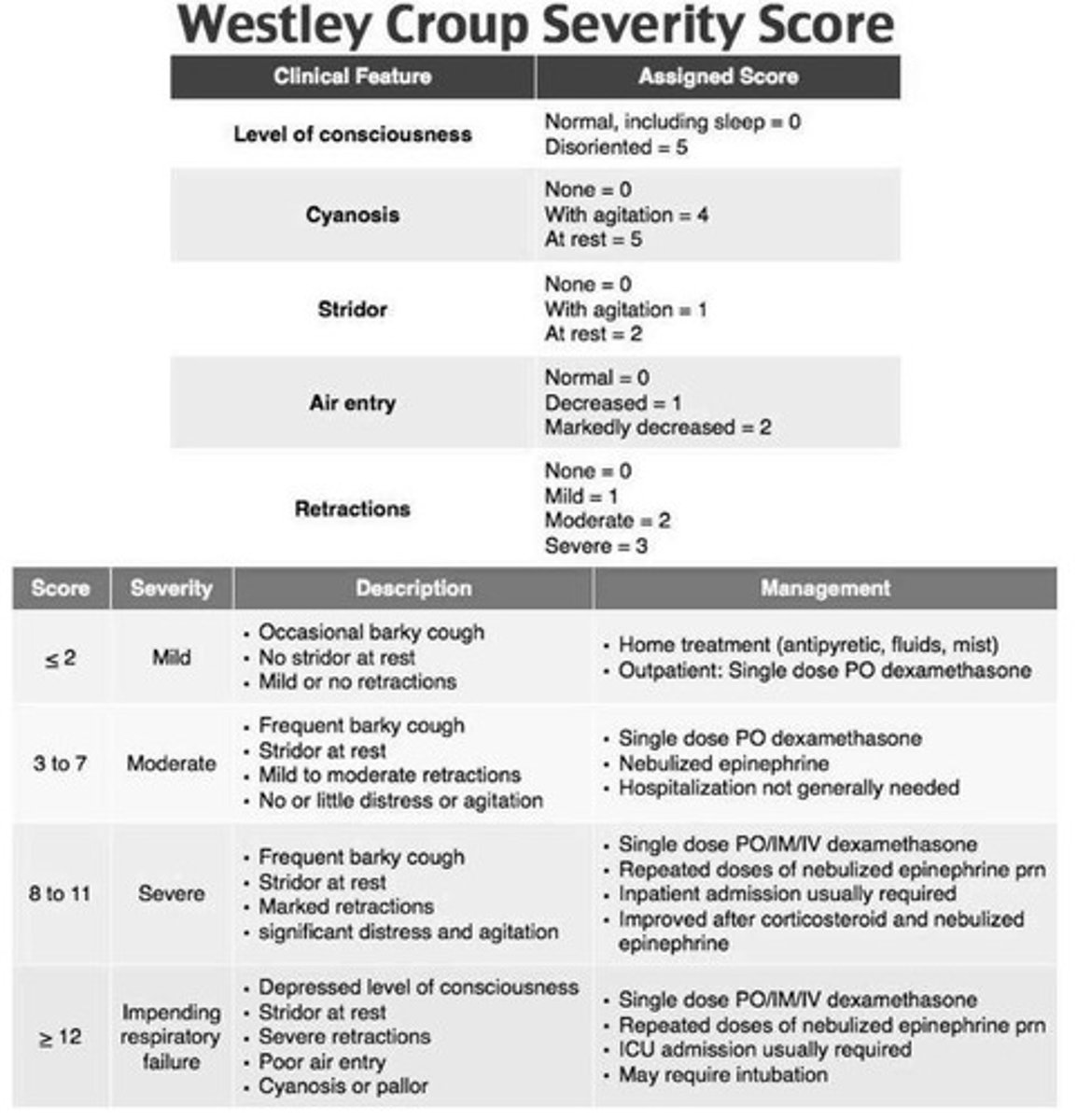
What score indicates mild croup severity on the Westley Croup Severity Score?
A score of ≤2.
What treatment is recommended for mild croup?
Home treatment with antipyretics, fluids, and mist.
What is the recommended treatment for moderate croup?
Single dose of oral dexamethasone and nebulized epinephrine.
What indicates severe croup requiring hospitalization?
A score of 8 to 11 on the Westley Croup Severity Score.
What is the dose of dexamethasone for treating croup?
0.6 mg/kg.
What symptoms may worsen at night in croup patients?
Barking cough and inspiratory stridor.
What are the signs of impending respiratory failure in croup?
Severe retractions, poor air entry, cyanosis or pallor.
What is the typical dose of Dexamethasone for ICU admission?
0.6 mg/kg
What are the two species of bed bugs?
Cimex lectularius and Cimex hemipterus.
How long do bed bug eggs take to hatch?
4-12 days.
What is the lifespan of an adult bed bug?
6-12 months.
What are some clinical findings associated with autism?
Altered response to environmental stimuli, impaired social interaction, restricted repetitive behaviors, and communication deficits.
What are signs of child abuse?
Vague history not compatible with injury, delay in seeking care, soft tissue markings, and developmental delays.
What lead level indicates lead poisoning?
>5 mcg/dl.
What are some symptoms of lead poisoning?
Vague GI symptoms, lethargy, difficulty walking, headaches, and bluish discoloration of the gingival border.
What are common neurologic disorder symptoms in children?
Developmental delays, abnormal head size, motor function issues, slurred speech, and seizures.
What are differential diagnoses associated with stridor?
Laryngotracheobronchitis, Croup, epiglottitis, bacterial tracheitis, inhaled foreign body, anaphylaxis, diphtheria.
What are the findings associated with asthma?
Persistent cough, exercise intolerance, prolonged expiratory phase, and high-pitched rhonchi.
What are the general treatments for asthma?
SABA (albuterol), LABA (salmeterol), and Anticholinergics (Ipratropium bromide).
What are common risk factors for fractures in children?
Most common in elbow and femur, open growth plates increase injury risk.
What is a Salter-Harris fracture?
A fracture unique to pediatrics that occurs in the growth plate of long bones.
What causes Nursemaid's elbow?
Swinging or pulling the child's arm, leading to radial head subluxation.
What are the three grades of sprains?
Grade 1: stretching, no tearing; Grade 2: partial tearing; Grade 3: complete tearing.
What are the symptoms of a Grade 1 sprain?
Local tenderness, minimal edema, and no joint instability.
What are the symptoms of a Grade 2 sprain?
Localized edema, significant pain with weight bearing, and some joint instability.
What are the symptoms of a Grade 3 sprain?
Severe pain, significant edema, joint instability, and inability to bear weight.
What initial treatment is recommended for sprains?
RICE: Rest, Ice, Compression, and Elevation.
What are some treatment options for sprains?
Pain medicines (ibuprofen), activity restrictions, splints, physical therapy, and surgery if necessary.
Who is most susceptible to sprains?
Active teens who play sports and engage in activities involving pivoting or falling.