Cell Physiology Lecture 2 - Cell Transport
 Call Kai
 Learn
Learn Practice Test
 Spaced Repetition
 Match
Match Flashcards
 Knowt Play
1/45

There's no tags or description
Looks like no tags are added yet.
Name | Mastery | Learn | Test | Matching | Spaced | Call with Kai | Chat |
|---|
No analytics yet
Send a link to your students to track their progress
46 Terms
Vesicular Transport
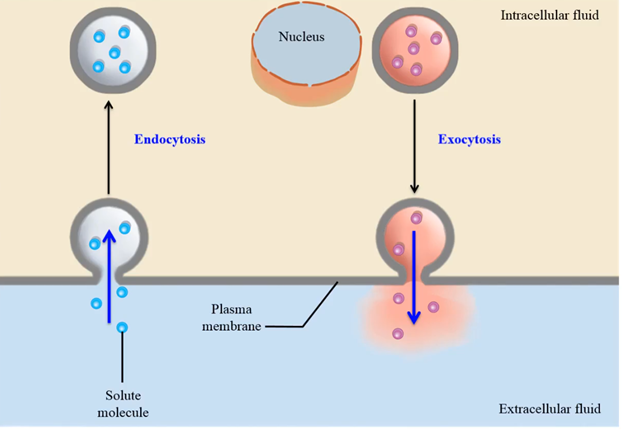
Transport that uses vesicles to move substances across biological membranes. Includes endocytosis and exocytosis
Endocytosis
Uptake of material into cells using vesicles that contain material that pinch off from the plasma membrane and enter the cytoplasm of the cell
3 types of endocytosis
Phagocytosis, Pinocytosis, Receptor-mediated endocytosis
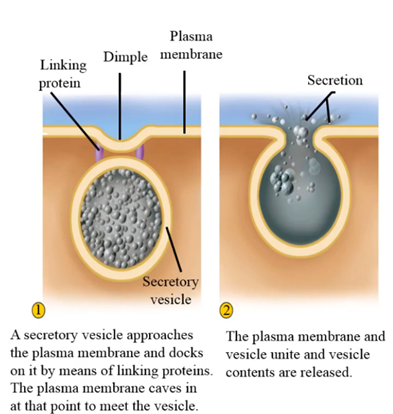
Exocytosis
Release of material from the cell using vesicles containing material that fuse with the plasma membrane and release their contents into the extracellular fluid
Endocytosis vs. Exocytosis
Endocytosis - materials brought into the cell using vesicles
Exocytosis - materials are released from the cell using vesicles
Phagocytosis
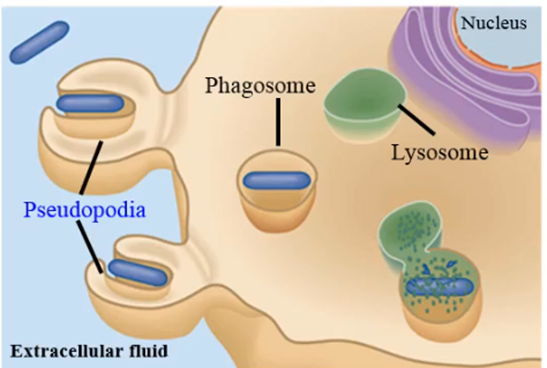
Cell eating - pseudopdia surround material being brought into cells
Used to bring large particles into cell, such as bacteria or cell debris
Processed used by WBCs and Macrophages
Pinocytosis
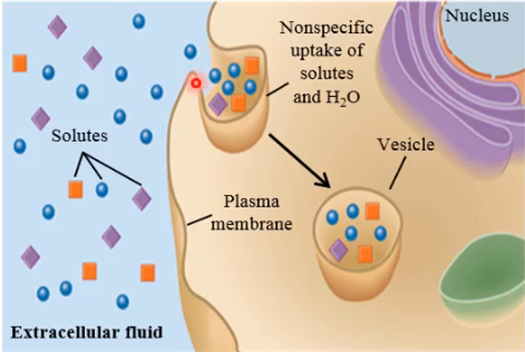
Cell drinking - plasma membrane indents below particles to bring them into cell (no psuedopodia)
Non-specific - engulfs in the ECF and all solutes
Used to ingest small molecules
Steps of Phagocytosis
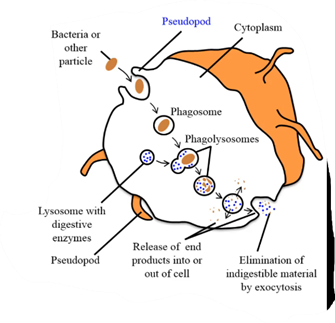
Recognition of substance to be ingested on surface membrane
Attachment of phagocyte to substance to be ingested
Pseudopodia reach around substance to form a phagosome
Fusion of phagosome to lysosome to form a phagolysosome
Destruction of ingested substance by lysosomal enzymes
Release of end products into the cell or out of the cell via exocytosis
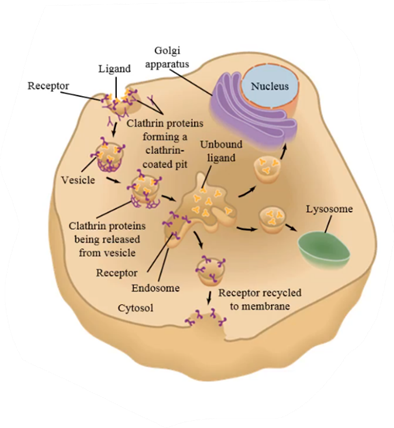
Receptor-mediated endocytosis
Phagocytosis that involves binding specific ligands to be brought into the cell. Requires the use of clathrin coated pits
Steps of receptor-mediated endocytosis
Extracellular molecules bind to receptors on plasma membrane; receptors cluster together
Plasma membrane sinks inward, forming clathrin coated pit
Pit separates from the plasma membrane to form a clathrin-coated vesicle. Vesicle contains concentrated molecules from the ECF
Clathrin is released from the vesicle and is recycled back to the membrane
Vesicle will then travel to specific organelles ot be modified, processed, or released back out of the cell
Exocytosis functions
Secrete specifc substances
Release waste products
Add components of the membrane (lipids/proteins) to the plasma membrane when the vesicles fuse with the membrane
Driving forces for non-vesicular transport
Chemical, electrical, electrochemical
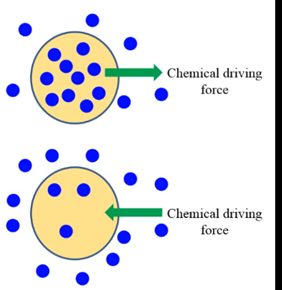
Chemical driving force
Molecules will move passively down their chemical concentration gradient
As the size of the gradient increases, the rate of transport of the substance increase
Electrical Driving force
Membrane potential is a difference in electrical potential or voltage across a cell membrane. Charged molecules will move to an area with a higher concentration of the opposite charge
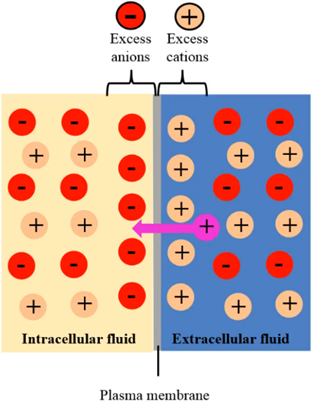
Example of a seperation of charge
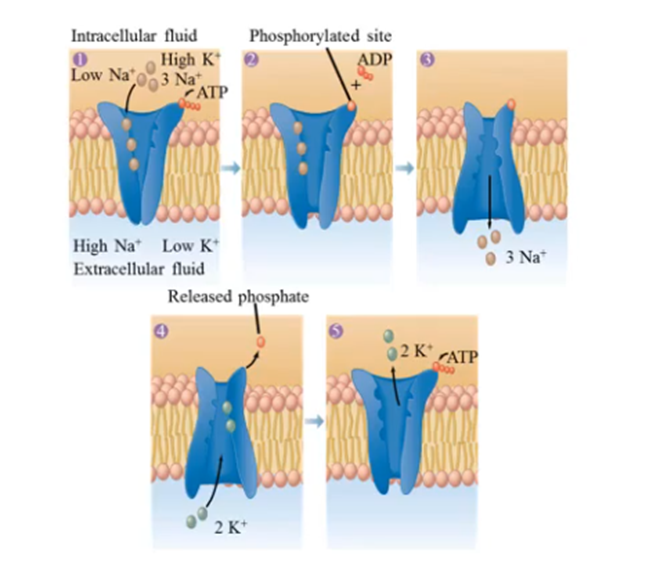
Na+/K+ pump. - 3 Na+ move out of the cell, 2 K+ move into the cell
Electrochemical driving force
Sum of the electrical and chemical driving forces acting on an ion
If a chemical and electrical driving force push the ion in different directions, the electrochemical driving force is the sum
Electrochemical driving force depends on the net direction of the driving forces
Simple diffusion
Passive movement of molecules through a lipid bilayer. Does not require the input of energy. Molecules move from an area of high concentration to low concentration (down the concentration gradient)
Factors that affect how well a substance crosses the bilayer
Solubility (polar or non-polar?)
Size (smaller moves easier)
Charge (ions do not move by simple diffusion)
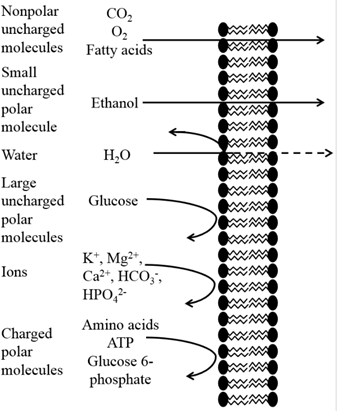
What substances will move by simple diffusion?
Small, non-polar uncharged
Small molecules that are polar and uncharged may pass via SD
What substances will not move by simple diffusion?
Large particles
Charged particles
Factors that influence the rate of simple diffusion
Magnitude of the driving force - greater concentration difference = greater rate of SD
Membrane SA - more SA of membrane = greater rate of SD
Membrane Permeability - higher permeability = more difusion. Depends on (ranked)
Lipid solubility of diffusing substance (non-polar = more diffusion)
Size and shape of diffusing substance (small regular shapes = more diffusion)
Temperature (higher Temp = more diffusion)
Diffusing distance (smaller distance = faster diffusion)
Osmosis
Passive movement of water across a selectively permeable membrane driven by a difference in solute concentration
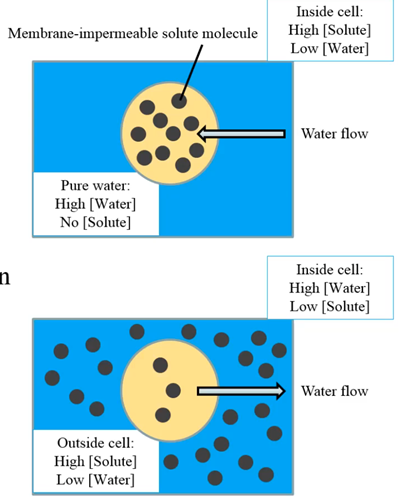
Which way does water flow
From an area of low solute concentration to an area of high solute concentration
Can water move via simple diffusion?
Yes. Water is a small, polar molecule
Aquaporins
Water channels on the plasma membrane
Carrier-mediated facilitated diffusion
passive movement of molecules across a membrane via carrier transport proteins which have a specific binding site for the substance being transported
How does carrier mediated facilitated diffusion work?
Specific molecules bind to the transporter protein binding sites, causing a conformational change in the protein to expose the molecule to the other side of a membrane
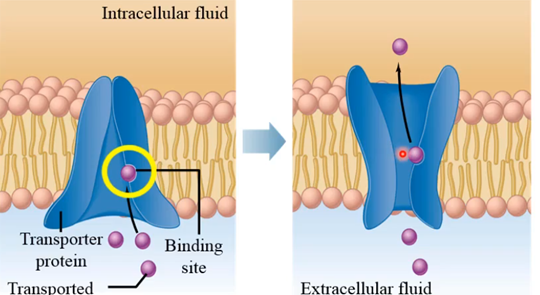
Example of a transporter protein
GLUT proteins - move glucose down the concentration gradient
Glucose is nonpolar and uncharged, but is too big for simple diffusion
Channel-mediated facilitated diffusion
Passive movement of a molecule down its gradient via protein channels. Protein channels are specific
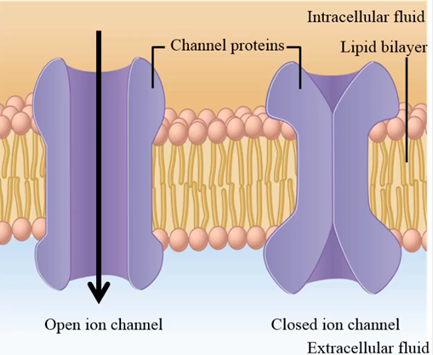
Gating of ion channels
Opening (activation) or closing (deactivation) of ion channels. Gating is the process of the ion channel transforming between conducting and non-conductive states
Types of gates for protein channels
Voltage gated - change in voltage opens/closes channels
Ligand gated - binding of ligand to binding site opens/closes channels
Mechanically gated - stretching or swelling of cell opens/closes channels
Mediated transport
The use of a protein to cross the cell membrane
2 forms of mediated transport
Facilitated diffusion and active transport
Active transport
The movement of molecules against their electrochemical/concentration gradient. Requires an energy input. The proteins that facilitate this transport are called pumps
Primary active transport
ATP hydrolysis is the energy source used to drive actin transport
ATP —> ADP + Pi + energy
Example of primary active tranpsort
Na+/K+ pump (Na+/K+ ATPase)
Steps of the Na+/K+ pump
Na+/K+ pump moves 3Na+ ions out of the cell and 2K+ ions into the cell for every molecule of ATP hydrolyzed
Both molecules go against their concentration gradient
Protein is activated by phosphorylation (non-covalent modification)
Functions of the Na+/K+ pump
Establishes and Maintains membrane potential of the cell
Maintains Na+ and K+ concentration gradients
Secondary active transport
Couples movement of an ion down it’s electrochemical gradient with a substance moving up it’s gradient
Examples of secondary active transport
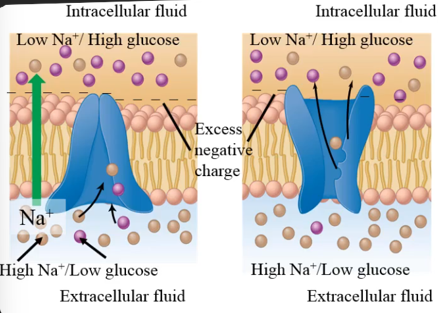
Na+/glucose symporter, and the Na+/H+ antiporter
Na+/glucose symporter steps
Sodium moves down its chemical gradient, moving into the cell
Glucose transport is coupled , moving into the cell up its concentration gradient
Movement is electrogenic (positive charge movement into the cell)
Na+/H+ antiporter steps
Sodium moves down its chemical gradient, moving into the cell
Proton transport is coupled, moving out of the cell down it’s concentration gradient
Movement is electroneutral (no net charge movement
Symport vs. Antiport
Symport - transport protein moves both molecules in/out of the cell
Antiport - transport protein moves one molecule into the cell, and the other molecule out of the cell
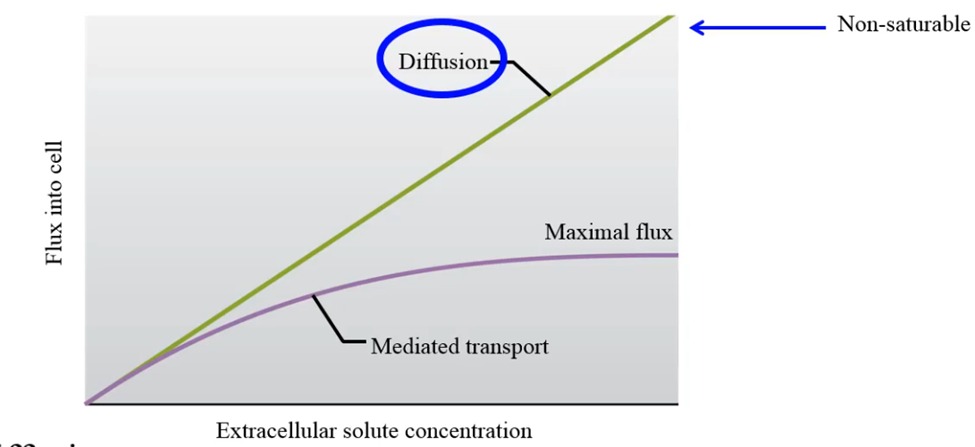
Transport Rate of Diffusion
Unsaturable transport process - no maximum filled binding sites because there is no binding sites
Flux is proportional to solute concentration
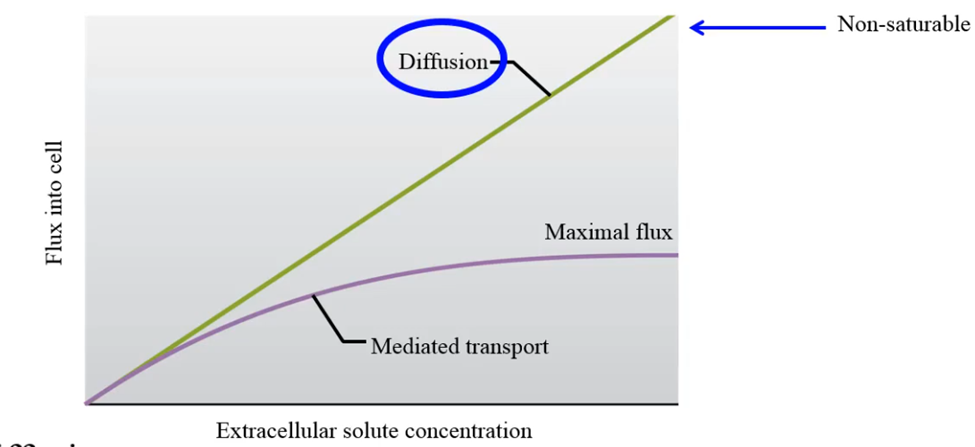
Transport Rate of Mediated Transport
Saturable transprot process - each cell has limited binding sites for a substance
Transport rate will plateau when all binding sites are saturated
Can you plateau a ion channel for maximum flux?
No. Not at physiological conditions