Exam 1-Micro
 Call Kai
 Learn
Learn Practice Test
 Spaced Repetition
 Match
Match Flashcards
 Knowt Play
 Podcast
1/155

Earn XP
Description and Tags
Lesson 1-10
Name | Mastery | Learn | Test | Matching | Spaced | Call with Kai | Chat |
|---|
No analytics yet
Send a link to your students to track their progress
156 Terms
What are Antoni Van Leeuwenhoek contributions of to the field of microbiology?
Often considered the “father of microbiology” for his discovery of bacteria, animalcules(tiny animals), which were recognized as microorganisms in tiny droplets of water using a handheld microscope.
What are the 6 groups of microorganisms?
bacteria, viruses, fungi, protozoa, algae, and helminths
Characteristics of Bacteria
unicellular, prokaryotic, much smaller than eukaryotic cells, found in moist environments, reproduce asexually, cell walls made of peptidoglycan, some completely lack cell walls
Characteristics of Archaea
unicellular, prokaryotic, much smaller than eukaryotic cells, found in moist environments, reproduce asexually, cell walls made of different polymer (not peptidoglycan),many live in extreme environments
Characteristics of Fungi
eukaryotic(membrane bound nucleus), heterotrophic(obtain food from other organisms), cell wall made of chitin.
Characteristics of Protozoa
single-celled eukaryotes, lack cell walls, animal-like nutrient needs and structure, and live freely in water/outside animal host
Characteristics of Algae
vary widely in size, shape, pigment, and structure, they are unicellular or multicellular, use photosynthesis for energy, have simple reproductive structures and are classified based on pigment and cell wall composition
What are Helminths?
Eukaryotic organisms like worms and parasites
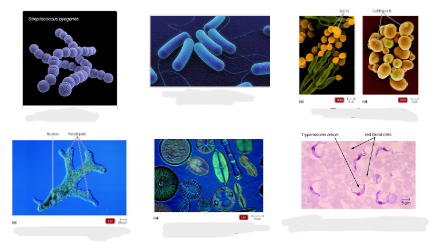
Identify each group of microorganisms

What are the 2 types of fungi and there characteristics?
Yeasts are unicellular and reproduce asexually by budding, while molds are multicellular and reproduce by sexual and asexual spores and have filamentous structures called hyphae.
Difference between procaryotic and eukaryotic microorganisms?
Prokaryotic microorganisms lack a nucleus and are smaller, whereas eukaryotic microorganisms have a defined nucleus and are larger.
What is the monomers and type of bond of Carbohydrates?
monosaccharides joined by glycosidic bond
What is the monomers and type of bond of Proteins?
amino acids linked by peptide bond
What is the monomers and type of bond of Nucleic acids?
nucleotides linked by phosphodiester bond
What is the monomers and type of bond of Lipids?
fatty acids and glycerol connected by ester bond
Define biological macromolcles?
large molecules that are built from smaller organic molecules.
What is the difference between dehydration synthesis and hydrolysis?
Dehydration synthesis is a chemical reaction that involves the removal of water to form bonds between monomers, whereas hydrolysis is the process where water is added to break hydrogen bonds between monomers.
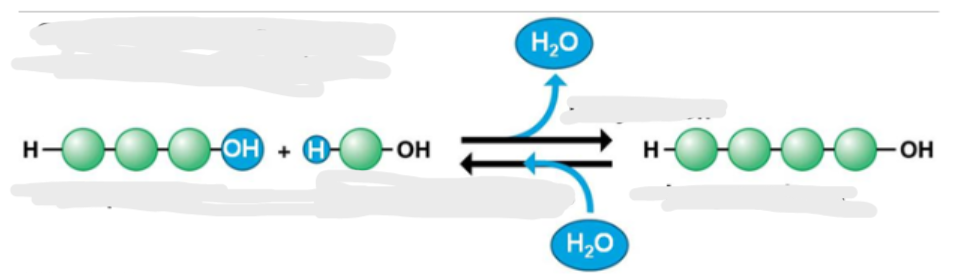
Label the following parts of the reaction
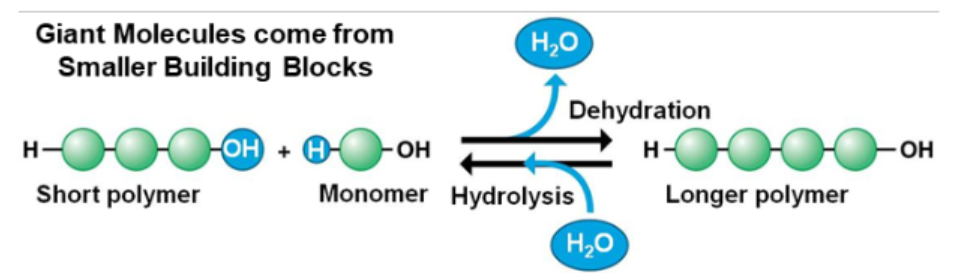
What are is a functional group?
a small group of atoms within a molecule that have characteristic properties and chemical reactivity, which dictate the behavior of the entire molecule in chemical reactions. Functional groups determine molecular properties.

Identify the functional group of the structure
Hydroxyl

Identify the functional group of the structure
Ether

Identify the functional group of the structure
Ketone

Identify the functional group of the structure
Aldehyde
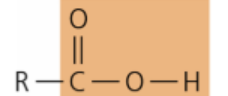
Identify the functional group of the structure
Carboxyl

Identify the functional group of the structure
Amino

Identify the functional group of the structure
Ester

Identify the functional group of the structure
Sulfhydryl

Identify the functional group of the structure
Organic Phosphate
What are the functions of carbohydrates?
energy source, structural component, reserve food
What is the basic structure of a carbohydrate?
composed of carbon, hydrogen, and oxygen in a ratio of approximately 1:2:1

What kind of macromolecule is this?
glucose(carbohydrate)

What is the difference between Alpha and Beta glucose?
Alpha glucose has a hydroxyl group(OH) on the first carbon atom oriented downward, while beta glucose has it oriented upward. This structural difference affects how these molecules bond and their biological roles.
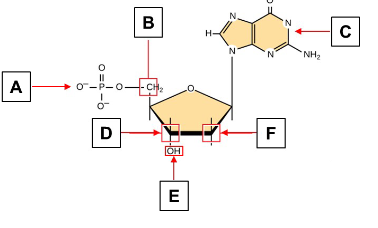
What kind of macromolecule is this? Label and draw it!
nucleic acid.
A. phosphate group
B. 5’ carbon
C. nitrogenous base
D. 3’ carbon
E. hydroxyl group
F. 2’ carbon
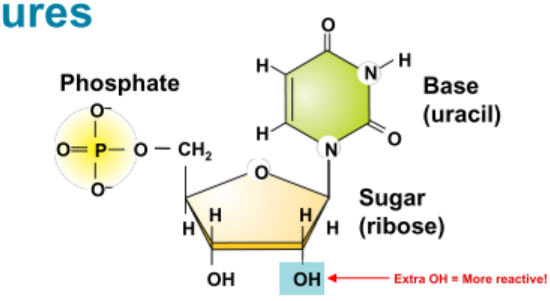
What kind of molecule is this?
RNA
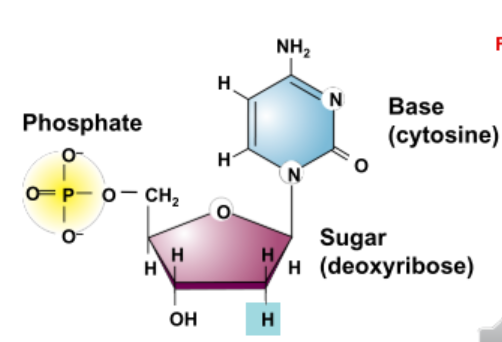
What kind of molecule is this?
DNA
How to tell the difference between DNA and RNA molecule?
RNA has a hydroxyl group(OH) on the 2’ carbon of the ribose sugar, whereas DNA has a hydrogen atom (H) at that position.
Why is the phosphate functional group critical in biological molecules like ATP and
phospholipids?
The phosphate group stores and transfers energy through high-energy bonds, crucial for cellular functions, and provides structural integrity to phospholipid bilayers in cell membranes.
What is the function of nucleic acids?
responsible for storage, expression, and transmission of genetic material (DNA/RNA)
What are nucleotides composed of?
a nitrogenous base, a five-carbon sugar (ribose or deoxyribose), and one or more phosphate groups.
Differences between DNA and RNA?
DNA is double-stranded, stores genetic information, while RNA is single-stranded and plays a role in protein synthesis, gene expression, and acts as enzyme.
Monosaccharides can exist in both linear and ring forms. In aqueous solutions, such as inside cells or in biological fluids, monosaccharides predominantly exist in the cyclic (ring) form. How does the ring structure of fructose differ from that of glucose in aqueous solutions?
Fructose forms a five-membered ring, while glucose forms a six-membered ring
A pentose sugar is a carbohydrate that contains five carbon atoms. Why is the pentose sugar in nucleotides critical to the structure of nucleic acids?
The pentose sugar (ribose in RNA and deoxyribose in DNA) is a key component of the nucleotide that links to both the phosphate group and the nitrogenous base, forming the backbone of the nucleic acid and determining its structural properties and stability.
Blank is the main short-term/limited energy supply that releases energy when there phosphate bonds are broken.
ATP(Adenosine Triphosphate)
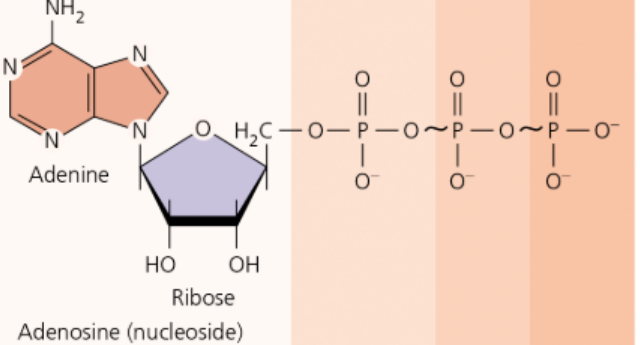
Identify AMP(Adenosine Monophosphate), ADP(Adenosine Diphosphate), and ATP(Adenosine Triphosphate).
AMP, 2.ADP, 3.ATP
Draw a hydrogen bond between 2 water molecules?

Define matter? What are the 2 elements properties of matter?
anything that has mass and occupies space. 2 element properties are chemical(determines reactivity, bonding, role in biological processes) and physical(determines state, density, boiling point)

What type of reaction is this?
Dehydration Synthesis

What type of reaction is this?
Hydrolysis/Decomposition

What type of reaction is this?
Exchange
Atomic number
is the number of protons in the nucleus of an atom, determining the element's identity and its position on the periodic table.

Isotopes
are atoms of the same element with the same number of protons but different numbers of neutrons, resulting in different atomic masses.
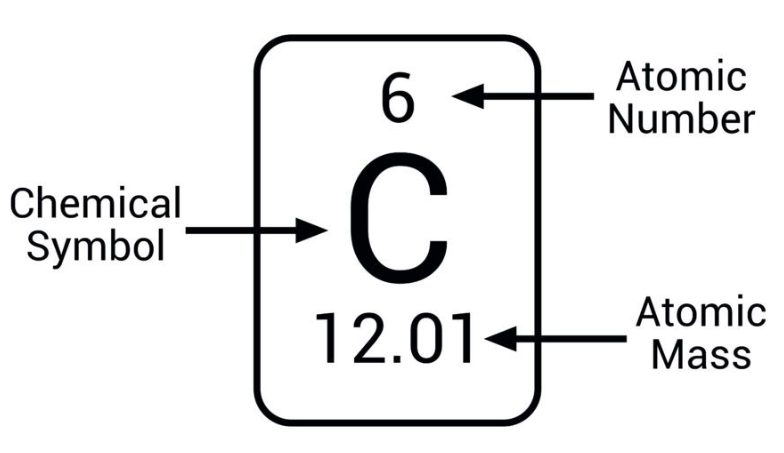
How to find the number of neutrons?
atomic mass-atomic number
What does the Bohr model state?
that electrons orbit the nucleus in fixed paths or energy levels and that energy is absorbed or emitted when an electron jumps between these levels. (2,8,16)
Francesco Redi was one of the first scientist to challenge Aristotle’’s theory of spontaneous generation. Instead he hypothesized that life come from life. What experiment helped prove his findings?
The meat and flies experiment, where he placed meat in jars and observed that maggots only appeared in jars exposed to flies, demonstrated that life does not arise spontaneously.
Which of the following best describes the challenges and steps involved in applying Koch's postulates to establish SARS-CoV-2 as the causative agent of COVID-19?
Isolating and growing the virus in pure culture, showing it's present in all cases of the disease, causing the disease in a healthy host, and re-isolating the virus from the newly infected host.
Which of the following compounds is an example of an ionic compound
sodium chloride (NaCl)
Consider the following molecules: H2O, CO2, NH3, and CH4. Which molecule would exhibit the greatest difference in electronegativity between its constituent atoms?
H20
John Needham came after Francesco Redi and supported Aristoles’s view that microbes could arise from nonliving matter through what experiment?
He conducted experiments with boiling beef broth for 10 minutes, then sealed the flasks with corks, which he claimed became cloudy with microbes after being exposed to air, suggesting spontaneous generation.
Lazzaro Spallanzani came after John Needham and found strong evidence against spontaneous generation through which experiment? What did critics say about this experiment?
He boiled broth for longer than sealed the flasks, observing that they remained clear unless opened. Critics argued that extensive heat destroyed the life force.
How did Louis Pasteur contribute to the idea of spontaneous generation in microbiology?
He disproved spontaneous generation by demonstrating that microorganisms in air contaminated sterile solutions. His swan-neck flask experiment showed that if flasks were sealed, no microbial growth occurred, supporting biogenesis.
How did Louis Pasteur contribute to the idea of fermentation in microbiology?
He identified that yeasts were responsible for fermentation and that specific microbes were essential for producing alcohol. His work led to the development of pasteurization to eliminate unwanted microbes.
What was the germ theory of disease proposed by Pasteur?
that specific microorganism cause specific diseases and that these pathogens are disease causing microbes
What are the 5 steps of the scientific method described?
1) Observation= notice something unusual
2) Question= ask a specific question based on observation
3) Hypothesis= propose a testable explanation
4) Experiment= test hypothesis through controlled experiment
5) Analyze results= support hypothesis(strengths argument), reject hypothesis(needs to be revised/abandoned)
What is the difference between a hypothesis and a theory?
A hypothesis is a testable prediction about the relationship between variables, whereas a theory is a well-substantiated explanation of an aspect of the natural world, supported by a body of evidence and multiple tests.

What are 3 ways that protozoa move explained?
A. flagella= few long-whip like tails for propulsion
B. pseudopodia=flowing extensions of cytoplasm(crawling movement with false feet)
C. cilia= many short hair-like structures for swimming
Aristotle strongly support blank theory of life?
the spontaneous generation meaning life could arise directly from nonliving materials.
How did Robert Koch contribute to the field of microbiology?
Developed simple staining techniques, got the 1st photo off bacteria, created the 1st photomicrograph, and popularized the petri dish.
What are the 4 steps to Koch’s Postulates?(Think, “Ashlyn is cooking ribs”)
Association=The microorganism must be found in abundance in all organisms suffering from the disease, but should not be found in healthy organisms.
Isolation=The microorganism must be isolated from a diseased organism and grown in pure culture.
Causation= The cultured microorganism should cause disease when introduced into a healthy organism.
Re-isolation= The microorganism must be re-isolated from the newly diseased host and compared to the original organism.
Blank is the ability of an atom to bond with other based on how many electrons are available.
valency
In blank the atom has electrons to give up
In blank the atom need electrons to fill its shell
Positive and Negative
In blank atoms join by sharing or transferring valence electrons that form molecules and compounds?
Chemical bonding
What is the difference between a molecule and a compound?
A molecule is a group of two or more atoms bonded together, while a compound specifically refers to a molecule that contains at least two different elements.
What is the difference between polar and non-polar covalent bonding? What is the range of electronegativity difference?
Polar covalent bonding involves unequal sharing of electrons because of unequal atomic pulls 0.0-0.4 electronegativity difference on the Pauling scale, whereas non-polar covalent bonding features equal sharing of electrons due to similar atomic pulls, 0.5-1.9 electronegativity difference on the Pauling scale
What is the difference between covalent and ionic bonding?
Covalent bonding involves the sharing of valence electrons between atoms, while ionic bonding involves the transfer of electrons from one atom to another, resulting in the formation of charged ions.
What is the electronegativity difference between atoms of ionic bonds?
Ionic bonds typically involve a high electronegativity difference, generally greater than 2.0 on the Pauling scale, leading to electron transfer and the formation of ions

Ionic bonds create Cations and Anions what are these salts charges?
Cations are positively charged ions formed when metals loses one or more electrons, while anions are negatively charged ions created when nonmetals gains electrons. Together, they form ionic compounds, commonly known as salts(sodium cholride NaCl)
The density of ice is blank than the density of liquid water?
less, that’s why ice floats
What are hydrogen bonds?
Weak electrostatic attractions between a partially positive hydrogen and a partially/fully negative atom. These interactions are crucial in determining the properties of water and the structures of proteins and nucleic acids.
What are the properties of water?
polar molecule that forms hydrogen bonds given its high cohesion and surface tension, its a universal solvent, and stabilizes temp in organisms/ecosystems.
What are the 4 major types of reactions with example?
synthesis: A+B = AB
decomposition: AB = A+B
single replacement: AB+C = AC+B
double replacement: AB+CD = AD+CB
Explain the role of buffers relative to PH change
resist sudden change function by maintaining a stable pH level in a solution, helping to neutralize small amount of acids and bases.
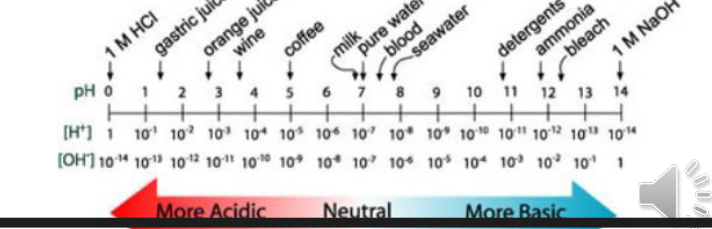
As H+ increase what happen to PH?
pH decreases, becoming more acidic.
How is the concentration of H+ ions in a solution expressed? *don’t need to know equation just how to use it.
on a logarithmic scale(PH= -log [+H]), meaning a change in one Ph unit represents a tenfold(10x, 100x, 1000x) change in H+ concentration.
What are salts(electrolytes)?
compounds that dissociate in water into cation and anions other than H+ or OH+ they can conduct electricity and play crucial roles in biological functions.
Blank donate protons, which increases H+
Blank accept protons, which increases OH+
Acids, Bases
As energy blank, temp increases because molecules are moving faster this is how water changes states of matter.
increases with heat
PH scale

Which of the following best describes the image
Two water molecules dissociating into hydronium and hydroxide ions
Which of the following is the closest approximation to the hydrogen ion concentration [H+] of standard table vinegar with a pH of 2.8?
1 x 10^-3 M
Compare protons, neutrons, and electrons?
Protons=positively charged particles, in the nucleus mass of 1AMU, neutrons= neutral particles, in the nucleus, mass of 1 AMU, and electrons= negatively charged particles, orbiting around the nucleus, no mass
Define etiology
the study of the exact causes, origins, or causative agents of infectious diseases.
Define metabolism
the totals set of all chemical reactions that happen inside a microbe to keep it alive.
Compare cohesion and adhesion?
Cohesion=water molecules stick to each other, caused by hydrogen bonding, and create surface tension.
Adhesion= water molecules stick to other surfaces, especially polar/charged ones
What is the smallest unit of matter that retains the chemical identity of an element?
atoms
Define electronegativity
how strongly an atom pulls electrons toward itself(higher electronegativity=stronger pull). It increases as you go up and right on the periodic tabel.
What is the amount of energy needed to raise the temp of 1 gram of a substance by 1 degrees C?
Specific heat capacity
What is an exchange reaction?
breaking and forming covalent bonds may include endothermic and exothermic steps.
Blank is a bond between the amino group of one atom and the carboxyl group of an adjacent amino acid(links amino acids together to form a protein)?
Peptide bond
Blank bonds play a key role in protein secondary structure by forming alpha helicase and beta sheets?
hydrogen bonds