Genetics chapter 2 Chromosomes and cellular reproduction
 Call Kai
 Learn
Learn Practice Test
 Spaced Repetition
 Match
Match Flashcards
 Knowt Play
1/53

There's no tags or description
Looks like no tags are added yet.
Name | Mastery | Learn | Test | Matching | Spaced | Call with Kai | Chat |
|---|
No analytics yet
Send a link to your students to track their progress
54 Terms
Prokaryotic cells reproduce via what?
Binary fission
What is binary fission
The simple process where the single, circular DNA molecule replicates, and the cell divides into two identical daughter cells.
Eukaryotic DNA is complexed with histone proteins and is enclosed within what?
A nuclear envelope
Sexual reproduction, as described in the context of eukaryotes, involves the fusion of gametes produced via what?
Meiosis
What domains do prokaryotes belong to
Eubacteria and Archaea
Cell structure of prokaryotes?
Lack membrane-bound organelles and a nucleus.
What cell structures do prokaryotes typically have
Cell wall, plasma membrane, ribosomes, and a single circular DNA molecule
What does the DNA of prokaryotes look like?
The DNA is not highly organized and is not complexed with histones.
Where does the DNA of prokaryotes reside?
The nucleoid
Cell structure of eukaryotes?
They are larger than prokaryotic cells and possess membrane-bound organelles, including a nucleus
What does the DNA of eukaryotes look like?
It is organized into multiple linear chromosomes.
In Eukaryotes, each chromosome consists of DNA tightly associated with what?
Histone proteins, which forms chromatin
The DNA of eukaryotes is enclosed within what?
Nuclear envelope
Haploid (n)
Contains one set of genetic information
Diploid (2n)
Contains two sets of genetic information, one set inherited from each parent
Homologous pairs
occurs in diploid organisms where 2 chromosomes correspond to each other. One inherited from each parent that carry the same genes but may have different alleles
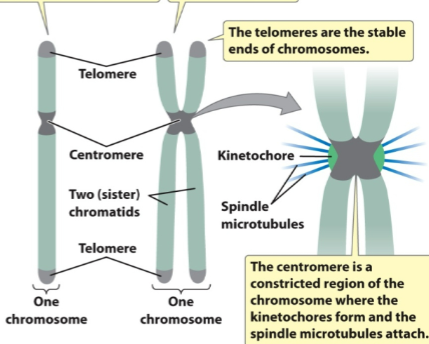
What is the centromere of a chromosome?
A constricted region where kinetochores form, serving as attachment points for spindle microtubules
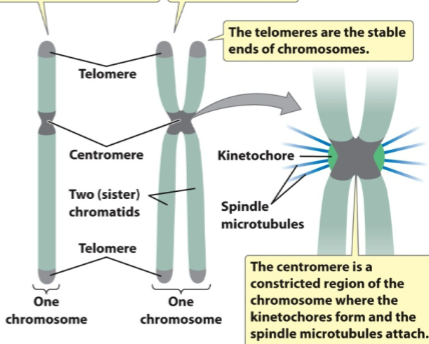
What are the telomeres of chromosomes
The stable tips of linear chromosomes
Origins of replication
Sites where DNA synthesis begins
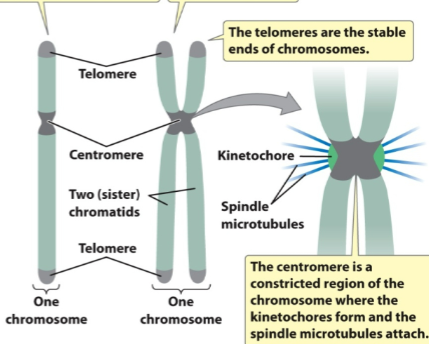
Chromatids
Before replication, a chromosome has one chromatid. After replication, it consists of two identical sister chromatids joined at the centromere

What type of chromosome is this?
Submetacentric

What type of chromosome is this?
Metacentric

What type of chromosome is this?
Telocentric

What type of chromosome is this?
Acrocentric
Phases of the Cell Cycle
Interphase → M phase → Phase checkpoints in between
Phases of interphase
G1 → S → G2
G1 of interphase
Growth occurs and proteins necessary for cell division are synthesized
G0 of interphase
occurs when cells exit the active cell cycle to enter a resting, non-dividing state. Cells enter this phase to conserve energy, complete specialized jobs, or respond to a lack of nutrients and signals
G1 / S checkpoint
key control point at the end of the G1 phase where a cell decides if it is ready to divide. It stops the cell cycle before DNA replication begins to prevent damaged cells from multiplying
S phase of interphase
a critical period in interphase where a cell replicates its entire genome. Occurring between the G1 and G2 phases, it ensures that each future daughter cell receives an identical, complete set of genetic material
G2 phase of interphase
The final subphase of interphase. Occurs after S phase and precedes mitosis. Cell continues to increase in size here and produces extra proteins, RNA, and duplicates remaining organelles needed for cell division.
G2 / M checkpoint
cellular quality control station located at the end of the G2 phase, right before mitosis (M phase). Its main job is to make sure DNA replication is complete and that any damaged DNA is fixed before the cell divides.
M phase
Consists of Mitosis and Cytokinesis and takes place after interphase
Mitosis
Separation of sister chromatids
Cytokinesis
Separation of cytoplasm; the cytoplasm divides and the cell wall forms in plant cells
What is the order of mitosis
Prophase → Prometaphase → Metaphase → Anaphase → Telophase
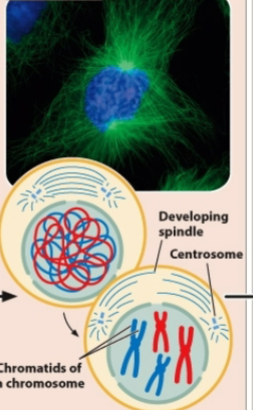
Prophase of mitosis
Chromosomes condense and the mitotic spindle forms
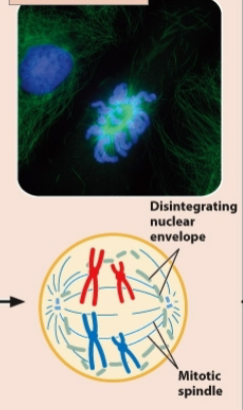
Prometaphase of mitosis
Nuclear envelope disintegrates and spindle microtubules anchor to kinetochores
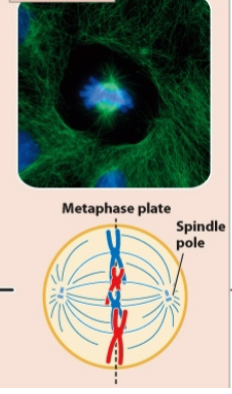
Metaphase of mitosis
Chromosomes align on the metaphase plate; spindle-assembly checkpoint
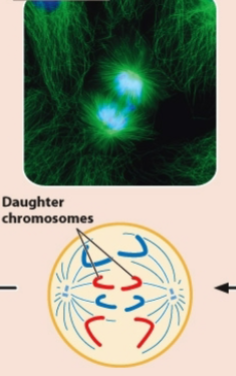
Anaphase of mitosis
Sister chromatids separate, becoming individual chromosomes that migrate toward spindle poles
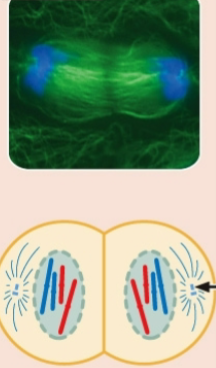
Telophase of mitosis
Chromosomes arrive at spindle poles, the nuclear envelope re-forms and the condensed chromosomes relax
Spindle microtubules are composed of what?
Tubulin Subunits
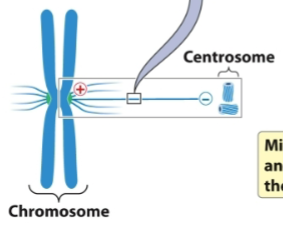
The positive end of spindle microtubules attach where
To the kinetochore at the centromere
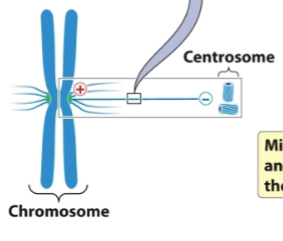
The negative end of microtubules attach where?
At the spindle pole in the centrosome
Tension along the microtubules allows for indication where?
At the checkpoints
Microtubules disassemble at both ends to do what?
To pull chromatids apart