3a. Muscle Contraction
 Call Kai
 Learn
Learn Practice Test
 Spaced Repetition
 Match
Match Flashcards
 Knowt Play
1/25

There's no tags or description
Looks like no tags are added yet.
Name | Mastery | Learn | Test | Matching | Spaced | Call with Kai | Chat |
|---|
No analytics yet
Send a link to your students to track their progress
26 Terms
Motor Unit
Functional unit of contractility; comprised of spinal nerves & cord, nerve fiber (axon), and the muscle fiber being innervated
Motor Neuron Pool
All motor neurons innervating a muscle; 1:1 muscle fiber to motor neuron ratio in mature animals, each neuron innervates multiple fibers
Slow twitch fibers
AKA: Type I
Fatigue resistant; high myoglobin count > red coloration, high mitochondria concentration, low glycogen concentration
Intermediate (Fast) Twitch
AKA Type IIa
Fatigue resistant, fewer myoglobin > pink coloration, highest mitochondrial concentration, high glycogen concentration
Fast Twitch
AKA Type IIb
Non-fatigue resistant, no myoglobin > white coloration, fewer mitochondria, high glycogen concentration
Which types of muscle fibers undergo oxidative metabolism?
Slow (I) and Intermediate (IIa) Twitch fibers
What type of metabolism do Fast Twitch muscle fibers undergo?
Glycolytic metabolism
What neurotransmitter is released during muscle contraction
Acetylcholine (ACh); increases membrane permeability to Na ions
As the AP spreads across the surface of the sarcolemma
AChE breaks down ACh, to begin repolarizing the cell
What causes the depolarization of muscle cells?
Opening of Ca-ion voltage gated channel
Where is Ca stored when not in use
The sarcoplasmic reticulum; when released induce contraction of sarcomere
Termination of Muscle Contraction
Na-Ca exchange, and Ca-ion pump out Ca ions
Ca pump sequesters Ca within sarcoplasmic reticulum
Ca is bound in the SR via calreticulin & calsequestin
What is the relationship between muscle size and duration of twitch responses?
The larger the muscle in mass, the longer the duration of the twitch response
Laten period
Time between peak contraction and start of relaxation
How many muscle cells needed to generate a twitch response?
1; single muscle cell produces single twitchT
Tetany
Sustained muscle contraction, due to uniform frequencies
Unfused tetany
Rapid, repetitive contractions with little relaxation between; due to reception of high, unfused frequencies
Fused tetany
Sustained contraction with little relaxation between; due to rapid, repetitive, fused frequencies
Spatial (recruitment) Summation
Multiple, presynaptic neurons release enough ACh to generate an AP
Temporal Summation
Singular neuron releases enough ACh to generate an AP
Isometric contraction
Constant length of muscle maintained, tension placed on fibers increased during activity
Isotonic contraction
Decrease in length when active; increase in upward velocity when baring constant weight
Slow waves
Rhythmic, spontaneous depolarizations (5–15 mV) of gastrointestinal smooth muscle cells that set the maximum frequency of contraction, known as the basic electrical rhythm (BER)
Generation of Slow Waves
Voltage-gated Ca-ion channels open
AP spike
Ca-ion influx, rise in ICM conc.
Ca-dependent K-channels open
Slow hyperpolarization
Ca-ion channels close, decreasing ICM conc.
Ca-dependent K-channes close
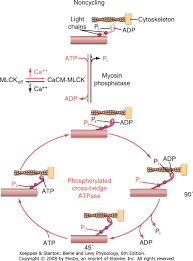
Cross Bridge cycling in Smooth Muscle
fundamental, repeating process of actin and myosin filaments interacting within muscle cells to produce contraction, using ATP for energy
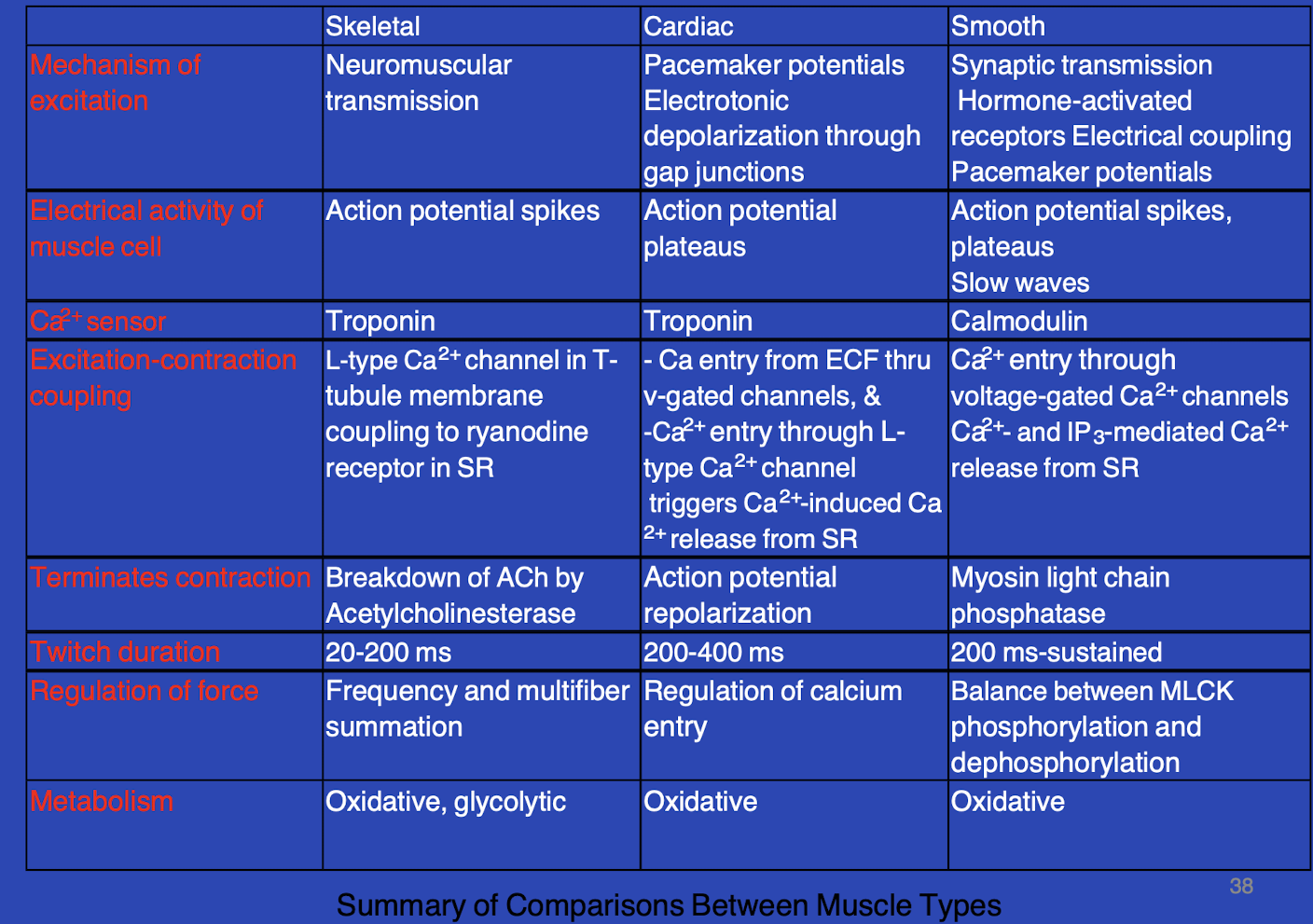
Summary of Comparisons