20. Homeostasis: Regulation of Intracellular Calcium

0.0(0)
studied byStudied by 0 people
0.0(0)
full-widthCall Kai
learnLearn
examPractice Test
spaced repetitionSpaced Repetition
heart puzzleMatch
flashcardsFlashcards
GameKnowt Play
Card Sorting

1/11

encourage image

There's no tags or description

Looks like no tags are added yet.

Study Analytics
Name
Mastery
Learn
Test
Matching
Spaced

No study sessions yet.

12 Terms

1
New cards

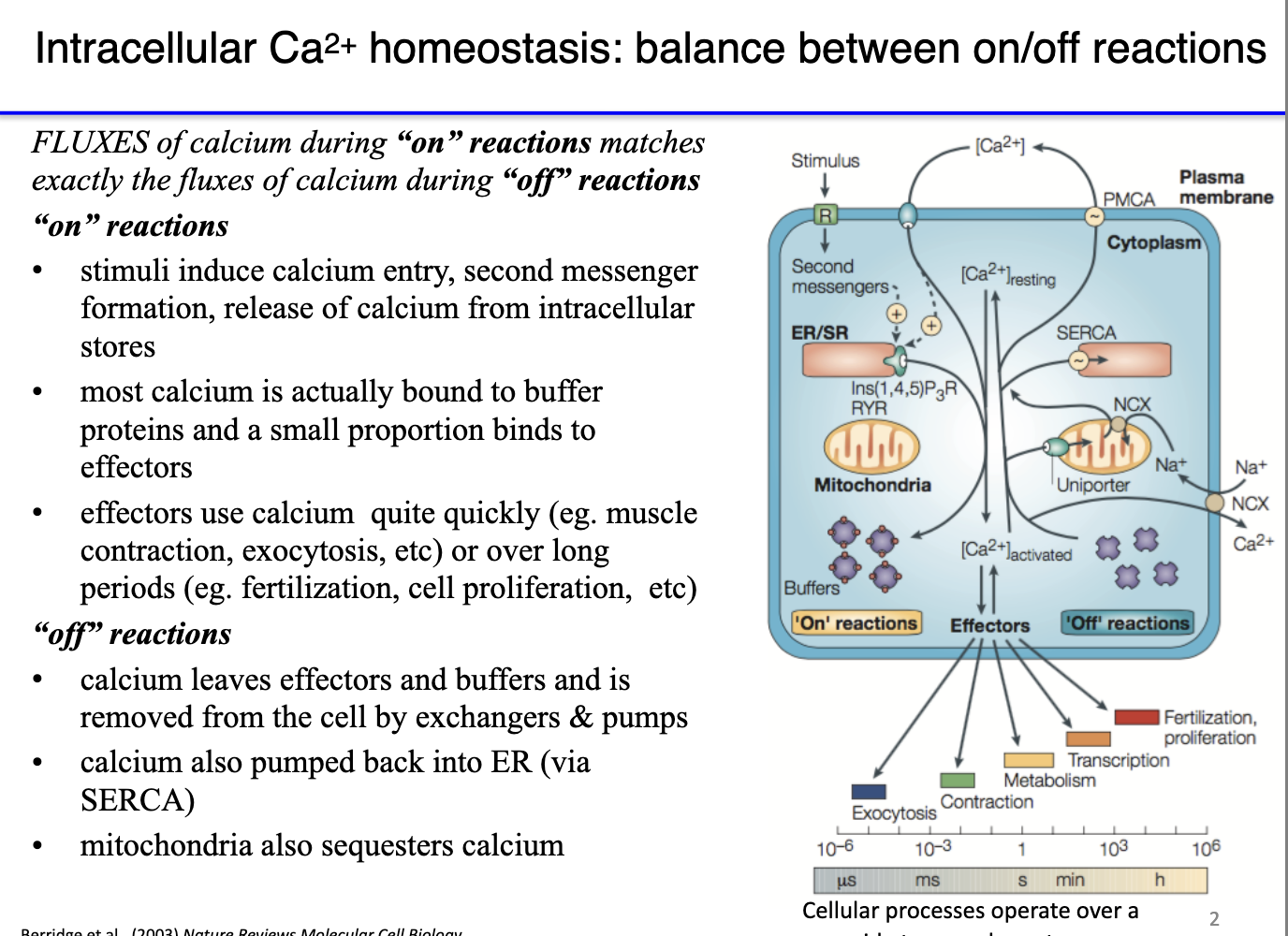
How does calcium function as an ON/OFF switch in muscle and other cells?

  • ON reaction: Ca²⁺ floods into cytoplasm → binds effector proteins (e.g., troponin) → exposes myosin binding sites → triggers contraction or other Ca²⁺-activated pathways.

  • OFF reaction: Ca²⁺ must be rapidly removed so it dissociates from effectors:

    • PMCA pumps Ca²⁺ out of the cell (ATP-dependent).

    • Na⁺/Ca²⁺ exchanger exports Ca²⁺ via secondary active transport.

    • SERCA returns Ca²⁺ to the SR.

  • Ca²⁺ is not degraded, only sequestered into compartments where it can’t activate proteins.

  • Muscle function depends on Ca²⁺ cycling: brief cytoplasmic spikes (ON) followed by rapid clearance (OFF).

  • This fast ON/OFF cycling enables repeated, coordinated contractions across whole muscles.
<ul><li><p class="isSelectedEnd"><strong><span>ON reaction:</span></strong><span> Ca²⁺ floods into cytoplasm → binds effector proteins (e.g., troponin) → exposes myosin binding sites → triggers contraction or other Ca²⁺-activated pathways.</span></p></li><li><p class="isSelectedEnd"><strong><span>OFF reaction:</span></strong><span> Ca²⁺ must be rapidly removed so it dissociates from effectors:</span></p><ul><li><p class="isSelectedEnd"><strong><span>PMCA</span></strong><span> pumps Ca²⁺ out of the cell (ATP-dependent).</span></p></li><li><p class="isSelectedEnd"><strong><span>Na⁺/Ca²⁺ exchanger</span></strong><span> exports Ca²⁺ via secondary active transport.</span></p></li><li><p class="isSelectedEnd"><strong><span>SERCA</span></strong><span> returns Ca²⁺ to the SR.</span></p></li></ul></li><li><p class="isSelectedEnd"><span>Ca²⁺ is </span><strong><span>not degraded</span></strong><span>, only </span><strong><span>sequestered</span></strong><span> into compartments where it can’t activate proteins.</span></p></li><li><p class="isSelectedEnd"><span>Muscle function depends on </span><strong><span>Ca²⁺ cycling</span></strong><span>: brief cytoplasmic spikes (ON) followed by rapid clearance (OFF).</span></p></li><li><p><span>This fast ON/OFF cycling enables </span><strong><span>repeated, coordinated contractions</span></strong><span> across whole muscles.</span></p></li></ul><p></p>
2
New cards

How does the mitochondrial calcium uniporter (MCU) complex regulate Ca²⁺ entry into the matrix?

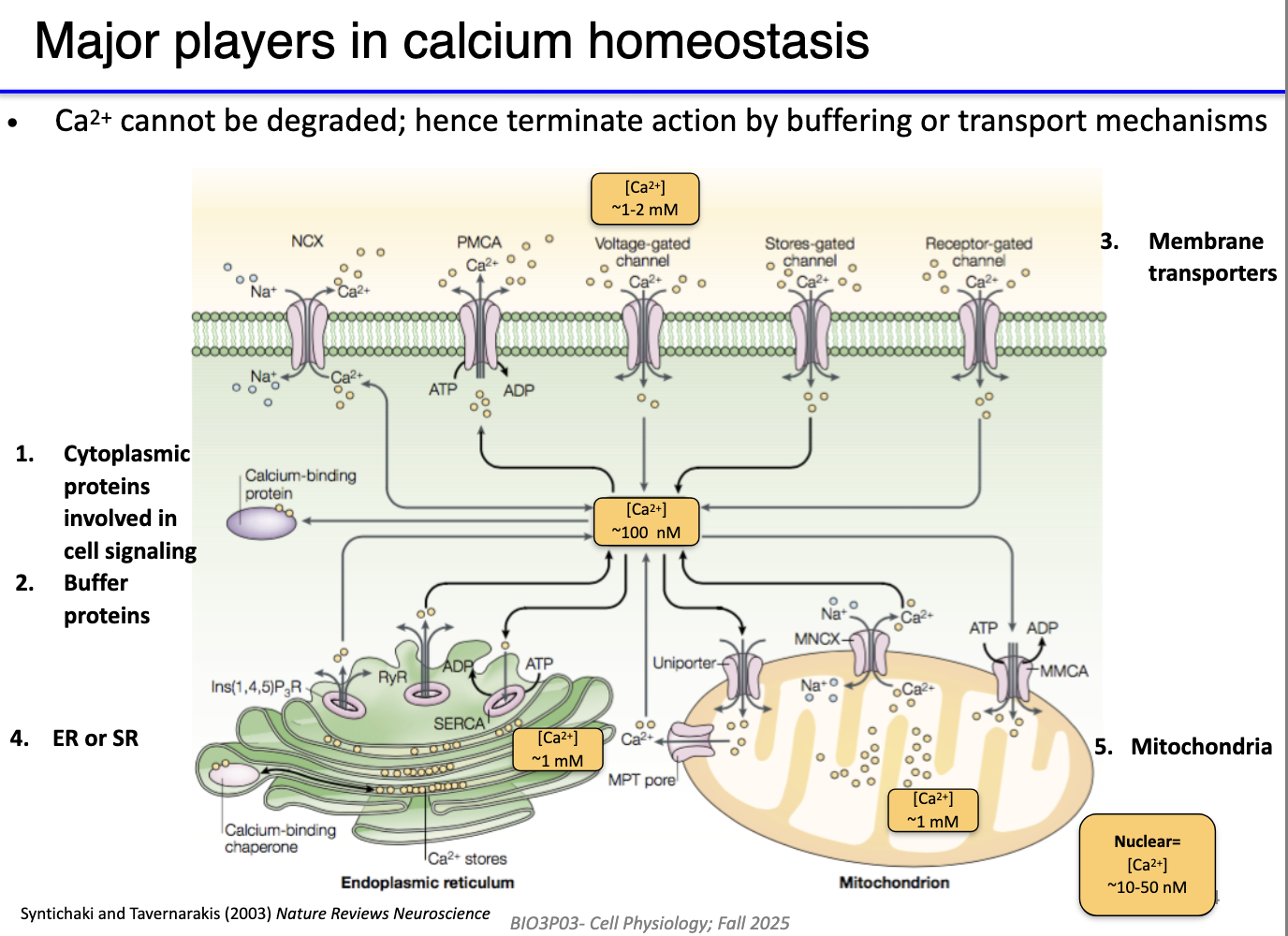
  • Resting cytoplasmic Ca²⁺ ~100 nM (very low).

  • High Ca²⁺ stores:

    • Extracellular fluid: 1–2 mM

    • SR/ER: very high

    • Mitochondria: high (similar to SR)

  • Low Ca²⁺ areas: cytoplasm, nucleus.

  • Key Ca²⁺ regulators:

    • VG Ca²⁺ channels → Ca²⁺ influx.

    • PMCA → pumps Ca²⁺ out (ATP-dependent).

    • Na⁺/Ca²⁺ exchanger → secondary active export.

    • IP₃R & RyR → Ca²⁺ release from SR/ER.

    • SERCA → returns Ca²⁺ to SR/ER.

  • Homeostasis must support rapid spikes (ON) and rapid clearance (OFF) while maintaining stores for future signaling.
<ul><li><p class="isSelectedEnd"><strong><span>Resting cytoplasmic Ca²⁺ ~100 nM</span></strong><span> (very low).</span></p></li><li><p class="isSelectedEnd"><strong><span>High Ca²⁺ stores:</span></strong></p><ul><li><p class="isSelectedEnd"><strong><span>Extracellular fluid</span></strong><span>: 1–2 mM</span></p></li><li><p class="isSelectedEnd"><strong><span>SR/ER</span></strong><span>: very high</span></p></li><li><p class="isSelectedEnd"><strong><span>Mitochondria</span></strong><span>: high (similar to SR)</span></p></li></ul></li><li><p class="isSelectedEnd"><strong><span>Low Ca²⁺ areas:</span></strong><span> cytoplasm, nucleus.</span></p></li><li><p class="isSelectedEnd"><span>Key Ca²⁺ regulators:</span></p><ul><li><p class="isSelectedEnd"><strong><span>VG Ca²⁺ channels</span></strong><span> → Ca²⁺ influx.</span></p></li><li><p class="isSelectedEnd"><strong><span>PMCA</span></strong><span> → pumps Ca²⁺ out (ATP-dependent).</span></p></li><li><p class="isSelectedEnd"><strong><span>Na⁺/Ca²⁺ exchanger</span></strong><span> → secondary active export.</span></p></li><li><p class="isSelectedEnd"><strong><span>IP₃R &amp; RyR</span></strong><span> → Ca²⁺ release from SR/ER.</span></p></li><li><p class="isSelectedEnd"><strong><span>SERCA</span></strong><span> → returns Ca²⁺ to SR/ER.</span></p></li></ul></li><li><p><span>Homeostasis must support </span><strong><span>rapid spikes</span></strong><span> (ON) and </span><strong><span>rapid clearance</span></strong><span> (OFF) while maintaining stores for future signaling.</span></p></li></ul><p></p>
3
New cards

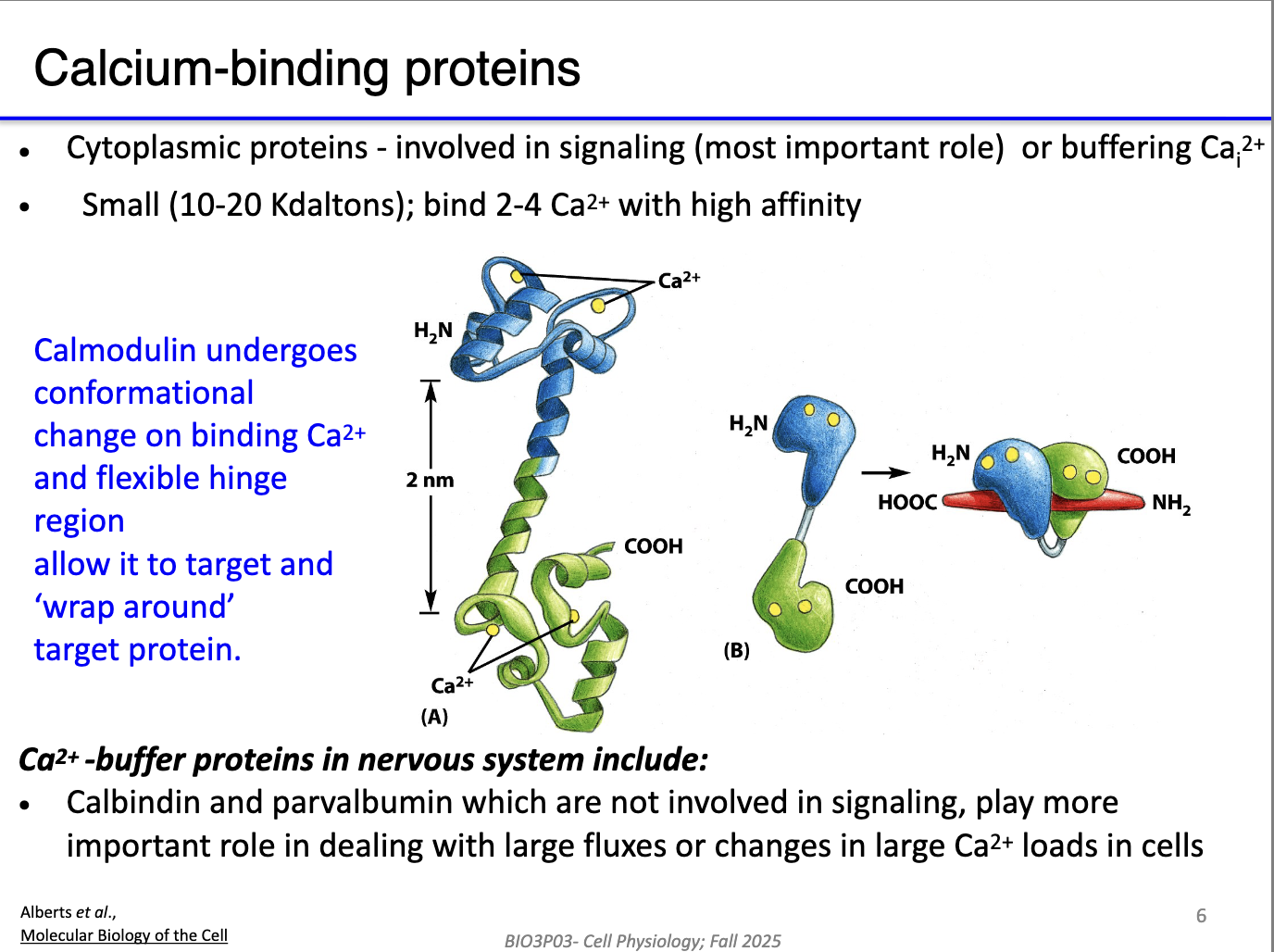
What roles do calmodulin and Ca²⁺-buffering proteins play in calcium signaling?

  • Calmodulin:

    • Monomer with two globular domains + hinge.

    • Ca²⁺ binding → conformational change → wraps around target proteins → alters the protein activity.

  • Ca²⁺ buffer proteins (e.g., calbindin, parvalbumin):

    • Bind Ca²⁺ quickly to reduce free Ca²⁺.

    • Temporarily block Ca²⁺ from activating effectors.

    • Speed the OFF reaction by limiting Ca²⁺ availability before pumps fully clear it.
<ul><li><p class="isSelectedEnd"><strong><span>Calmodulin</span></strong><span>:</span></p><ul><li><p class="isSelectedEnd"><span>Monomer with two globular domains + hinge.</span></p></li><li><p class="isSelectedEnd"><span>Ca²⁺ binding → conformational change → wraps around target proteins → alters the protein activity.</span></p></li></ul></li><li><p class="isSelectedEnd"><strong><span>Ca²⁺ buffer proteins</span></strong><span> (e.g., calbindin, parvalbumin):</span></p><ul><li><p class="isSelectedEnd"><span>Bind Ca²⁺ quickly to </span><strong><span>reduce free Ca²⁺</span></strong><span>.</span></p></li><li><p class="isSelectedEnd"><span>Temporarily block Ca²⁺ from activating effectors.</span></p></li><li><p class="isSelectedEnd"><span>Speed the </span><strong><span>OFF reaction</span></strong><span> by limiting Ca²⁺ availability before pumps fully clear it.</span></p></li></ul></li></ul><p></p>
4
New cards

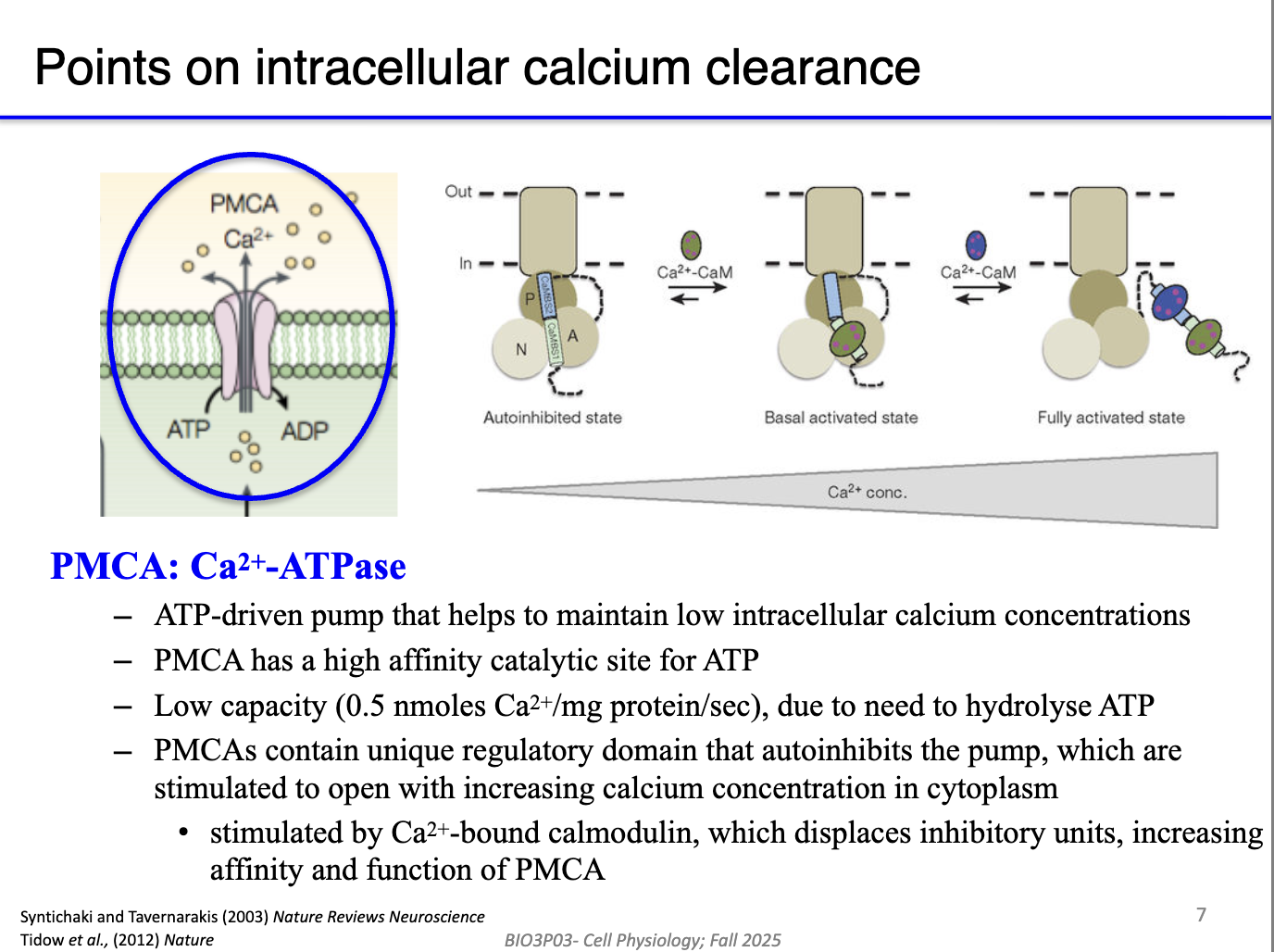
How does calmodulin regulate PMCA to control Ca²⁺ clearance?

  • PMCA pumps Ca²⁺ out of the cell but is autoinhibited at rest to avoid wasting ATP.

  • High cytosolic Ca²⁺ → Ca²⁺ binds calmodulin → Ca²⁺/CaM complex binds PMCA’s inhibitory domain.

  • This removes autoinhibition → activates PMCA → rapid Ca²⁺ export.

  • As Ca²⁺ falls, Ca²⁺ unbinds calmodulin → PMCA becomes autoinhibited again.

  • Creates a feedback system: PMCA turns on only when Ca²⁺ is high.
<ul><li><p class="isSelectedEnd"><strong><span>PMCA</span></strong><span> pumps Ca²⁺ out of the cell but is </span><strong><span>autoinhibited at rest</span></strong><span> to avoid wasting ATP.</span></p></li><li><p class="isSelectedEnd"><span>High cytosolic Ca²⁺ → Ca²⁺ binds </span><strong><span>calmodulin</span></strong><span> → Ca²⁺/CaM complex binds PMCA’s inhibitory domain.</span></p></li><li><p class="isSelectedEnd"><span>This removes autoinhibition → </span><strong><span>activates PMCA</span></strong><span> → rapid Ca²⁺ export.</span></p></li><li><p class="isSelectedEnd"><span>As Ca²⁺ falls, Ca²⁺ unbinds calmodulin → PMCA becomes autoinhibited again.</span></p></li><li><p><span>Creates a feedback system: </span><strong><span>PMCA turns on only when Ca²⁺ is high.</span></strong></p></li></ul><p></p>
5
New cards

How does the Na⁺/Ca²⁺ exchanger contribute to Ca²⁺ clearance?

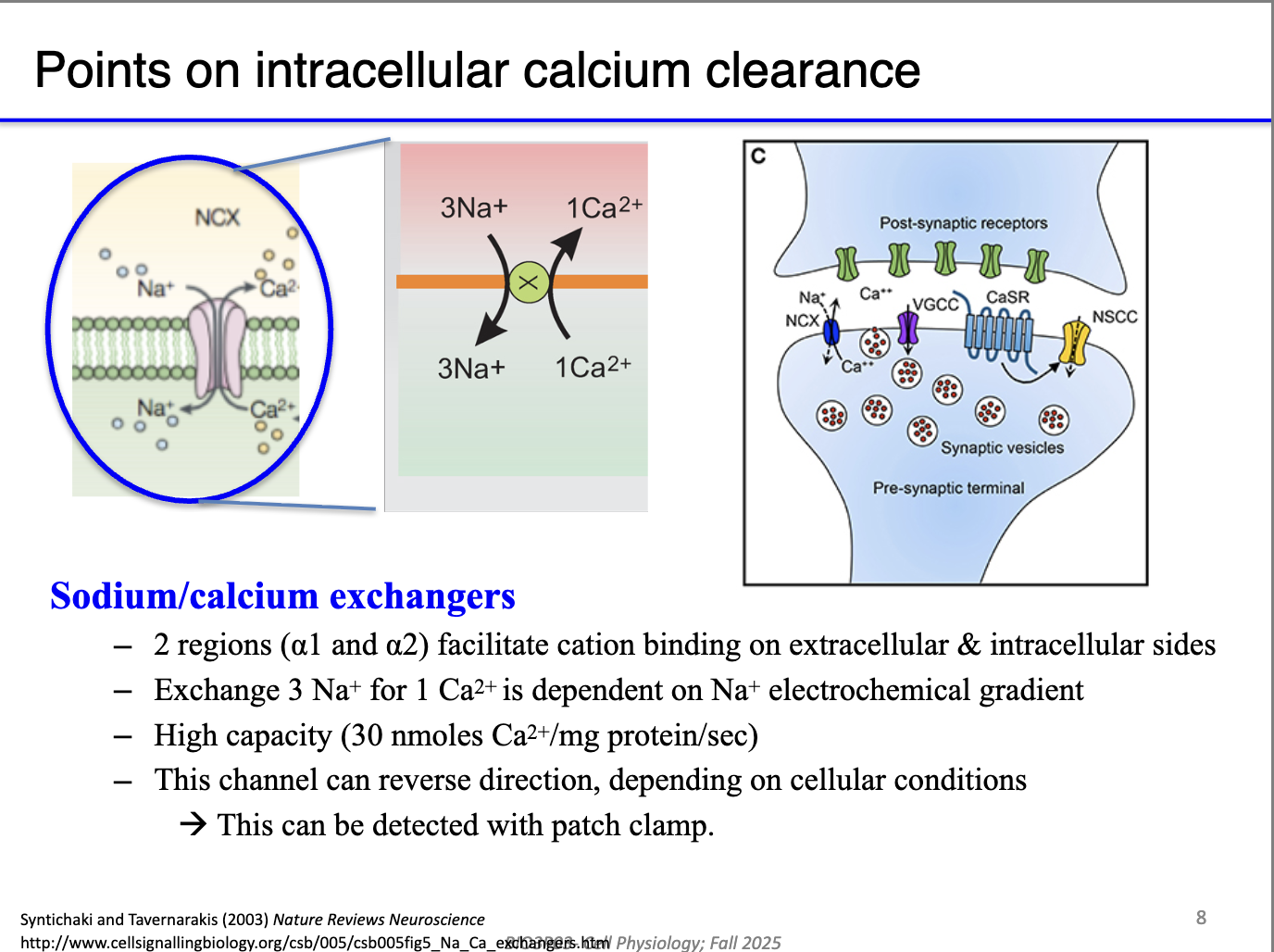
  • Secondary active transport: uses Na⁺ gradient (maintained by Na⁺/K⁺-ATPase) to export Ca²⁺.

  • Fast, always running in the background—no calmodulin required.

  • Critical in presynaptic terminals, where Ca²⁺ must be cleared quickly to stop continuous vesicle fusion.

  • Prevents excess transmitter release by removing Ca²⁺ after each action potential.
<ul><li><p class="isSelectedEnd"><strong><span>Secondary active transport</span></strong><span>: uses Na⁺ gradient (maintained by Na⁺/K⁺-ATPase) to export Ca²⁺.</span></p></li><li><p class="isSelectedEnd"><strong><span>Fast</span></strong><span>, always running in the background—no calmodulin required.</span></p></li><li><p class="isSelectedEnd"><span>Critical in </span><strong><span>presynaptic terminals</span></strong><span>, where Ca²⁺ must be cleared quickly to stop continuous vesicle fusion.</span></p></li><li><p><span>Prevents excess transmitter release by removing Ca²⁺ after each action potential.</span></p></li></ul><p></p>
6
New cards

Why does Ca²⁺ flow into mitochondria, and what drives it?

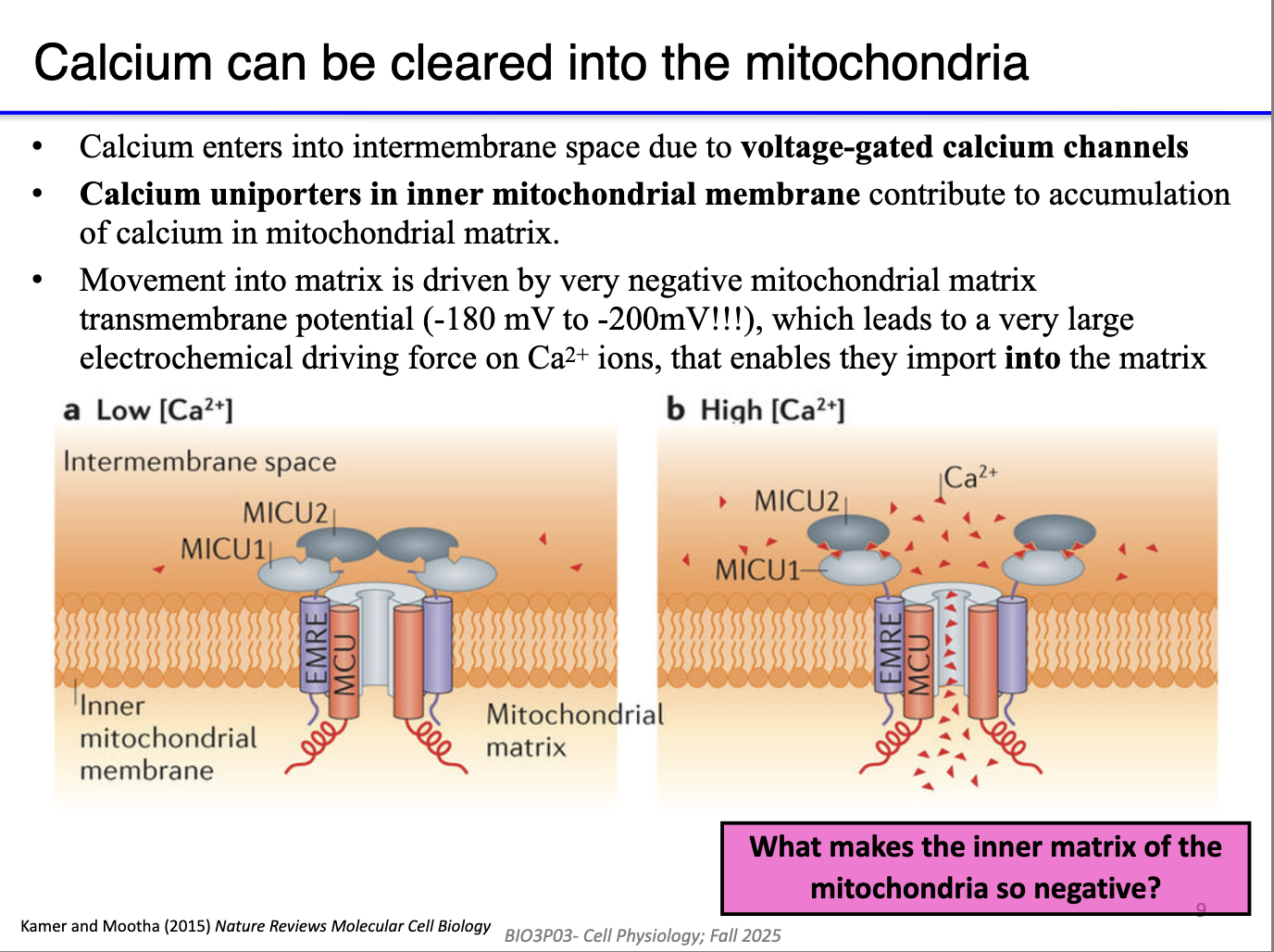
  • Mitochondria have two membranes; Ca²⁺ passes outer membrane via VDAC channels.

  • Inner membrane Ca²⁺ entry is driven by the strongly negative mitochondrial matrix (~–200 mV).
<ul><li><p><span>Mitochondria have </span><strong><span>two membranes</span></strong><span>; Ca²⁺ passes outer membrane via VDAC channels.</span></p></li><li><p><span>Inner membrane Ca²⁺ entry is driven by the </span><strong><span>strongly negative mitochondrial matrix</span></strong><span> (~–200 mV).</span></p></li></ul><p></p>
7
New cards

What makes the inner mitochondrial matrix so negative?

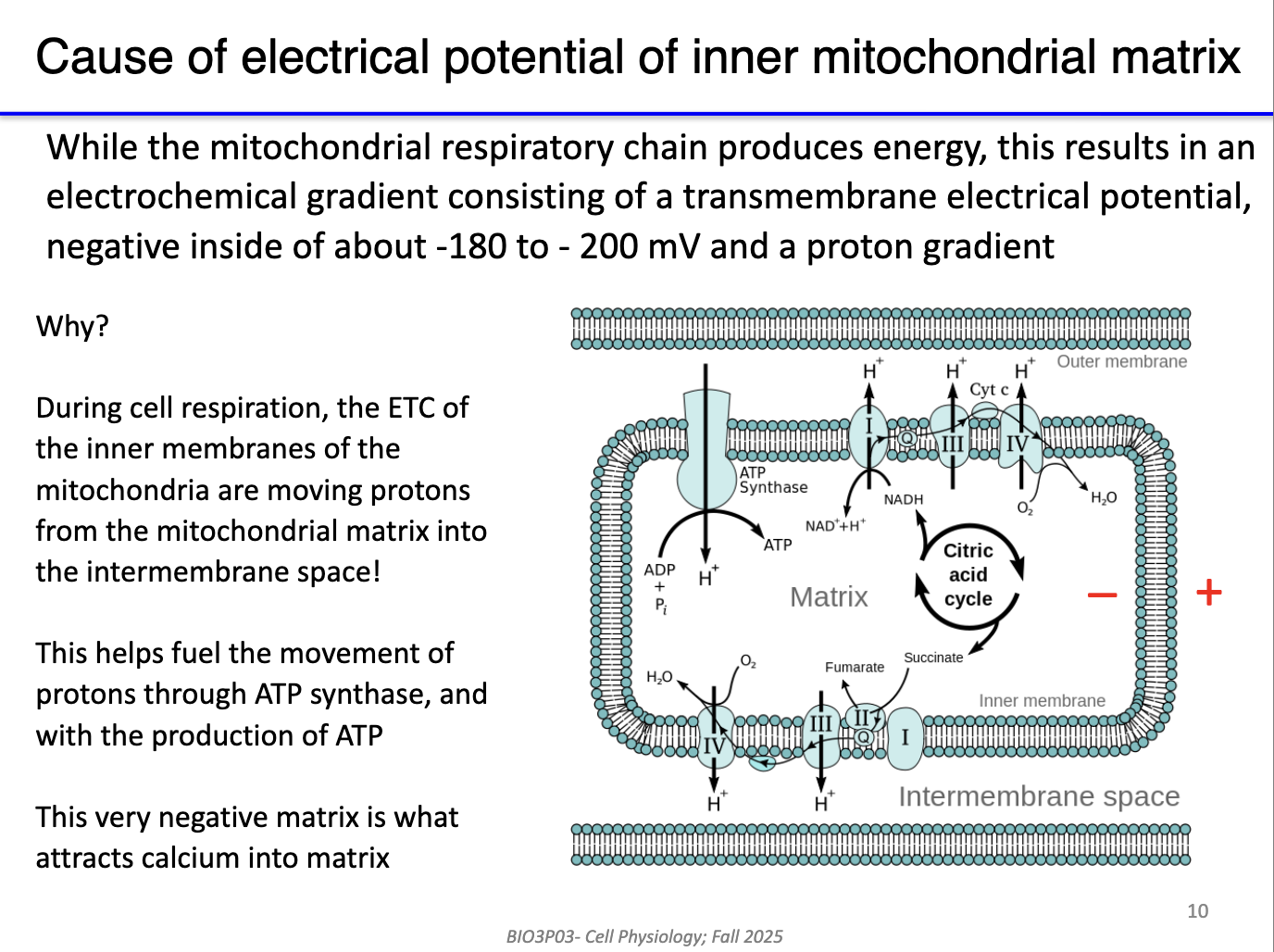
  • This negativity results from the electron transport chain pumping protons into the intermembrane space.

  • No pumps required: Ca²⁺ moves via channels because of the large electrical gradient.

  • Mitochondria act as a secondary Ca²⁺ reservoir and use Ca²⁺ to stimulate metabolic enzymes.
<ul><li><p><span>This negativity results from the </span><strong><span>electron transport chain pumping protons</span></strong><span> into the intermembrane space.</span></p></li><li><p><span>No pumps required: Ca²⁺ moves via channels because of the </span><strong><span>large electrical gradient</span></strong><span>.</span></p></li><li><p><span>Mitochondria act as a </span><strong><span>secondary Ca²⁺ reservoir</span></strong><span> and use Ca²⁺ to stimulate metabolic enzymes.</span></p></li></ul><p></p>
8
New cards

How does the mitochondrial calcium uniporter (MCU) complex regulate Ca²⁺ entry into the matrix?

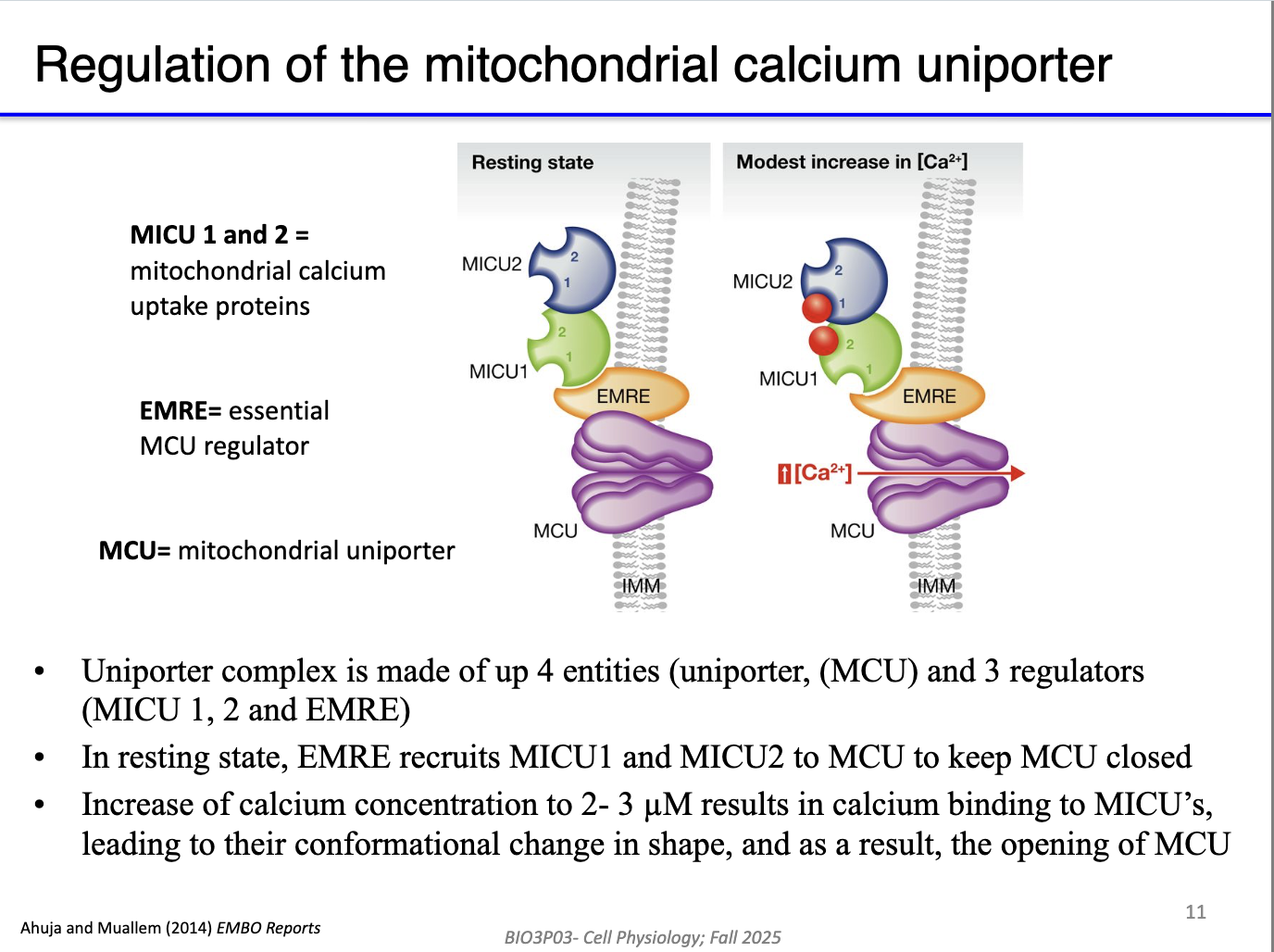
  • MCU (inner membrane channel) allows Ca²⁺ entry when open.

  • EMRE (MCU regulator) organizes the complex.

  • MICU1/2 are Ca²⁺-binding gatekeepers:

    • Low Ca²⁺ → MCU closed.

    • High Ca²⁺ → MICU1/2 bind Ca²⁺ → conformational change → MCU opens.

  • Allows controlled Ca²⁺ entry despite huge electrical driving force.

  • Mitochondria store Ca²⁺ and also use it to stimulate the Krebs cycle & ETC.
<ul><li><p class="isSelectedEnd"><strong><span>MCU</span></strong><span> (inner membrane channel) allows Ca²⁺ entry when open.</span></p></li><li><p class="isSelectedEnd"><strong><span>EMRE</span></strong><span> (MCU regulator) organizes the complex.</span></p></li><li><p class="isSelectedEnd"><strong><span>MICU1/2</span></strong><span> are Ca²⁺-binding gatekeepers:</span></p><ul><li><p class="isSelectedEnd"><span>Low Ca²⁺ → MCU closed.</span></p></li><li><p class="isSelectedEnd"><span>High Ca²⁺ → MICU1/2 bind Ca²⁺ → conformational change → MCU opens.</span></p></li></ul></li><li><p class="isSelectedEnd"><span>Allows controlled Ca²⁺ entry despite huge electrical driving force.</span></p></li><li><p><span>Mitochondria store Ca²⁺ and also use it to </span><strong><span>stimulate the Krebs cycle &amp; ETC.</span></strong></p></li></ul><p></p>
9
New cards

What happens when mitochondria take up too much Ca²⁺?

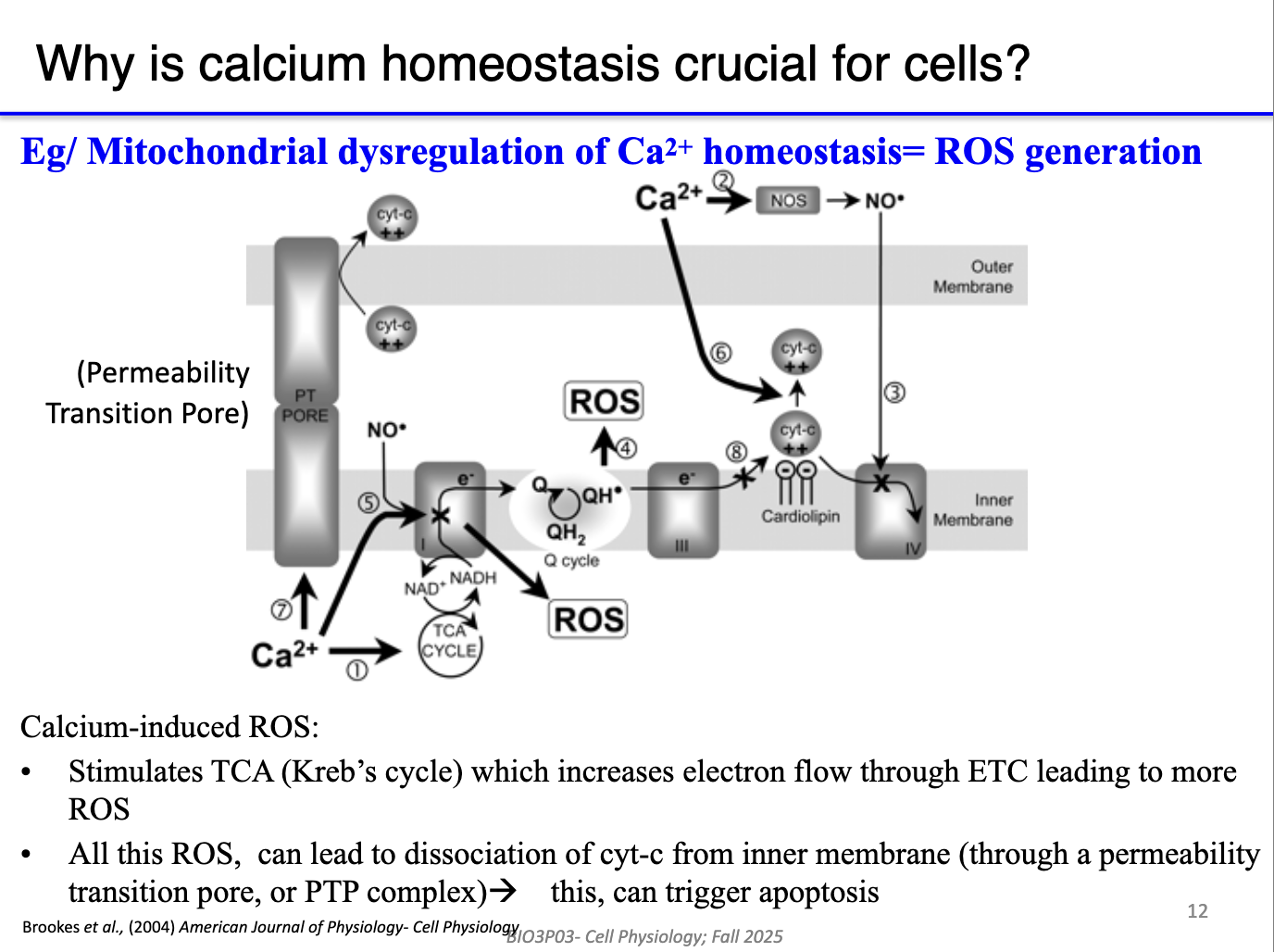
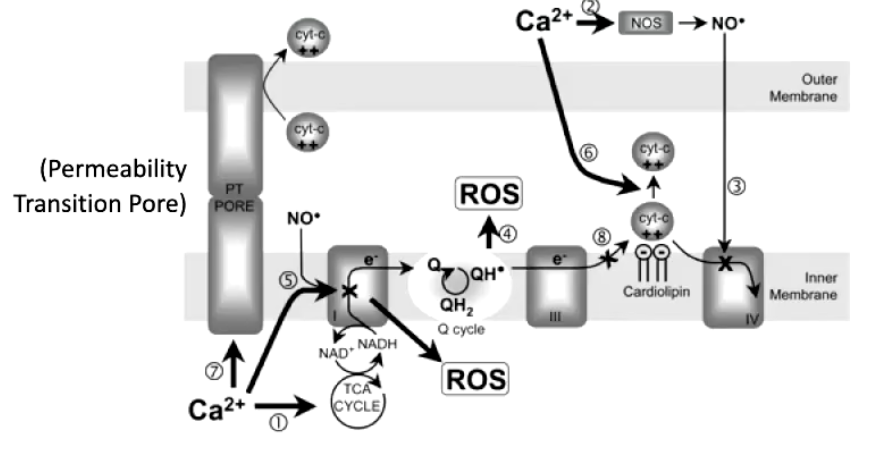
  • Excess matrix Ca²⁺ → overactivation of Krebs cycle + ETC → excessive proton pumping.

  • Leads to ROS (reactive oxygen species) production at the electron transport system.

  • ROS damage:

    • DNA, proteins, lipids (especially phospholipid inner membrane).

    • Causes cytochrome c leakage, triggering apoptosis.

  • Mitochondrial Ca²⁺ overload = major trigger for cell death.
<ul><li><p><span>Excess matrix Ca²⁺ → </span><strong><span>overactivation</span></strong><span> of Krebs cycle + ETC → excessive proton pumping.</span></p></li><li><p><span>Leads to </span><strong><span>ROS (reactive oxygen species)</span></strong><span> production at the electron transport system.</span></p></li><li><p><span>ROS damage:</span></p><ul><li><p><span>DNA, proteins, lipids (especially phospholipid inner membrane).</span></p></li><li><p><span>Causes </span><strong><span>cytochrome c leakage</span></strong><span>, triggering </span><strong><span>apoptosis</span></strong><span>.</span></p></li></ul></li><li><p><span>Mitochondrial Ca²⁺ overload = major trigger for cell death.</span></p></li></ul><p></p>
10
New cards

How do mitochondria and ER/SR share Ca²⁺, and why does it matter?

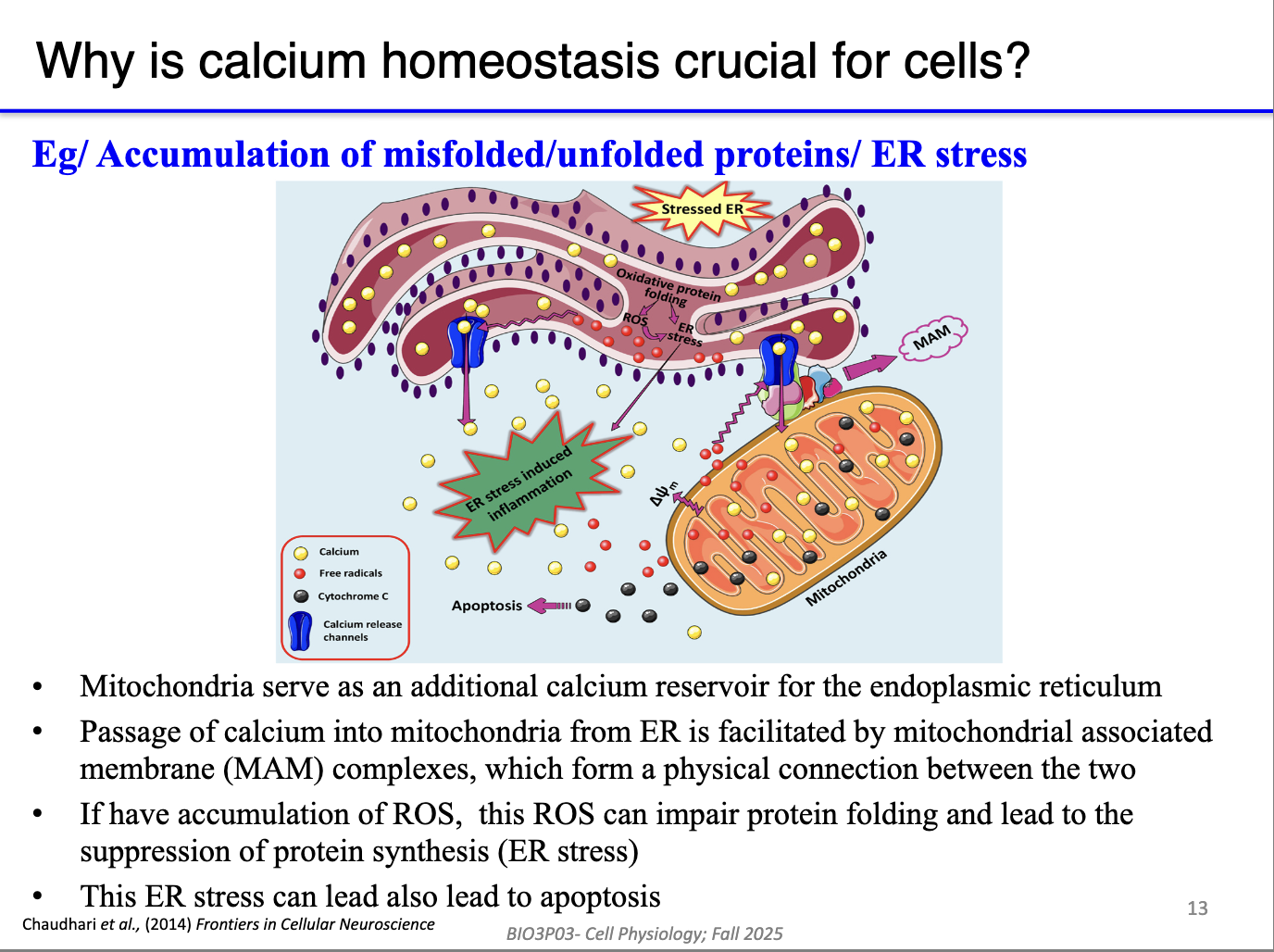
  • Linked via MAMs (mitochondria-associated membranes) → direct Ca²⁺ and stress signal transfer.

  • Mitochondria act as a reserve reservoir:

    • Can return Ca²⁺ to ER/SR when stores run low.

  • However, ROS or Ca²⁺ overload in mitochondria can spread stress to ER/SR → ER stress → apoptosis.

  • MAMs allow both beneficial Ca²⁺ sharing and propagation of damage.
<ul><li><p class="isSelectedEnd"><span>Linked via </span><strong><span>MAMs</span></strong><span> (mitochondria-associated membranes) → direct Ca²⁺ and stress signal transfer.</span></p></li><li><p class="isSelectedEnd"><span>Mitochondria act as a </span><strong><span>reserve reservoir</span></strong><span>:</span></p><ul><li><p class="isSelectedEnd"><span>Can return Ca²⁺ to ER/SR when stores run low.</span></p></li></ul></li><li><p class="isSelectedEnd"><span>However, ROS or Ca²⁺ overload in mitochondria can spread stress to ER/SR → </span><strong><span>ER stress → apoptosis</span></strong><span>.</span></p></li><li><p><span>MAMs allow both </span><strong><span>beneficial Ca²⁺ sharing</span></strong><span> and </span><strong><span>propagation of damage</span></strong><span>.</span></p></li></ul><p></p>
11
New cards

Why does reperfusion after ischemia cause dangerous mitochondrial Ca²⁺ overload?

  • During ischemia/hypoxia (low O₂):

    • ETC stops → no proton gradient.

    • Ca²⁺ pumps (PMCA, SERCA) fail due to low ATP.

    • Na⁺/Ca²⁺ exchanger fails because it relies on the gradients set up by Na+/K+ pump, which uses ATP.

    • Ca²⁺ builds up in cytoplasm but does not enter mitochondria (no negative matrix).

  • During reperfusion (O₂ returns):

    • ETC restarts instantly → matrix becomes highly negative before Ca²⁺ pumps recover.

    • Massive Ca²⁺ rushes into mitochondria → ROS burst → membrane damage → cytochrome c release → apoptosis.

  • This is why reperfusion injury is worse than the ischemia itself.
<ul><li><p class="isSelectedEnd"><strong><span>During ischemia/hypoxia (low O₂):</span></strong></p><ul><li><p class="isSelectedEnd"><span>ETC stops → no proton gradient.</span></p></li><li><p class="isSelectedEnd"><span>Ca²⁺ pumps (PMCA, SERCA) fail due to low ATP.</span></p></li><li><p class="isSelectedEnd"><span>Na⁺/Ca²⁺</span><strong><span> </span></strong><span>exchanger</span><strong><span> </span></strong><span>fails because it relies on the gradients set up by Na</span><sup><span>+</span></sup><span>/K</span><sup><span>+</span></sup><span> pump, which uses ATP. </span></p></li><li><p class="isSelectedEnd"><strong><span>Ca²⁺ builds up in cytoplasm</span></strong><span> but does </span><em><span>not</span></em><span> enter mitochondria (no negative matrix).</span></p></li></ul></li><li><p class="isSelectedEnd"><strong><span>During reperfusion (O₂ returns):</span></strong></p><ul><li><p class="isSelectedEnd"><span>ETC restarts instantly → matrix becomes highly negative </span><strong><span>before</span></strong><span> Ca²⁺ pumps recover.</span></p></li><li><p class="isSelectedEnd"><span>Massive Ca²⁺ rushes into mitochondria → </span><strong><span>ROS burst → membrane damage → cytochrome c release → apoptosis</span></strong><span>.</span></p></li></ul></li><li><p><span>This is why reperfusion injury is worse than the ischemia itself.</span></p></li></ul><p></p>
12
New cards

How do mitochondria safely store Ca²⁺ without triggering damage?

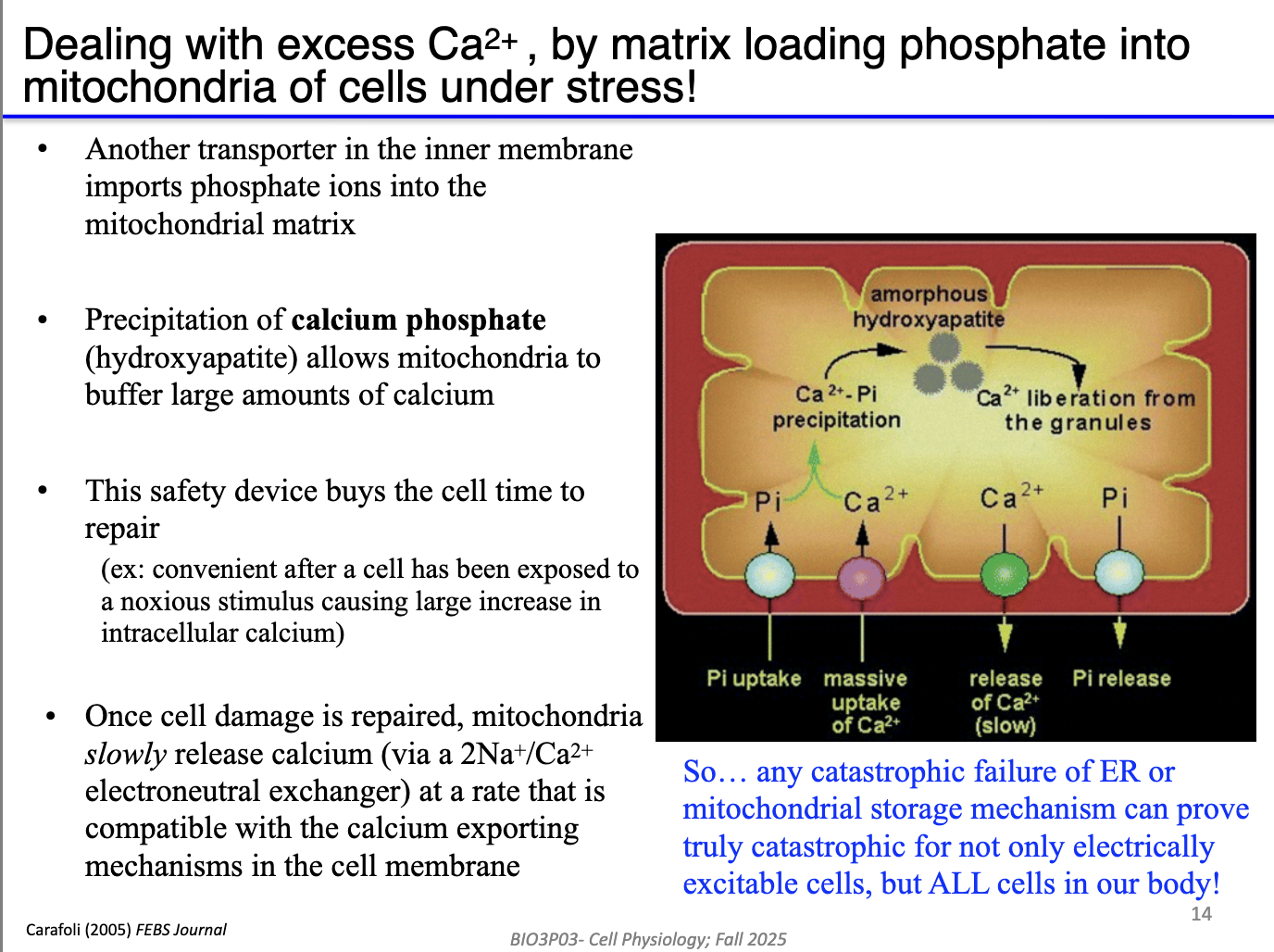
  • Mitochondria import inorganic phosphate (Pi).

  • High Ca²⁺ + Pi → form calcium phosphate precipitates.

  • Precipitated Ca²⁺ = inactive, preventing:

    • Excess Krebs cycle stimulation

    • Excess ETC flux

    • ROS generation

  • When ER/SR needs Ca²⁺, free Ca²⁺ diffuses out → due to low Ca2+ in mitochondria, precipitates dissolve → replenish Ca²⁺ stores.

  • Buffering prevents mitochondrial Ca²⁺ overload except under extreme stress (e.g., ischemia/reperfusion).
<ul><li><p class="isSelectedEnd"><span>Mitochondria import </span><strong><span>inorganic phosphate (Pi)</span></strong><span>.</span></p></li><li><p class="isSelectedEnd"><span>High Ca²⁺ + Pi → form </span><strong><span>calcium phosphate precipitates</span></strong><span>.</span></p></li><li><p class="isSelectedEnd"><span>Precipitated Ca²⁺ = </span><strong><span>inactive</span></strong><span>, preventing:</span></p><ul><li><p class="isSelectedEnd"><span>Excess Krebs cycle stimulation</span></p></li><li><p class="isSelectedEnd"><span>Excess ETC flux</span></p></li><li><p class="isSelectedEnd"><span>ROS generation</span></p></li></ul></li><li><p class="isSelectedEnd"><span>When ER/SR needs Ca²⁺, free Ca²⁺ diffuses out → due to low Ca</span><sup><span>2+</span></sup><span> in mitochondria, precipitates dissolve → replenish Ca²⁺ stores.</span></p></li><li><p><span>Buffering prevents mitochondrial Ca²⁺ overload except under extreme stress (e.g., ischemia/reperfusion).</span></p></li></ul><p></p>