Plet 222 exam 1
 Call Kai
 Learn
Learn Practice Test
 Spaced Repetition
 Match
Match Flashcards
 Knowt Play
1/67

There's no tags or description
Looks like no tags are added yet.
Name | Mastery | Learn | Test | Matching | Spaced | Call with Kai | Chat |
|---|
No analytics yet
Send a link to your students to track their progress
68 Terms
List 4 main types of hazards on an injection molding press and example where they can be found
Pinch point - Mold halves/ejectors/screw
Burn/High Temp - Barrel
High Pressure - oil lines/nozzle tip
Electric Shock - electrical box
5 steps of design hierarchy for safety
Eliminate the hazard
Guard
Warning signs
Training
PPE
Main purpose of lockout tagout system
Control Hazardous Energy
Thoroughly explain Hazardous Communication (MSDS)
All chemicals used in an area need to have a data sheet which describes appropriate safety gear and what to do in event of spill, fire, etc.
Why is it extremely important to keep a clean and organized work enviornment
Eliminates slip hazards/ inspectors look closer at cluttered areas/ disorganized
Most important rule of ladder safety
3 points of contact
List and explain steps of injection molding cycle
Mold closes - Mold closes
Fill - Inject part to 95%-99% full
Pack - Finish filling + pressurize cavity
Cooling time - material in mold cools
screw rotate - screw rotates back to shot size
Mold open - Mold opens
Eject - Ejectors move forward + backwards
List 4 main plastic variables and why they are important
Temperature - affects viscosity
Flow rate- affects viscosity
pressure gradient - affects shrinkage
Cooling - affects shrinkage
List 7 steps of optimizing a process in order
Optimize Velocity
Optimize Hold Pressure
Optimize Hold Time
Cooling + Recovery Time
Minimize clamp pressure
other variables
set safeties
Where do you set injection fill time at the start and why we set it there
15-25 seconds
to set scale on graph
where do we set injection fill time at end of the process and why
10% higher then actual
accommodate material variation / safety so we don’t flash mold
Where do we set injection fill pressure at the start of process set up and why
Max
don’t pressure limit velocity
Where do we set injection fill pressure at the end of process set up and why
200 hyd psi / 2000 psi plastic above actual
accommodate material variation / safety so we don’t flash mold
Where do we set screw rotate speed at the start of process set up and why
90% max
don’t want recovery time to limit cycle
Where do we set screw rotate speed at the end of process set up and why
so it returns 1-2sec before end of cooling time
want screw to rotate as slow as possible w/o affecting cycle time
Where do we set hold pressure at the start of process set up and why
0 psi
trying to get 95% full part on fill only
Where do we set hold pressure at the end of process set up and why
avg of just full and flashy pressures
packout cavity without flashing
Where do we set transfer position at the start of process set up and why
0.1 inch
don’t want to screw overtravel to affect velocity data
Where do we set transfer position at the end of process set up and why
Where necessary to provide a cushion of about 10% of shot size while maintaining 95% full part
Need to maintain psi in cavity w/o degradation + 95% full part at transfer
Why do we need a cushion during the injection molding cycle?
Maintain pressure in cavity
where should cushion be set in an optimized process?
10% shot size
Why do we set the cushion at 10% shot size in optimized process?
want to maintain pressure without degradation
if it is not the right size how do we adjust it? (cushion)
adjust shot size and transfer position by same amount
If BY turns off the hold pressure at the end of your practical the parts must be 95% full. Why wouldn’t the part be 95% full at this point?
The mold has heated up and now there is a thinner frozen layer which allows the material to flow easier
What are the 3 main functions of the clamping unit.
Move the mold
hold the mold closed
provide a means of ejection
Hydraulic clamping advantages
Pressure directly behind the mold
more consistent clamp pressure
Hydraulic clamping disadvantage
low spring rate / less energy efficient
Mechanical clamping advantages
High spring rate
more energy efficient
mechanical clamping disadvantage
clamp force outside of platens / harder to maintain
Hydro-mechanical clamp advantages
Pressure directly behind mold
faster operation
Hydro-mechanical clamp disadvantage
Expensive / hard to maintain

What is #1 and its function?
injection cylinder - provides linear forward motion to push plastic into the mold

What is #2 and its function?
Screw - rotates to mix and melt plastic material, moves back while rotating
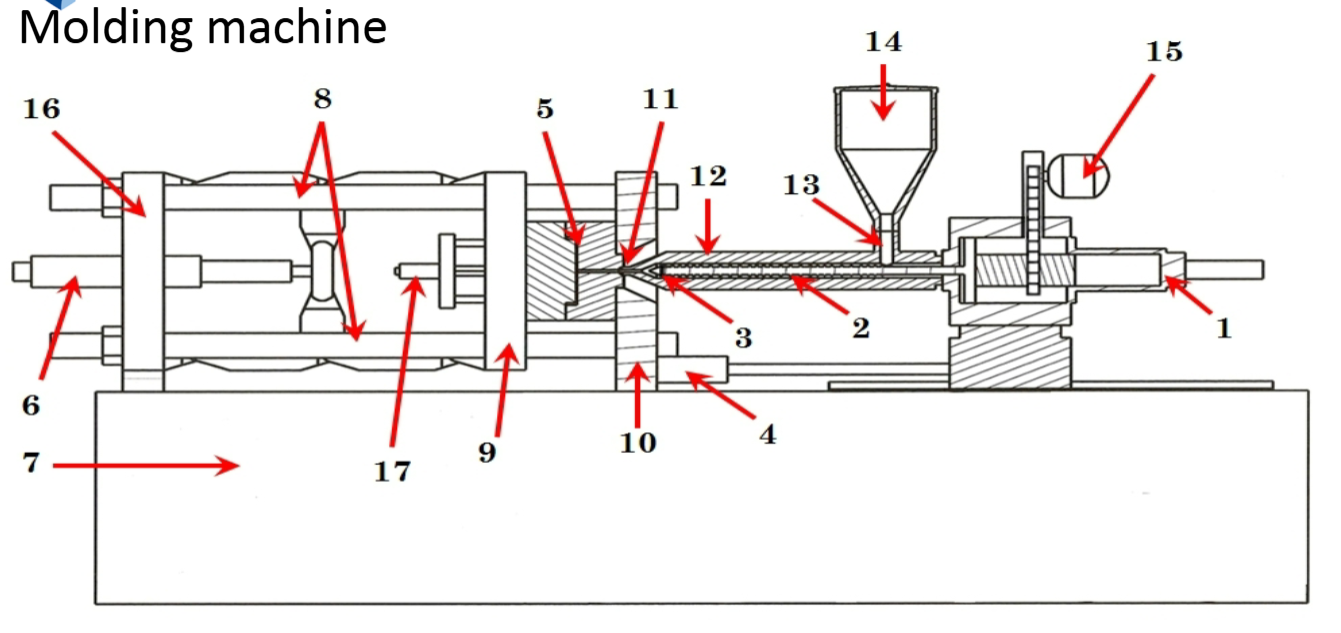
What is #3 and its function?
Non-return valve - prevents plastic from flowing back over the screw during injection
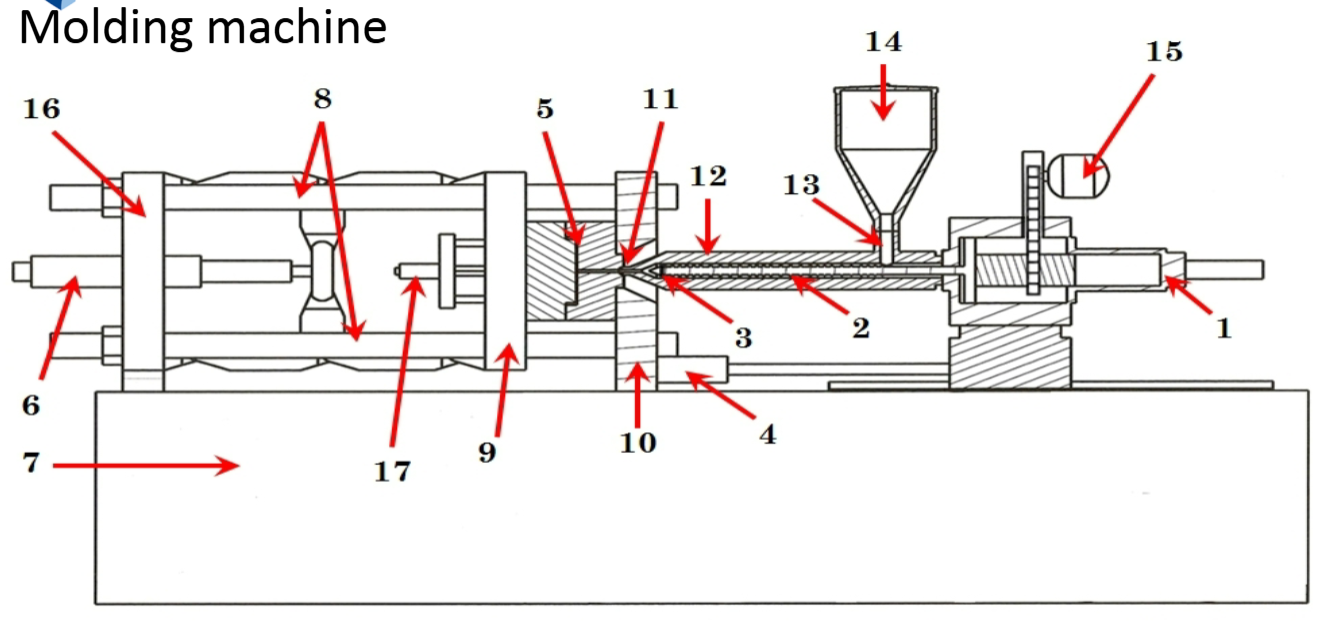
What is #4 and its function?
Pull-in cylinder - moves injection unit forward to contact the mold
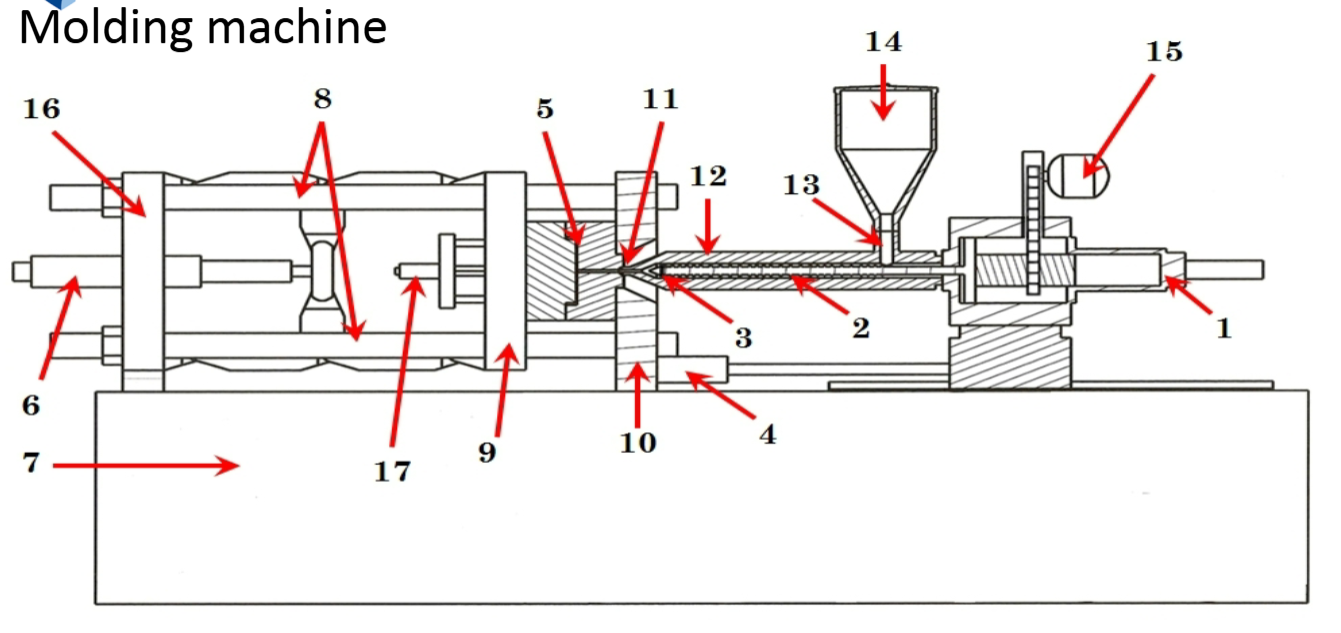
What is #5 and its function?
mold - provides geometric shape for plastic to melt

What is #6 and its function?
clamp cylinder - moves mold and holds it closed during injection

What is #7 and its function?
machine base - support structure

What is #8 and its function?
tie bar - stretches to build clamp tonnage, main tension element in load path

What is #9 and its function?
movable platen - supports movable half of mold

What is #10 and its function?
stationary platen - supports stationary half of the mold, provides space for nozzle tip to contact mold

What is #11 and its function?
nozzle tip - adapter between injection unit and mold

What is #12 and its function?
Barrel - heated, houses the screw

What is #13 and its function?
feedthroat - where material enters the barrel and falls on the screw

What is #14 and its function?
Hopper - material storage during processing
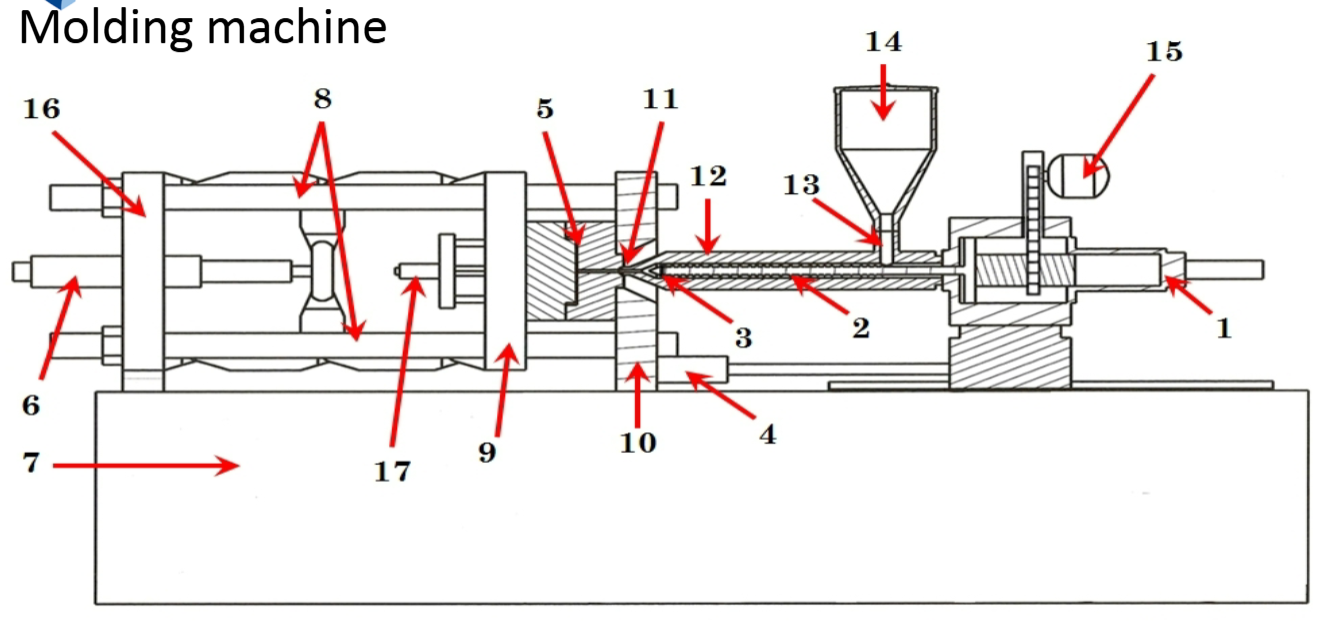
What is #15 and its function?
Screw motor - rotates the screw causing it to move back to shot size
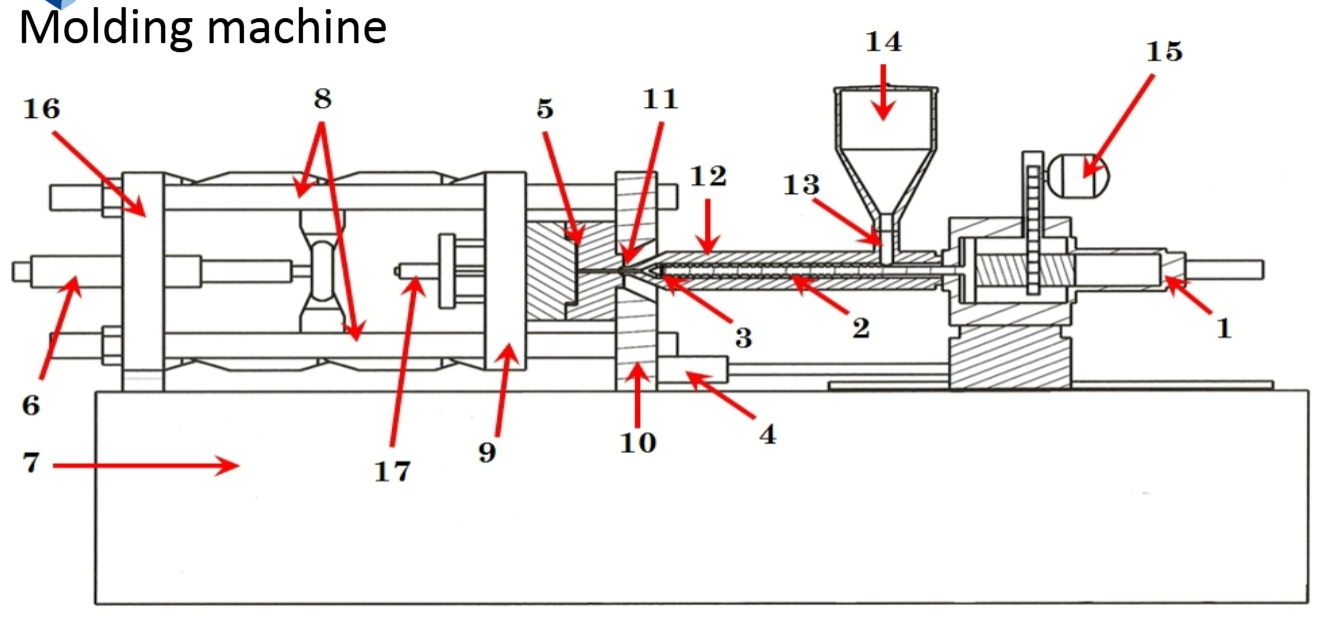
What is #16 and its function?
Rear platen - supports clamping cylinder, floats

What is #17 and its function?
Ejection cylinder - provides means to move ejection plate through holes in movable platen
Tie bar stretch equations
Stress = Force / Area
Modulus (E) = stress / strain
Strain = ΔL / L
Area = [(πd2)/4] × 4
modulus of steel
3 × 10⁷ psi
Intensification ratio equations
Hydraulic area / screw area
plastic pressure / hydraulic pressure
why does loading factor affect adjusted fatigue strength
the type of load will affect how fast a component will fatigue
why does failure rate factor affect the adjusted fatigue strength
takes into account scatter testing data for initial fatigue data
why does surface treatment factor affect the adjusted fatigue strength
the surface treatment can put the surface component in a state of compression
Four main functions of the screw and which section performs each
feed - moves material
compression - melts material
metering - mix material
non-return valve - builds pressure for injection
Most common non-return valve
Check ring
Other 2 non-return valves and why would you use them
ball check, poppet
low viscosity materials
which barrel zone is most likely to over-ride and why
compression zone - that’s where the shear heat is generated and there is no where for the heat to go.
why is it important that all of the tie bars stretch the same amount
puts uneven stress on the mold
why do we only weigh parts when we perform a gate freeze study
we are only concerned where the gate freezes and not the runners

What nozzle is this?
reverse taper

What nozzle is this?
General purpose

What nozzle is this?
nylon
3 types of injection unit
ram extruder (plunger)
ram-assisted screw extruder
reciprocating screw
Explain why temperature is one of the main things that affect a materials viscosity?
At high temps molecules are further apart making them flow past each other easily
Explain why strain rate is one of the main things that affect materials viscosity?
It isn’t
Explain where the screw is most likely to wear and why it wears there?
At the back of the flights in the feed zone, the polymer is not melted and fillers rub against flights
How can you tell if either the screw or barrel is leaking?
You cant maintain a cushion. If you move your shot size and transfer position and still cant maintain a cushion then it is probably the check ring. Barrel usually only worn in the front of metering zone.