Exam 2
 Call Kai
 Learn
Learn Practice Test
 Spaced Repetition
 Match
Match Flashcards
 Knowt Play
1/621

There's no tags or description
Looks like no tags are added yet.
Name | Mastery | Learn | Test | Matching | Spaced | Call with Kai | Chat |
|---|
No analytics yet
Send a link to your students to track their progress
622 Terms
______: End oxidation of carbohydrates; fatty acid oxidation; O₂ consumption; ATP synthesis by oxidative phosphorylation.
Mitochondria
_______: Protein synthesis.
Ribosomes
_______: “Secretory pathway”; synthesis of membrane lipids, membrane proteins, and secreted proteins.
ER and Golgi
______: Many biosynthetic pathways; initial catabolism of monosaccharides; storage of glycogen and fat.
Cytoplasm
______: Digestion of endocytosed and phagocytosed materials.
Lysosomes
_______: Specialized reactions that form hydrogen peroxide (H₂O₂) as a byproduct.
Peroxisomes
Which organelle contains hydrolytic enzymes that function best in acidic environments and are essential for intracellular digestion?
Lysosome
______: Synthesis of ribosomal RNA (rRNA) and assembly of ribosomal subunits.
Nucleolus
_______: Central databank; DNA and RNA synthesis
Nucleus
What the the DNA level or metabolic pathways?
Amount of enzyme is adjusted by change in its synthesis/degradation
It is LONG TERM
What is the protein level of metabolic pathways?
Modified covalently by de-/phosphorylation
it is short term
What is the ATP level of metabolic pathways?
Metabolic enzymes can be regulated by allosteric effectors (substrate, intermediate, or product of pathway)
Allosteric Effectors - a molecule that binds to an enzyme or protein at a site other than the active site, changing its shape and activity
Of the three metabolic pathways, which is the fastest?
Allosteric effectors (ATP) level are the fastest
Of the three metabolic pathways, which is the slowest?
Long-term (DNA level) - this is due to the lifespand of the metablic enzyme ranging from 1 hr - days
Of the three metabolic pathways, which is the second fastest?
short term (protein level)
requires protein kinase and protein phosphatase
What do protein Kinases do?
Attach a phosphate group
What do protein Phosphatase do?
Remove a phosphate group
What is phosphoylation?
Formation of a phosphate derivative
What is dephosphoylation?
removale of a phosphate groups
_______ pathway: Regulation by feedback inhibition
Anabolic pathway
_______ pathway: regulation by ATP and ADP. Pi, inorganinc phosphate
catabolic
_________ pathway: regulation by feedworward stimulation
Catabolic pathway
Regulation pathways: traits of the anablic pathway (feedback inhibition)?
the end product inhibits an earlier enzyme
This prevents the cell from making more product when enough has accumulated
Regulation pathways:traits of the catabolic pathway (regulation by ATP, ADP, and Pi)
Reflects the cells energy status
High ATP → generally slows catabolic pathways because energy is plentiful
High ADP/Pi (and often AMP) → generally stimulated catabolism because more ATP is needed
Regulation pathways: catabolic pathways → feedforward stimulation
an earlier metabolite activates an enzyme later in the pathway.
This prepares downstream rections to handle incoming metabolites
In an anabolic pathway, the final product accumulates and binds to an enzyme that acts early in the pathway, decreasing its activity. What type of regulation is occurring?
A. Feedforward stimulation
B. Feedback inhibition
C. Substrate-level phosphorylation
D. Energy-charge regulation
E. Competitive activation
Answer: B. Feedback inhibition
The end product feeds back and inhibits an earlier step, preventing unnecessary production.
When Z reaches a high concentration, it inhibits the enzyme responsible for converting A → B. What is the primary advantage of this regulation?
A. It increases ATP production
B. It accelerates breakdown of Z
C. It prevents unnecessary synthesis of Z
D. It increases the concentration of B
E. It stimulates catabolic pathways
C. It prevents unnecessary synthesis of Z
This is feedback inhibition: enough final product → shut down an earlier step.
A cell has a high ATP concentration and low ADP concentration. What would most likely happen to a catabolic pathway responsible for producing ATP?
A. Its activity would increase
B. Its activity would decrease
C. It would switch to an anabolic pathway
D. ADP would inhibit the pathway
E. ATP would have no regulatory effect
Answer: B. Its activity would decrease
High ATP = plenty of energy, so there is less need for ATP-producing catabolic pathways.
During intense exercise, ATP is rapidly consumed and ADP and Pi concentrations increase. What effect would this most likely have on ATP-producing catabolic pathways?
A. Inhibit them
B. Have no effect on them
C. Stimulate them
D. Convert them into anabolic pathways
E. Cause feedback inhibition by ATP
Answer: C. Stimulate them
↑ ADP/Pi = energy demand is high → stimulate catabolism → produce more ATP.
In a catabolic pathway:
A → B → C → D → E
An increase in B activates the enzyme responsible for converting D → E. What type of regulation is this?
A. Feedback inhibition
B. Competitive inhibition
C. Feedforward stimulation
D. Product inhibition
E. Energy-charge inhibition
Answer: C. Feedforward stimulation
An earlier metabolite stimulates a later step, preparing the pathway for increased incoming material.
Which scenario best represents feedforward stimulation?
A. ATP inhibits an enzyme in glycolysis when ATP levels are high.
B. The final product of a biosynthetic pathway inhibits its first committed step.
C. ADP stimulates a pathway that generates ATP.
D. An early intermediate activates an enzyme that functions later in the same pathway.
E. A final product activates the enzyme that produced it.
Answer: D. An early intermediate activates an enzyme that functions later in the same pathway.
_________: later product → inhibits earlier step.
Feedback inhibition
_______________: earlier metabolite → stimulates later step.
Feedforward stimulation
what type of pathway is this?

it is an anabolic pathway via feedback inhibition
A → B → C → etc. (its continously adding products) = anabolic
The end product is stopping the start = feedback inhibiton
What type of pathway is this?

since its being broken down into smaller peices (CO2 and H20) = catabolic
Regulated by ATP, ADP, and Pi. High ATP inhibits the pathway, while high ADP + Pi stimulates it.
Q: What does a high ADP level indicate about the cell?
A: The cell is in a low-energy state and needs to produce more ATP.
Q: How does increased ADP generally affect catabolic pathways?
A: Stimulates catabolism → increases fuel breakdown to generate ATP.
Q: How does increased ADP generally affect anabolic pathways?
A: Decreases/favors slowing anabolism because anabolic pathways require energy, which is currently limited.
Q: What does a high ATP level indicate about the cell?
A: The cell is in a high-energy state and has abundant energy available.
Q: How does increased ATP generally affect catabolic pathways?
A: Inhibits catabolism because the cell does not need to produce as much additional ATP.
Q: How does increased ATP generally affect anabolic pathways?
A: Favors anabolism because sufficient energy is available for biosynthesis.
Q: What is the general relationship between cellular energy status and metabolism?
↑ ADP/AMP → ↑ catabolism, ↓ anabolism
↑ ATP → ↓ catabolism, favors anabolism
what type of pathway is the following?

we know it is catabolic because it is being broken down
since an early metabolite is stimulating the next step, we know ots feedforward
high ATPs role on pathways
High ATP:
Favors anabolic pathways (Activates)
does not favor catabolic pathways (Inhibits)
high ADPs role on pathways
High ADP:
Favors catabolic pathways (activates)
Does not favor catabolic pathways (inhibits)
When is insulin produced?
After carbohydrate-rich meal
When is Glucagon produced?
During fasting
When is norepinephrine/noepinephrine produced?
During acute stress & physical exertion
When is cortisol produced?
during prolonged stress
function of insulin?
Stimulates utilization of dietary nutrients
function of glucagon?
Maintains blood glucose levels
function of Epinephrine & Norepinephrine?
Stipulates mobilization of glucose from glycogen and utilization of stored fat
function of cortisol?
Promotes glucose synthesis & fat breakdown
Enzyme deficiancy pathways:
Anabolic pathways?
Lack of product causes clinical signs/symptoms to manifest (Metabolite C accumulates, product is deficient)
What kind of defiancy pathway is the following?

Anabolic Pathway: Lack of product causes clinical signs/symptoms to manifest (Metabolite C accumulates, product is deficient)
Enzyme deficiancy pathways:
Catabolic pathways?
Catabolic Pathway: Depends on where deficient enzyme is in pathway; Deficiency of an enzyme in a major, ATP-producing catabolic pathway causes serious problem to cells that depend on pathway for energy.
What kind of defiancy pathway is the following?
When there is an accumulation of nutrient (less toxic) or its metabolites (more toxic)
Other nutrients may still be catabolized to yield ATP
Catabolic
What kind of defiancy pathway is the following?
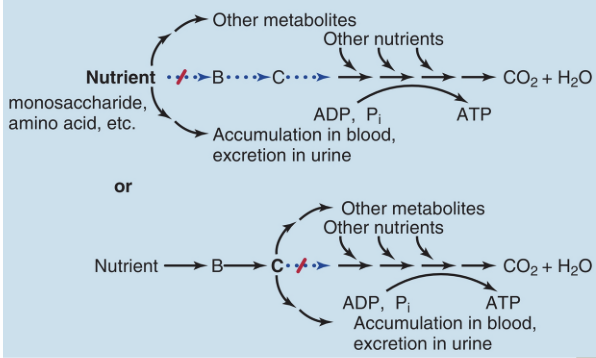
Catabolic Pathway: Depends on where deficient enzyme is in pathway; Deficiency of an enzyme in a major, ATP-producing catabolic pathway causes serious problem to cells that depend on pathway for energy.
A ________ is a disorder where a cell cannot properly break down or process a certain substance (usually macromolecules), so that substance accumulates (is “stored”) inside the cell.
storage disease
Enzyme deficiancy pathways:
Degredation of a macromolecules
The undegraded molecule C accumulates, mostly within the cells resulting in a storage disease.
What is the enzyme deficiancy is the following?

Degradation of a Macromolecule: The undegraded molecule C accumulates, mostly within the cells resulting in a storage disease.
Pathophysiology of vitamin defiancies?
Limits production of vitamin-derived coenzymes (NAD, FAD, CoA)
Pathophysiology of toxins (cyanide)?
Inhibition of metabolic enzymes: mitochondrial cytochrome oxidase
Pathophysiology of endocrine d/o: Diabetes?
Insufficient insulin action
effect of vitamin deficiencies?
Metabolic pathways are deprived of essential coenzymes
effect of Toxins: Cyanide?
Blocks cell respiration
effect of diabetes?
Disruption of pathways in carbohydrates & fat metabolism
Which type of metabolic regulation is considered the fastest in response to changes in metabolic pathways?
a) Protein synthesis or degradation at the DNA level
b) Allosteric effector binding to enzymes
c) Phosphorylation by kinases
d) Dephosphorylation by phosphatases
e) Transcription factor activation
b) Allosteric effector binding to enzymes
traits of glucose
Most abundant monosaccharide in diet
Made from other monosaccharides
Made by breaking down glycogen (storage polysaccharide)
Made from amino acids & other non-carb structures
traits of glucose transport
Glucose is not sufficiently lipid soluble to enter cells via simple diffusion (“passive” transport) across the plasma membrane
Glucose is bulky and tends to form H+ bonds (hydrophilic).
How does dierary glucose enter interstitial mucosa?
via sodium cottransport (“facilitated diffusion”)
Q: How does dietary glucose enter intestinal mucosal cells?

A: Through Na⁺-glucose cotransport (SGLT), driven by the Na⁺ concentration gradient.
Q: What drives Na⁺-glucose cotransport in the intestine?
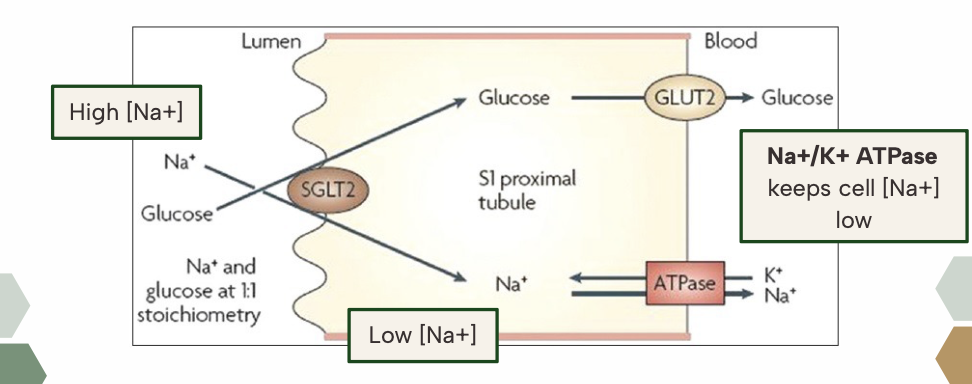
A: Na⁺ moving down its concentration gradient from high Na⁺ outside → low Na⁺ inside the intestinal cell. This movement provides the energy to bring glucose into the cell.
Q: What maintains the Na⁺ gradient needed for intestinal glucose absorption?

A: The Na⁺/K⁺ ATPase, which uses ATP to pump Na⁺ out of the cell, keeping intracellular Na⁺ low.
Q: How does glucose leave the intestinal cell and enter the blood?

A: Through GLUT2 by facilitated diffusion, moving glucose down its concentration gradient.
Q: What is the key difference between dietary glucose transport and circulatory glucose transport?

Dietary glucose: enters intestinal cells through Na⁺-glucose cotransport (SGLT).
Circulatory glucose: enters cells through GLUT transporters by facilitated diffusion.
Steps of fascilitated diffusion of glucose?
Glucose binds to the transport protein (GLUT)
Binding of glucose causes conformational change.
Glucose dissociates from the transport protein and is released.
Transport protein returns to its original conformation.
How does glucose move?
It moves down its concentration gradient and does not require ATP
(glucose binding itself causes the transporter to change shape.)
Dietary glucose in the intestinal lumen is absorbed into an intestinal mucosal cell primarily through which mechanism?
A. Simple diffusion through the lipid bilayer
B. GLUT2-mediated facilitated diffusion
C. Na⁺-glucose cotransport through SGLT
D. Na⁺/K⁺ ATPase-mediated glucose transport
E. ATP-dependent glucose pumping
Answer: C. Na⁺-glucose cotransport through SGLT
Why: SGLT uses the Na⁺ concentration gradient to bring Na⁺ and glucose into the intestinal cell together.
What directly provides the driving force for glucose uptake through the intestinal Na⁺-glucose cotransporter?
A. Hydrolysis of ATP by SGLT
B. Movement of K⁺ down its concentration gradient
C. Movement of Na⁺ down its concentration gradient
D. Movement of glucose down its concentration gradient
E. Hydrolysis of GTP
Answer: C. Movement of Na⁺ down its concentration gradient
Inhibition of the Na⁺/K⁺ ATPase in an intestinal epithelial cell would eventually decrease dietary glucose absorption because:
A. GLUT2 requires ATP directly
B. Intracellular Na⁺ would increase, reducing the Na⁺ gradient
C. Extracellular glucose concentration would decrease
D. SGLT would begin pumping glucose out of the cell
E. Intracellular K⁺ would increase and inhibit GLUT2

Answer: B. Intracellular Na⁺ would increase, reducing the Na⁺ gradient
After glucose enters an intestinal mucosal cell through SGLT, how does it primarily leave the cell and enter the bloodstream?
A. Na⁺/glucose cotransport
B. Simple diffusion
C. Na⁺/K⁺ ATPase
D. GLUT2-mediated facilitated diffusion
E. Primary active transport
Answer: D. GLUT2-mediated facilitated diffusion
Which statement best distinguishes the transport of dietary glucose from the transport of glucose already present in the circulation?
A. Both require Na⁺ cotransport to enter cells
B. Dietary glucose uses SGLT in intestinal absorption, whereas circulating glucose generally uses GLUT transporters
C. Dietary glucose uses GLUT2 to enter intestinal cells from the lumen
D. Circulating glucose requires direct ATP hydrolysis by GLUT transporters
E. Dietary glucose crosses the intestinal membrane by simple diffusion
Answer: B. Dietary glucose uses SGLT in intestinal absorption, whereas circulating glucose generally uses GLUT transporters
A mutation causes the Na⁺/K⁺ ATPase of an intestinal epithelial cell to become significantly less active. Which sequence of changes would be expected?
A. ↓ intracellular Na⁺ → ↑ Na⁺ gradient → ↑ glucose absorption
B. ↑ intracellular Na⁺ → ↓ Na⁺ gradient → ↓ SGLT-mediated glucose uptake
C. ↑ intracellular Na⁺ → ↑ Na⁺ gradient → ↑ glucose absorption
D. ↓ intracellular Na⁺ → ↓ GLUT2 activity → ↓ glucose absorption
E. ↑ intracellular K⁺ → ↑ SGLT-mediated glucose uptake
Answer: B. ↑ intracellular Na⁺ → ↓ Na⁺ gradient → ↓ SGLT-mediated glucose uptake
pathway of Na+/K+ ATPase intracellularly
Na⁺/K⁺ ATPase keeps intracellular Na⁺ LOW → creates Na⁺ gradient → Na⁺ enters through SGLT → glucose comes with it.
A glucose molecule enters a cell through a GLUT transporter by facilitated diffusion. Which event occurs immediately after glucose binds to the transporter?
A. ATP is hydrolyzed
B. The transporter undergoes a conformational change
C. Glucose is phosphorylated
D. The transporter is degraded
E. ADP binds to the transporter
Answer: B. The transporter undergoes a conformational change
Which statement best describes glucose transport by facilitated diffusion?
A. Glucose moves against its concentration gradient using ATP
B. Glucose crosses directly through the lipid bilayer without a protein
C. Glucose moves down its concentration gradient with the assistance of a membrane transport protein
D. ATP binding causes glucose to move through the transporter
E. Glucose movement requires phosphorylation of the transporter
Answer: C. Glucose moves down its concentration gradient with the assistance of a membrane transport protein
A mutation allows a glucose transporter to bind glucose normally but prevents the transporter from undergoing a conformational change. What would most likely occur?
A. Glucose would still cross normally because ATP provides the necessary energy
B. Glucose would be unable to efficiently cross the membrane through this transporter
C. Glucose would begin moving against its concentration gradient
D. The transporter would convert glucose into ATP
E. Glucose would diffuse directly through the lipid bilayer at the same rate
Answer: B. Glucose would be unable to efficiently cross the membrane through this transporter
A researcher observes glucose moving through a membrane protein from an area of high glucose concentration to an area of low glucose concentration. The membrane protein repeatedly changes conformation during transport, but ATP consumption does not increase. Which mechanism best explains this observation?
A. Primary active transport
B. Secondary active transport
C. Simple diffusion
D. Facilitated diffusion
E. Endocytosis
Answer: D. Facilitated diffusion
Which change would most directly prevent a GLUT transporter from completing one cycle of facilitated glucose transport?
A. Preventing ATP hydrolysis
B. Preventing ADP formation
C. Preventing glucose from binding to the transporter
D. Increasing intracellular ATP
E. Increasing mitochondrial ATP production
Answer: C. Preventing glucose from binding to the transporter
Which sequence correctly describes facilitated diffusion of glucose?
A. ATP hydrolysis → glucose binding → conformational change → glucose release
B. Glucose binding → ATP hydrolysis → glucose release → conformational change
C. Glucose binding → conformational change → glucose release → transporter returns to original conformation
D. Conformational change → ATP binding → glucose binding → glucose release
E. Glucose phosphorylation → glucose binding → ATP hydrolysis → glucose release
Answer: C. Glucose binding → conformational change → glucose release → transporter returns to original conformation
Q: What drives glucose transport by facilitated diffusion, and why does it not require ATP?
A: The glucose concentration gradient drives transport. Glucose moves from high → low concentration through a GLUT transporter, so ATP is not required.
GLUT1 is expressed where?
most tissues
what is the function of GLUT1?
Basal glucose uptake
GLUT2 is expressed where?
Liver, intestine, pancreatic β-cells
Function of GLUT2?
High-capacity glucose uptake
GLUT3 is expressed where?
Brain
GLUT3 function
Neuronal glucose uptake
Where is GLUT4 location?
Muscle, adipose tissue, heart
GLUT4 function
Insulin-dependent glucose uptake