BIO CH 2
 Call Kai
 Learn
Learn Practice Test
 Spaced Repetition
 Match
Match Flashcards
 Knowt Play
1/34

There's no tags or description
Looks like no tags are added yet.
Name | Mastery | Learn | Test | Matching | Spaced | Call with Kai | Chat |
|---|
No analytics yet
Send a link to your students to track their progress
35 Terms
What is an atom?
basic building block of all physical matter in the universe
What is a molecule?
a group of atoms held together (bonded) by energy in a stable association
Atomic Structure
Protons ( + charge) in nucleus
Neutrons ( no charge) in nucleus
Electrons (- charge) found in orbitals surrounding nucleus
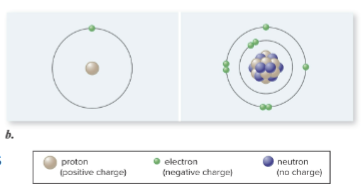

Be able to identify atomic #, symbol, and mass
Atomic Number gives you the what?
Number of protons
Atomic mass gives you the what
amount of matter in an atom
Ions
Charged particles (unbalanced)
Cation: + charge, looses electrons
Anions: - charge, gains electros
change in particle dictates how it behaves in the body
What is an Isotope?
Have same # of protons but different neutrons
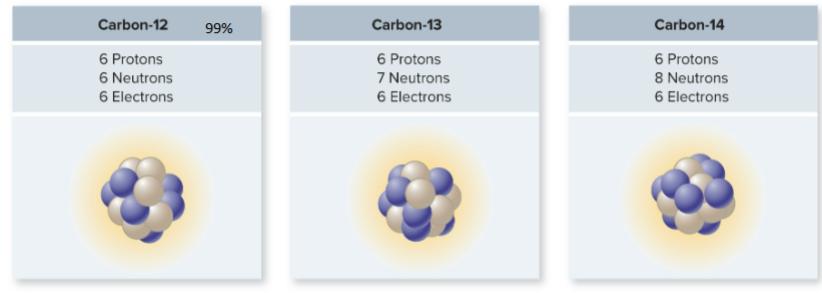
Radioactive Isotopes
unstable and emit radiation as the nucleus breaks up (radioactive decay)
Electron Arrangement
Key to the chemical behavior of an atom lies in the number and arrangement of its electrons in their orbitals
Electron energy levels
Electrons have potential energy related to their position
• Electrons farther from nucleus have more energy
Valence electrons
Outermost orbital
when shell is full (8) atom is stable
Inert elements (nonreative)
have a full valence shell and are stable
Molecules
groups of atoms held together (bonded) in a stable association
Compounds
molecules containing more than one type of element
Ionic Bonds
Opposites attract
gain or loss electrons
Transfer of electorns
Covalent Bonds
Formed when atoms share 2 or more electrons
more electrons share = stronger bond
Hydrogen Covalent
covalent bond
no net charge
octet rule satisfied
Properties of covalent bonded molecules
Very strong
requires energy to break
low boiling points
Typically, not soluble in water
Non-polar covalent bonds
share electrons equally
Polar covalent bonds
Share electrons unequally
Hydrogen Bond
form when a partially charged atom is attracted to hydrogen ( weak bond)
What is a chemical reaction?
Involves formation or breaking of bonds
Reactants
Original molecules
Products
Molecules resulting from reaction
Water
ability to from hydrogen bonds (b/c molecule is partially charged)
bond is strong enough to keep it together but weak enough so its constantly moving
Water has specific heat
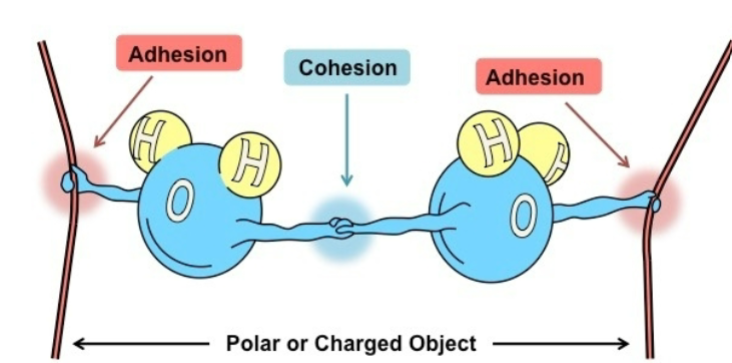
Adhesion and Cohesion in water
Cohesive: water moleculs attract to one another
Adhesion: attract to other polar molecules
What is pH
Used to measue the amount of Hydrogen in a solution
what is an acid
substance that increases hydrogen atoms
What is a base
substance that decreases hydrogen atoms
Whats the blood pH? Why must the body maintain certain pH?
7.35-7.45
To maintain homeostasis
If pH changes what can occur?
proteins can begin to denature (unfold)
What are buffers?
substances that resist changes in pH
goal: to keep Hydrogen atoms constant
biological buffers consist of what?
pair of molecules, on an acid and the other a base.
Carbonic acid buffer system
Helps out bodies transport CO2 and O2 in our bodies
Keeps the blood at a certain pH