Molecular biology and Genetics Midterm 1
 Studied by 0 people
 Call Kai
 Learn
Learn Practice Test
 Spaced Repetition
 Match
Match Flashcards
 Knowt Play
1/113

There's no tags or description
Looks like no tags are added yet.
Name | Mastery | Learn | Test | Matching | Spaced |
|---|
No study sessions yet.
114 Terms
How did Mendel jumpstart field of modern genetics?
Conducted systematic experiments and analysis using replicates and controls including applying statistics
How did we determine dates of domestication and the birth of agriculture?
When plants and animals are domesticated, they are being selectively bred. This can cause marked genetic changes in these organisms
Examples
Figs
discovery of seedless figs in Jericho 11,400 yrs ago
Called parthenocarpic figs
Since seedless plants should be at a disadvantage, this indicates that they had been manually vegetatively propagated.
Horses
Images of spotted horses → did exist prior to domestication
Previously believed to not exist before domestication because the mutation causing spottedness also causes blindness in horses
Extracted bone marrow from spotted horses
Indicated that they were not selectively bred
Spotted horses did not have any other characteristics of domestication
Common Phenotypic changes associated with domestication
No seeds in plants
Piebald spotting
Lack of coloring in an area on the head → indicates changes to neuro
Floppy ears
Indicates change in connective tissue
Dogs and Siberian Fox Experiment
aken over by Cornell after fall of Soviet Union
Siberian Fox experiment aimed to try and recreate dog from foxes
Bred aggressive foxes with aggressive foxes and softer foxes with softer foxes → resulted in genetic changes over time
Selected for juvenile traits, many traits in domesticated animals are juvenile traits
Same process by which animals were domesticated for agricultural purposes
Mendel Sheep Experimentation
Mendel compared domesticated sheep and goats with non domesticated versions of these animals
Mendel’s question → what is inherited and how?
Interest for Mendel
Creation of hybrids in both plants and animals
Could be interspecies hybrids or hybrids between different strains
Hybrids over multiple generations were found to be unstable
Instability of hybrids was a big question for Mendel and other researchers
Unstable hybrids do not maintain the desired phenotype over several generations
Under advising of Napp and Nestler, two sheep breeders in his monastery, Mendel conducted experiments
Were breeding their sheep for wool softness and mutton production
Alternate theories about life
some people believed that life could come from inorganic matter, which was disproved
discontinuous traits
can only be either or
Three hypotheses for genetics
Uniparental (only one parent gives factors to offspring)
Blending (bi parental, but mixes traits)
Particulate (bi parental but no mixing of traits)
uniparental (preformationist)
Spermists → Everything needed for an organism is contained within sperm. Female just provides environment that is suitable for the organism to develop
Ovists → Everything needed for an organism is in the egg. Sperm just provides incentive for the egg to develop
blending genetic theory
Sperm and egg come together and blend in the hybrid
Stresses fusion and idea of stable hybrids
Focuses on the idea that by blending, a new thing is being formed
Ex. mixing paint blue and yellow = green and then should stay green forever
The problem was that there were red + white flowers being bred to make pink flowers, but the next generation may be red, pink or white
Gave rise to particulate hypothesis
particulate theory (mendel’s, right)
Strains must be pure/true breeding (homozygous) for specific discontinuous phenotypes that are easily identified and clearly different between different striains
Must be an easy way to ensure paternity
Good that he picked pea plants because they need to be fertilized before they bloom
Tend to self fertilize
Mendel cut stamen in some pea plants while they were still buds to ensure paternity
All genotypes should be equally fertile
“proposes that traits are passed from parents to offspring through discrete, unchanging units called genes. Unlike the earlier "blending" theory, this model suggests that these genes do not merge but are sorted and passed down in their separate identities, and recessive traits can be masked but are not lost forever”
Law of dominance
Phenotype transmitted entire or almost unchanged → dominant
Disappear in hybrids → recessive
“when an organism has two different alleles for a trait, one allele (the dominant allele) will mask the expression of the other allele (the recessive allele), resulting in the expression of the dominant phenotype”
How did Mendel disprove ovists and spermists
results did not show that the female/male trait was dominant (trying to cross specifically with female with the trait or male with the trait) and it was found that the trait itself was dominant and not the ‘female trait’ or ‘male trait’
How did Mendel disprove blending believers
F2 generation shows reappearance of the recessive trait
How did mendel disprove blending theory
plants still ended up white or purple, none were lilac or pale purple etc
All white flowers were true breeding and homozygous
Mendel’s Law of Inheritance
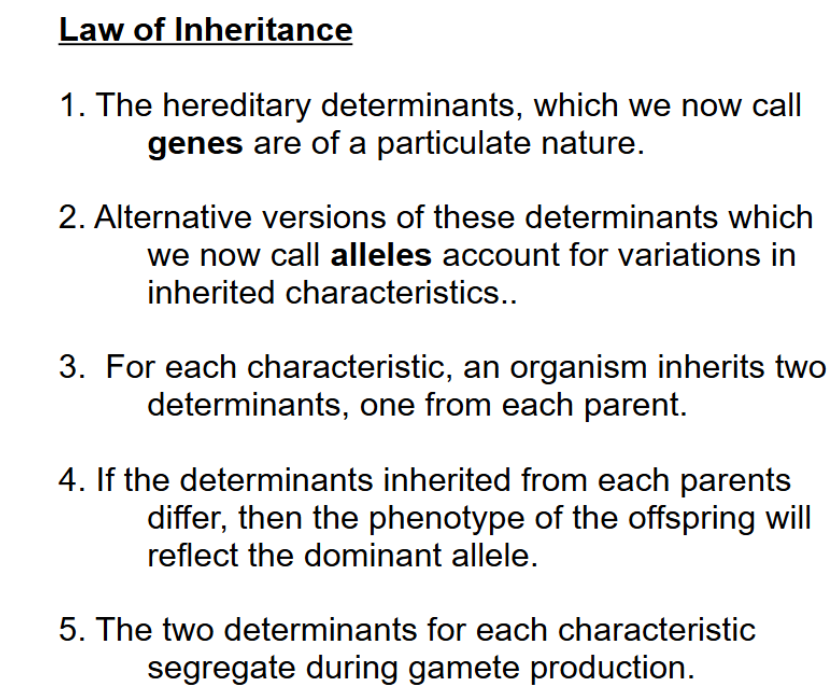
Genes tend to be named for which allele?
Recessive
Different opinions on what hereditary material is
Darwin → circled around stoma and coalesces in gonads during mating
Galton → blood, transfused blood between rabbits thinking they would change traits
Weissman → germline passed on genetic information
Boveri and Sutton →found chromosome reduction in meiosis → oogenesis
Used light microscopy observing cell nuclei in grasshopper testes
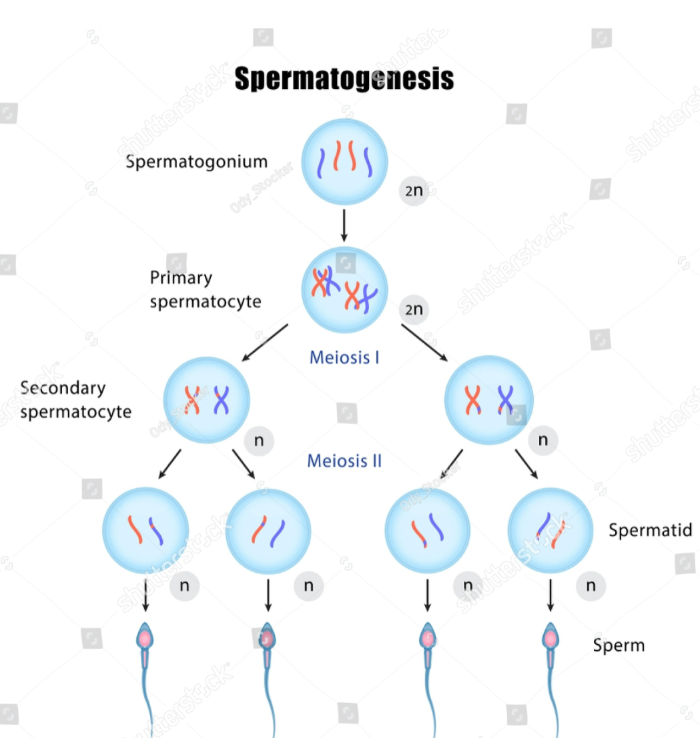
Found evidence of meiosis reducing chromosome number in gonads → spermatogenesis
spermatogenesis
Cis and trans orientation
During meiosis
dominant and dominant allele together, recessive alleles together
Law of Segregation
alleles for a trait separate during gamete formation
during gamete formation (sperm and egg), the two alleles (gene versions) for each trait separate, so each sex cell receives only one allele, ensuring offspring get one allele from each parent
Mendel → Chromosomal Theories
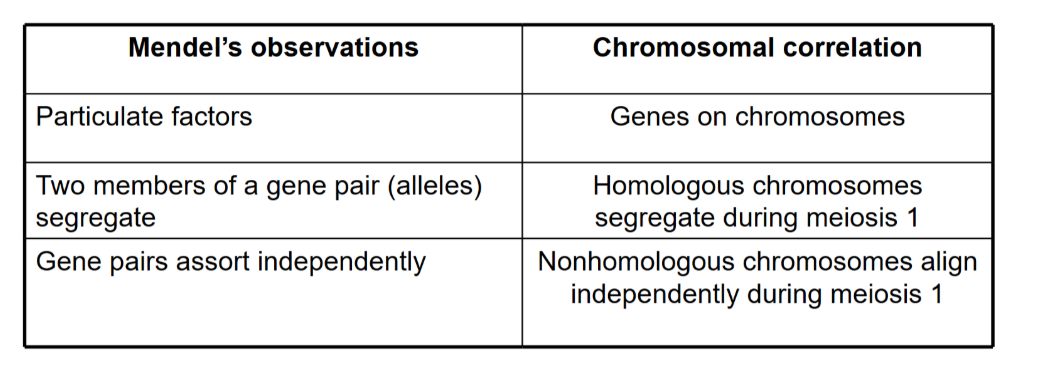
Morgan and Bridges → fly studies
first to provide data of hereditary traits
chromosomal basis of sex in flies, found X linked white eyes trait in flies
Looked at the few flies in his group that had white eyes → flies with white eyes turned out to be male
Crosses white male with red female
Got 100% red eyed flies
Understand red to be dominant to white
In the next generation males have white eyes in a 1:1 ratio to males with red eyes
Slightly off because white eyed flies are less viable bc the gene responsible for making flies have red eyes is also involved in neural development
He thinks this means the trait is linked to the x chromosome
Once he got a white eyed female, he crossed them with males with red eyes
Found that all the males had white eyes and all the females had red eyes
This helped to show that the gene mutation was x linked and therefore was more prevalent in males
After genotyping finds some rare classes
Male with red eyes that are sterile (Only has one sex chromosome X and no Y, and got the X from the father)
Females with white eyes that are sterile (Has three sex chromosomes XXY, and got two X chromosomes from the mother and no X chromosomes from the mother)
These were results of nondisjunction
Rare examples further proved that the rare eye color gene is contained on the x chromosome
Observation of linked traits, flower example
Bateson, Punnett and Saunders
Studying red and purple flowers
After breeding for stamen height and color between two different ones found that the ratio resulting from crossing the two did not match independent assortment
Found
Heterochromatic knob and translocation in corn
“Barbara McClintock's landmark 1931 study with Harriet Creighton used the conspicuous heterochromatic knob on maize chromosome 9 to provide the first direct physical proof of genetic recombination (crossing over) and chromosome translocation, linking visible traits (like kernel color/starchiness) to specific physical exchanges between chromosomes, demonstrating that genes aren't just linked but can physically swap locations”
Found that these two phenotypes correlated with kernel phenotypes
Found that certain combinations of traits were not possible
Colorless waxy and colored starchy were not found
Found that despite crossing over
Saw a few examples physically of crossing over between chromosomes
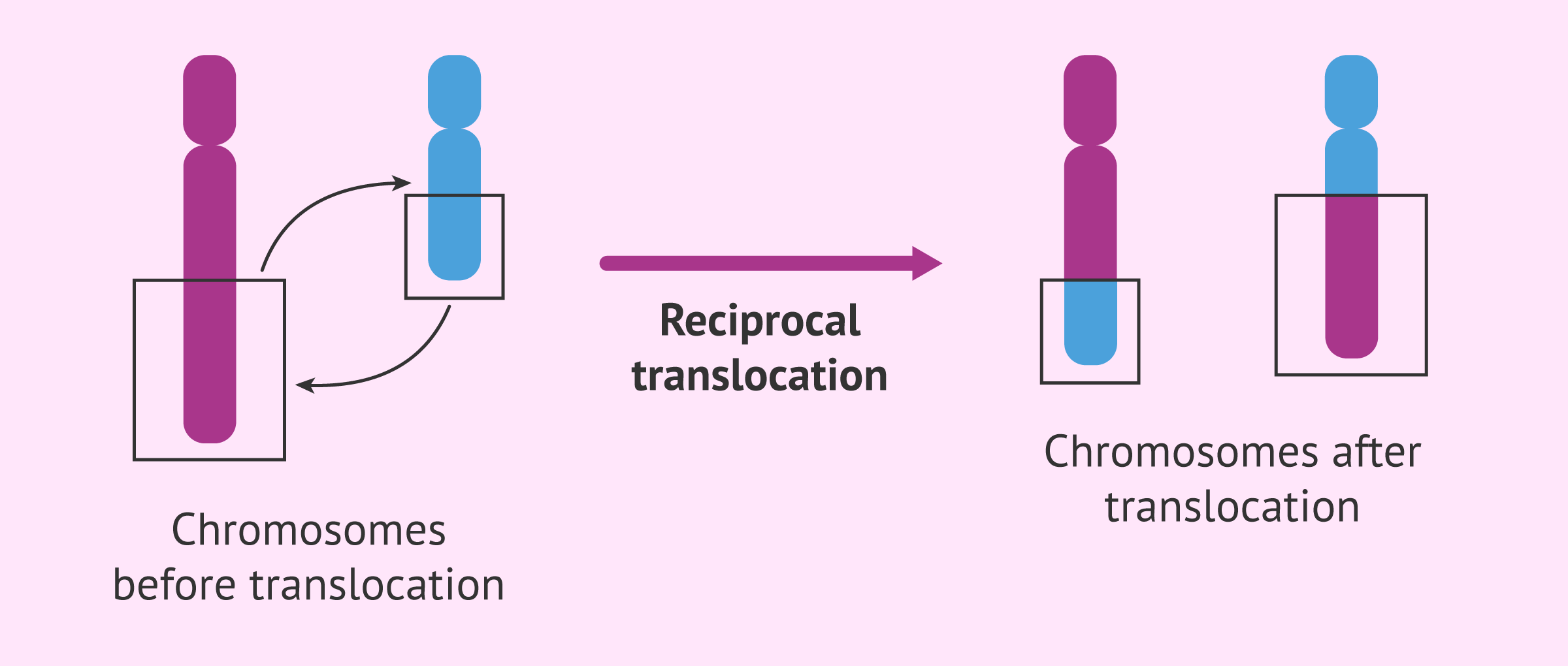
translocation
the genetic process where a piece of one chromosome breaks off and attaches to a different chromosome
“Translocation is the movement of a piece of one chromosome to a different, non-homologous chromosome, often causing a genetic abnormality”
Pedigree female
CIRCLE
Pedigree male
square
Double line
incest
Dot in center of person
heterozygosity
Proband/propositus
individual presenting with a specific phenotype that the consultand wants to have their genes analyzed
Consultand
person who approaches genetic counselor
Alternate sex/chromosomal approaches
sex is determined by female and are the heterogametic sex
Males are ZZ and make sperm
Females are ZW and make egg
In these organisms, females would be more affected by disorders that are Z linked
How do biologists determine sex?
who makes sperm? = male
who makes egg? = female
Hardy Weinberg Equation
p² + 2pq + q² =1
Penetrance
percentage of individuals with a specific genotype that will develop or express the mutant phenotype
Expressivity
Degree to which an individual with a specific genotype displays the mutant phenotype
Microsatelite Region
Microsatelite region -> Repeat regions are prone to expansion or contraction
The repeat region can cause the polymerase to stutter
Creates polymorphism
If it’s all the time → poor marker
If it’s occasional -> good marker
Pseudoautosomal Region
XY → on y chromosome but there is a corresponding region on the X chromosome
Homologous between X and Y → pseudo autosomal region
This region can be protected from inactivation
“a small, homologous segment on the tips of the human X and Y chromosomes where they pair and recombine during meiosis, behaving like autosomes rather than sex chromosomes, allowing genes within these regions to be inherited non-sex-linked, escaping X-inactivation and present in two copies in both sexes”
my understanding - since theyre both activated on x and y chromosomes, these regions can also both be activated on both regions for females (in females, there tends to be x chromosome silencing to match expression of males) this is what it means by escaping inactivation
why are repeat genetic regions used as markers?
Repeat regions in the genome are less stable than other regions so they can be used as markers
They are also more prone to mutation → polymorphic
Capillary electrophoresis
gives a decimal number of the number of base pairs in the DNA region/sample
Allele binning
label the smallest result in a pedigree as 1, and then the largest as 4 and then number upwards and label
Allele binning in genetics involves grouping similar genetic variants (alleles) by size or function, especially for markers like microsatellites, to simplify analysis, while pedigrees visually map family inheritance patterns to track traits or diseases across generations
FA on polar body testing results
failed PCR amplification
Whatever allele the second polar body gets, the egg will get the __________.
opposite
Polar body testing and oocyte
Whatever the second polar body gets, the egg must get the opposite
Ex. if 2nd polar body gets the WT allele, then the egg will get mutant
Homozygous for the allele, no recombination = write down only once
Increased peak size or band thickness → indicates this
Nondisjunction in the polar body for 10 shown
The oocyte would get no alleles and the 2nd polar body got both
Then oocyte is not viable
How does recombination affect relationship between second polar body genotype and the ootid genotype
Without recombination → ootid genotype is the same as the genotype of the second polar body
With recombination → ootid genotype is opposite genotype of the second polar body
Allelic series
multiple different kinds of alleles for a trait
Writing one gene on one chromosome

Writing two genes on one chromosome

Writing two genes on two chromosomes

An allele is dominant if ____________ + example
An allele is dominant if it has the same phenotypic effect in heterozygotes and homozygous
Example with flies → red eyes are the same in both +/+ and w/+
w/w is white
plus means
WT
haplosufficient
Those loci are haplosufficient
Only need one copy of the gene in order to achieve the wild type phenotype
Dominant allele (+)
an allele that expresses its phenotypic effect even when heterozygous with a recessive allele
Recessive allele (w)
an allele whose phenotypic effect is not expressed in heterozygote
Graph depicts amount of pigment made by each genotype of fly → can see that there is a threshold to depict the trait
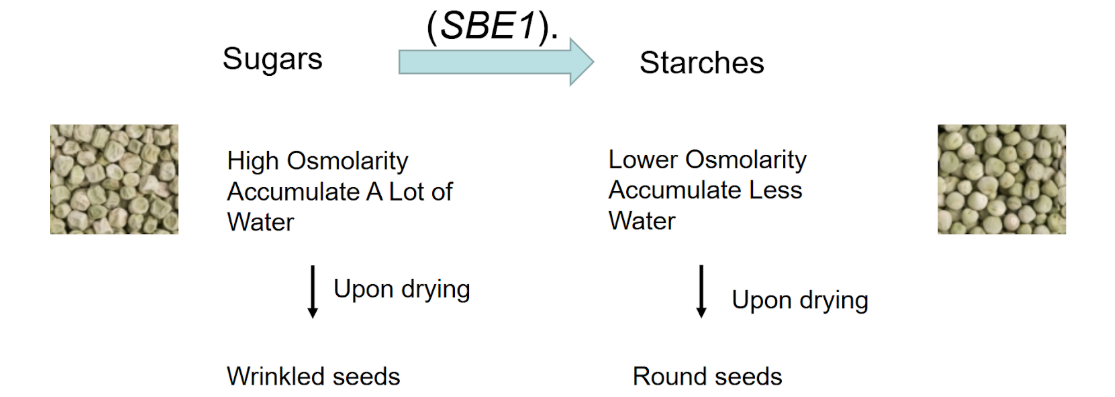
Wrinkled vs Round Peas
Because round ones have lower osmolarity to start with, they have less water to lose meaning they maintain a more round shape
Because wrinkled ones have higher osmolarity to start with and they have more water to lose, the loss of water causes a more noticeable physical effect.
Wrinkled peas are homo for an insertion in the SBE1 coding sequence that disrupts the function of the gene that converts the sugar to starches
Means that they have no functional starch branching enzyme, because the sugars can’t get converted into starches they just have sugars
All loci that Mendel studied were ___________
All of the loci that Mendel studied were haplosufficient, and all of the mutant alleles are loss of function
Haploinsufficient Gene + Examplez
In a diploid cell, a gene that can promote wild type function with only one functional copy (common)
Example in people
PAH human
Loss of one copy -> normal
Loss of both gene copies → end up with PKU disease
Disease (phenotype is inherited as a Mendelian recessive disorder
Haploinsufficient
In diploid cell, gene that cannot promote wild-type function with only one functional copy (rare)
Example in people
Connective tissue disorder making people tall, long-limbed, predisposed to aortic tearing
Loss of one gene copy → Marfan syndrome
Loss of both gene copies → very rare and lethal
List all of Mullers Morphs
amorph, hypomorph, hypermorph, neomorph, antimorph
Loss of function mutations
amorph, hypomorph
Gain of function mutations
hypermorph, neomorph, antimorph
Amorph
complete loss of a functional product (null)
Hypomorph
incomplete loss of function (leaky)
hypermorph
increase in normal function
Neomorphs
new function, often with loss of normal function
Antimorph
opposes the wild type function (dominant negatives)
“genetic mechanism where a mutated gene product interferes with the normal function of the wild-type gene product, leading to a more severe loss of function than if the gene were simply non-functional”
Dominant negative
antimorph, “genetic mechanism where a mutated gene product interferes with the normal function of the wild-type gene product, leading to a more severe loss of function than if the gene were simply non-functional”
What did Muller do/find?
Exposed flies to x-rays
Collected flies that had different colored eyes due to different mutations in the white gene (on scale from white, apricot etc… red)
White ones were complete homozygous → zero functional protein made
Found that the wild type was dominant to all of the alleles and it was a haplosufficient locus
Used deletions and rearrangements as tools for his experiment
Found some chromosomes with complete deletion of the white locus
Something about banding that I didn’t catch
Referred to as a deficiency chromosome in flies
Found some mini X chromosomes
Only contained centromere and the white coding region
More
White apricot was incompletely dominant to white
Transheterozygote → two different alleles to the same gene
Those with one white apricot allele had less function than both apricot but more than white
Indicates that white apricot has some more function
He found a hierarchy of the white eye alleles in these flies
All these flies were females though
He next did experiments with males
What did Muller do to males?
Instead of silencing the X in the females, they amplify the X in males (hyperactivation)
White apricot in male looked just like the white apricot in females that were homozygous
This because the males are upregulating the expression on that chromosome
Added mini X chromosome to some females and gave them three copies of apricot
Allowed them to look more close to the wild type
In males
Added mini chromosome to make XxY flies
The mini x chromosome was not enough to make the males female
He was finding these flies with these genotypes naturally ??
Transheterozygote
carrying two different mutant alleles for the same gene
Flies and eyes, distinguishing amorphic and hypomorphic alleles
Looking at the presence or absence of an eye in flies
Typical for alleles to be of different strengths
Weak allele (weak hypomorph)
Strong alleles (strong hypomorphs)
Null alleles (amorphs)
Hypomorph gene/hypomorph was wild type
Enhancer screen
e^+ / e^ null → wildtype
Mutagenize these
Everything else ends up +/+, +/e^h, e^h/e^n
Ended up with some with an intermediate phenotype
Way to isolate hypomorphic alleles
Hypermorph → what would you expect the phenotype to be of a fly that is B/def?
Neomorph in depth with examples
Most neomorphs are giving a new function because it’s expressed in a time or place where is usually is not
Example of sickle cell anemia
People who are homozygous for mutation related to making a subunit of hemoglobin
Make a hemoglobin susceptible to lower oxygen levels
Usually fetal hemoglobin gene turns off and then you get adult hemoglobin
People with sickle cell have some persistence of the fetal hemoglobin
Neomorphic because it’s expressed at a time when it shouldn’t be
Example of lactase persistence
Ability to breakdown lactase in milk should usually turn off around the age of 10 years old
Due to single point mutation C → T caused lactase persistence and lactose tolerance
New alleles for lactase persistence are emerging in subsaharan african populations where keeping cattle is relatively new
Antimorph in depth with examples
Loss of normal function and opposes the wild type function
Very useful to knock out wild type function
Example in fly eyes
Antimorphic dominant negative mutation in sine oculis (so)
+/+ → normal eye
so/so → poor eye development
soD/+ –. Small eye development
soD/ added so+
In antimorph version →Transcription factor binds to promoter region but is unable to recruit the coactivator → sits on promoter region and blocks access even if heterozygous
Think about breaking your key off in the lock, then you can’t even use a spare key
protooncogenes
Gene inserts randomly into the genome
The mutant copy is still present in the genome
Most dominant inherited diseases are probably..
semidominant
Gene therapies
gene augmentation therapy, gene inhibition therapy
Gene Augmentation Therapy
Insert a functional gene into a cell with a nonfunctioning gene
Treat amorphs and hypomorphs
Treat cystic fibrosis
Gene inhibition therapy
Insert a blocking gene that will allow the functional gene to act normally
Can be used to treat hypermorphs and neomorphs and antimorphs
Cancer caused by proto oncogene mutation
Which are more common, completely dominant or semi/incompletely dominant genes?
Semidominant / incompletely dominant genes
Recessive lethality example in cat
Gene in cats relating to their tails
tt or mm is wild type
Tt or Mm is a tail-less cat
TT or MM is dead
Phenotype expresses itself variably
Can be a stub to a no tail to losing vertebrae to form rectum
Manx cat development = shortening of the vertebrae
MM → dead
semidominance example, flowers
white pink red flowers
Why not increase the gene dosage so that even when you lose a copy you would still be above the threshold?
Too much and too little both will have deleterious effects
Result of incomplete dominance
leads to a continuum of different phenotypes
Phenotype varies in proportion to the amount of gene product
Bistability
two genes work to modulate and stabilize each other with their products
If you have only one functional copy (null/+ or def/+) = making 50% of gene product?
Almost never true, but there are some examples
Bistability is common in developmental loci
Threshold is around wildtype level so that having one copy doesn’t matter
In which loci is bistability common?
developmental loci
Order of Actions for determining flies
Order of things to do
1) Cross the mutant found back to the wildtype
2) Look at phenotype of the F1 individuals
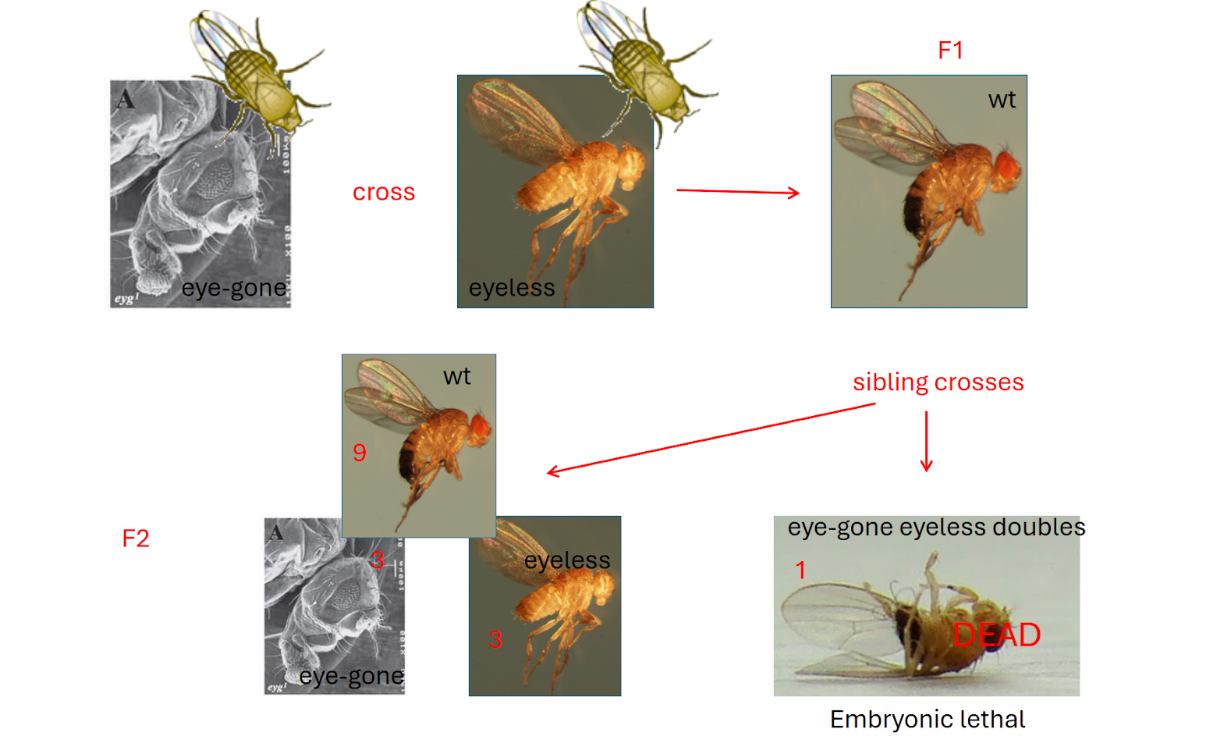
ey/ey (eyeless) or eya/eya (eyes absent) X with wildtype resulted in all wildtype offspring
What can we conclude?
Indicates recessivity of this gene
Indicates that both loci are haplosufficient
Recessive alleles = easier to work with
3) Cross eyes absent flies with eyeless flies and look at the phenotype
Cross and find that F1 generation all has eyes (wildtype)
Indicates that they are different genes
If it was the same gene then F1 would be eyeless
Since they are different genes they are in two different complementation groups
4) Sibling crosses
Expect 9:3:3:1 ratio
9 WT, 3 Eyes absent, 3 eyeless, 1 double eyeless/eyes absent
Double mutant looks like eyes gone
5) Cross eyes gone to wild type
eyg/eyg x WT → all wildtype in F1
6) Sibling cross
Eyes gone and eyesless doubles are dead
synthetic lethality and fly eyes
Indicates that eyes gone gene would have another function that is essential for life
Arrest early in larvae development, they don’t make a properly functioning head and nervous system
Example in humans and drosophila of synthetic lethality
Genetic redundancy
RAD52 family gene
Loss of RAD52 OR RAD 59 is tolerated because the other can partially compensate
However, double mutants are inviable because homologous recombination repair of double strand breaks is completely crippled
Drosophila tubulin isoforms (aTub84B and aTub84D)
Functionally redundant
Mutation in one is tolerated but double mutants are lethal because no alpha tubulin protein remains to form microtubules
Built in redundancy is a simple explanation for synthetic lethality
Some are not paralogs or orthologs
conditional expression
Epistasis
type of interaction between the alleles of different genes,
Phenotype of individuals with mutations in two different genes are analyzed
Deviates from 9:3:3:1
epistasis vs dominance
Incomplete dominance/semidominance and codominance all describes a relationship or interaction between alleles of the same gene
deviation from 3: 1
Complementation testing example (forward genetics)
Plant model
Small, weedy plant with a relatively small genome, 6 chromosomes
Not a lot of redundancy compared to other model systems
Genetically tractable → can be mutagenized and cloned
Glandular trichomes produce chemical compounds for plants, ex. Cannabis, tea, mint
Visual screen for abnormal trichomes
Mutagenize by soaking in chemical compound to result in changes in DNA
Grew up seeds, put in a greenhouse, then screened for plants in which trichome structure was different from the wildtype
One was called rastafari and one was called polychome (NOT comb)
Want to see if these are alleles of the same gene or if they are different genes at different loci
If there are two different genes, then you want to know what their relationship is
Need to do a double mutant
Isolate two pure breeding lines
If the cross yields a wildtype result, we know they are both recessive
If the cross yields a mutant result, we have to stop and think
Do Rastafari and polychome lines have mutations in the same gene?
Complementation test
complementation test process
We start with recessive mutations (ideally nulls) in genes that act in the same process (have similar phenotypes)
If mutations complement (F1 is wildtype) the mutations are in different genes
If the mutations fail to complement (F1 looks like either parental) they are alleles in the same complementation group
Endoreduplication
cell copies its genome but does not reduplicate (2C → 4C → 8 C) keeps increasing the copies of its genome without dividing
trichome formation
One cell receives a signal telling them that they need to develop into a trichome
Endoreduplication→ cell copies its genome but does not reduplicate (2C → 4C → 8 C) keeps increasing the copies of its genome without dividing
Allows to make extra transcripts and proteins
Other mutation examples increased the number of rounds of endoreduplication → caused a greater number of branches to be present
Looking at polychome and rastafari, they hypothesized that this same situation was occurring in them
RFI inhibits excess endoreduplication → increased branch number
PYM inhibits excess endoreduplication → increase in branching
neurofibromatosis type 1
dominant autosomal
huntington disease
dominant autosomal
Lethal allele
An allele that causes death when homozygous is known as a:
Epistasis
When one gene masks or modifies the effect of another gene, this interaction is called: BIG POINT THAT TWO DIFF GENES
9:3:4 ratio is evidence of
recessive epistasis