ECON TEST #3
 Call Kai
 Learn
Learn Practice Test
 Spaced Repetition
 Match
Match Flashcards
 Knowt Play
1/43

There's no tags or description
Looks like no tags are added yet.
Name | Mastery | Learn | Test | Matching | Spaced | Call with Kai | Chat |
|---|
No analytics yet
Send a link to your students to track their progress
44 Terms
Total Cost
Fixed Cost + Variable Cost
Fixed Costs
Costs that remain constant as a firm’s level of output changes
Variable Cost
Costs that change as the firms level of output changes
Marginal Cost
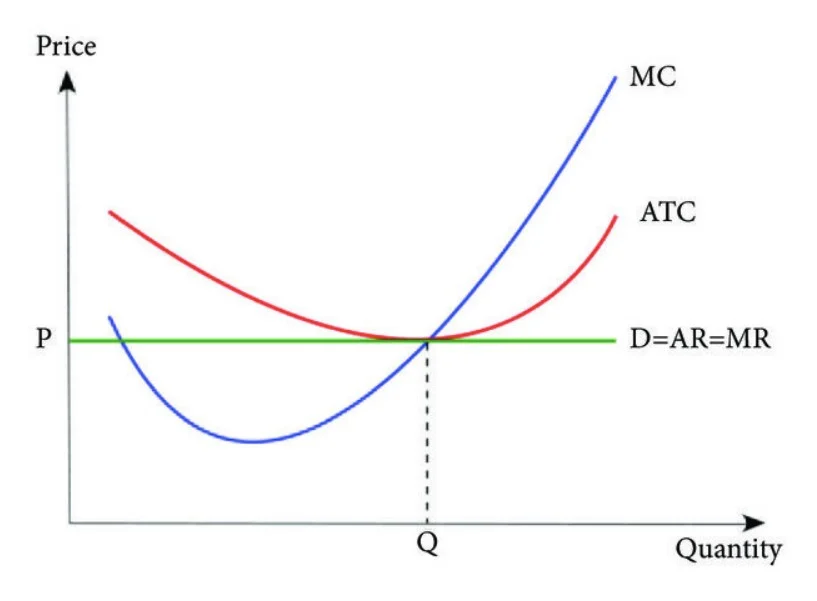
Change in Total Cost / Change in Quantity
Average Total Cost
Total Cost / Quantity
Average Fixed Cost
Fixed Cost / Quantity
Average Variable Cost
VC / Q

Implicit Cost
A nonmonetary opportunity cost
Explicit Cost
A cost that involves spending money
Marginal Product Of Labor
Change In Quantity / Change In Labor
Average Product Of Labor
Total Quantity / Quantity Of Labor
Long Run Average Cost
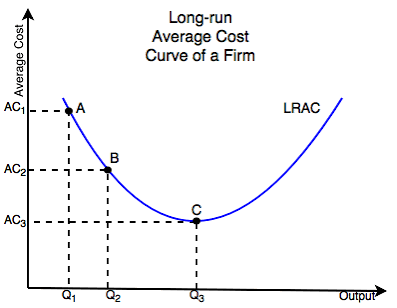
A curve that shows the lowest cost at which a firm is able to produce a given quantity of output in the long run, when no inputs are fixed.
Economies Of Scale
When a firm’s long-run average cost fall as it
increases the quantity of output produced.
Constant Returns to Scale
LARC remain unchanged as a firm increases output
Diseconomies Of Scale
When a firms LARC rises as a firm increases output.
Minimum Efficient Scale
The level of output at which all economies of scale are exhausted
ONLY in Perfectly Competitive Market:
Price = Demand = AR = MR
Market Demand Curve
Normal good, downward sloping curve

Firm Demand Curve
Perfectly elastic, many producers each a very small fraction of overall market
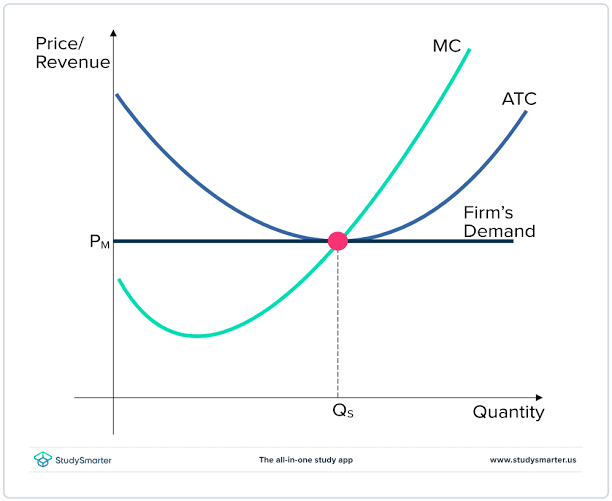
If TR > TC
Firm is making a profit
If TR < TC
Firm is experiencing a loss
If TR = TC
Break Even operations
Perfectly competitive firms are price takers
They are unable to affect the market price. This is because they are tiny relative to the market and sell exactly the same product as everyone else.
When MR = MC this is quantity where firm is receiving the
Greatest Profit
If MR > MC
Firm can make more revenue by producing another unit
If MR < MC
Firm loses money from producing last unit
Total Revenue
P* X Q*
Total Cost
PATC X Q*
If P < AVC
SHUT DOWN
Allocative efficiency
a state of the economy in which production represents consumer
preferences; every good is produced up to the point where the last unit provides a marginal benefit to consumers equal to the marginal cost of producing it.
Monopolistic competition
a market structure in which barriers to entry are low and many firms compete by selling differentiated products.
Monopoly
a market structure consisting of a firm that is the only
seller of a good or service that does not have a close substitute.
Public Franchise
Exclusive legal provider of a good or service.
Market Power
the ability of a firm to charge a price greater than marginal cost
Collusion
An agreement among firms to charge the same price or otherwise not to compete.
Antitrust Laws
Laws aimed at eliminating collusion and promoting competition among firms.
Sherman Act 1890
Prohibits “restraint of trade” including price fixing and collusion. Also outlawed cartels and trusts.
Clayton Act 1914
Prohibits mergers or price discrimination if it lessons competition.
Robinson-Patman Act
Prohibited firms from buying stock in competitors and from having directors serve on boards of competing firms. Prohibit price discrimination if the result reduces competition.
Federal Trade Commission
Unfair methods of competition and deceptive acts are made illegal.
Department Of Justice Antitrust Division 1956
Led by Economist Dr. Donald Turner who significantly impacted antitrust law through economic analysis of:
• Market definition
• Measures of concentration (Herfindahl-Hirschman
Index)
• Merger standards (impact to market concentration,
horizontal mergers, vertical mergers)
Horizontal megers
Between firms in the same industry
Vertical mergers
Between two firms at different stages of the production process
Appropriate Market
the smallest market containing the firms’ products for which an overall price rise within the market would result in total market profits increasing.