PSY389 Week 3
 Call Kai
 Learn
Learn Practice Test
 Spaced Repetition
 Match
Match Flashcards
 Knowt Play
1/52

There's no tags or description
Looks like no tags are added yet.
Name | Mastery | Learn | Test | Matching | Spaced | Call with Kai | Chat |
|---|
No analytics yet
Send a link to your students to track their progress
53 Terms
What are the two main approaches to studying the effects of AOD?
Epidemiological approach and experimental approach.
What is a major limitation of the epidemiological approach?
It cannot control variables such as dose, sampling bias, and personality.
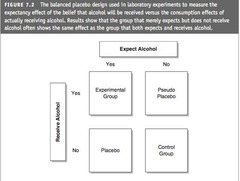
What is the balanced placebo design?
A method that separates pharmacological effects from expectancy effects by using groups that are told different information about alcohol consumption.
What are the two primary motives for AOD use?
Enhancement (to increase positive emotions) and coping (to reduce negative emotions).
How does alcohol influence mood and emotion?
Alcohol can enhance positive emotions or be used as a coping mechanism for negative emotions.
What is the impact of blood alcohol concentration (BAC) on mood?
Lower BACs can lead to euphoria and stimulation, while higher BACs can result in fatigue and negative mood.
How does alcohol affect sensory motor skills?
High doses impair visual processing, while low doses can slow attention and reaction times.
What BAC level is particularly dangerous for driving?
BAC around 0.08%.
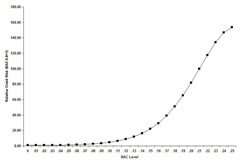
What is the relationship between alcohol and crash risk?
Crash risk increases significantly at BAC levels above 0.04 g/dL.
What are the acute effects of alcohol on memory?
Alcohol impairs working memory and can affect explicit and implicit memory differently.
What is state-dependent learning in relation to alcohol?
Recall may be improved if learning and retrieval occur in the same drug state.
How can expectancy effects influence behavior and memory?
Believing one has consumed alcohol can create perceived memory impairment and influence social behavior.
What is the significance of the ascending vs. descending BAC curve?
Timing of alcohol effects differs, contributing to variability in research findings.
What are the limitations of the experimental approach to studying AOD?
Small doses of drugs, shorter observation durations, and small sample sizes limit generalizability.
How does alcohol expectancies relate to aggression?
Individuals who believe alcohol increases aggression may exhibit aggressive behaviors when primed with alcohol-related cues.
What is the role of alcohol expectancies in shaping subjective experiences?
Expectancies can influence perceived effects of alcohol and subsequent behavior.
What factors can influence driving performance under the influence of alcohol?
Attention, reaction time, motor coordination, and individual differences in drinking habits.
What is the effect of THC on driving skills?
High doses of THC impair motor control and increase body sway, affecting driving ability.
What is the relationship between alcohol and nicotine in driving performance?
Nicotine may improve driving simulator performance by alleviating withdrawal effects.
What findings did Moller et al. (2012) report regarding substance use and self-harms?
Their findings highlight the relationship between substance use and increased risk of self-harm.
What is the significance of the study by Drummer et al. (1994) on substance use and crash risk?
It found that alcohol significantly increases crash risk, while cannabis showed a decrease in risk.
What is the impact of alcohol on risk perception?
Alcohol reduces hazard detection and increases impulsive responses.
What is the effect of alcohol on dual-task performance?
Impaired dual-task performance contributes to difficulties in driving.
What is the influence of individual differences on alcohol effects?
Moderate/heavy drinkers may experience greater stimulant effects compared to lighter drinkers at similar BAC levels.
What are the implications of the European Integrated Project DRUID findings?
It outlines the relative risk levels of serious injury or death associated with various substance groups.
What is the role of coping-motivated drinking?
Coping-motivated drinking is strongly associated with mood, indicating greater vulnerability to emotion-driven use.
How does alcohol affect attention and reaction time?
Low doses of alcohol can impair attention and slow reaction times.
What effect do alcohol expectancies have on aggression?
Individuals who believe alcohol increases aggression show increased hostile responses after being primed with alcohol-related words.
What are the chronic effects of heavy drinking on memory?
Chronic heavy drinking leads to cognitive and memory impairment, including poorer spatial memory and pattern recognition.
What is Wernicke-Korsakoff syndrome?
A brain damage condition associated with thiamine deficiency from prolonged alcohol misuse, characterized by anterograde amnesia, confusion, balance problems, and visual disturbances.
What is alcohol-related dementia?
A general decline in intellectual functioning associated with long-term alcohol-related brain damage.
How does cannabis affect cognitive functions?
Cannabis use is associated with decreased attention and memory.
What cognitive effects are associated with cocaine use?
Cocaine use leads to decreased memory, learning, attention, and abstract reasoning.
What are the cognitive effects of amphetamines?
Amphetamines are associated with decreased memory, working memory, attention, cognitive flexibility, and verbal fluency.
What brain dysfunction is associated with prolonged AOD use?
Prolonged use of alcohol and other drugs leads to prefrontal cortex dysfunction, impairing executive functions such as planning and decision-making.
How does nicotine affect cognitive functioning in smokers?
Smokers may show improved cognitive functioning after nicotine exposure due to pharmacological effects or expectancy effects.
What was the sample size in McCann et al.'s (1999) study on methamphetamine users?
The study involved 23 methamphetamine users and 23 non-drug users as controls.
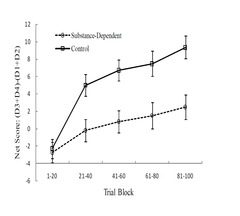
What were the findings of Bechara et al.'s (2002) Decision Making Task?
Substance-dependent individuals performed worse than controls, showing impaired decision-making and reduced emotional signaling.
What is the General/Diffuse Hypothesis regarding alcohol-related brain damage?
This hypothesis suggests that alcohol damages both cerebral hemispheres, leading to widespread disruption of cognitive functioning.
What is the Frontal Lobe Hypothesis in the context of alcohol-related brain damage?
This hypothesis posits that alcohol-related damage is concentrated in the frontal lobes, impairing executive functions.
What evidence supports the Frontal Lobe Hypothesis?
Chronic alcohol users show poorer spatial working memory performance and reduced frontal cortex activation during working memory tasks.
What cognitive impairments do long-term alcohol users exhibit in social cognition?
They show impairments in interpreting facial expressions, understanding emotions, and interpreting humor and non-literal communication.
What does the Right Hemisphere Hypothesis suggest about chronic alcohol use?
It suggests that chronic alcohol users have preserved verbal abilities (left hemisphere intact) but impaired visuospatial abilities (right hemisphere dysfunction).
What are the Premature Aging and Increased Vulnerability hypotheses regarding alcoholism?
These hypotheses suggest that alcoholism accelerates cognitive impairments and that older brains are more vulnerable to alcohol effects.
What did Bartels et al. (2007) find regarding cognitive impairments and long-term abstinence?
Many studies showed that cognitive impairments can be reversed with long-term abstinence from alcohol.
What was the association between substance use and self-harm in Moller, Tait & Byrne (2013)?
Substance use, particularly problematic alcohol use, was independently associated with greater odds of self-harm.
What predictors were associated with self-harm in the Australian longitudinal study?
Predictors included alcohol dependence, cannabis use, smoking, psychological distress, adverse life events, financial strain, younger age, male gender, childhood sexual abuse, and bisexual orientation.
What is the significance of the findings regarding substance use and self-harm?
The findings highlight the strong association between substance use and self-harm, emphasizing the role of psychological distress and maladaptive coping.
What does the study suggest about the relationship between substance use and self-harm?
The relationship may be bidirectional, with substance use increasing vulnerability to self-harm and vice versa.
Placebo
Given AOD, but not told given AOD
Pseudo Placebo
Not given AOD, but told given AOD
Experimental
Given AOD, told given AOD
Control
Not given AOD, not told given AOD