NUR 326: Module 1 Online 💯
 Call Kai
 Learn
Learn Practice Test
 Spaced Repetition
 Match
Match Flashcards
 Knowt Play
1/22

Earn XP
Description and Tags
Tissue Integrity
Name | Mastery | Learn | Test | Matching | Spaced | Call with Kai | Chat |
|---|
No analytics yet
Send a link to your students to track their progress
23 Terms
what is tissue integrity
the state of structurally intact and physiologically functioning epithelial tissues
what is epithelium vs emollient
- epithelium: tissue that lines cavities and structure surfaces throughout the body
- emollient: agents that soften skin or treat dry skin
what is granulation, debridement, and turgor
- granulation: connective tissue that forms on surface of healing wound
- debridement: removal of dead, damaged, or infected tissue
- turgor: elastic state of skin and tissue
what are epithelial cells
covers all internal and external body surfaces
- functions as protection, absorption, secretion, and excretion
what is primary intention
- wound margins well approximated
- lacerations and surgical incisions
- most rapid healing
(think edges together and wound margins touching eachother like having staples or sutures after incision)

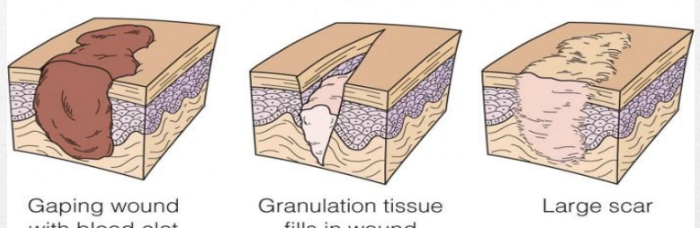
what is secondary intention
- wound margins not well approximated
- larger wound area requires formation of granulation tissue to fill gaps
- longer period of time needed to heal
(think open wound, edges cannot be pulled together, granulation tissue has to be grown to fill in missing tissue)
what is tertiary intention
- wound healing delayed and occurs when wound previously open and is not closed
- usually associated with large infected/contaminated wounds
(think it was left open for some time to heal and now getting closed, tertiary intention eventually get surgically closed after being left open)

who are populations at greatest risk for impaired tissue integrity
- impaired tissue integrity can potentially occur in all individuals
- populations at greatest risk: infants, children, older adults
what are individual risk factors for impaired tissue integrity when it comes to health conditions
- poor peripheral perfusion
- malnutrition or obesity
- impaired mobility
- dehydration or edema
- immunosuppression
what are individual risk factors for impaired tissue integrity when it comes to exposure to irritants
- radiation
- temperature extremes
- chemical
- mechanical trauma
- medical treatments
what are individual risk factors for impaired tissue integrity when it comes to tissue trauma
- friction
- shearing
- moisture
- pressure
what are different types of drainage and exudate
- serous: clear or pale yellow, thin, and watery fluid
- serosanguineous: light pink or blood-tinged fluid that come from healing
- sanguineous: bright red, thin fluid composed of fresh blood
- purulent: thick, opaque, pus-like fluid
what is stage 1 pressure ulcer
non-blanchable erythema of intact skin (stays red when pressed)

what is stage 2 pressure ulcer
partial-thickness skin loss involving dermis or epidermis

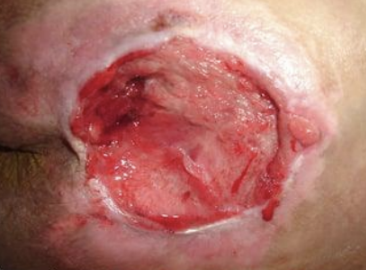
what is stage 3 pressure ulcer
full-thickness skin loss involving subcutaneous tissue

what is stage 4 pressure ulcer
full-thickness skin loss with damage to muscle, bone, or supporting structures
what is unstageable
obscured full-thickness skin loss and tissue loss → covered in necrotic tissue or eschar

what are clinical management for impaired tissue integrity for primary prevention
- skin hygiene
- adequate nutrition and hydration
- avoidance of excessive sun exposure
- burn safety precautions
- dermal ulcer prevention
- activity restriction
how do you prevention pressure ulcers
- inspect skin daily
- minimize pressure: frequent position changes, reposition at least every 2 hr, protect skin during turning and repositioning-lift device
- manage moisture: incontinence care, bathing-soaps, warm water, lotion and massage but don’t do so over body prominence, clean/dry linens
what are the principles of wound care
- initial and ongoing assessment
- cleansing and irrigation: cleaning is preformed for the removal of debris and exudate, normal saline is used and harsh solutions are avoided
what are the different types of dressings for wound care
- gauze, non-adherent dressings, occlusive, semi-occlusive, hydrocolloid, hydrogel, alginate
- vacuum-assisted systems are used
what are collaborative interventions for clinical management of wounds
- pharmacotherapy: antibiotics, steroids, emollients, chemotherapy agents
- phototherapy
- surgical interventions; excisions, debridement, skin grafts/flaps, bypass/angio plasty
- wound care
- nutritional support: protein, vitamin A and C
how do you screen for malignant melanoma
A: asymmetry
B: border
C: color
D: diameter
E: evolving