Genetics
 Call Kai
 Learn
Learn Practice Test
 Spaced Repetition
 Match
Match Flashcards
 Knowt Play
1/47

There's no tags or description
Looks like no tags are added yet.
Name | Mastery | Learn | Test | Matching | Spaced | Call with Kai | Chat |
|---|
No analytics yet
Send a link to your students to track their progress
48 Terms
Nucleotide/base pairings
Adenine and thymine, cytosine and guanine
Relationship between DNA, genes and chromosomes
DNA are genetic material in a double helix shape. Genes are segments of DNA to make traits. Chromosomes are long strands of DNA.
Substitution
A DNA mutation where a different base is incorrectly inserted
Insertion
A DNA mutation where one or more extra bases are inserted by mistake
Deletion
A DNA mutation where one or more bases are removed
Deoxyribonucleic acid
A long molecule found in the nucleus of cells that carries the genetic information of an organism
Genes
A specific segment of DNA that codes for a characteristic
Chromosome
A tightly coiled strand of DNA found in the nucleus of the cell. 46 are in somatic cells, 23 are found in gametes.
Haploid
A cell with one set of chromosomes, e.g sperm and egg cells
Diploid
A cell with 2 sets of chromosomes, e.g somatic cells
Karyotype
A picture of an organism's full set of chromosomes
Down syndrome
An extra copy of chromosome 21
Monosomy
One chromsome of a pair missing
Trisomy
An extra copy of a chromosome is added to a pair
Translocation
When a part of a chromosome breaks and reattches to another chromosome
Difference between mitosis and meiosis
Mitosis produces 2 identical diploids from the parent cell. Meiosis produces 4 haploids with half as many chromosomes.
How does meiosis contribute towards genetic variation?
Genetic information is exchanged by both pairs of chromosomes during the Prophase of meiosis
Genotype
The genetic code of an organism for a specific trait
Phenotype
The physical expression of a genotype
Allele
A variation of a gene
Homozygous
When there are 2 identical alleles present
Heterozygous
When there are 2 different alleles present
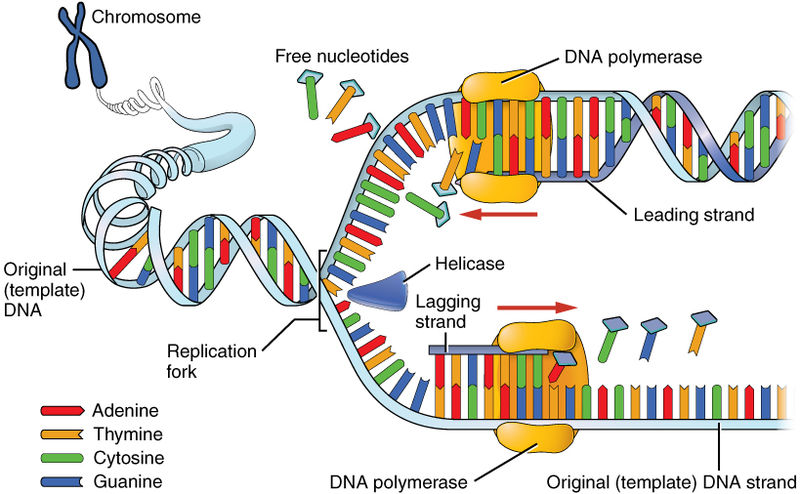
Helicase
An enzyme which breaks down the hydrogen bonds of bases and unzips the DNA
Primase
An enzyme that attatches primers to a DNA strand and preps it for replication
Polymerase
An enzyme that connects to the primer and creates new bases of DNA
Exonuclease
An enzyme that removes all the RNA primers from both strands of DNA
Ligase
An enzyme that seals up fragments of DNA in both strands
RNA
Carries genetic instructions from DNA
Primers
Small pieces of RNA that attatches to bases to prep for replication
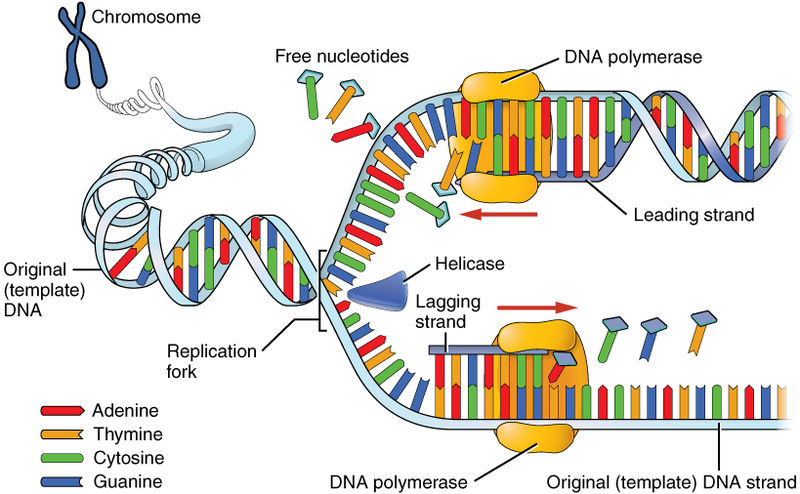
Process of DNA replication
DNA is unzipped by helicase -Primase preps for replication - Polymerase connects new bases one at a time - Exonuclease removes RNA and more polymerase replaces it with DNA - Ligase seals up DNA strands
Biotechnology
The use of living organisms to develop products
In vitro fertiliasation (IVF)
Fertilisation of the sperm and egg that occurs outside the human body
Stem Cell
A cell type that is unspecialised and can develop into other types of cells
Adult stem cell
Limited in their dividing and what kind of cell it can develop to
Embryonic stem cell
Can develop into almost any cell
Types of biotechnology
Stem cell, IVF, genetically modified crops
Advantage of stem cell biotechnology
Can cure many diseases and disorders, e.g diabetes and Parkinson’s disease
Disadvantage of stem cell biotechnology
Stem cell science is still new so it is only used to its full extent in bone marrow transplants
Social consideration of stem cell biotechnology
Stem cell science is still new so the long-term impacts on people are unknown
Ethical consideration of stem cell biotechnology
Harvesting embryonic stem cells kills off pre-embryo cells, which can deter people who believe life starts at conception
Advantage of IVF
It allows people to have children naturally despite age, health or other factors
Disadvantage of IVF
It is extremely expensive for each treatment and is invasive to the mother
Social consideration of IVF
It is not easily accessible to the public due to the costs
Ethical consideration of IVF
Past reports show that doctors have inserted multiple fertilised eggs into a woman, instead of one, to boost high success rate statistics. This is dangerous to the babies and the mother.
Advantages of genetically modified crops
Can contain more nutrients, less space needed to grow, use less water, pesticides, soil and fertilisers, more resistant to herbicides
Disadvantages of genetically modified crops
Pollen from GM crops may carry over to other crops and cross-polinate, resulting in different plants grown.
Social consideration of genetically modified crops
GM crops can contaminate neighbouring farms, leading to other farmers not being able to label their crops as ‘certified organic’ and leading to less income.
Eithical consideration of genetically modified crops
More foods are genetically modified but aren’t labelled as so, leading to consumers having less options on choosing what they want.