All L.A.'S GEE
 Call Kai
 Learn
Learn Practice Test
 Spaced Repetition
 Match
Match Flashcards
 Knowt Play
1/74

Earn XP
Description and Tags
It's the final countdownnnn
Name | Mastery | Learn | Test | Matching | Spaced | Call with Kai | Chat |
|---|
No analytics yet
Send a link to your students to track their progress
75 Terms
Explain the concept of natural selection
Individuals with certain traits (in a species/population) may reproduce at a higher rate (because of those traits), over time as this process is repeated the favourable adaptation become more frequent.
What are the four adaptation categories, explain and identify an adaptation for each classification
Structural adaptations: Physical features that aid survival, a giraffe’s long neck to be able to reach leaves from high trees to eat them.
Behavioural adaptations: Things organisms do to survive, phototropism in plants: plants growing towards any light they may sense
Physiological adaptations: How an organism functions on the inside, a snake having venom
Coadaptation: Coevolution of advantageous traits, a flower growing in such a shape that only its desired pollinator can access it’s pollen.
Give 4 examples of evidence for evolution
Direct observation of evolutionary change: The adaptation of certain traits in species with short lifecycles and bacteria developing (multi-)drug resistance
homology: Similarity in structure (of limbs) resulting from common ancestry,
Anatomical homology: the arms of a human and the fins of a whale
Molecular homology: Having similarities in genes
Analogy is when independent evolution causes similar features to appear in species from different ancestors
Fossil records: can provide evidence of the extinction of a species, the origin of new groups and changes within groups over time.
Biogeography: The study of geographic distributions of species
Define and explain the difference between micro- and macroevolution
Microevolution: Evolution up to a species level, a change in gene frequency within a population. (e.g. different dog breeds)
Macroevolution: Evolution beyond a species level (e.g. evolving from a unicellular organism into a multicellular one)
Name the five mechanisms behind evolutionary change and give an example for each.
Natural selection: Green beetles being preyed upon more than the brown beetles in a population, therefore causing the amount of green beetles to diminish.
Mutation: A beetle population of green beetles mating with one another and producing a baby beetle that is brown because of a mutation.
Gene drift: Chance events that cause change to a population leading to an allele being disproportionately over- or underrepresented in the next generation, e.g. natural disasters wiping out a part of a population of mixed coloured beetles leading to lots of green beetles dying and more brown ones surviving
Gene flow/Migration: Individuals from different populations visiting each other and introducing genes into the other population. If they stop visiting the gene will vanish from the population!
Non-random mating(/sexual selection): When individuals with certain characteristics are more likely to acquire mates, therefore causing their genes-traits to be more abundant in a population as others are not (as) desired. e.g. Beetles preferring to mate with dark brown beetles over light brown or yellow ones
What is a Hardy-Weinberg equilibrium and what are the conditions a population must have in order to be in one.
A population being in a Hardy-Weinberg equilibrium means that the population is NOT evolving, the allele and genotype frequencies remain constant
No natural selection
No mutations
There MUST be random mating. There must be no sexual selection
There must be no gene flow
The population must be of an extremely large size
Describe the concept of biological species and reproductive isolation
(Biological) Species: A group of populations whose members have the potential to interbreed (in nature) and produce viable, fertile offspring.
Reproductive isolation: The existence of biological factors/barriers that impede two species from producing viable, fertile offspring
Name the two categories of reproductive isolation
Prezygotic barriers (before gamete fusion)
Postzygotic barriers (after gamete fusion)
Give all possible prezygotic barriers and state before what “key event” they take place
Habitat isolation: BEFORE MATING ATTEMPT, Two species encounter each other rarely because of a difference in habitat, despite not being isolated by physical barriers (e.g. flies living on different trees growing in the same area)
Temporal isolation: BEFORE MATING ATTEMPT, two species cannot mix their gametes because they breed during different times of the day, different seasons or even years.
Behavioural isolation: BEFORE MATING ATTEMPT, Courtship rituals/mating behaviour unique to a species are a barrier for mating with others.
Mechanical isolation: BEFORE FERTILIZATION, morphological (shape and structure) differences can prevent successful completion of mating.
Gametic isolation: BEFORE FERTILIZATION, Sperm of one species may not be able to fertilize eggs of a different one (species)
Give all possible postzygotic barriers and state before what “key event” they take place
Reduced hybrid viability: BEFORE VIABLE, FERTILE OFFSPRING, Offspring may not be viable, the genes of the different species may interact and impair the hybrid’s development OR survival in its environment.
Reduced hybrid fertility: BEFORE VIABLE, FERTILE OFFSPRING, the offspring may survive, but not be able to reproduce
Hybrid breakdown: BEFORE VIABLE, FERTILE OFFSPRING, the hybrid may reproduce, but as generations pass the offspring will become more and more short lived and have its survival impacted (so won’t survive to last as a species as the offspring will die out after a few generations)
What are two approaches taken to understand how life on earth developed?
Top-down: Reduce complex systems to derive precursor states
Bottom-up: Construct increasingly complex systems from fundamental components
explain how life on earth probably developed in 4 steps
Abiotic synthesis created the first small organic molecules, this likely happened near openings of volcanoes or deep-sea hydrothermal vents.
The small molecules were joined into macromolecules, small organic molecules like amino acids polymerized on hot surfaces (hot sand, clay or rock)
The molecules were packed into protocells (Pre-cells)
These protocells formed the origin of self-replicating molecules as the first form of genetic material present, RNA, can act as enzymes (ribozymes) which catalyze many different reactions, one being making complementary copies of RNA
Explain how eukaryotes were formed in 4 steps
The nuclear envelope and endoplasmic reticulum (ER) evolved because the plasma membrane folded in on itself, because of that becoming an ancestral PROkaryote
This ancestral prokaryote engulfed an aerobic (proteo)bacterium, now becoming a host cell for it as it developed into a mitochondrion. This became the ancestral EUkaryote
The ancestral eukaryote (heterotroph) engulfed a photosynthetic cyanobacterium
The photosynthetic bacterium developed into a plastid and the whole (complex) became the ancestral photosynthetic eukaryote

Interpret and construct simple phylogenetic trees from molecular data:
Give for each number the correct term
Branch point
Most recent common ancestor
Sister taxa
Basal taxon


Interpret and construct simple phylogenetic trees from molecular data:
Give the correct name and description for each present, numbered group
Monophyletic group: The selected taxa all derive from the same common ancestor and are ALL the derived taxa from this common ancestor.
Paraphyletic group: The selected taxa all derive from the same common ancestor, but NOT ALL taxa FROM this common ancestor are shown
Polyphyletic group: The selected taxa derive from multiple ancestors (they are in separate clades

Interpret and construct simple phylogenetic trees from molecular data:
Define the next terms:
Outgroup
Plesiomorphy
Apomorphy
Maximum Parsimony
Maximum Likelihood
Molecular clock
Outgroup: The taxon in a phylogenetic tree that is (presumably) less related
Plesiomorphy: An ancestral characteristic (a characteristic a distant ancestor had????)
Apomorphy: A derived characteristic (unique to a taxon?)
Maximum Parsimony: The phylogenetic tree that requires the fewest evolutionary events
Maximum Likelihood: The tree with the most likely sequence of evolutionary events
Molecular clock: The approach for measuring the absolute time of evolutionary change, with the assumption that there is an approximately constant rate of mutation (HOEVEELHEID MUTATIES IS RECHT EVENREDIG MET DE TIJD SINCE DIVERGENCE)

Interpret and construct simple phylogenetic trees from molecular data:
Name the right term for each description:
The taxon in a phylogenetic tree that is (presumably) less related
An ancestral characteristic (a characteristic a distant ancestor had????)
A derived characteristic (unique to a taxon?)
The phylogenetic tree that requires the fewest evolutionary events
The tree with the most likely sequence of evolutionary events
The approach for measuring the absolute time of evolutionary change, with the assumption that there is an approximately constant rate of mutation (HOEVEELHEID MUTATIES IS RECHT EVENREDIG MET DE TIJD SINCE DIVERGENCE)
Outgroup
Plesiomorphy
Apomorphy
Maximum Parsimony
Maximum Likelihood
Molecular clock
Describe what conservation biology is/does
conservation biology seeks to conserve the diversity of life on earth
What are the 3 levels of biodiversity
Genetic diversity: Genetic variation within a population AND between populations.
Species diversity: The variety of species in an ecosystem or throughout the biosphere.
Ecosystem diversity: The variety of ecosystems in the biosphere (earth)
Ecosystem: A highly complex biological system made up of living organisms interacting in a physical environment.
Explain the 4 main threats to biodiversity
Habitat loss: Humans alter habitat through agriculture, forestry, urban development, mining and pollution.
Introduced species: Species moved by humans from native locations to new geographic regions, either by accident or intentionally. Since the new species is free from native predators, herbivores, pathogens or competitors they can spread rapidly. Then they may pray upon/outcompete native organisms leading to their extinction.
Overharvesting: When humans harvest wild plants or animals at a rate that exceeds the ability of the populations of those species to rebound (/bounce back/regain numbers).
Large organisms with low reproductive rates are especially vulnerable to overharvesting
Global change: Alterations in climate, atmospheric chemistry and broad ecological systems that reduce the Earth’s capacity to support life.
e.g. acid precipitation containing sulfuric acid and nitric acid as a result from burning wood and fossil fuels. Chemical reactions with these acids decreases nutrient and increases toxic metal concentrations in soil and water, which can harm some organisms.
(NOT DONE) Explain solutions to climate change
Global warming can be slowed down by reducing energy needs and converting to renewable sources of energy
Establish regional networks of protected areas
Protect hot spots of high biodiversity
Explain/define minimum viable population (MVP) size
The minimum viable population (MVP): The minimum population size at which a species can survive
Depends on factors that affect a population’s chances of survival over a particular time. if not much is known then it is usually around 50

Explain the difference between/define mutualism, competition and predation
Mutualism: a positive interaction (+/+) where both species in the interaction benefit from it.
Commensalism (+/0) can become mutualistic
Competition: All (- / -) interactions
Interspecific competition occurs when species compete for a resource that is in short supply, limiting the survival & reproduction of both individuals/species.
Competitive exclusion: Local elimination of a competing species as a result of strong competition. Principle: 2 species competing for the same limiting resource cannot coexist in the same place.
^^ (BASIS FOR THE REALIZED AND POTENTIAL NICHES!!)
Predation: An interaction in which an individual of one species (predator) kills and eats an individual from a different species (prey)
A form of exploitation: any + / - interaction in which individuals of 1 species benefit by feeding on individuals of another species.
There are three main categories that ecological behaviour can be divided into: Positive interactions, competition and exploitation.
What are the 2 components of species diversity and what do they entail
Species richness: The total number of different species in the community
Relative abundance: The proportion each species represents of the total individuals in the community

Define what an ecological niche is and explain the competitive exclusion principle in terms of the niche concept
ecological niche: The total of a species’ use of biotic (living) and abiotic (non-living) resources
The competitive exclusion principle: When two different species are ecologically similar, their niches will (likely) also be similar. These species can therefore only exist together if there are one or more significant differences in their niches (REMEMBER: Competition in ecological behaviours). Due to this competition a species’ fundamental niche (theoretical, e.g. ideally living in trees) may differ from their realized niche (reality, e.g. to avoid competition by living in a tree the species will instead live in bushes nearer to the ground.
Resource partitioning: Differentiation of ecological niches so similar species can coexist in a community
Distinguish between the fundamental and the realized niche
Fundamental niches: Are all the theoretical possibilities as to where an organism/species can live/survive.
Realized niches: Are the reality of where an organism/species lives.
You can distinguish the two as the Fundamental niches represent all the environmental conditions where a species is able to live and the realized niche is where the species is actually living in. so fundamental niches are larger or the same size as the realized niche
Define “disturbance” (with the three aspects it influences) and explain the intermediate disturbance hypothesis
Disturbance: An event that changes a community, removes organisms from it and alters resource availability. (e.g. fire)
According to the intermediate disturbance hypothesis moderate levels of disturbance can foster greater diversity than either high or low levels of disturbance.
goldilocks kind of idea, just right not too hot or too warm but with competition.
High levels of disturbance exclude many slow-growing species and select for quick colonisers that reach maturity quickly.
Low levels of disturbance allow dominant species to exclude less competitive species.

Explain the species area curve
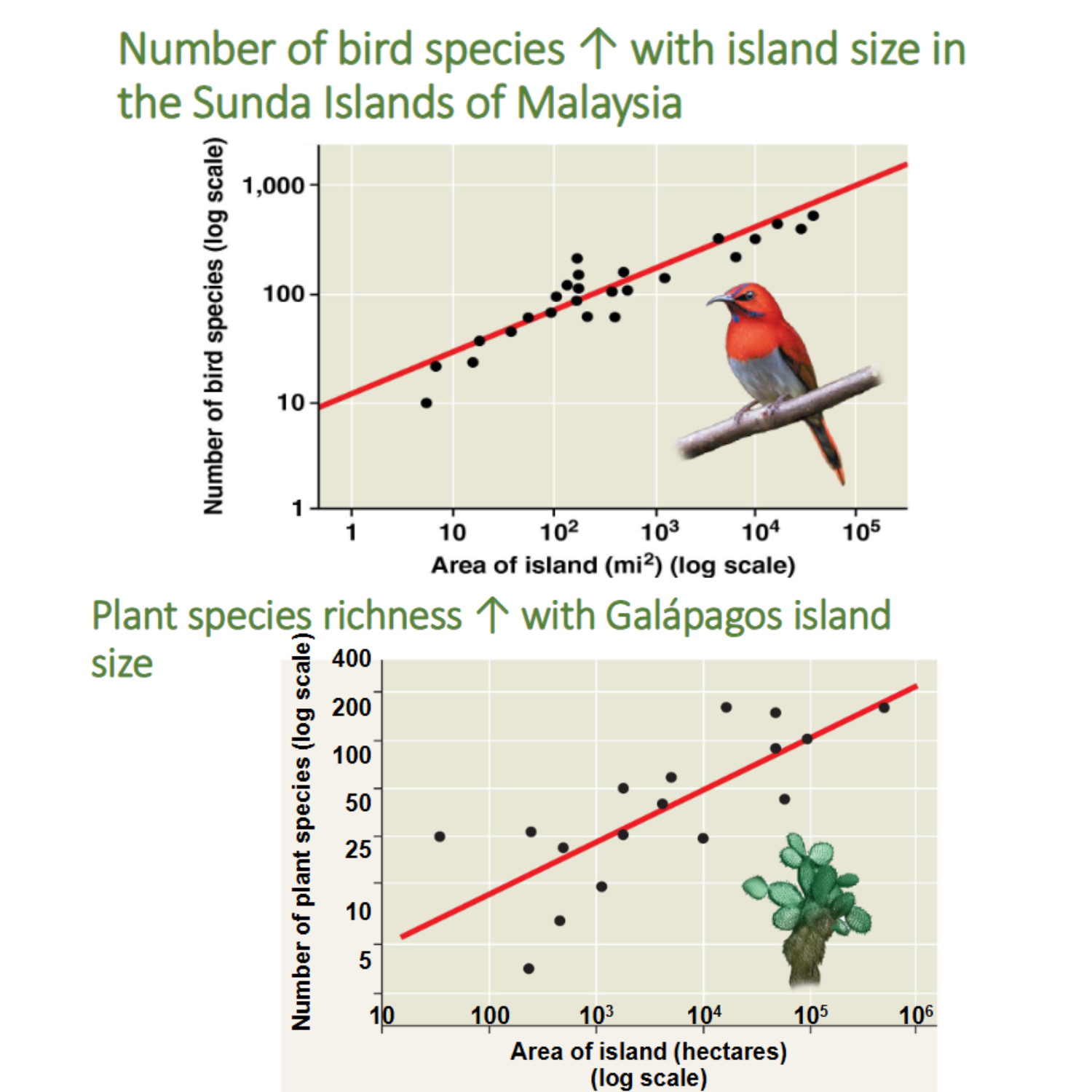
The species area curve quantifies the idea that if all other factors are equal, a larger geographic area will have more species, since larger areas have a greater diversity of habitats and microhabitats
(DUS EEN RECHTEVENREDIG VERBAND TUSSEN DE GROOTTE VAN DE HABITAT EN DE HOEVEELHEID SPECIES)
Name Tinbergen’s 4 Q’s about behaviour, name for each their 2 categories(/subdivisions) and explain them (with an example)
Causation/Mechanisms, Proximate (how) & Contemporary (now), the mechanical reason behind behaviour; what causes this behaviour (e.g. hormones)
Function/Adaptive value, Ultimate (why) & Contemporary (now), the reason for why the behaviour could take place now/in the situation, what advantage/adaptive value does it provide the individual displaying the behaviour (e.g. a male lion kills cubs that aren’t his so the female lion will be ready to mate and produce his offspring quicker therefore reassuring his genetic material is passed down
Ontogeny/Development, Proximate (how) & Historical (evolved), what (event?) has caused the behaviour to develop in an INDIVIDUAL’S lifetime (e.g. a bird learning a song from their parents)
Phylogeny/Evolution, Ultimate (why) & Historical (evolved), why has this behaviour persisted/changed throughout the evolution of this SPECIES. (e.g. different bird songs having evolved from a common more simple birdsong over time)

Name and explain 3 methods of hypothesis testing
comparison between individuals within a species: individuals within a species are compared to see what drives behaviour (?)
experiments: Experiments that vary one factor at a time and have control groups for all variables are used to see what factor influences behaviour
comparison between different species: Observing why the behaviour of a particular species is different from other species (to find out how differences in behaviour reflect differences in ecology)
Give 5 ways on how to distinguish the difference between adaptation and story-telling, and define the terms.
story-telling is when we use our own minds to fill in the blanks, to decide the reason why a behaviour or trait has evolved the way it has, while adaptation is the actual course a (behavioural) trait has come to be (the adaptive value the trait has provided the organism).
To distinguish the difference between adaptation and storytelling you must
Test/consider multiple alternative hypotheses
Quantify ecological variables
Identify IF there is cause and effect/correlation & causation, if so then what are they
Consider IF there even is an adaptive difference, does the trait/behaviour increase fitness or is it simply just how development has occurred to get to the same endpoint, are there non-adaptive explanations (when comparing between different species)
analyse statistically independent data (phylogeny)
Whys is it important to control for phylogeny (relatedness) when testing hypotheses across species?
It is extremely important to control for phylogeny when testing a hypothesis across species since the species should be independent from on another.
Close relatedness means that there are/will be great overlaps in the behaviour of the species, they likely underwent similar evolution/development. This means the species are not independent form one another
(they’re too similar, its like you’re testing the same species. WHICH ISNT WHAT U WANT!)
Why does correlation (a clear relationship/association between two things/factors) not equal causation (reason for being/cause)?
A correlation means that two things are correlated, they share a relationship/association, causation means that a change in one variable (cause) will cause a change (effect) in another as well. A relationship between two traits does not mean that they will influence one another!
Define the terms: Sexual selection, sexual conflict and anisogamy and give an example for each term
sexual selection: The evolution of traits to increase mating success
Larger antlers in male deer to have a greater chance of winning fights between males and then being able/allowed to mate with females
sexual conflict: The conflicting evolutionary interests (for partner choice/caring for offspring) of the two sexes in a species
Parental care/(investment for) caring of eggs/offspring, a female may invest more care for offspring than males
Choice of mating partner
Anisogamy: When there is a size difference between male and female produced gametes
a sperm cell of a human male being (way) smaller than an egg cell of a human female
A difference in size leads to one sex having to invest more in gamete production.
The sex with the smaller gametes has a reproductive success that is dependent on the amount of individuals.
The sex with the larger gametes has a reproductive success that is dependent on the amount of resources available.
Define the two types of sexual selection and explain the 5 different types of male vs male selection. Also mention whether we speak of direct or indirect male vs male competition.
Intra-sexual selection: Male vs male competition for a female mate
Inter-sexual selection: A female’s choice of male mate
Different types of sexual (male vs male) selection are:
Weaponry (direct) : Organisms develop (external) weaponry in order to have an increased chance at winning fights against other males (in order to mate with a female/females). (e.g. antlers in male deer)
Sexual dimorphism (direct): A difference in size between males and females of the same species. (e.g. Males being larger than females so they stand greater chances of winning fights against males)
Ornate plumage display (direct): Some bird species may develop intricate plumage displays in order to gain a female’s attention
Mate guarding (indirect): males may stalk females they want to mate with in order to guard off any other males that may want to attempt as well.
Sperm competition (indirect) : males may use various tactics in order to ensure that their sperm is the one to fertilize the female they mated with
Name the 5 different kinds of sperm competition in intra-sexual selection.
Copulatory plug: A gelatinous substance that hardens over time that males will use to either “cement” a female’s genitalia after mating so no other male can mate with the female, or do the same to another males genitalia in order to ensure the male cannot expel any sperm in a female.
Sperm injection in the walls: of either a female, to hopefully combat the other male’s sperm, or another male, to have it’s sperm reach the injected male’s testes so when the injected male mates there is a chance that his sperm wont be the one to fertilize the female.
Adapted penis structure: In some species females store sperm in a sack called the spermatheca. Males can have an adapted penis structure that removes any sperm that has already been injected from the spermatheca to ensure that their sperm is the only one being stored.
Sperm displacement: Male’s insemination fluids can either flush out a previous male’s sperm OR also push another male’s sperm to the back of the spermatheca allowing his sperm to be the last one in and therefore the first one out of the spermatheca (aka have the greater chance of fertilizing the female)
chemical manipulation: Male’s can chemically manipulate the female (‘s accessory gland proteins?) in order to incapacitate the previous male’s sperm. This however does affect the female’s longevity.
Explain inter-sexual selection
inter-sexual selection is when a female picks a male mate. A kind of counter adaptation for mate guarding.
Give 4 reasons as to why females should be choosy when picking their mate?
To discriminate between species
(to discriminate males within a species)
In order to gain good resources & parental ability (e.g. good territory with little predation and advantageous circumstances for offspring development) (Non-genetic benefit)
To ensure her/their offspring has good genes (genetic benefit)
What are the two hypotheses as to why (some) males have elaborate ornaments? Name and explain them.
Handicap hypothesis (Zahavi): The elaborate ornament is not only nice to look at, but can be a burden as well. Males that survive with such a costly trait must be strong. Strong males will lead to an increase of the survival of the offspring since they’ll have a higher genetic quality!
Fisher’s hypothesis/attractive sons hypothesis: The ornaments are nice to look at, a good-looking male will likely lead to attractive sons with a higher chance of mating themselves, this ensures that the genetic material of the parents will be passed on.
Name and explain the different types of mating systems
Monogamy: One male and one female mate exclusively to each other.
One female is present in the territory of a male
Polygyny: A single male mates with multiple females
Two females each have their own territory inside a male’s territory
Multiple females have a shared territory inside a male’s territory
a male has two separate territories where in each a female has her own territory.
Polyandry: A single female mates with two(/multiple) males
A female has her own territory inside a shared territory of two(or more) males.
A female has her own territory in which two (or more) males each have their own territory.

When should a male be monogamous or promiscuous?
Males
Desertion of a female and her brood causes for the male’s reproductive success to decrease with a formula: 1/x (x being the amount of females he can mate with if no parental care is provided to the brood). So a male should desert/be polygynous if he can find >x females.\
e.g. if a male mates with two females and provides no parental care this leads to a reproductive success of the broods to ½ each!!. leading to half of the broods surviving. But if a male leaves one female and mates with another and provides parental care for the second brood, the success will be ½ for one brood and full survival for the other. leading the male to have 1,5 more brood than if it stayed with only one female
When should a female be monogamous or promiscuous?
A female should pick between monogamy vs polygyny according the the polygyny threshold model by Orians!
If PT > C then the better option (polygyny?) must be chosen. e.g. when having to choose between becoming the 2nd polygyny for a male with a rich territory quality and monogamy with a male that has poor territory quality the reproductive chances with the 2nd polygyny are higher!

Explain what an evolutionary arms race is and give 3 examples!
Antagonistic interactions between predators and prey will lead to the evolution of adaptations and counter adaptations, but they each may experience no change in their relative success
A predator may develop improved visual activity, a prey will then undergo crypsis (the ability to hide better in environment)
A predator may learn to search for specific imagery, a prey will then develop polymorphism (having different looks)
A predator will hunt in a specific location, a prey will then to spread out.
What is cooperative behaviour and explain why males may cooperate in their courtship days.
Cooperative behaviour is when two or more individuals perform an action that benefits both actor(s) and recipient(s)
actors are individuals who provide help
recipients are the individuals receiving the help
during courtship days some courtship is more effective with/requires two (or more) males. An alpha and a beta male dynamic will develop. The alpha male will be able to mate with females if courtship is successful, the alpha male and beta male may be closely related or not at all
When not closely related, the alpha male will gain direct benefit because of an increased fitness after mating with the females present at a courtship site. The beta male, normally younger in these cases, will not mate. Once the alpha male dies, females will still continue to visit the courtship site, now older, the beta male can assume the role of alpha male as he inherits the courtship site. (delayed direct benefit)
When closely related the dominant and subordinate males will work together to get the dominant male to mate with a female. the subordinate male will not mate whatsoever and has no direct benefit. The two males being closely related however, allows for the dominant male to partially pass some genes that overlap with the subordinate male due to close relatedness. This is a case of altruism since it provides no direct benefit for the subordinate male
What is population ecology and what are the three types of survivorship curves
Population ecology: The study of populations in relation to the environment including: environmental influences on density & distribution, age structure and population size.
a population is a group of individuals of a single species living in the same general area
dispersion is the pattern of spacing among individuals within the boundaries of the population
Type 1(I) curve: Low deathrates during early and middle life, increase of deathrates among older age groups. Few offspring, high parental care
Type 2 (II): Death rate is constant over the organisms life span
Type 3(III): high death rates for the young, then a slower deathrate for survivors. Many offspring but no parental care

Which type of curve is each letter
A = 3
B = 2
C = 1

Explain the exponential model of population growth
Exponential model: The population growth in an ideal, unlimited environment (J-shape)
Idealized situations help to understand the capacity a species has to increase, and the conditions that may facilitate this growth
dN/dt = rN where N = population size, t = number of generations d = delta difference and r = intrinsic rate of increase of the population
intrinsic rate of increase: the rate of reproduction is at its maximum (under the ideal conditions in the exponential model)
The J-shape is characteristic (?) of some populations introduced to a new environment
Explain the logistic models of population growth
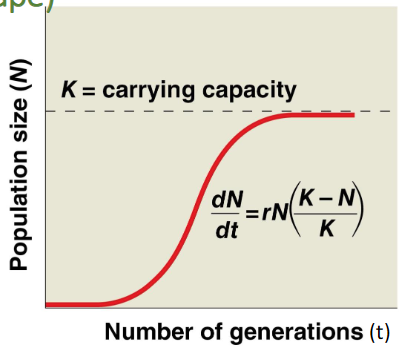
Logistic model: Exponential growth cannot be sustained for long in any population (S-shape)
Carrying capacity (K): The maximum population size the environment can support
Population growth slows as it nears carrying capacity
dN/dt = rN((K-N)/K) Where d = delta difference (?), N = population size, t = number of generations, K= carrying capacity and r = intrinsic rate of increase of the population
Some populations overshoot K before settling down to a relatively stable density
What factors affect population growth?
whether a population is a density-dependent or -independent one
A density-dependent population: birth rates decrease and death rates increase with population density
A density-independent population: Birth & death rates don’t change with population density
Changes in predation pressure can drive population fluctuations
Explain what a meta population is and what factors affect patch occupancy.
Metapopulations: groups of populations linked by immigration and emigration. (distribution is dynamic over time, there are local extinctions and recolonizations)
Occupancy of patches is affected by extinction and colonization probability
Extinction probability: Depends on patch size and habitat quality
Colonization probability: Depends on isolation or connectivity (as corridors between patches are believed to increase movement between patches) and the demographic state of surrounding patches.
Name a few examples of sexual reproduction
Sexual reproduction in animals entails the fusion of male and female gametes in the process of fertilization
Sexual reproduction in plants entails pollen landing on the stigma which leads to a pollen tube bringing the pollen down to the egg to be fertilized.
Name a few examples of asexual reproduction in animals
Asexual reproduction in animals is called parthenogenesis. This can be either facultative or obligate. Facultative means that it is not the only way for an organism to reproduce, sexual reproduction is also an option. Obligate means that it is the only way the organism will reproduce, species that procreate by obligate parthenogenesis will be a female only species.
In sharks who undergo facultative parthenogenesis an (X) egg cell will be fertilized by a different X cell that became a polarized cell.
Name a few examples of asexual reproduction in bacteria and yeasts and a major difference between the end results of the two processes.
Bacteria will reproduce through binary fission. The process involved a parent cell replicating its DNA and then splitting itself entirely into two identical daughter cells.
Yeasts will reproduce through budding. A parent cell will grow a tiny bud on itself, after nucleus division/mitosis the bud will absorb the newly created DNA of the parent cell and then remove itself entirely.
The greatest difference between the results of budding and binary fission is that after budding the parent cell still exist, while after binary fission there is no longer a parent cell, simply just two identical daughter cells!
Give 2 examples of asexual reproduction in plants
Apomixisis a facultative kind of asexual reproduction where tiny little plants grow on the parent plant’s leaves and drop from them once big/grown enough
Tillering consists of a runner growing from a (parent) plant which will then “anchor” wherever deemed fit and grow another plant (e.g. strawberries).
These two are both forms of vegetative reproduction: where a new plant emerges from the vegetative parts (leaf, stems, runners etc.) of a parent plant. (Budding in yeasts is also a form of vegetative reproduction!!!!)
Describe the structure of a chromosome
A chromosome consists of two chromatids which each consist of a threadlike structure of DNA and proteins. These two chromatids are attached to one another by a centromere. The ends of the chromatids are called the telomeres
Name the four locations that a centromere can have on a chromosome, and mention whether or not these can be found in the human genotype.
Metacentric: Around the middle, found in the human genome
Sub-metacentric: Further away from the middle, but still quite close, found in the human genome
Acrocentric: Clearly closer to an end of a chromosome, found in the human genome
Telocentric: On the end of the chromatids, not found in the human genome
Explain how meiosis can drive genetic diversity
Meiosis results in four daughter cells with each having randomly assigned chromosomes. This is combination with the possibility of crossing over happening allows for a very large amount of possible gene combinations allowing lots of diversity.
Know how to draw a punnet square/test cross:
What is the difference in table size when looking at linked and unlinked genes (2 genes)?
When looking at multiple traits that follow the dominant/recessive traits what allele will be written first? (just to make notations clearer)
When looking at two genes (e.g. gene Y and gene R) if the two are linked, the table will become a two by two, and if not linked the table will be a 4×4 since all possible gamete combinations must be notated.
The dominant allele will be notated first (e.g. if an individual will have a Y, y, r and R gene, the notation of its genotype will be YrRr)
Explain the (/Mendel’s) Law of Segregation
During gamete formation two alleles for a heritable characteristic will separate from each other, only one of the two gene copies is distributed to each gamete and the allocation is random
(e.g. if a parent organism has alleles Pp for a gene the gametes it creates will have a 50% chance to have been allocated gene P and 50% chance for gene p)
Explain the (/Mendel’s) Law of Independent Assortment
Alleles for different genes are usually inherited independently, if not then they are classified as “linked genes”
Explain, by giving 5 examples, why inheritance of characteristics may deviate from simple Mendelian patterns
Incomplete dominance: Alleles can have a different degree of dominance than what Mendelian patterns suggest, when neither allele is be dominant. The notation for these alleles would then be a superscript used to indicate the characteristic (this can lead to the mixing of colours! red and white snapdragons forming a hybrid pink one!)
When a gene has more than two allelic forms: Human blood has three different forms of alleles to determine which carbohydrates will attach to the red blood cells and form bloodtype (A, B, AB, O)
Polygenic inheritance: Multiple genes can independently affect a single trait. Traits that are are determined by multiple genes are often ones that can be described/observed in a spectrum/gradient, they’re (often) quantitative traits. (e.g. skin colour, height).
Pleiotropy: When a single gene can affect more than 1 trait (e.g. one gene causes the “frizzly chicken” phenomenon that consists of multiple traits being out of the ordinary for chickens)
Multifactorial traits: When multiple genes combined with an environmental influence change the phenotype of an organism (e.g. hydrangeas changing colour depending on if the soil has certain characteristics or not)
Describe how genes are located on a chromosome and what could be used to find out their location relative to each other.
Locus: The fixed place where a gene for a trait will be found on
Linkage maps are useful to find out the distance between different loci and in what order genes are located on a chromosome. Genes are a certain amount of map units/% away from one another.
What are 2 assumptions made when making a linkage map
Crossing over is random
The chance of crossing over is equal along the chromosome
Explain why some traits inherit together?
Some linked genes are inherited together because of their close location to each other. If C.O. were to happen there would be a great chance that they both stay together (since the odds of C.O. happening so close to the same place is small.)
Give two/three examples of a disease/disorder that is only inherited by one sex, and explain that is the case.
Hypertrichosis: a disorder causing (more) hair to grow on certain (unusual) parts of the body
Ichthyosis hystrix/Porcupine man
Webbed toes CAN be Y-linked
These disorders/diseases can only be inherited by the male sex since the gene for these is located on the Y-chromosome. they will therefore always be passed from father to son.
Name two kinds of chromosomal abnormalities and what causes them
Numerical abnormalities: The genome of a person has more OR less chromosomes than usual due meiotic non-disjunction. Meiotic nondisjunction is when instead of separating, chromosome copies stay together during meiosis. This can happen during Meiosis I/1 or II/2
Structural abnormalities: The structure of 1 or more chromosomes is affected due to mutagens (damaging agents like radiation) or errors in meiosis
Describe what happens if meiotic non-disjunction is the case during meiosis I/1
If meiotic non-disjunction happens during meiosis I then all gametes produced will be affected. 50% of the gametes will have too many chromosomes and 50% will have too little chromosomes
Describe what happens if meiotic non-disjunction is the case during meiosis II/2
If meiotic non-disjunction happens during meiosis II/2 half of the produced gametes will be affected. 25% of the gametes will have too many chromosomes and 25% of the gametes will have too little chromosomes.
Give 5 different types of structural abnormalities in chromosomes
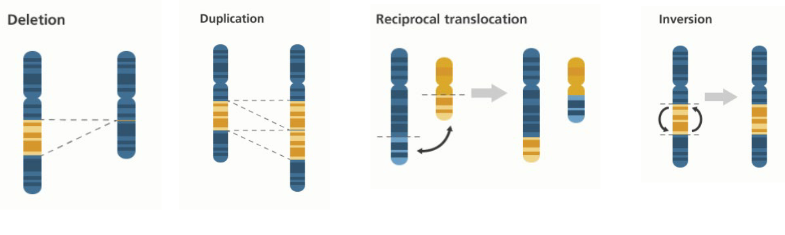
Deletion: A segment of the chromosome is removed.
Duplication: A segment of a chromosome is duplicated and added directly after the original segment it copied.
Reciprocal translocation: Two segments of two chromosomes for different genes are switched with each other.
Inversion: A segment of a chromosome is inverted into the opposite direction.
Polyploidy: An organism has more than 2 copies of chromosomes per gene.
Give two reasons why small scale mutations don’t always have a phenotypic effect
The mutation can lie outside of a protein coding region
The change can still code for the same amino acid (see the codon sun)
What is a point mutation and name 5 different kinds.
A point mutation is the mutation of a single nucleotide (pair).
Silent substitution: The change of nucleotide has no effect on the amino acid sequence/still codes for the same amino acid.
Missense substitution: The effect varies upon position, and which different than previously coding amino acid will be made in the sequence.
Nonsense substitution: The effect (so how many amino acids will no longer be made) depends on the location. A stop codon will take place where this mutation has occured and therefore end the amino acid chain.
Nucleotide pair insertion: The insertion of a nucleotide pair causes a frameshift (in the reading of the nucleotides per amino acid) leading to missense or nonsense
Nucleotide pair deletion: The deletion of a nucleotide pair causes a frameshift (in the reading of the nucleotides per amino acid) leading to missense or nonsense
Define and then explain why the gene density is higher in bacteria than in mammals
gene density: the amount of genes per (about) million base pairs
The gene density in bacteria is higher because bacteria do not have introns
intron: A noncoding sequence of DNA within a gene that is transcribed into mRNA but is removed from the primary gene transcript
Give the three components of non-coding DNA and discuss with two arguments why non-coding DNA is not “junk DNA”
Pseudogenes: Former functioning genes that due to accumulated mutations have lost their function
Repetitive DNA: A duplication of DNA sequences
Short tandem repeats (STR): A series of repeating units of 2-5 nucleotides which can vary among sites in a genome and in individuals.
Individual STR’s can be used in forensic investigations and to analyse paternity.
It can be said that if these sections of “junk DNA” were truly junk they wouldn’t have been preserved.
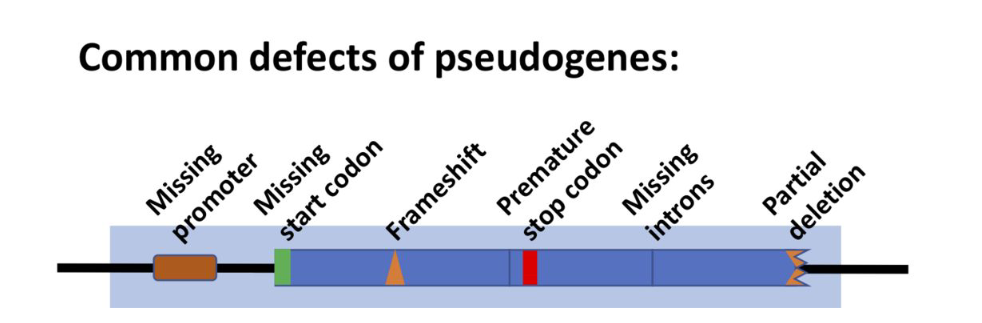
Give the 6 mutations most common in pseudogenes
Missing a promotor
Missing a start codon
Missing introns
Having undergone a frameshift
Having undergone a partial deletion
Having a premature stop codon
Describe 5 ways that show how changes in gene and chromosome structure contribute to genome evolution
Duplication of entire chromosome sets because of accidents in meiosis cause polyploidy. Organisms with these changes are better adaptable for environmental changes, and if organisms with these alterations survive and procreate these mutations will be passed onto offspring.
Alteration of chromosome structure can include a BLOCK of genes present on ONE chromosome of a species being found in PARTS on MULTIPLE chromosomes of a different species. This can indicate that the genes stayed together in both lineages.
Transposable elements can provide a crossover site for non-sister chromatids. this can lead to changing the chromosome structures leaving one with a deletion and the other with a duplication of a gene.
Genes can duplicate and after a while the duplications can transposition onto DIFFERENT CHROMOSOMES. this in combination with repeating duplications and mutations can lead to pseudogenes .
Different gene parts can be rearranged to create new genes. Exon shuffling for example can, in combination with exon duplication, create new genes