mastication
 Call Kai
 Learn
Learn Practice Test
 Spaced Repetition
 Match
Match Flashcards
 Knowt Play
1/12

Earn XP
Description and Tags
Name | Mastery | Learn | Test | Matching | Spaced | Call with Kai | Chat |
|---|
No analytics yet
Send a link to your students to track their progress
13 Terms
temporomandibular joint
what is it
what prevents caudal dislocation of the TMJ
articulation between condylar process of mandible and mandibular process of skull
left and right temporomandibular joint have been considered a single joint
caudal dislocation of the TMJ is prevented by a prominent retro articular process
mandibular symphysis
what is it
what type of joint is it
what does it do to each mandibular bone
where left and right mandible join
fuse in majority of mammals
fibrous joint
precise occlusion
independent rotation of each mandibular bone
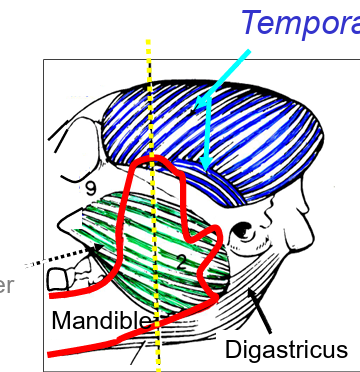
temporal masticatory muscle
origin- which surface
insertion
which direction does it pull the mandible
origin on cranium lateral surface
insertion on coronoid process
pulls mandible dorsally
some fibres pull mandible rostrally some caudally
innervation and origin of masticatory muscles
1st pharyngeal arch
mandibular branch of CN V
masseter masticatory muscle
where
insertion- what side of the manduble?
what sort of contraction
movement of jaw
maxillary region of skull and zygomatic arch
insertion on wide area of caudal side of mandible
several divisions
participates both unilateral and bilateral contracion
protudes jaw
medial pterygoid muscle
origin
insertion
what does it do to the jaw
origin is pterygopalatine region of skull
insert into medial aspect of mandible
close jaw
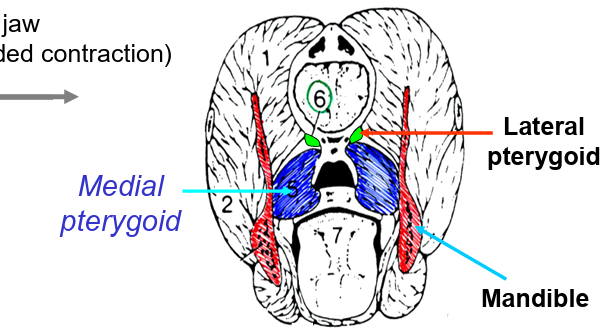
lateral pterygoid muscle
origin
insertion
what does it do to the jaw
origin on pterygopalatine region of skull
insert into medial aspect of mandible
closes and protudes jaw
what is the digastricus
origin
insert
2 parts and innervation
jaw opening muscle
origin is paracondular process of occipal bone
inserts into angle of mandible
caudal belly- CN VII
cranial belly CNV
nasal cavities
what do they contain
what thickens some bones bordering the nasal cavity
twinned pair of cavity
head conformation gauges size
nasal cavity contains turbinate bones - covered by mucous forming conchae
features of neighbouring anatomy reduce size
certain bones bordering the nasal cavity are thickened by air spaces- the paranasal sinuses. (not part of nasal cavity but comminicate with it)
what features reduce size of nasal cavity
paranasal sinuses in neighbouring bones
roots of upper cheek teeth occupy space
turbinate bones
mucosal covering of turbinate bones
conchae
what are they
what do they compartmentalise
foldings of inner nasal wall towards nasal sepum that compartmentalise the nasal cavity
meatus
nasal cavity compartments
rostrally the dorsal and ventral meatus are very large but middle meatus is small, which expands as you move back
3 examples of jaw closing muscles
temporal
masseter
lateral and medial pterygoids