Superpowers and Geopolitics
 Call Kai
 Learn
Learn Practice Test
 Spaced Repetition
 Match
Match Flashcards
 Knowt Play
1/37

There's no tags or description
Looks like no tags are added yet.
Name | Mastery | Learn | Test | Matching | Spaced | Call with Kai | Chat |
|---|
No analytics yet
Send a link to your students to track their progress
38 Terms
What is a ‘collective’ in geography terms?
The population.
What is a superpower?
A country that can project its power or influence anywhere in the world and is a dominant global force.
What is an example of a superpower country?
The USA.
What does ‘geopolitics’ mean?
The geographical element of politics.
(Usually territory, environmental, worldwide effects, etc)
What can turn a country into a power?
Wealth
Resource potential
Influence in certain markets like technology
A large collective or territory
Economic stability
A good military
Historical alliances
Superior education
What do ‘unipolar’, ‘bipolar’, and ‘multipolar’ mean?
Unipolar = One supreme power controlling everything
Bipolar = Two powers in control, usually conflicting with each other
Multipolar = Multiple powers in control; can lead to conflicts but is the most diverse
Why can a country be a power in one region but irrelevant in the next?
Because influence and alliance only extend so far.
Why would one place fear and obey another that they have nothing to do with?
What is the BRICS alliance? (2009)
An alliance formed between Brazil, Russia, China, India, and South Africa.
What are some facts about the BRICS alliance?
It contains around 40% of the world’s population.
It contains around ¼ of the world’s GDP.
It is majorly comprised of countries in the Global South.
Why was the BRICS alliance formed?
For mutual benefit, diverse cooperation, and protesting against historical Western domination.
Why is the world divided into the Global North/South along the Brandt line?
Global North = More developed countries at the top of the map.
Global South = Less developed countries towards the bottom of the map.
Which nation was arguably the first superpower? What kind of world did it make?
The British Empire; it created a monopolar world across its vast territories, around ¼ of the Earth’s surface by 1913.
How was the British Empire’s legacy positive?
It introduced many countries around the world to trade; interdependence turned into connections.
It brought many modern technologies to lands that had not yet developed them.
It made certain places powerful in the manufacturing industry by default.
British-implemented infrastructure still runs today and helps many lives, especially in less-developed countries.
Britain spread its democratic governing style around the world, preventing the long process of eventually achieving democracy from autocracy.
How was the British Empire’s legacy negative?
The countries that had been exploited were left developmentally stunted; they were adept in production and export but heavily underfunded in terms of infrastructure.
Britain still owes massive debts from hoarding profits from its territories.
The British destroyed certain cultures such as that of the Aborigines of Australia.
Stuff like maybe I don’t know THE SLAVE TRADE?
How did the British Empire collapse?
Its territories were beginning to ask for independence.
There were lots of debts owed and not a lot of money to go around after a war.
Other countries were becoming influential.
Interdependence turned into unwanted financial responsibility.
What are the MINT nations?
Mexico, Indonesia, Nigeria, and Turkey.
This is not an official alliance or organisation like BRICS, just a group of rapidly-developing countries that have the potential to soon become very influential. It is more of a classification.
What makes Mexico a MINT nation?
Population = Around 132 million
GDP = Around $1.2 trillion
Mexico is a major manufacturer due to low labour costs; 80% of these exports go to the USA thanks to its location next to the superpower.
Mexico has oil and many tourists.
What makes Indonesia a MINT nation?
Population = Around 236 million, the fourth most populated country in the world This population is relatively young, meaning there are lots of ready workers.
The economy is worth around 1.4 trillion.
HELLA tourists
Indonesia is a huge exporter of pretty much every natural resource apart from oil.
Indonesia is located long many major trade routes, giving it regional advantages.
What makes Nigeria a MINT nation?
Population = Around 240 million, one of the largest in Africa. This is a young population.
GDP = Around $370 billion
Nigeria produces around 1.5 million barrels of oil a day.
It is connected to the global energy trade (gas and oil).
Nigeria is gaining influence in things like entertainment (Nollywood), technology, and banking.
What makes Turkey a MINT nation?
Population = Around 87 million
GDP = Around $1.4 trillion
Turkey has lots of tourists.
Turkey has strong industry and industry exports.
It is located right between Asia and Europe, which is a huge advantage as trade literally passes right through it.
Define ‘sovereignty’.
Supreme power or authority [over something].
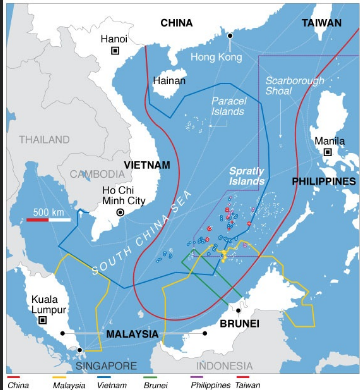
Where is the South China Sea?
It is located south of China and bordered by Taiwan, Indonesia, the Philippines, and Vietnam.
Why is the South China Sea such a controversial place?
Because the countries with exclusive economic zones (EEZs) that extend into the sea want certain parts of it. The South China Sea is important because it holds many valuable natural resources (oil, natural gas, and fish) and a massive shipping network (1/3 of global trade).
What is the Nine-Dash Line (2016 by Xi Jinping)? Why is it controversial?
A claim made and officially recognised by China that entitles the nation to 90% of the sea under the pretence that it belongs to China because of historical exploration.
It is controversial because China has built artificial islands that serve as military bases, monitor the waters as if they were its own, repeatedly ignored international law, and refused to acknowledge that the countries around the South China Sea need it too.
What is China’s claim for the South China Sea?
Why does it justify this?
How powerful is it?
Claim = 90% of the sea along the Nine-Dash Line.
Why = Chinese explorers had been in the region for a long time going back in history. China believes this gives them historical rights.
How powerful? = Second-largest economy in the world, largest military in Asia; tons of artificial islands housing military bases and missiles
What is Vietnam’s claim for the South China Sea?
Why does it justify this?
How powerful is it?
Claim = The Paracel Islands and the Spratly Islands (which China claims).
Why = Vietnam has controlled these islands since the 1600s, before Chinese activity. It also wants the fish and oil.
How powerful? = Strong, growing military; long coastline; often stands up to China in politics.
What is the Philippines’ claim for the South China Sea?
Why does it justify this?
How powerful is it?
Claim = Areas like Scarborough Shoal and parts of the Spratly Islands, which are both near its coast.
Why = These areas are within the EEZ of the Philippines.
How powerful? = Backed by international law against the Nine-Dash Line; military ally of the USA.
Define ‘geopolitics’.
The geographical element of politics
(land, territory, and interconnection)
What is Taiwan’s claim for the South China Sea?
Why does it justify this?
How powerful is it?
Claim = Similar to China (most of the sea)
Why = Taiwan uses the same historical maps and arguments as China – it sees itself as the true governor of the other nation.
How Powerful? = Modern military; controls the largest Spratly island; supported by the USA despite not being recognised as a country by China.
Why is Greenland such a sought-after nation by the USA?
It is located strategically between North America and Europe, providing it with control over some major trading routes.
It is located strategically near the North Pole, where the USA could keep an eye on its rivals if it conquered Greenland. It could also intercept potential missile attacks from Russia and China.
The USA would surround Canada if it had Greenland. Annexing Canada has been something that Trump has expressed interest in.
It is theorised that many American billionaires want a tax-free society in Greenland, and they aim to accomplish this by pushing Trump to demand sovereignty over Greenland.
What makes China so powerful?
Second-largest economy in the world
Huge population of >1.4 billion
Largest military in Asia with very advanced technology
Large amounts of land
Massive manufacturer and exporter (though it is slowly deindustrialising in some cases)
LOTS of natural resources
Major river and energy systems
Access to the South China Sea
Investments in other countries
What is Foxconn?
One of the world’s largest electronic manufacturers. Most of its factories are based in China, and it is a major manufacturer for companies such as Microsoft, Sony, and Apple.
How has Foxconn been beneficial to China?
Manufacturing grows the economy, reducing poverty
It provided over 300,000 jobs for Chinese people impacted by China’s infamous job market, especially those attempting to relocate into an urban area from a rural area.
How has Foxconn been controversial in China?
It is a microcosm of China’s toxic work industry.
Workers lived in crowded dormitories, in which many committed suicide.
Shifts sometimes extended over 12 hours.
There is immense pressure and low pay to meet tight deadlines.
After the 14-suicide incident in 2010, Foxconn agreed to improve the conditions. However, there has been a recent shift of their factories to countries like Vietnam, where the labour costs are even cheaper.
Foxconn is not the first TNC to use methods like this; it shows the price of development via purchased labour that the labourers pay.
What does ‘informal’ mean in economics?
Economic activity, such as paying a salary, that is not monitored or taxed by any form of government.
Why are informal (or ‘cash-in-hand’) jobs not very beneficial to an economy?
Because the lack of tax or monitoring means that there is no definite impact on the economy. The employees are not guaranteed to spend money on industries in the same economy, and the government does not claim any money through tax.
How is India proficient in space technology?
It is one of the few countries to have sent missions to the Moon and Mars.
Their missions are some of the most cost-effective and cheapest.
India has launched over 300 satellites, meaning it can forecast its own weather and also hold power in that field. This also benefits the economy.
Its satellites have greatly helped farmers and those in remote areas with weather forecasting and communication.
How is India’s eager involvement in the development of space technology harmful to the country?
The investment in space and the jobs it creates completely ignores the millions living in slums with poor infrastructural care.
The creation of jobs sounds fantastic, but in reality, millions of Indians rely on informal jobs in slums in order to survive (around 25% of the population lives in slums).
People in slums live in absolute poverty.
India’s investment in space technology is arguably premature or at least not handled correctly as the enormous number of slum residents barely receive economic aid in favour of technological prestige.