Learning Test 1
 Call Kai
 Learn
Learn Practice Test
 Spaced Repetition
 Match
Match Flashcards
 Knowt Play
1/195

Earn XP
Description and Tags
girl study
Name | Mastery | Learn | Test | Matching | Spaced | Call with Kai | Chat |
|---|
No analytics yet
Send a link to your students to track their progress
196 Terms
History
frames our understanding of the present
Past learning can interfere with ____ learning
FUTURE
Learning: taking something in to ______ your _______ behavior
CHANGE, FUTURE
Learning is active or passive?
BOTH
Learning is ____ and ______ for survival
BIOLOGICAL, NECESSARY
we must learn to make/withhold responses
ex: kids learn not to touch a burning sparkler, stove, things that are hot etc. through learning
learning can occur without _______
CONSCIOUS AWARENESS:
ex: having reactions to smells (can bring back a memory of something or remind you of a person - not an active process)
Active vs. Passive
running to hug grandma:
active —> mom says “go run and hug grandma”
passive —> they just do it
Aristotle’s 3 Principles for Establishment of Association —>
Contiguity
close in TIME AND SPACE
ex: if you see lightning and then hear thunder you are likely to associate the two
Similarity
common look- generalization
both dogs
Contrast
perceived DIFFERENCE- discrimination
two different breeds of dogs
Nativism
we are born with innate ideas
Our ideas of God, of eternal truths, and of true and immutable natures (such as mathematical concepts) are innate. They may be dormant but they are present from birth
All born to understand what a triangle is (shape with 3 corners)- when you go to class it unlocks the ability for you to know what a triangle is
Nativism examples
we have some innate fears
everyone who did not develop a fear of heights —> fell off the cliff (d*ed )
born with the ability to sleep
born with certain brains + neurons connected/not connected
Righting Reflex
INNATE
when a mouse/cat is dropped from a distance from the ground on their backs they will turn and land on their feet (an innate reaction that restores an upright position when displaced, tilted or falling)
BUTTTTTT
if the mouse baby was born in space the innate-ness of the righting reflex goes away
SOOOO….
this suggests we consider these things innate behaviors because we DONT know WHAT is CAUSING them
Babinski reflex
If you touch upward on thier feet they will spread out their toes
Empiricism
mind gradually fills with ideas and information when a person senses the world around them
mind starts as a clean slate (tabula rasa)
Some learned behaviors:
most mannerims
social/ cultural boundary (personal space)
Sensory Processing Systems
sight
touch
hearing
taste
introception
proprioception
vestibular
smell
Distinction between VOLUNTARY and INVOLUNTARY behavior
believed voluntary behavior is controlled by the mind BUTTTT
believed the mind operated predictably, like a reflex
Voluntary behavior is governed by the principle of ______
HEDONISM
pursuing pleasure and avoiding pain
thomas hobbes
a drive to feel good + a drive to NOT feel bad
(do thin you like, not do things you don’t)
people sometimes do nice things because THEY feel good about it
Fastest way we learn?
AVOIDING something that SUCKS and MAXIMIZING something that is GOOD
Learning from Brain —> Muscles
sensory info (from sense organs)—> central nervous system
motor info (from central nervous system) —> muscles (think m,m)
Injury: if SENSORY NERVE cut, animal is capable of _____
MUSCLE MOVEMENT
Injury: If MOTOR NERVE cut, animal is capable of ______
registering sensory info
SECHENOV: Nuancing Stimulus and Response
Stimuli DO NOT elicit responses directly in ALL CASES
(stimulus can release a response from inhibition)
BASICALLY SAYING:
reflexes are more COMPLICATED than stimulus → response
brain can facilitate or suppress a reflex
whether a response occurs depends on what is happening in the nervous system
Inhibition
response intensity does not always depend on stimulus intensity (example: violent sneeze with little dust)
Pavlov (omg)
BEFORE CONDITIONING:
Unconditioned stimulus: food
unconditioned response: salivation
neutral stimulus: bell (dog has not made the association yet)
no response: dog does nothing
DURING CONDITIONING:
food+ bell presented together and the dog salivates → but that is still an unconditioned response
AFTER CONDITIONING:
conditioned stimulus: ringing the bell
conditioned response: salivating in response to JUST the bell
PAVLOV conditioning shows ________
NOT ALL REFLEXES ARE INNATE
new ones can be learned through ASSOCIATION
New reflexes to stimuli can be established through mechanisms of ______
ASSOCIATION
Modern Behavior theory built on the concept of
STIMULUS RESPONSE (S-R)
Idea→ whatever you learn is association (just associating two things together)
EX: School → cranky → alarm clock → school → alarm clock → cranky
What else can change behavior WITHOUT LEARNING
environment
being on a drug (changes internal environment)
moods/ emotions (if you are happy you will want to go to class, if you are fighting w a bf you will not want to go)
*GROWING (height) → when you are close to the ground you are willing to do things on the ground (kids sit on the ground more than adults), when you ski little kids are more willing to fall (they are smaller + force you experience is different)
vision (probability of driving at night decreases as you age)
Learning helps animals ___ and ____
ADAPT TO THEIR ENVIRONMENT + SURVIVE
Darwin: animal human connection
some human behaviors (like reflexes) are ANIMAL LIKE
why → evolution duh
We use/feel we can use animal models because there is an underlying belief we are evolutionarily descended from certain animals (similar bones, neural pathways, etc.)
Learning is ____ and primarily conducted in _____
EXPERIMENTAL, LAB
Not knowing behavior → training session → test you to see how well you perform
Can be done over and over again
The context in which you learn things ____
MATTERS
Ex:
Control group gets taught in this classroom + retested here (DOES BETTER)
Experimental: gets taught in this classroom + takes exam in the grass (more distractions + not used to the environment)
Investigating Learning
we focus a lot on the whole organism

Learning is
AMBIGUOUS
****LEARNING (her definition)
the process of acquiring sensory information and updating yourself with that information
Thorndike: How many ways do we learn?
Scientists assume “universal” laws of association are responsible for learning, but….
There is diversity of stimuli /responses
Different animals may learn more quickly/slowly (learning rate)
General Process Approach to Learning about Learning
Need for “standard” experimental paradigms
ex: skinner box
Necessity of Animal Research
Research with nonhuman animals provides ways to better understand learning and our human behaviors
ex: anxiety disorders, autism, durg abuse
animals useful to test pharmaceuticals
BUTTTT… drawing inferences about human behavior from animal research can be incorrect and ethically controversial
Mice have maternal behaviors but a lot of mice also eat their babies….
Wild mice and lab mice are _____
NOT THE SAME
we see behaviors that might not always occur in the wild because they are in an artificial environment
We control everything about their existence → they both do/stop doing things they would do in the wild in a cage
Rat cage opened (lab)→ the rat just sat there and didn't run
also, must understand what is evolutionarily preserved
things can look the same and not be the same thing
Three R’s of Animal Research
REDUCE → reduce the number of animals used
REFINE → refine tests to cause animals less stress
REPLACE → replace animal studies with other methods
Is animal research necessary?
Why don't we just do research on humans:
Might be unethical
We change our behavior when we are being observed
Time (lifetime): can study animals throughout their lifetime (shorter than human lifetime)
Its dangerous (if we are not sure if a drug is dangerous we start with an animal not a human)
Differences in life history (mice have had the same food/living conditions/number of parents, some labs control the number of siblings, temp)
Differences in valuation of rewards
(if we did the drooling study with pizza, and someone doesn’t like pizza, they will likely not drool)
valuation of money decreases as you get older ( $20 undergrad example)
a kid vs. adult wanting chocolate (has different meaning)
Too many variables
Can be hard to parse out what is a result of experience and what generalizable principles
What do we use animal research for?
To make something safe
To be able to study human behavior without studying humans
Makeup testing
scientists assume ____ laws of _____
UNIVERSAL, ASSOCIATION
stimuli, response
stimuli: anything that is sensed
response: behavior
Chapter 2
Elicited Behavior, Habituation and Sensitization
Philosophy vs. Science
Philosophy- not falsifiable (cannot be wrong)
Science - falsifiable
Hedonism is ____
PHILOSOPHY
Philosophy is usually _____ true and very hard to ____
UNIVERSALLY, DISPROVE
Theory of Falsification
A theory or claim is only scientific if its falsifiable (it can be proven wrong)
Karl Popper: theory of falsification (he HATED freud): “you ever hate someone so much you redefine science just to rule their theory invalid”, LOVED einstein
For your hypothesis to be scientific you must be able to design an experiment that would disprove it
If your hypothesis is untestable, it is not science, it is philosophy (sorry freud)
stimuli
any change or signal in an environment (inside or outside the body) that causes a living thing to react
whether its visual, emotional, environmental, auditory, olfactory, operant conditioning, gustatory stimuli, classical conditioning, tactile
Stimuli+Behavior: Elicited Behavior
an AUTOMATIC, INVOLUNTARY reaction that occurs as a direct response to a specific environmental stimulus
**** UNCONDITIONED RESPONSE
ex: baby drooling, being surprised, a child feeling happy in response to eating ice cream
an UNCONDITIONED STIMULI causes an
UNCONDITIONED RESPONSE
Some unconditioned responses may be categorized as innate or reflexive behaviors
Learned vs. Innate Behaviors
learned → sitting still in a classroom and being quiet is a CONDITIONED behavior (it is something we learn to do
innate → sleeping
Innate behaviors/reflexes are _________to the population
GENERALIZABLE
Is sleeping at on your desk at school learned or innate?
IT DEPENDS
innate IF → you are reallllyyy sleepy and you cannot stay awake you will fall asleep
learned IF → it is comfy enough and it passes time in a boring class BUT you are not super sleepy
reflexes
involve an incoming sensory stimulus and corresponding linked motor response
INNNATE BEHAVIORS!!!!
ex: startle reflex → you don’t have to think about being scared to jump at a loud noise (it is sort of automatic)
suckling → if you put anything in a baby’s mouth they will do this
righting reflex → from a heigh enough height if you drop a cat, they will flip and land on their feet
Vestibular System → allows you to ___
SENSE
turning
rotation of the head
gravity
straight-line movement
ex: allows you to maintain looking at an object with your eyes when you move your head
What is a common symptom associated with vestibular system dysfunction?
VERTIGO → A sudden sensation that you are moving
Something in the outside is moving (triggers sensation you are moving)
Neurons are creating the sensation you are moving (by UNCONDITIONED stimulus)
UNCONDITIONED response
Your body is triggering the sensation without the stimulus (sensation of motion without external stimuli
Vestibular Ocular Reflex
keeping your eyes on an object when your head moves
Vestibular Responses + Space!
testing hypothesis that the absence of earth-normal gravity stimulus during the prenatal period would “unload” or reduce input to the fetuses developing vestibular systems
is gravity actually a stimulus that is allowing us to learn these reflexes?
would we have reflexes without gravity ????
group 1 FLIGHT→ pregnant mother sent to space (eliminates gravity), everything else is the exact same but of course there are other variables including; air pressure, weight, atmosphere, stress of going up in space
group 2 SYNCHRONOUS CONTROL→ mice on earth being put in similar conditions as the mice up in space (no exposure to launch/spaceflight), in orbital environment simulator chamber
group 3 VIVARIUM CONTROL → mice on earth in a typical lab environment
mice are put in a water aversion test!!!! → meaning the mice are put upside down in water (we are testing the righting reflex here as the mice should land on his feet at the bottom)
RESULTS:
Day 1: flight group does the worst (less of the mice have the reflex)
Day 3: 2 controls equal, flight less
Day 5: they can all do it
Gravity does affect ability for reflexes, but ONLY in the first few days!!!!

Bracket means they compared groups and in both cases they were significant (they did flight vs. synchronous and flight vs. vivarium)m→ we understand these groups to be statistically the same
*= statistically significant
here you can see how all the rats preformed the same on day 5 (100%)
“Contact righting”
a table/solid surface (instead of water in this case)
Flight: did well
Synchronous: did the worst
Vivarium: did well
Flight + vivarium did it the same amount
Why are the flight mice able to do the reflex on the table vs. the water?
What other stimuli can provide sensory cues for invoking reflexes?
They can feel the table under their body (tactile cues)
EASIER TO DO ON TABLE
Does elicited response, particularly a simple reflex response, automatically occur the same way each time the eliciting stimulus is presented?
NOOOOO!!!!
Behavior is not invariant and can be modified
Some reflexes can be heightened/lessened
Reflexes are _____ in short term, but in long term will _____
MALLEABLE, REEMERGE
Withdrawal Reflex
If you step on/ touch something that is painful/unexpected
Some instances it does not occur
Most “trainable”/ cognitively shape
You can disengage this reflex (ex: startle reflex is incredibly hard to disengage)
Questions to think about
Do you ever not react?
You usually will still have some type of motor sensation, sometimes cognitive input can shape/ kinda stop the reflex
Are reflexes always all or nothing?
nope!
Do reflexes have to happen every time?
ehhh, maybe not!
habituation
when your mind tunes out certain stimuli so you can focus on other, presumable more important stimuli (body got tired of responding, stimulus not important)
ex: on a long drive you will pay more attention to the turns in the road + other cars than the power lines on the side
more exposure to a stimulus → the less of that behavior you will observe (like hearing that loud sound over and over, startling less)
less neural activity → less behaviors
why we WANT habituation
energy conservation
the stimulus loses meaning (for a period of time)
Sensitization
when your mind specifically targets stimui that it deems more important and makes you pay more attention to
ex: a ball flying toward your head will cause a stronger reaction than the color of the trees around you
like HEY LOOK AT ME!!!! type of stimulus
Stimulus Response CURVES
*not linear bro
why? → Something is happening in the world so the reflexive behavior caused by the stimulus is greater than it would have been without that other thing present
ex: you are more likely to jump at a loud noise after watching a scary movie
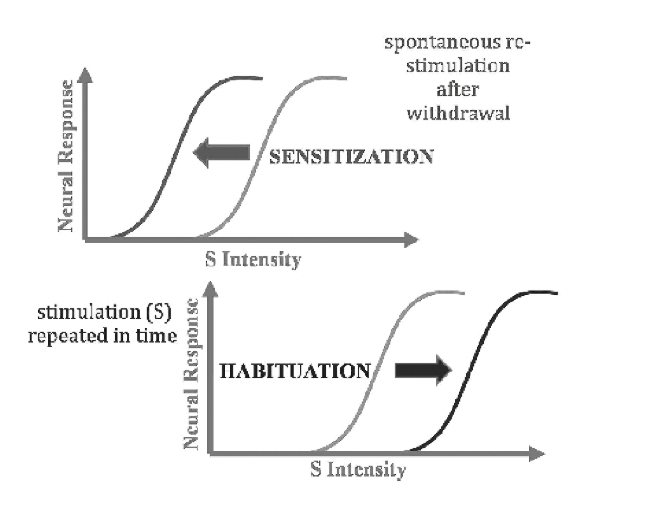
STIMULUS RESPONSE CURVES:
****Sensitization takes normal curve and shifts it LEFT
****Habituation does the opposite and shifts it to the RIGHT (has to be more intense to cause the same neural response)
more intense stimuli → more neural response
Habituation and sensitization shifts your response curve
Ex: putting your foot on something dull vs. sharp → sharp is more of a stimulus (it hurts more), further to the right and the dull would be further to the left
Dull does not FEEL as painful (does not activate as many nerves)

Salivation and Hedonic ratings of taste in People
First bite YUMMMMMM, second bite: still good but not as good, when you are eventually SUPER full the chinese food does NOT taste as good
You were HABITUATING to the food
Habituation Effect
decline in responding that occurs with repeated presentation
stimulus SPECIFIC
Visual Attention in Human Infants
babies have longer attention spans when staring at a more complex/interesting stimuli
stimuli magnitude effects behavioral response
individuals can ______ to a stimulus
HABITUATE
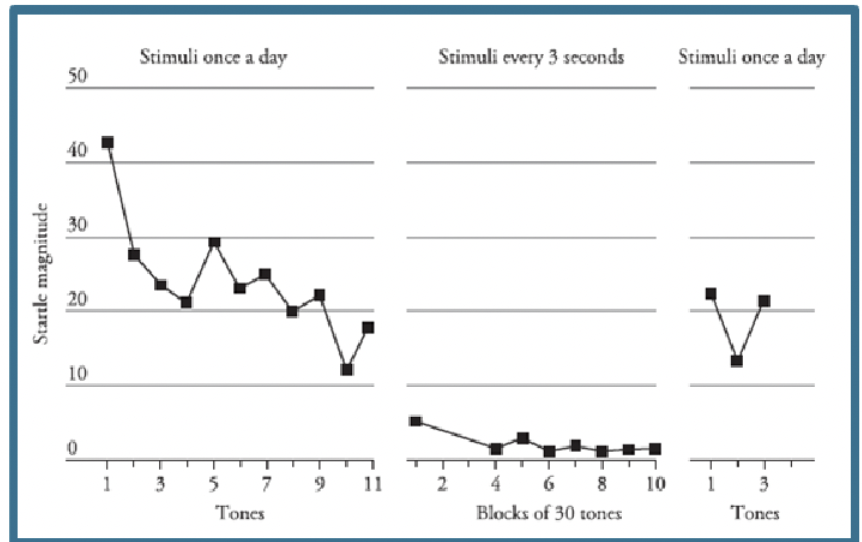
The Startle Response + Habituation
defensive reaction to a potential attack (like someone blowing a loud whistle behind your back , you are likely to jump)
with repeated startling stimuli (whistle), the startle response will progressively GO DOWN, however there will STILL be a RESPONSE
startle does not ALWAYS decrease from tone to tone (mostly downward slope though)
Tone very 30 mins
Tone very 1 minute
Initial reaction is the same because it is their first time hearing the sound -
Less of a reaction each time you hear the sounds
If you played the sound a week later it would be similar/the same as the initial reaction
Habituation does NOT last forever, there is __________
SPONTANEOUS RECOVERY→ wait for period of time before presenting the startling stimuli again, startle response returns
*Repeated presentations of a stimulus do not always result in both long-term and short-term habituation effects
It is hard to habituate
reflex where your leg moves when you hit your knee
Sensitization Effect
Sensitization Effect: already aroused? The same eliciting stimulus will trigger a much stronger reaction (ex: hearing a loud noise when alone and scared at night in the dark)
involved in our modern understanding of behavioral states
Pleiotropic Effects
changes many different traits or parts of the body at the same time (don't memorize this) idk if this needs to be on here lol
When you are hungry you are more likely to actually search for food, salivate, less likely to focus,
When you are hungry the probability of you to do a behavior changes
Habituation vs. Sensory Adaptation + Response Fatigue
not all instances where repetitious stimuli result in response decline are due to habituation
Sensory Adaptation
when the sense organs become temporarily disabled due to stimuli overload
ex: you are temporarily deafened by a particularly loud noise
Response Fatigue
when sensory receptors won’t receive stimuli because they are fatigued
ex: when taking a super long exam, you might do badly because your mind becomes fatigued and fails to focus on the questions
Why don't you feel your t-shirt?
You didn't habituate to your shirt you are just not responding as much
Its about the way your cells work, no the stimulus
The Dual- Process Theory of Habituation and Sensitization
assumes different types of underlying neural processes are responsible for increases and decreases in responsiveness to stimulation
Habituation and Sensitization are NOT __________
MUTUALLY EXCLUSIVE
they can happen at the SAME TIME !!!!!
all habituation and sensitization effects are the sum result of both habituation and sensitization processes
Habituation Processes
assumed to occur in the S-R (Stimuli - Response) system and are activated every time eliciting stimuli are produced
Sensitization Processes
assumed to occur in the state system, which activates only in presence of arousing stimuli (CONTEXT)
habituation is ______ specific while sensitization is not highly ____ specfic
STIMULUS
Opponent Process Theory of Motivation
biphasic emotional reaction
weakened primary reactions to repeated stimulations
weakening of primary reaction with repetition accompanied by strengthening of after-reaction
certain mechanisms in pace to keep us at emotional homeostasis
presentation of an emotional arousing stimulus will initially elicit Process A (primary process), Process A elicits Process B (opposite reaction)

previous slide
Emotional Reactions + Aftereffects
Intense emotional reactions can be biphasic: one emotion during the eliciting stimulus and the opposite emotion when the stimulus is terminated
Ex: drinking vodka makes you mellow that night. Drinking lots of vodka makes you irritable the next day
Emotional reactions change with experience: primary reaction becomes weaker and after-reaction becomes stronger
Modal Action Patterns (MAP)
Response sequences typical of a particular species
Many stimuli will elicit different responses from different organisms
Ex: chicks peck a red patch near the tip of the parent’s bill, causing the parent to regurgitate food for them
Sign Stimulus :Eliciting Stimuli for Modal Action Patterns
specific stimulus that elicits certain response
Ex: when chicks peck at their parents’ beak to get them to regurgitate, the long, moving object with a contrasting red spot near the tip is the sign stimulus
Supernormal Stimulus :Eliciting Stimuli for Modal Action Patterns
exaggerated stimulus used to cause extremely vigorous response
Ex: foods with high levels of sugar and fat cause humans to have much higher rates of salivation and craving than normal food
Sequential Organization of Behavior
The Sequential Organization of Behavior:
Appetitive Behavior: early components of behavior sequence
Example: squirrel finding a pecan tree, finding a nut, and cracking it open
Consummatory Behavior: end components of behavior sequence
Example: squirrel chews the nut and swallows it
Appetitive behavior is used to bring the organism into contact with the stimuli that will trigger the consummatory behavior
Can group by general search mode, focal search mode and food handling and ingestion mode