Lecture 3: Thermoregulation
 Call Kai
 Learn
Learn Practice Test
 Spaced Repetition
 Match
Match Flashcards
 Knowt Play
1/18

There's no tags or description
Looks like no tags are added yet.
Name | Mastery | Learn | Test | Matching | Spaced | Call with Kai | Chat |
|---|
No analytics yet
Send a link to your students to track their progress
19 Terms
Define conformer
Matches internal environment to external environment (ex. If outside temp goes up, inside temp goes up)
Define regulators
Hold internal environment constant (homeostasis) regardless of external environment (ex. If outside temp goes up, inside temp will remain constant)
Define homeotherms
Animals that must maintain a constant internal body temperature to function
Define poikilotherms:
animals who can function at a range of internal body temperatures
To maintain homeostasis, you must balance the heat you are gaining and losing.
True or false.
True
Define endotherm
Gain most of their heat through their own metabolism.
Define ectotherms
Gain most of their heat from the environment
whats the diff between Homeotherms vs Poikioltherm and Endotherm vs exotherm
Homeotherms are most likely to be endotherms. Poikiolotherms are not likely to be ectotherms. Homeotherms vs Poikioltherm are talking about survival temps. Endotherm vs extotherm is talking about how animal gets majority of its heat.
define thermoneutral zone (TNZ). is this where the metabolic rate for endotherms is the lowest?
Where metabolic rate is equal to the basal metabolic rate.
Endotherm metabolic rate is lowest in the thermoneutral zone.
Humans thermoneutral zone is around room temperature.
What happens to the rate of metabolism when humans are outside of TNZ
It increases to combat temp change. Shivering to get warmer takes energy. Sweating to gt colder takes energy.
Why do poikilotherms metabolic rate correlate to temperature (confsued ask during office hours)
Cold environments are suitable for homeotherms/poikilotherms, warm envrionemtns are suitable for homeotherms/poikilotherms.
homeotherms; poikilotherms.
whats Fouriers law. list what each variable is
Q = kA (deltaT/d)
Q is amount of heat transferred
A is surface area of heat
deltaT: temp diff between two sides of transfer
d: material thickness (how good our oven mitts are)
k: thermal conductivity
List the 4 ways animals can take advantage of fouriers law
deltaT: by moving environments
Change A (behaviorally): laying flat when hot, cuddling yourself when cold
Change B (anatomically): same species have different traits in different environments (snow hare vs dessert hare)
Change k and d: by insulation
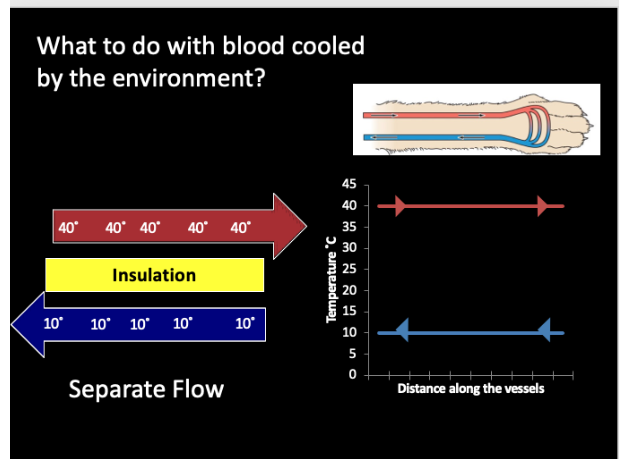
define seperate blood flow (draw figure)
good for maximizing heat loss via extremities.
Warm blood and cold blow flow opposite of each other. There is insulation between warm and cold blood so that heat doesn't transfer!
As warm flow goes to environment is it warm, it loses heat to environment, now cold blood returns to body.
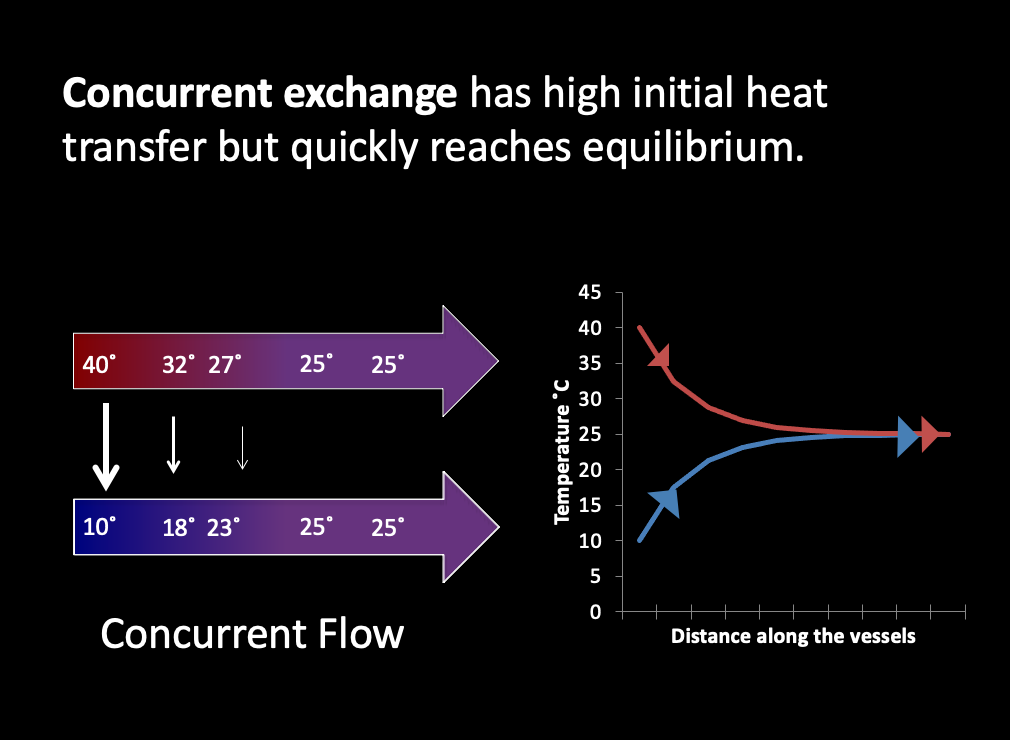
define concurrent exhcnage (draw figure). does it exist irl and if not why?
Concurrent exchange (does not exist irl bc isnt efficient)
Has high initial heat transfer but quickly reaches equilibrium. Warm and cold blood flowing in same direction and touching eachother (exchanging heat no insulation). Warm blood warms cold blood and losses heat, then both blood cessels reach equilibrium.
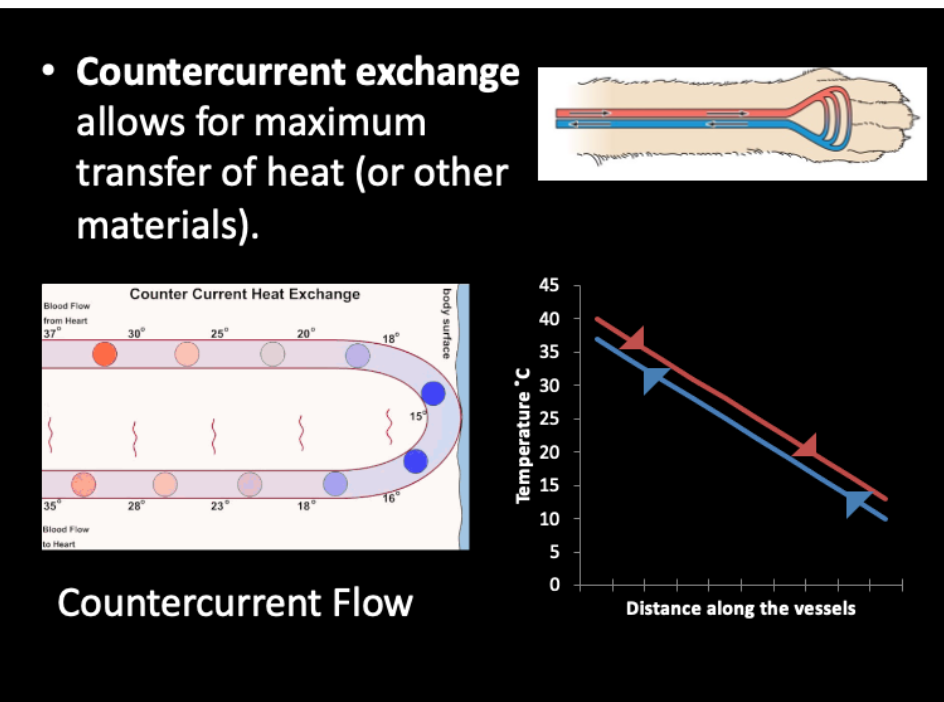
define countercurrent exchange (draw figure)
Allows for maximum transfer of heat. Allows for minimum heat loss.
Warmer blood and warm blood (exchanging heat, flowing diff ways). Warmer blood gets cold as it gets to extremity, this cold blood then is returned as warm blood.
graph the two graphs for endotherms/homeotherms:
environmental temp vs body temp
environmental temp vs metabolic rate (include TNZ)
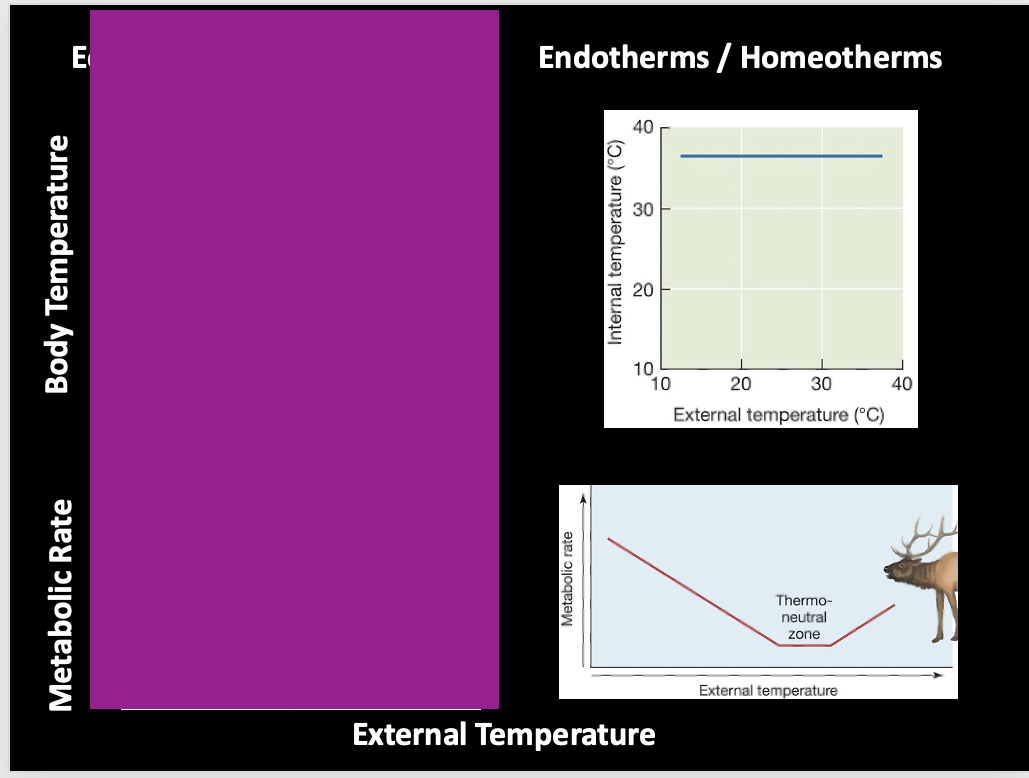
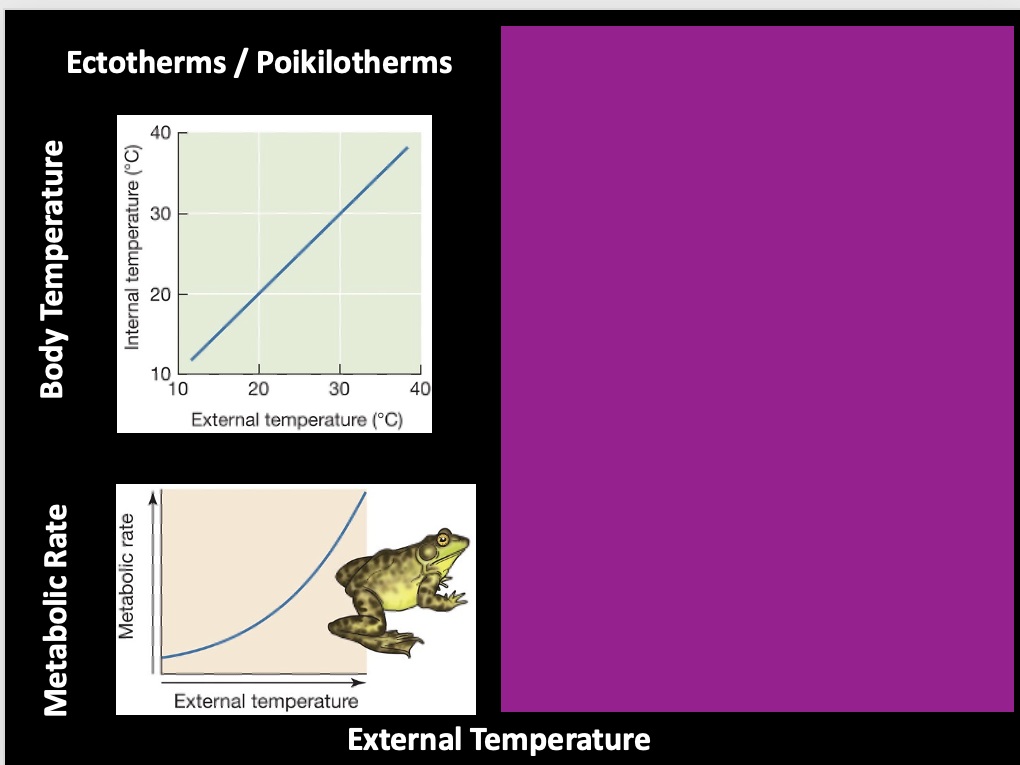
graph the two graphs for ectotherms/poikilotherms:
environmental temp vs body temp
environmental temp vs metabolic rate