Immuno 2: Disease and Lab Diagnosis
 Call Kai
 Learn
Learn Practice Test
 Spaced Repetition
 Match
Match Flashcards
 Knowt Play
1/100

There's no tags or description
Looks like no tags are added yet.
Name | Mastery | Learn | Test | Matching | Spaced | Call with Kai | Chat |
|---|
No analytics yet
Send a link to your students to track their progress
101 Terms
which category of PID refers to predominantly antibody deficiencies?
3
which category of PID refers to purine-nucleoside-phosphorylase (PNP) deficiency?
1
which category of PID refers to combined immunodeficiencies with associated or syndromic features?
2
what condition has the following characteristics:
rare autosomal recessive trait
presents in infancy (pulmonary infections, UTI)
affects an enzymes involved in the metabolism of purines
moderate to severe defect in CMI with normal or only mildly impaired HMI
PNP deficiency
what condition refers to a progressive decline in T cell number due to accumulation of toxic dGTP?
PNP deficiency
what condition may be confused with neonatal HIV and needs to be differentiated using specific tests?
PNP deficiency
what category has the following characteristics:
nonimmunologic features in addition to the combined immunodeficiency
affect CMI (T cells) and indirectly other branches of immune response
increased risk of GVHD
2
what category includes the following:
wiskott aldrich syndrome (WAS)
22q11.2 deletion syndrome (DiGeorge syndrome)
ataxia-telangiectasia (AT)
2
what condition refers to a rare X-linked recessive syndrome that is defined by the triad of
immunodeficiency
eczema
thrombocytopenia
WAS
what condition is often fatal in childhood because of infection, hemorhage, or malignancy?
WAS
what condition has the following lab picture
thrombocytopenia, prolonged BT (PFA-100), very low isohemagglutinins (especially IgM diagnostic), increased serum AFP (diagnostic)
shortened half-life of PLTs, T lymphs affected, B lymphs appear to function normally
WAS
B lymphocytes appear to function normally in WAS. true or false?
true
a mutation in the ____ gene which encodes WASp required for actin polymerization in hematopoietic cells.
WAS
a mutation in the ____ gene results in defective signal transduction in lymphocytes and platelets.
WAS
in WAS, abnormal integral membrane protein _____ is due to the mutated WAS gene on the X chromosome.
CD43
the following characteristics are associated with ____:
thrombocytopenia = increased bleeding time
small PLTs
infections
eczema
absence of isohemagglutinins
autoimmunity and/or malignancies
WAS
the following characteristics are associated with ____:
autosomal dominant
deleted genes affect thymus development in embryo
deletion of q11.2 on chromosome 22
DiGeorge syndrome
if there is partial 22q11.2 deletion, there is near normal immune function. true or false?
true
around 20% of children with 22q11.2 deletion syndrome have severe ____ deficiency.
T cell
what condition is associated with the following:
severe, recurrent viral and fungal infections
tetany due to hypocalcemia resulting from hypoparathyroidism
DiGeorge syndrome
what condition is associated with the following:
a complex, autosomal recessive syndrome
combined defect of humoral and cellular immunity
ataxia telangiectasia
what condition is characterized by involuntary muscle movements and capillary swelling that results in red blotches on the skin?
ataxia telangiectasia
what term refers to involuntary muscle movements?
cerebellar ataxia
what term refers to capillary swelling that results in red blotches on the skin?
telangiectasia
ataxia telangiectasia will have a(n) increased/decreased serum alpha-fetoprotein (AFP) level (pick one).
increased
ataxia telangiectasia will have a defect in the ____ gene on chromosome 11, region 22.
ATM
what gene is required for recombination process for genes in the immunoglobulin superfamily?
ATM
in ataxia telangiectasia, the ____ gene abnormality results in a defective kinase involved in DNA repair and cell cycle control (high risk of developing lymphoid malignancies).
ATM
what term refers to a loss of motor control?
ataxia
what term refers to spider veins?
telangiectasia
what condition is associated with the following:
neurodegenerative, inherited disease
causes tumor formation
impairs cerebellum
prevents repair of broken DNA
ataxia telangiectasia
what condition is associated with the following:
nystagmus (rapid involuntary eye movement)
ocular telangiectasia
ataxia telangiectasia
which category of PID refers to diseases of immune dysregulation?
4
which category of PID includes many diseases with normal numbers of T or B cells but with reduced control over their functions?
4
many diseases of category 4 have features of autoimmunity. true or false?
true
what category 4 condition refers to mutations in genes controlling apoptosis in the thymus that may lead to autoreactive cells in circulation?
autoimmune lymphoproliferative syndrome
what category 4 condition refers to a lack of T regulatory (Treg) cells that may lead to lymphoproliferation and autoimmunity?
CD25 deficiency; mutation of FOXP3 gene
what category 4 condition refers to a mutation in the LYST gene and is characterized by a reduced number of NK cells and neutrophils as well as an increased production of inflammatory proteins?
chediak higashi
which category of PID refers to congenital defects of phagocyte number, function, or both?
5
what category 5 condition is associated with the following:
group of disorders that involve abnormality in neutrophil microbicidal function
70% cases x-lnked (more severe)
symptoms
recurrent suppurative infections
pneumonia
osteomyelitis
draining adenopathy
liver abscess
dermatitis
hypergammaglobulinemia
infections usually begin before 1 year of age and the syndrome is often fatal in childhood
CGD
what category 5 condition refers to when phagocytic cells ingest but do not kill bacteria due to failure to form oxygen radicals (no NADPH oxidative)?
CGD
what category 5 condition typically has catalase positive organisms (e.g., staphylococcus aureus) and fungi (aspergillus and nocardia)?
CGD
in CGD, infections usually begin before 1 year of age, but the syndrome is often treatable in childhood. true or false?
false
mutations in any of these 5 components of NADPH oxidase for are associated with which condition?
p22 phox
p40 phox
p47 phox
p67 phox
gp91 phox
CGD
for CGD lab diagnosis by flow cytometry using dihydrorhodamine (DHR), DHR will allow DHR to fluoresce when it is ____.
reduced
for CGD lab diagnosis by flow cytometry using dihydrorhodamine (DHR), what cells are activated using phorbol myristate acetate (PMA)?
neutrophils
phorbol myristate acetate (PMA) is mitogenic for what cells?
neutrophils
neutrophils from CGD patients are unable to undergo oxidative burst and will show less fluorescence than normal neutrophils when performing flow cytometry using dihydrorhodamine (DHR). true or false?
true
for CGD diagnosis, what test measures the ability of a patient’s neutrophils to reduce the yellow dye nitroblue tetrazolium to a deep blue produce (formazan) precipitated in neutrophils that could be detected microscopically in a PBS?
NBT dye test
for a nitroblue tetrazolium (NBT) dye test for CGD, what term refers to the deep blue produce created based on the ability of a patient’s neutrophils to reduce the yellow dye?
formazan
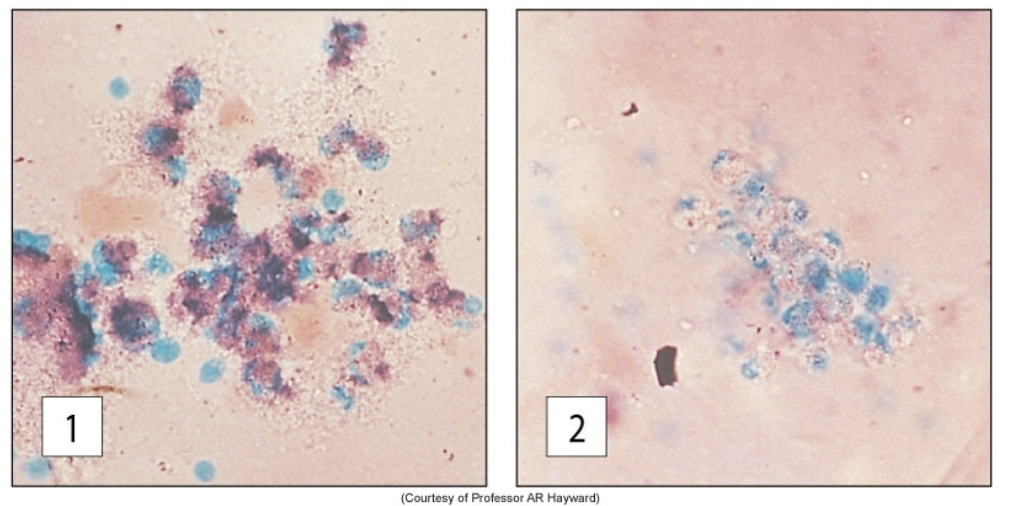
this is an image of the results of 2 different patient samples that underwent the NBT dye test. which one is of the normal patient (no CGD)?
1
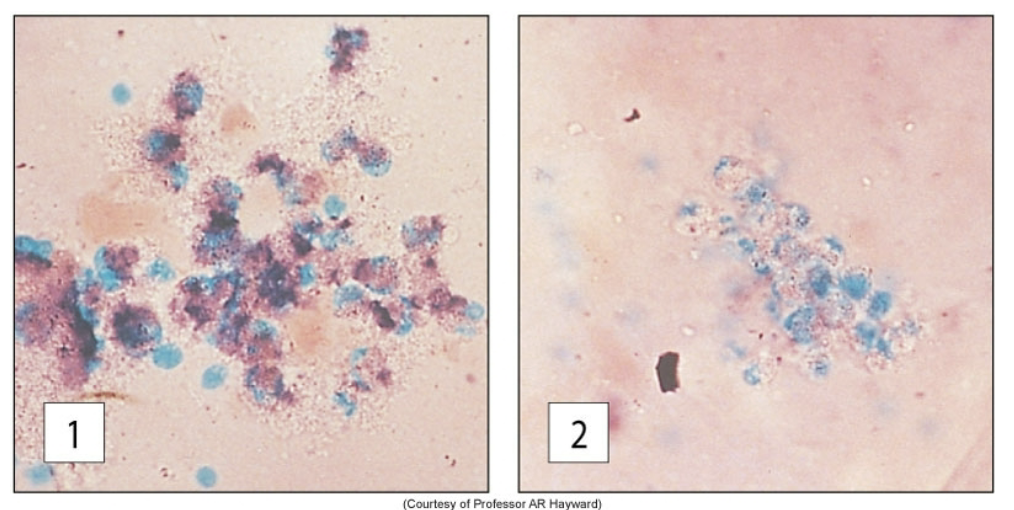
this is an image of the results of 2 different patient samples that underwent the NBT dye test. which one is of the patient with CGD?
2
what condition refers to an absent beta subunit (CD18) on neutrophils for 3 cell surface integrin complexes on neutrophils?
leukocyte adhesion deficiency
what gene defect on chromosome location 21q22.3 encodes CD18 is associated with leukocyte adhesion deficiency?
ITGB2
what refers to a common protein that forms part of the β2 integrins needed for white blood cells to adhere to blood vessel walls?
CD18
in leukocyte adhesion deficiency, without CD18, there is ineffective adhesion. true or false?
true
in leukocyte adhesion deficiency, CD11a/CD18 are beta2 integrins found on what cells?
T cells
in leukocyte adhesion deficiency, CD11b/CD18 and CD11c/CD18 are beta2 integrins found on what cells?
PMNs/Mono
in leukocyte adhesion deficiency, what cells cannot migrate toward inflammatory stimuli or adhere to vascular endothelium?
neutrophils
what diagnosis is suggested by these features:
recurrent soft tissue infections, periodontal
delayed wound healing
delayed umbilical cord separation
no pus formation despite high WBC counts
leukocyte adhesion deficiency
what category of PIDs refer to complement deficiencies?
8
what category of PIDs are associated with early complement components deficiency associated with recurrent pyogenic infection and also connective tissue disease (especially C2 and C4)?
8
for category 8, complement deficiency of components 5 through 8 are associated with recurrent ____ species infection.
neisseria
for category 8, deficiency of the complement regulatory protein _____ is associated with angioedema (hereditary angioedema).
C1 esterase inhibitor
which group of category 8 PIDs refers to immune complex disease?
I
which group of category 8 PIDs refers to angioedema?
II
which group of category 8 PIDs refers to recurrent pyogenic infections?
III
which group of category 8 PIDs refers to recurrent neisseria infections?
IV
which group of category 8 PIDs refers to asymptomatic?
V
which group of category 8 PIDs is associated with the following deficiencies:
C1q
C1s, or C1r + C1s
C2
C4
I
which group of category 8 PIDs is associated with the following deficiencies:
C1 inhibitor
II
which group of category 8 PIDs is associated with the following deficiencies:
C3
factor H
factor I
III
which group of category 8 PIDs is associated with the following deficiencies:
C5
C6
C7
C8
properdin
factor D
IV
which group of category 8 PIDs is associated with the following deficiencies:
C9
V
when performing diagnostic testing for immunodeficiency, it is important for laboratorians to compare the results for a patient with appropriate age-matched controls. true or false?
true
in tests of cellular function, the patient’s cells need to be tested in parallel with cells from a abnormal control. true or false?
false
when an abnormal test result is obtained with evaluation immune dysfunction, it should be confirmed by repeat testing. true or false?
true
____ with small PLTs can be detected in WAS.
thrombocytopenia
by the age of ____, an individual should have naturally-occurring IgM antibodies against ABO blood group antigens.
2
the absence of IgM antibodies against ABO blood group antigens suggest an abnormal IgG response. true or false?
false
an overall assessment of ____ immunity can be made by measuring antibody responses to antigens to which the population is exposed normally or following vaccination.
antibody-mediated
which IgG subclass(es) normally respond to protein antigens, such as those found in tetanus and diphtheria vaccines?
IgG1; IgG3
which IgG subclass(es) normally responds to polysaccharide antigens such as those in the H. influenzae and S. pneumoniae vaccines?
IgG2
screening for complement deficiencies usually begins with a ____ assay, which determines functional complement level in an individual.
CH50
undetectable ____ levels may indicate a deficiency in a specific component of the classical pathway of complement (but could also indicate consumption of C components).
CH50
what is the best confirmatory test when evaluating immune dysfunction?
flow cytometry
in flow cytometry, what cell type refers to CD19+?
B cells
in flow cytometry, what cell type refers to CD3+?
T cells
in flow cytometry, what cell type refers to CD3+/CD4+?
t helper cells
in flow cytometry, what cell type refers to CD3+/CD8+?
cytotoxic t cells
in flow cytometry, what cell type refers to CD16+ or CD56+?
NK cells
an absence of or profound decrease in the number of CD3+ cells would be consistent with _____.
digeorge syndrome
an absence of CD19+ B cells suggests _____.
Btk deficiency
_____ function can be measured by assessing the ability of isolated T cells to proliferate in response to an antigenic stimulus or to T-cell mitogens in culture, such as phytohemagglutinin (PHA) or Concanavalin A (Con A).
t cells
what refers to a substance that stimulated mitosis in all T cells or all B cells, regardless of antigen specificity?
mitogen
for QuantiFERON-TB assays and T-SPOT assays, IFNy is secreted by activated ____ and is quantitated by either an enzyme-linked immunosorbent assay (ELISA) or ELISPOT procedure.
Th1 cells
all states in the U.S. include PID testing as part of their newborn screening programs. true or false?
true
TCR excision circles (TRECs) in newborn blood for PID testing is identified by quantitative ____.
PCR
____ are present in T cells that have undergone alpha-beta receptor gene rearrangements.
TRECs
what refers to genetic material that has been removed from the germline DNA during alpha V-J and beta V-D-J recombination?
TRECs