DNA Organisation
 Call Kai
 Learn
Learn Practice Test
 Spaced Repetition
 Match
Match Flashcards
 Knowt Play
1/15

There's no tags or description
Looks like no tags are added yet.
Name | Mastery | Learn | Test | Matching | Spaced | Call with Kai | Chat |
|---|
No analytics yet
Send a link to your students to track their progress
16 Terms
What is DNA?
Aka deoxyribonucleic acid
Nucleic acid
Carries the genetic information of an organism
What is the monomer for DNA?
Deoxyribonucleotide
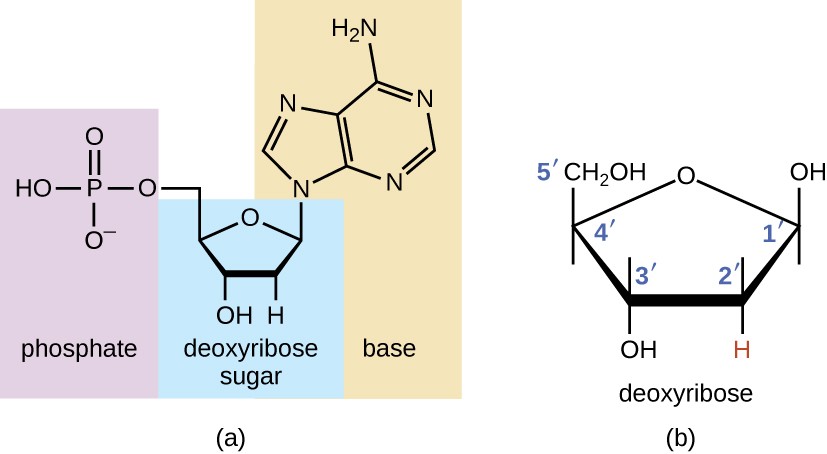
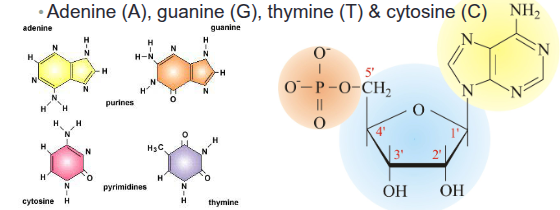
What is the structure of deoxyribonucleotides in DNA?
Deoxyribose (pentose/ 5C sugar)
Phosphate group
nitrogenous base
Adenine, guanine (purines, 2 rings)
thymine, cytosine (pyrimidines, 1 ring)
Glycosidic bonds hold these components together
What are 7 structural components of DNA? (polymer)
Sugar-phosphate backbone
Double-stranded helix
Over 3 billion base pairs
5’ end contains phosphate (-PO4) attached to the 5th C
3’ end contains a hydroxyl group (-OH) attached to the 3rd C
Strands run antiparallel
One strand goes from 5’ to 3’
Other strand goes from 3’ to 5’
2nm in diameter
One turn (about 10 base pairs) of the helix is 3.4 nm
Distance between base pairs is 0.34 nm
The two strands are not equally spaced, resulting in a major and minor groove due to the asymmetric spacing between the antiparallel backbones
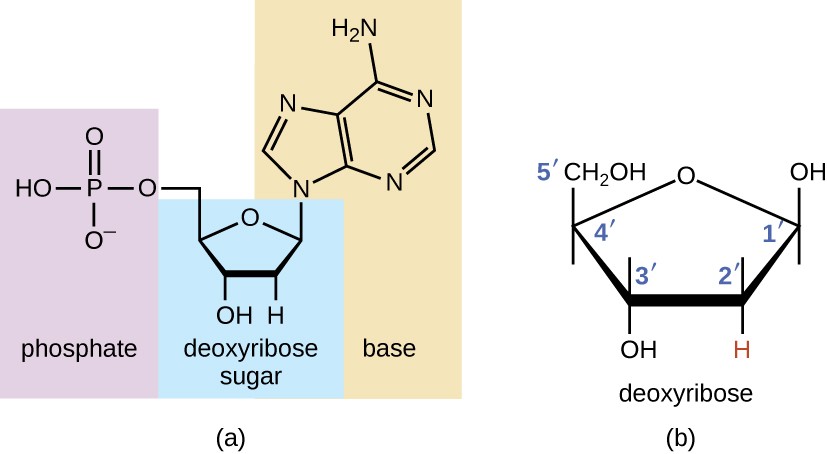
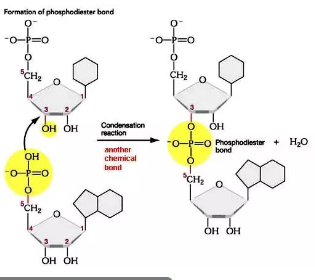
How is DNA’s phosphate sugar backbone formed? (polymer)
By forming phosphodiester bonds (condensation reaction) between the phosphate group of one nucleotide and the sugar of another.
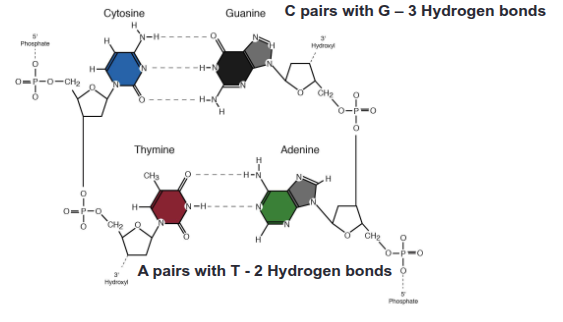
How is DNA’s double stranded helix formed?
Complementary base pairing connects purines to pyrimidines via hydrogen bonds:
C forms 3 hydrogen bonds with G (cars in the garage)
A forms 2 hydrogen bonds with T (apples on trees)
Recall: A, G - purines (2 rings), C,T pyrimidines (single ring)
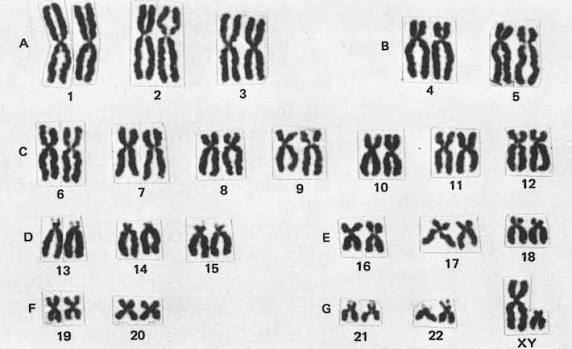
What does karyotype mean?
The number and distribution of chromosomes for a species
How many chromosomes do humans have?
Somatic cells have 46 chromosomes
23 homologous pairs
22 autosomes
1 sex-determining pair
Gametes have 23
What is the first step of DNA packing?
DNA is very long (about 2 m long when fully stretched out) and needs to be condensed
First, the DNA is coiled around 8 stabilizing proteins called histones
Since the positively charged histones are attracted to the negatively charged DNA
Forming a nucleosome
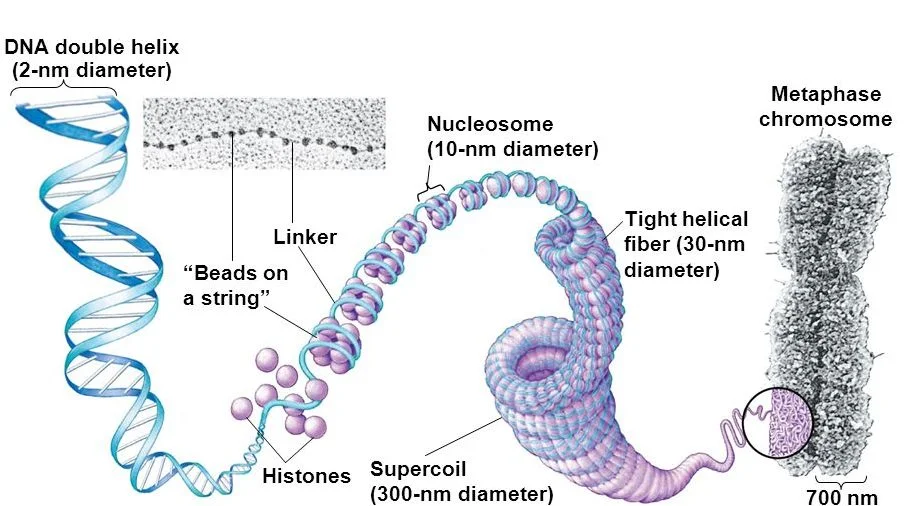
What is the second step of DNA packing?
The nucleosomes and the DNA between them coil into chromatin fibers
This is what occurs in interphase
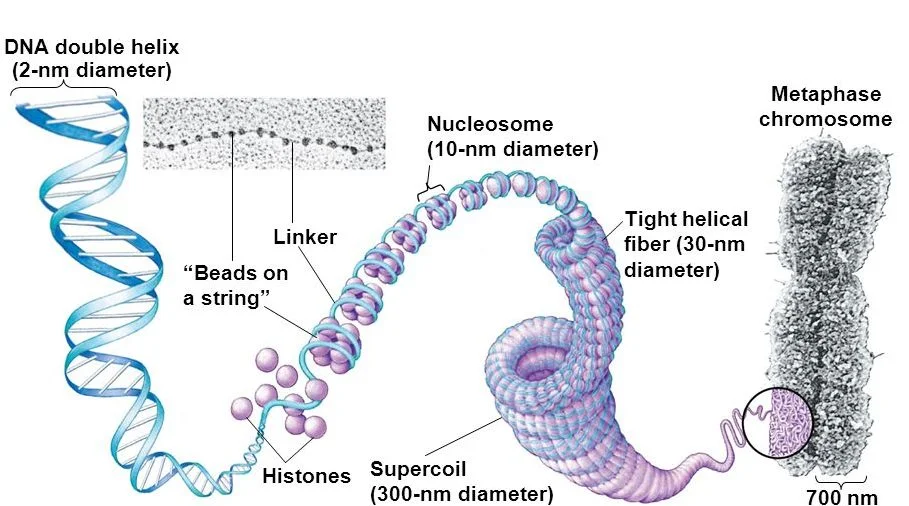
What is the third step of DNA packing?
The chromatin fibres fold in a process called supercoiling to form chromosomes
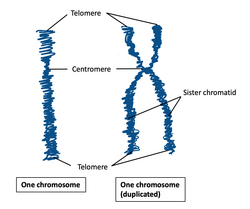
A chromosome is made up of two sister chromatids held together by a centromere
What are genes?
Sections of DNA that are located on specific chromosomes that code for specific proteins
Physical and functional units of heredity (i.e. they are passed from parent to offspring)
Currently, it is estimated that 30,000 genes exist within the human genome
What are noncoding regions?
Do not provide instructions for protein synthesis
More than 95% of the human genome is noncoding
Filled with variable number tandem repeats (VNTRs) (aka microsatellites)
Sequences of repeating base pairs (e.g.TAGTAGTAGTAG)
Vary among individuals
Useful for DNA fingerprinting & profiling
What are telomeres?
Cap-like features at the ends of chromosomes
Long sequence of repetitive, noncoding DNA
Protect cells from losing valuable genetic material during DNA replication
Bind to proteins that stop the ends from being degraded and sticking to other chromosomes
Over time (due to ongoing cell division), telomeres become shorter
Appears to be an indication of age and the general health of an individual
What are pseudogenes?
Have nucleotide sequences similar to a functioning gene, but do not seem to express any RNA or protein
LINEs (long interspersed nuclear elements) and SINEs (short interspersed nuclear elements) are 2 types of pseudogenes that are believed to be crippled copies of known functional genes
The function of LINEs and SINEs is unclear
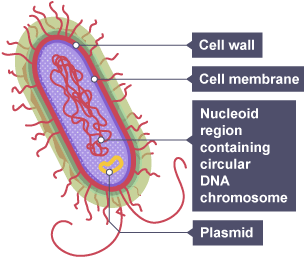
What is the shape of DNA in prokaryotes?
Most prokaryotes contain their genetic material in the form of a circular double-stranded DNA molecule floating in the nucleoid