ch 8-2 mercury and the moon pt 2
 Call Kai
 Learn
Learn Practice Test
 Spaced Repetition
 Match
Match Flashcards
 Knowt Play
1/83

There's no tags or description
Looks like no tags are added yet.
Name | Mastery | Learn | Test | Matching | Spaced | Call with Kai | Chat |
|---|
No analytics yet
Send a link to your students to track their progress
84 Terms
How are impact craters formed on the Moon?
A meteoroid strikes the Moon, ejecting material. The impact causes an explosion that throws out even more material, leaving behind a crater.
What happens when a meteoroid impacts the Moon's surface?
The impact ejects rock and debris, creating an explosion and forming a crater.
what protects the Earth from meteors?
Earth’s atmosphere
what does the moon lack?
an atmosphere
allows meteors to strike and causes energy to strike surface rocks therefore heat and deform and ejection of materials, leaving a crater
How does the size of an impact crater compare to the size of the incoming meteoroid?
The diameter of the resulting crater is typically about 10 times larger than the diameter of the incoming meteoroid.
what is the ejecta blanket?
materials thrown out by explosion
ranged from dust to large boulders
what sizes do craters come in?
all sizes from big to small
how is the shape of a crater determined?
by the way a meteor strikes
vertical strike
angle strike
what type of crater is formed from a vertical strike?
circular crater
what type of crater is formed from an angle strike?
elongated crater
what would a crater be like if the surface is soft and icey?
it would be bigger/deeper than if it struck solid rock
what is the main factor that determines the size of a crater?
size and speed of meteor
larger the mass and velocity, the deeper the crater
How does lower gravity affect impact crater formation?
Lower gravity makes it easier for material to be ejected during an impact, resulting in larger and deeper craters.
Why are craters often larger on bodies with lower gravity?
Because less gravity pulls the ejected material back down, allowing a larger crater to form.
what are micrometeroids?
form during impact were surface rock was struck and cooled quickly
“glass beads”
small craters or beads
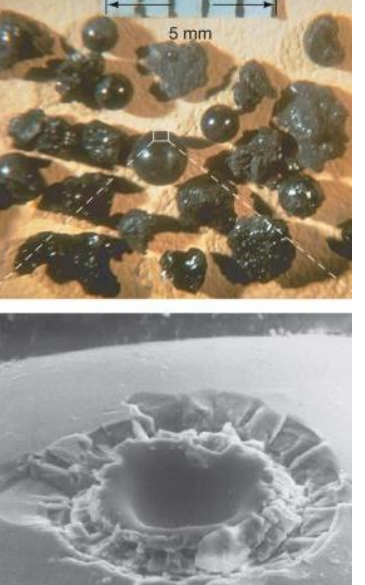
How large is a typical impact crater compared to the meteoroid that formed it?
A crater is typically about 10 times wider and about 2 times deeper than the incoming meteoroid.
impacts released lots of energy
What happens to rock beneath a meteoroid impact?
The rock is pulverized (crushed into fragments) to a depth much greater than the crater itself.
When did most lunar craters form?
Most lunar craters formed at least 3.9 billion years ago, during a period of heavy bombardment (intense comets and asteroids).
the moon is the only planet in the solar system to have?
accurate measurements
what is regolith?
thick layers of dust left by/ejected by meteorite impacts
fine lunar dust covers ~20 m of moon
contains no organic matter (lack of water)
layer of pulverized ejecta
Is the Moon still being bombarded by meteoroids today?
Yes. The Moon is continually struck by meteoroids, especially tiny micrometeoroids.
softens features
What are micrometeoroids?
Very small meteoroids that frequently impact the Moon's surface.
How do micrometeoroids affect the Moon's surface?
Over time, they wear down and soften surface features such as craters and rocks.
Do meteorites strike Earth as well as the Moon?
Yes. Meteorites regularly impact Earth and can form impact craters.
crater is in Arizona
roughly new ~50,000 y/o
50 m wide, 200 long
Where is ice thought to exist on the Moon?
Near the Moon's north and south poles, in permanently shadowed regions.
What evidence suggested the presence of ice on the Moon in 1996?
Radar echoes detected low-density material near the lunar south pole.
What lunar ice evidence was reported in 1996?
Radar echoes detected low-density material near the Moon's south pole, suggesting possible ice deposits.
What was reported about lunar ice in 1998?
Possible "lakes" of ice were reported at both the north and south lunar poles.
What evidence supports the existence of water ice on the Moon?
The 2009 LCROSS mission detected small amounts of water, especially near the lunar poles.
What did the LCROSS mission discover in 2009?
LCROSS detected small amounts of water on the Moon, supporting the idea that ice exists near the poles.
where was the ice found on the lunar surface possibly brought by?
meteorites and comets
How does Earth's surface composition differ from the Moon's?
Earth's surface contains a mixture of broken rock, dust, and soil, whereas the Moon lacks true soil and organic material.
What materials are commonly found in Earth's soil?
Silicates, metals, clay, iron oxides, organic matter, and salts.
Why is Earth's soil different from lunar regolith?
Earth's soil contains organic matter and is altered by water, weathering, and life, while lunar regolith is mainly broken rock and dust produced by impacts.
lunar regolith
contains no organic matters
samples have been dry
What does the presence of rilles on the Moon indicate?
They indicate that the Moon was volcanically active more than 3 billion years ago.
almsot all impact craters
What is a lunar rille?
A long channel or groove on the Moon's surface formed by ancient volcanic activity.
ditch where molten lava flowed
When was the Moon volcanically active?
More than 3 billion years ago, when lava flows helped shape features such as rilles and maria.
What can an alignment (chain) of volcanic features on the Moon indicate?
It may be the surface expression of a subsurface fault or fracture through which magma reached the surface.
How can a volcanic crater form when lava erupts?
Lava rises toward the surface, cools, and the volcanic dome or chamber may collapse, leaving a volcanic crater.
What is the relationship between faults and volcanic activity?
Faults and fractures can provide pathways that allow magma to rise to the surface
How does Mercury's cratering compare to the Moon's?
Mercury is less heavily cratered than the Moon.
What is a scarp on Mercury?
A long cliff-like feature that can extend for hundreds of kilometers and reach heights of up to 3 km.
How did Mercury's scarps likely form?
They formed as Mercury cooled and contracted, causing the crust to buckle and create large cliffs.
thought to have formed when the planet cooled and shrink during early history
scrap that does not appear to be a result of volcanic or any other familiar geological activity likely was produced…
after bombardment ended
what are hollows?
unique to mercury
not impact craters
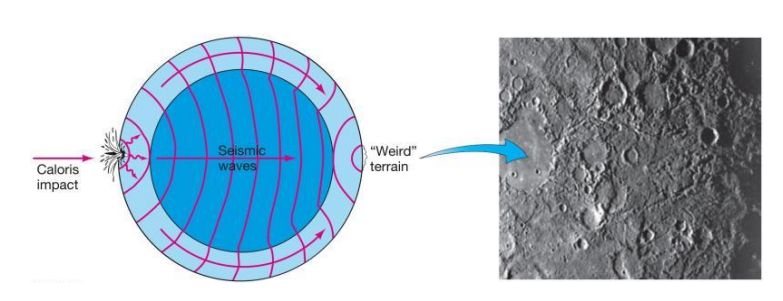
What is the Caloris Basin?
A massive impact basin on Mercury formed by a giant asteroid impact.
Where is Mercury's "weird terrain" located relative to the Caloris Basin?
On the opposite side of Mercury from the Caloris Basin.
How did Mercury's weird terrain likely form?
Shock waves from the impact that formed the Caloris Basin traveled through Mercury and disrupted the crust on the opposite side of the planet.
How did Mercury's weird terrain form?
The giant impact that created the Caloris Basin sent powerful seismic (shock) waves through Mercury. These waves converged on the opposite side of the planet, disrupting the crust and creating the weird terrain.
What is believed to have caused Mercury's "weird terrain"?
The focusing (convergence) of seismic waves generated by the giant impact that formed the Caloris Basin.
How are Mercury's weird terrain and the Caloris Basin related?
The impact that created the Caloris Basin sent seismic waves through Mercury, which focused on the opposite side of the planet and disrupted the crust, forming the weird terrain.
Why do scientists think the Moon does not have a large iron-nickel core?
Because the Moon has a relatively low density (~3300kg/m3) and no global magnetic field.
What does the Moon's low density suggest about its interior?
It suggests the Moon contains much less iron and nickel than Earth and lacks a large metallic core. (less likely to have)
reinforced by moons lack of magnetic filed caused by churning liquid on outer core of Earth)
How does the Moon's crust compare to Earth's crust?
The Moon's crust is much thicker than Earth's crust.
constitutes moons lithosphere
Why is Mercury denser than the Moon
Mercury contains a much larger proportion of iron, giving it a higher overall density.
What evidence suggests Mercury has a molten core?
Mercury has a weak magnetic field, which is thought to be generated by a molten metallic core.
Why is Mercury's magnetic field surprising?
Because Mercury rotates very slowly, making it unclear how its molten core generates a magnetic field.
what is the approximate radius of Mercury's central core?
Mercury's central core has a radius of about 330 km.
what is the thickness of Mercury’s mantle?
400 km
semisolid rock having properties similar to Earth’s asthenosphere
what lies above Mercury’s inner mantle?
900 km thick outer mantle of solid rock
what is mercury topped by?
30 km thick crust
lunar core is denser therefore?
more iron rich and denser than the rest of the moon
What is unusual about the Moon's mantle?
It appears to have a nearly uniform density, although it is chemically differentiated.
What does it mean that the Moon's mantle is chemically differentiated?
Different regions contain different minerals and chemical compositions, even if their densities are similar.
How does the Moon's crust differ between the near side and far side?
The far side crust is thicker than the near side crust, possibly due to the influence of Earth's gravity during the Moon's formation.
What is the current leading hypothesis for the Moon's formation?
The Giant Impact Hypothesis: a Mars-sized body struck the young Earth, ejecting material that later formed the Moon.
What happened during the Giant Impact Hypothesis?
A Mars-sized object collided with the still-molten Earth, ejecting material into orbit around Earth.
Where did most of the material that formed the Moon come from?
Mostly from Earth's mantle, which was blasted into orbit by the impact.
elected into orbit and created disk of dust and molten rock → moon
what does sister or coformation theory suggest?
that the moon formed as a separate object near Earth in much same way our own planet formed
what does impact theory suggest?
Collison with large mars-sized object with a youthful and molten Earth
What happened on the Moon about 4.6 billion years ago?
The Moon formed, and heavy bombardment melted much of its surface.
oldest rocks 4.4B years, crust solidified by this time
What happened on the Moon about 3.9 billion years ago?
Bombardment became much less intense, and volcanic activity filled the maria with lava.
What happened on the Moon about 3.2 billion years ago?
Most volcanic activity on the Moon ceased.
created Maria
during the earliest phases of the moons existence…
~1.2 billion years
meteoritic bombardment must have been frequent enough to heat and re-melt most of the surface layers of the moon
When did Mercury form?
Mercury formed about 4.6 billion years ago.
Why was Mercury molten early in its history?
Heavy bombardment and impacts generated enough heat to melt much of the young planet.
How did Mercury's cooling affect its surface?
As Mercury cooled and contracted, it shrank, causing its crust to crumple and form large scarps (cliffs).
would’ve differentiated layers formed and cooled began to shrink and compressed and cooled the crust causing the scarps we see
what is the reason Mercury has large iron core?
consequence of planet’s location in the hot inner regions of the solar system
main surface features on moon?
maria, highlands
what do mercury and moon have in common?
both heavily cratered
both have no atmosphere, and large day-night temperature excursions
tidal interactions responsible for?
synchronicity of Moon’s orbit, and resonance of Mercury’s
moon’s surface has both?
rocky and dusty material
mercury has no maria but does have?
extensive intercrater plains and scarps