NSG 217: Weeks 1-3 (Development & Developmental Theorists)
 Call Kai
 Learn
Learn Practice Test
 Spaced Repetition
 Match
Match Flashcards
 Knowt Play
1/113

There's no tags or description
Looks like no tags are added yet.
Name | Mastery | Learn | Test | Matching | Spaced | Call with Kai | Chat |
|---|
No analytics yet
Send a link to your students to track their progress
114 Terms
Sigmund Freud
Psychosexual Theorist
Id, Ego, Superego
Psychosocial development (Freud)
Oral stage (birth to 1 year)
Anal stage (1 to 3 years)
Phallic stage (3 to 6 years)
Latency period (6 to 12 years)
Genital stage (≥ 12 years)

Oral Stage
birth to 1 year
everything as far as pleasure is centered around the oral fixation
sucking, biting, chewing and vocalizing
children up to 1 year are putting everything in their mouths
Anal Stage
1 to 3 years
sphincter muscle begins to develop and potty training can occur
a negative or positive experience with potty training can really affect personality development
Hold off on potty training until the child can actively participate in potty training & don’t force or shame child into potty training
Phallic Stage
3 to 6 years
Phallic stage: Phallic means genitalia
when they start to realize that there's a difference in genders
when child starts to experience the oedipus complex
typically around the age of 4
unconscious sexual desire for the parent of the opposite sex, and a wish to exclude the parent of the same sex
children may want to marry their mom or dad and get upset if the other parent shows any affection towards them
typically doesn’t last for a long period of time
Latency Period
6 to 12 years
Latency period: Stable period
all earlier issues have been resolved or repressed
not a whole lot of changes are going on
Genital Stage
≥ 12 years
Genital Stage:
Starts with puberty; when the sex hormones are being produced
Genital organs are now a source of tension and pleasures
masturbation usually occurs during this stage
they start forming friendships and preparing for marriage
Erickson
Psychosocial Theorist
Ego, personal identity, socio cultural identity
Psychosocial development (Erikson)
Trust vs. mistrust (birth to 1 year)
Autonomy vs. shame and doubt (1 to 3 years)
Initiative vs. guilt (3 to 6 years)
Industry vs. inferiority (6 to 12 years)
Identity vs. role confusion (12 to 18 years)

Trust vs. Mistrust
birth to 1 year
Virtue of hope
develops trust when they’re taking in all of their senses
Caregivers respond to the infant’s basic needs by feeding, changing diapers, cleaning, touching, holding, and talking to the infant.
Trust: their needs are consistently met by a caring, loving, motherly figure
“mother” is just whoever provides their mothering care
Mistrust: when that consistent loving care is inconsistent or lacking
Example: when a baby is crying, if their motherly figure consoles the baby & takes care of them and tries to figure out why they’re crying then the baby will develop trust, but if that consoling does not occur mistrust will develop
Autonomy vs Shame & Doubt
1 to 3 years
Virtue of will
Autonomy: the child is discovering that they can do things on their own, the parent then allows them to do so
Shame & doubt develop when the parents don’t allow the child to do things on their own or scolds them when they attempt & they fail.
Example: when a child is trying to put their shoes on, if the mother encourages them, helps them, & praises them when they get it right autonomy develops, but if the mother yells because they’re taking too long or because the put the shoes on the wrong feet, or if they still can’t tie their shoes then shame & doubt develops.
Achieves autonomy and self-control,
Separates from parent/caregiver,
Withstands delayed gratification, imitates adults and children.
Negativism abounds, show affection
Cannot take turns in games until age 3 years
Initiative vs Guilt
3 to 6 years
Virtue of purpose
Initiative: they have a strong imagination, they start to make up games & initiate activities with others. Often mixed up with autonomy, but in initiative they are developing or making up things. Not just realizing that they can do things on their own but now they’re making things up on their own
Guilt: when the mother criticizes or controls their imagination & those games that theyre making up & that child feels like a nuisance.
Example: When the child makes up a game on their own and it may not make any sense to us as adults but if the mother plays along & tries to learn more about the game initiative will develop, if the mother ignores the child, refuses to play with them tells them their game is stupid or that it doesn’t make sense then guilt will develop.
Likes to please parents, plans and initiates activities, make up games, explores new things,
Acts out the roles of other people (real and imaginary), explores new things
Develops sexual identity & conscience
May take frustrations out on siblings
Enjoys sports, shopping, cooking, working
Feels remorse for wrong choice or behaving badly
Cooperates with other children
Negotiates solutions to conflicts
Industry vs. Inferiority
6 to 12 years
Virtue of competency
Industry: means their peer group is very important to them, it helps them develop their self esteem. They need to win approval from their peers. their able to complete specific competencies like reading, writing, or they’re encouraged and reinforced if they are unable to meet those competencies
Inferiority develops when they are unable to complete those competencies & then their peers don’t accept them because of it
Example: Child is trying to read a book in front of the class, but is having difficulty, if the teacher encourages the child to read and helps them they will develop industry,if the teacher criticizes the child & skips them & embarasses them in front of their peers, then moves on to another child who can read better, the child develops inferiority. As a child start attending school teachers & school workers become much more important in the development of their psychosocial skills.
Interested in how things are made and run
Success in personal and social tasks
Increased activities outside home—clubs, sports
Increased interactions with peers, interest in knowledge
Needs support and encouragement from important people in child’s life
Needs support when child is not successful
Inferiority occurs with repeated failures with little support or trust from those who are important to the child
Identity vs. Role Confusion
12 to 18 years
Virtue of fidelity
Identity: a major stage in development where the child is learning the roles they will occupy as an adult.
Role confusion is failure to establish a sense of identity within a society.
Example: “I don’t know what I want to be when I grow up”. It’s okay for them to be unsure of what they want to do, but it’s the parent’s job to help encourage the child and help them find their interests & things that they think that they might want to do, that will help them develop their identity. They will develop role confusion if the parent is trying to pressure them without offering help. now they feel like what they identify with & what their parents want them to be is not meshing.
Adjusts to changed body image, frequent mood changes
Importance placed on conformity to peer norms and peer acceptance, tries out different roles in peer groups-need for peer acceptance at highest level.
Defining boundaries with parents and authority figures
Identifies with same-sex peers, interested in attracting opposite gender.
Takes more responsibility for own behaviors
Time of greatest conflict with parents/authority figures
By the end: Able to understand implications of behavior and decisions
Roles within peer groups established
Has matured sexual identity and idealistic career goals
Erickson’s Other Stages
Erickson also has 3 other stages:
Intimacy vs Isolation (20 - 39 yrs)
Generativity vs stagnation (40 - 64 yrs)
Integrity vs Despair (65 - Death)
Piaget
Cognitive development Theorist
Sensorimotor (birth to 2 years)
Preoperational (2 to 7 years)
Concrete operations (7 to 11 years)
Formal operations (11 to 15 years)

Sensorimotor
birth to 2 years
this is essentially their sense of cause. They direct their behavior towards objects & they problem solve by trial & error. They are very curious
approximately 4-7 months they develop object permanence.
Prior to 4 months of age if you take a block and put it behind your back the child will think that the block has disappeared, and not that it still exists but it’s just now out of her sight. at roughly 4-7 months of age the child then begins to realize now that when they block is put behind your back it still exists, and now the child will start to try to look behind your back to find the block.
Infant uses senses and motor skills to learn about the world.
Infant begins to gain control over reflexes and recognizes familiar objects, odors, and sounds.
Thumb sucking may occur by chance; then the infant repeats it on purpose to bring pleasure. Imitation begins.
Infant repeats actions to achieve wanted results (e.g., shakes rattle to hear the noise it makes).
Infants coordinate previously learned schemes with previously learned behaviors.
They may grasp and shake a rattle intentionally or crawl across the room to reach a desired toy.
Infant can anticipate events.
Object permanence is fully present at about 8 months of age. The infant begins to associate symbols with events (e.g., waving goodbye means someone is leaving).
Preoperational
2 to 7 years
children are very egocentric, they can’t put themselves in someone else’s shoes.
Example: If they push another child and you ask them how would you feel if I did that to you, they are unable to rationalize that in their head.
They also interpret objects in terms of their use or relationships to them.
Example: a child has a little toy handgun and makes it make the sound as pew pew, and they call the gun a “pewmer”, because to them that’s the noise it made. The child has no idea that it’s a gun and that it could harm people because to them, their relationship was that it was a “pewmer”.
Places items in and out of containers, completes puzzles with 4 pieces
Imitates chores, begins to represent the world symbolically.
Starting to think before acting.
Sense of ownership (me/mine)
Understands requests and can follow simple directions
Time, space, and causality understanding is increasing
Uses mental trial and error rather than physical
Plays make-believe with dolls, animals, and people
Increased use of language for mental representation
Starting to make connections between an experience in the past and a new one that is currently occurring
Classifies and sorts objects by shape and color
Play becomes more complex
Concrete operations
7 to 11 years
Kids start to become logical and coherent.
They can classify, sort, & organize facts.
They are able to problem solve in their head without actually acting out.
Examples: in sensorimotor phase a child might keep jumping and falling off of a couch because they learn by trial and error, but in the concrete operations phase they might realize that if they jump they might not make it and fall so they’re not going to try it, they don’t have to do trial & error any longer to try & figure those things out.
Child learns rules such as conservation.
Formal Operations
11 to 15 years
when they become flexible and adaptable.
They can think abstractly and draw logical conclusions.
Can transcend the concrete situation and start to think about the future.
Kohlberg
Moral Development Theorist
Preconventional level
Conventional level
Postconventional, autonomous, or principled level

Preconventional level
9yrs of age and younger
they determine goodness & badness of an action in term of the consequences.
if they’re punished its a bad action & if they were rewarded it’s a good action
they want to avoid punishment & they want to obey those with power
Conventional Level
mostly adolescents & adults
This consists of Conformity, loyalty, family, they generally want to be nice & obey the rules
Postconventional
also known as autonomous, or principle level phase
mostly adults
they try to correct their behavior to conform to that which is agreed upon by society as being acceptable
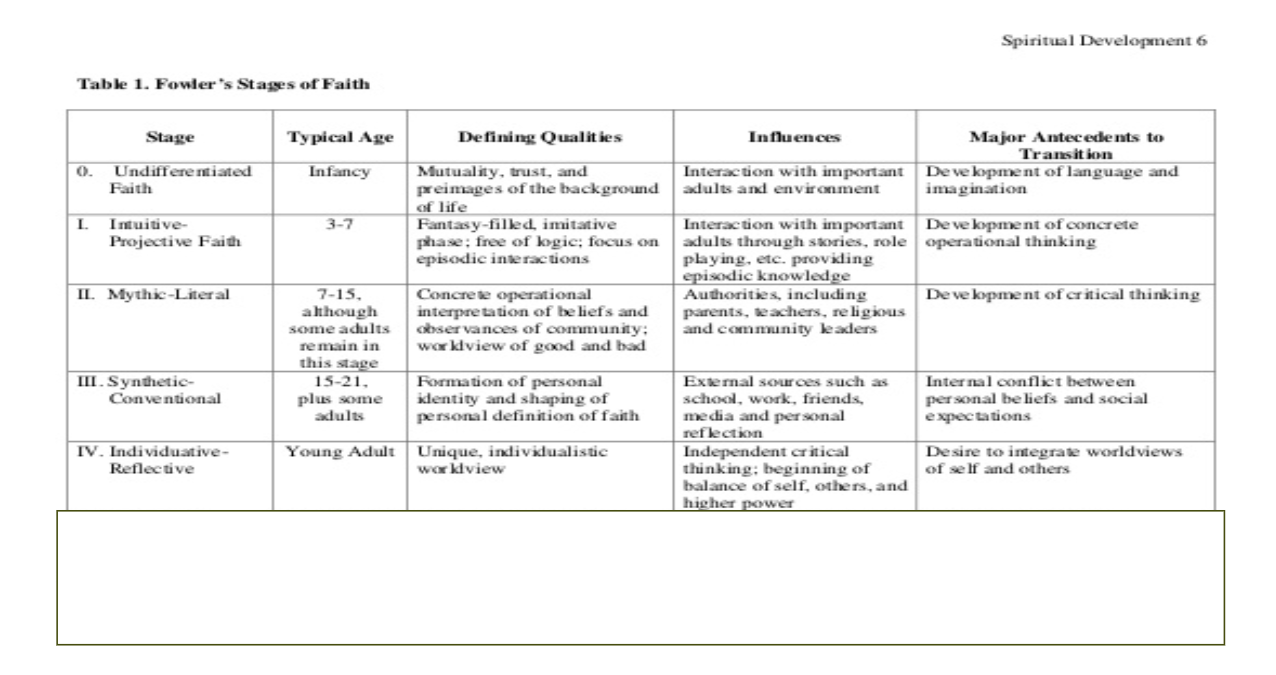
Fowler
Spiritual Development
Stage 0: undifferentiated
Stage 1: intuitive-projective
Stage 2: mythical-literal
Stage 3: synthetic-convention
Stage 4: individuating-reflexive
What is the most important part of pediatrics?
Development
Kids & Respiratory Depression
kids tend to respiratory arrest compared to an adult who cardiac arrests
unless they have an underlying cardiac condition of some sort
Growth & Development
Growth:
an increase in number and size of cells as they divide and synthesize new proteins; results in increased size and weight of whole or any of its parts
Development:
a gradual change and expansion; advancement from lower to more advanced stage of complexity; increased capacity through growth, maturation, and learning
Development is always compared to growth
most of the time the two go together, but you can develop without growth (ex: dwarfism) & you can grow without development (ex: cerebral palsy)
you need to know the childs given age and their developmental age, sometimes they can’t be drastically different
Directional Trends of Growth
Cephalocaudal: (Head to Tail)
Head develops first
Is large and complex
A baby’s head is really big compared to the rest of their body
usually when they’re about 4 months old they have a decent amount of head control, prior to that not so much
Lower develops later
Proximodistal: (Near to Far)
Midline to Peripheral
Proximodistal
develops their core first before the fine muscles (ex. fingers)
example: palmer vs pincer grasp
The palmar grasp uses the whole hand and palm to clutch an object in a fist, typically developing around 4 to 6 months. In contrast, the pincer grasp is a refined movement using just the tips of the thumb and index finger to pick up small items, emerging around 8 to 12 months.
Sequential Trends & Developmental Pace
Sequential Trends
Definite, predictable sequence
Some variance
Developmental Pace
Although development has a precise order
Does not progress at same pace
Although development has a precise order
Does not progress at same pace
Physiological Changes Through the Years
Metabolism
BMR (Basal Metabolic Rate) highest in newborns
Kids have a higher BMR
Temperature
Reflective of BMR
as body surface area increases, BMR decreases so temperatures and HRs are decreased as we get older. (a newborn would have a higher temp compared to an adolescent). Things tend to be faster the younger that you are. a higher respiratory rate in newborns doesn’t really correlate with their BMR.
Sleep & Rest
newborns sleep between 16-20 hours in a day. they need to be fed every 3 hours so we need to wake them up if they're sleeping
Nutrition
Single most important influence on growth
nutrition also impacts development as well.
socioeconomic status & accessibility to good nutrition is also something you need to consider
we can give older kids a food diary to ask what they ate prior to coming in so we can see if diet is the issue. We then try to see what resources we could offer
When does the normalization of adult vitals occur
The normalization of adult vitals would occur between the ages of 10-12.
How long do newborns sleep?
Newborns sleep between 16-20 hours in a day.
they need to be fed every 3 hours so we need to wake them up if they're sleeping
What is the single most important influence on growth?
Nutrition
nutrition also impacts development as well.
Role of Play in Development
Universal medium of play—children learn!
Play is their Work
Content of Play
Social-affective
Learn relationships
Skill
Acquire skills & further develop them
Dramatic/Pretend
Games
you may not understand everything that they learn for or exhibit from play
initiation vs Guilt
Types of play by age
Unoccupied
Solitary
Onlooker
Parallel
Associative
Cooperative
Unoccupied Play
0-3 Months
Baby makes random movements with arms, legs, hands, and feet—exploring their body and surroundings.
Solitary Play
0-2 Years
Baby is happy to play alone, focusing on their toys and learning independence.
Onlooker Play
Around 2 Years
Baby watches others play, learning by observing.
Parallel Play
2+ Years
Baby plays next to other children with similar toys but without direct interaction
Associative Play
3-4 Years
Baby begins to interact with others while playing, though play isn’t fully coordinated yet.
Cooperative Play
4+ Years
Baby plays together with others, sharing and collaborating in group activities.
Function of Play
Sensorimotor Development
Intellectual Development
Socialization
Creativity
Self Awareness
Therapeutic Play
Infants
Birth - 12 months
Erickson: trust vs mistrust
No concept of danger (crawler)
usually kids are crawling about 9 months of age
when they start to become problematic
Children don’t know whats dangerous and what isn’t; they don’t know any better
Ex. baby doesn’t know that they might drown in water or that they might fall down stairs
make sure bathroom, door is closed
Falls
falls are a big thing within this age group
usually due to adults leaving kids where they shouldn’t be left like couch or changing table
oral phase
you need to be careful of poison ingestion
Inhalation of foreign objects
Everything goes in the mouth
Suffocation leading cause of death
Ingestion injuries
Burns
What Erickson Stage are Infants in?
trust vs mistrust
Which Freud Stage are infants in?
oral phase
What is the leading cause of death in Infants?
Suffocation is the leading cause of death
Newborns
newborn: 0 - 28 days
we need to understand that there is a difference, because depending on whether or not you’d get a diagnosis, the child may end up on the nicu, picu, on the floor.
it overlaps with infants
The fastest period of growth is that first month of life
How much weight does an infant gain per week?
5-7 ounces weight gain per week
When does an infant double their weight?
Double birth weight by age 4-5 months
When does an infant triple their weight?
Triple birth weight by age 1 year
the most important thing to look for is has the baby tripled their birth weight by age 1 year because that’s going to tell you that they have been getting good nutrition for at least a year & if they’re still able to maintain their weight, height, head circumference within the percentile that we’re looking for.
How much taller does an infant get per month?
Height increases by 1 inch per month
Proportional Changes in an Infant
Expanding head size
Reflects the growth & differentiation of nervous system
Growth in “spurts” rather than gradual pattern
Fine Motor Development Infant
baby’s shouldn’t be holding their bottle on their own when being fed because they don’t know how to take the bottle out of their mouths so they’re at risk for aspiration
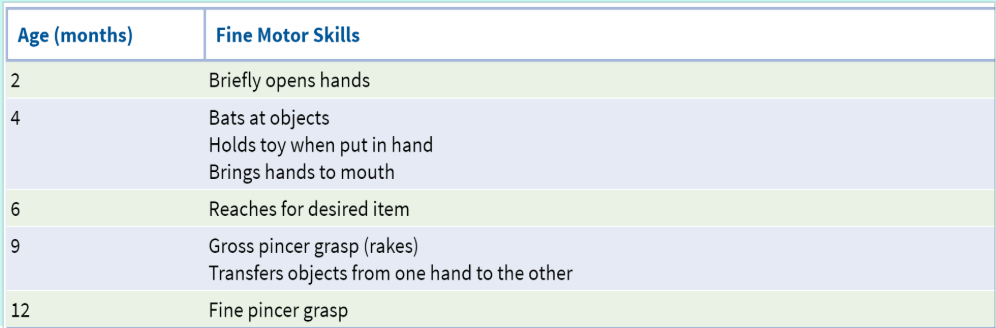
Which fine motor skill develops at 2 months?
Briefly opens hands
Which fine motor skills develops at 4 months?
Bats at objects
Holds toy when put in hand
Brings hands to mouth
Which fine motor skill develops at 6 months?
Reaches for desired items
Which fine motor skills develops at 9 months?
Gross pincer grasp (rakes)
Transfers objects from one hand to another
Which fine motor skill develops at 12 months?
Fine pincer grasp
Gross Motor Development Infants
Gross motor = bigger muscles
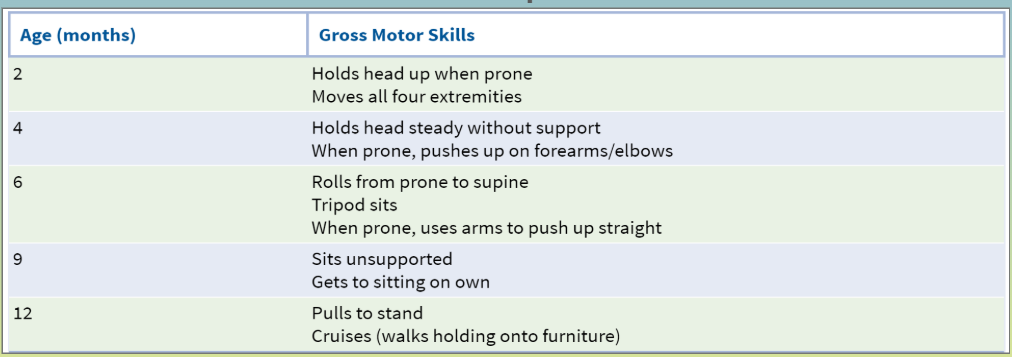
Which gross motor skills develop at 2 months?
Holds head up when prone
Moves all four extremities
Which gross motor skills develop at 4 months?
Holds head steady without support
When prone, pushes up on forearms/elbows
Which gross motor skills develop at 6 months?
Rolls from prone to supine
Tripod sits
When prone, uses arms to push up straight
Which gross motor skills develop at 9 months?
Sits unsupported
Gets to sitting on own
Which gross motor skills develop at 12 months?
Pulls to stand
Cruises (walks holding onto furniture)
When do children begin to crawl?
usually kids are crawling about 9 months of age
Abdomen off floor
When do children begin to walk with assistance?
10 months
may also be called ‘cruising’
(can occur as late as 12 months)
When do children begin to walk alone?
12 months
Maybe later or earlier
if a baby doesn’t show any desire to walk by 14-15 months we have to figure out why that may be, maybe due to leg muscle or nerve issues
Infants Social Development
Attachment
usually form an attachment to their mom; could be due to
breastfeeding (source of food)
skin to skin with the mother within the first hour of birth can decrease the likelihood of hypoglycemic events
Separation anxiety
10-12 months – distress when parent leaves
Language development
First language is crying, then its cooing (first 2 months), then smiling (could be gas), blowing raspberries
Play
Squealing, they can just hold on to toys.
the more that you encourage a child to play as they grow older, the more quickly developed their gross or motor skills would be.
When does an infant develop separation anxiety?
10-12 months – distress when parent leaves
Promoting Development-Play-Infant
Infant
Multisensory stimulation
they use their five senses
Hearing spoken language
Fine/gross motor activities
Remember what type of play the infant uses from the video.
Unoccupied Play (0-3 months) & Solitary Play (0-2 years)
Injury in Infants
Injuries are a major cause of death during infancy (especially 6-12 months)
6-12 months
babies start to become mobile, so things that weren’t initially a risk, are now becoming a risk.
Aspiration of foreign objects
Foods
Suffocation (balloons & gloves)
balloons & gloves when blown up can be popped if infant puts them into their mouth, which now makes it an aspiration risk
Motor vehicle injuries
Are the kids in a proper facing car seat?
Falls
Poisoning
the more mobile the child gets, the more susceptible they are to poisoning
Burns
Hot water (<120), sunburns, etc
Drowning
Foods that should be avoided in infants
Foods that should be avoided infants
grapes
honey
nuts
peanuts
hot dogs (biggest risk)
New laws regarding car seats
now the child needs to be in a rear facing car seat until they’re two or until the manufacturer of the car seat says so, the longer you can rear face the better.
they need to be in a car seat with a booster until they’re 5-8 years or 4’9 inches, whatever comes first
if they’re less than 13 years they need to be in the back seat.
Prevention of Injury Infants
Accident prevention is up to the adults
Children learn from your behavior
Bath water 100-105 degrees
Hot water heater set at 120° F (49° C)
Clothing should not have ties or buttons and should be fired retardant
Proper car seat use
Guard rails at top of the stairs
Car seats
Rear facing
Side rails up on cribs
Do not use baby powder
Never leave in high chair alone
Cover all electrical outlets
Avoid toys with small objects
Toddlers
Age 12-36 months (1-3yrs)
The biggest thing about toddlers is that they are developing autonomy
Erickson Stage: autonomy vs shame & doubt
Ex: if the child wants to pour their own milk into cereal
if the mom says no that they're going to make a ness they will doubt their own skills; sometimes you have to come up with a compromise
this may seem little compared to their childhood, but they carry on this doubt throughout their life
Compromise: mom can pour small amount of milk in a cup and give that to the child
“Negativism”
Stage of negativism
everything is “no”
they even say no to things that they like
“Ritualization” provides sense of comfort
Need to maintain sameness
Very stuck on routines and sameness
if they get admitted to the hospital we want to ask parents abt routine so that we can mimic that in the hospital as close as possible, so that it can decrease their anxiety and increase their compliance
Regression
You will also see a lot of regression
reverting back to previous things that you had moved beyond
Ex: a kid who is potty trained may wet the bed in the hospital
Regressions occurs because the child is in an unfamiliar environment & a high stress situation
we need to reassure parents that the regression is temporary
when they go home and aren’t under as much stress, then the regression will go away and they’ll be potty trained again.
Not aware of dangers
Just like infants toddlers aren’t aware of dangers
they will fall down stairs, touch a hot oven, may get burned around campfires, drowning (may not realize that water is as deep).
World is expanding because of biological growth, seeking autonomy
Because they are seeking autonomy and their growing biologically, they are expanding bc theyre learning so many new things and exploring the environment around them
Sibling rivalry
They will also have a sibling rivalry both ways (older or younger)
Older: they might be jealous bc they get to do more things, they have more autonomy, they get to go outside by themselves, etc
Younger: If the child is used to always being the baby, when they get a new younger sibling they will begin to envy the baby and seek out attention.
Toddlers Language Development
At this Stage language development is rapid, they go to knowing about 50 words when they’re two to 1000 words at 3.
their speech isn’t always the clearest
parents may understand them because they’re around them all of the time
Promoting Optimum Growth & Development Toddler
“The TERRIBLE Two’
Intense period of exploration
Temper tantrums/stubbornness occur frequently
The best way to deal with temper tantrums is to ignore them as long as the child is safe
children know what they're doing, they want to see how you’re going to react to what their doing
depending on how you react would tell them whether they will keep doing this over and over again, or if they realize that its not getting them anywhere so they just won't do it anymore
How much does weight gain slow down to in toddlers?
Weight gain slows to 3-5 lbs/year
When should birth weight be quadrupled?
Birth weight should be quadrupled by 2 ½ yrs old
How much does height increase per year in toddlers?
Height increases about 3” per year
Biological Development in Toddlers
Growth is “step like” rather than “linear”
By the time that they are a toddler, growing slows down a little bit
their growth is more step like
like they grow then stop for a little then grow then stop etc
Reach half of their adult height by 2 years old
Toilet training & Toilet Training Readiness
Toileting with toddlers
Toilet training
Anal Phase: 1-3
a lot of resources talk about not forcing potty training early because it can cause psychological damage long term
by 18-24 months they can develop sphincter control to where they can control their bowel movements. The problem with bowel movements is that children don’t like the way that it feels, especially children with autism, so they will often hold bowel movements, which leads to constipation
at roughly 8 months and older they start to have a dramatic increase in their bladder capacity, so they can hold their bladder for a lot longer
as children get older, bladder capacity increases and they can take bathroom breaks less frequently, and begin to tell their teacher when they need to go to the restroom
Biologic Development Toddler (Cont.)
Maturation of Systems
Most physiologic systems are relatively mature by the end of toddlerhood
usually by the time that they are ending toddlerhood (36 months), most of their physiological systems are pretty mature
Upper respiratory infections, otitis media, and tonsillitis are common among toddlers
Because by the time that a child is three they are exposed to more people (preschool, daycare, caretaker, etc.), they are more susceptible to getting infections, specifically Upper respiratory infections, otitis media, and tonsillitis (aka strep throat)
children are also more susceptible because they don’t tend to wash their hands, cover their coughs, pick & eat/wipe their boogers on things.
RSV = respiratory syncytial virus
very common
Body temperature is maintained
By toddlerhood temperature has leveled off
Child is physiologically able to control elimination
Defense mechanisms of skin are intact
up until toddlerhood their skin is very thin, and does not protect them from injury as well as our skin would
by the time they are at that end of toddlerhood, their skin is intact, and all of their levels have been developed, and they are now protected from potential injuries
Sensory Changes in Toddlers
Visual acuity of 20/40 acceptable
Hearing, smell, taste, and touch increase in development
Uses all senses to explore environment
Taste preferences
picky eaters
most of the time it’s vegetables
Physiologic Anorexia
Physiologic anorexia
theyre not growing as fast as infancy so they dont need as many calories as they needed in infancy
you may think that they have a poor appetite or that youre not feeding them enough, but at this age theyre going to tell you when theyre hungry
if you offer them a snack and they dont want it they either don’t like what youre offering them or theyre just not hungry
Development of Body Image Toddler
Development of body image parallels cognitive development
Child refers to body parts by name
they will refer to body parts by name if you refer to body parts by name
that's what they will refer to things for life
Child recognizes words used to describe appearance
You have to start avoiding negative labels because now the child begins to pick up on it
Child recognizes gender differences by age 2 years
When does a child begin to recognize gender differences?
Child recognizes gender differences by age 2 years
Development of Gender Identity Toddler
Exploration of genitalia is common
Genital fondling can occur – What Theorist?
Freud
Parental reaction should be accepting
Gender roles are understood by toddler
Playing “house”
Playing house mirrors their own house
they mimic what they are seeing or hearing at home
Gender identity is formed by age 3 years
By what age is gender identity formed?
Gender identity is formed by age 3 years
Play with Toddlers
Interaction with people more important
Parallel & Associative Play
Imitation
Fine/gross motor play
Reading aloud, naming objects
theyre continuing to grow and learn, vocab, etc.
Dental Health in Toddlers
Regular dental examinations
recommended to go to a pediatric dentist, not js a regular dentists
Our book recommends that they should have a dental exam at one year, but most dentists recommend 2-3 years
Removal of plaque
Fluoride
they will determine whether or not they need fluoride
they only get fluoride if public water system is lacking in fluoride
Dietary factors
Early childhood cavities
you can use a soft bristle toothbrush & just water up until the age of two
after two you can start using toothpaste; best to use dentist’s recommendation
at the maximum children should be weaned from bottles by the time they are 15 months of age
when they use bottles the liquid sits in their mouth and coats their teeth which may begin to decay their teeth
if they’re still sucking on a pacifier or a bottle then their teeth will begin to buck out which may lead to them needing braces later on
they say that you should also refrain from using sippy cups that require sucking for the child to use them, because of the same reason as pacifier
Don’t send them to bed with their bottles or sippy cups because if they fall asleep with them in their mouths, then whatever is in that bottle will just coat their teeth all night long breaking them down
Toddlers Characteristics
Increased initiative and desire to imitate the behaviors of adults
Doesn’t understand the concept of danger
Short attention span
Darts into streets (tricycles)
Falls-toddler is learning how to walk
if a child falls on their head or land on their arm and it looks more distorted that’s more serious so you’d want to seek medical advice
Preschoolers
Age: 3-6 Years
Erikson
Initiative vs Guilt
Feelings of guilt, anxiety, and fear may result from thoughts that differ from expected behavior
Believe in the power of words and are very literal
they believe in the power of words and take things very literally
Ex: “if i can be a fly on that wall”, they’re going to take that literally and ask why you’d want to be a fly
“Magical Thinkers”
they think that their thoughts are powerful
Ex: I dont think I’m batman, I am batman
kid can really believe it & try to fly
Oedipus stage
part of the phallic stage
they tend to wish the same gender parent is dead or goes away because they want the opposite gendered parent to themselves
they don’t act on it, but you may see it in their behavior
They begin to develop morals
most of the time from parents or adults who influence them (ex. teachers)
begin to subscribe to certain religion
or if their family are vegans they’d follow that
They’re starting to realize that getting rewards is better than getting punished
Promoting Optimal Growth and Development Preschooler
Preparation for most significant lifestyle change: going to school
Cooperative interaction with other children
Not all children have cooperative interactions
some kids may have varying diagnoses like autism or adhd oppositional defiant disorder
most of the time they’d have an individualized education plan to increase cooperation
Experience of brief and prolonged separation
Sometimes kids may not take separation as well especially if they’ve spent most of their time with their parent
Increased attention span and memory
What is the average weight gain for a preschooler?
Average weight gain remains about 5 lb/year
What is the average increase in height for a preschooler?
Average height increases 2½-3 inches/year
Biological development of a preschooler
Physical growth slows and stabilizes
Body systems mature and stabilize; can adjust to moderate stress and change
can adjust to moderate stress and change
which is why they can start to handle being dropped off at school
Walking, running, climbing, and jumping should be well established.
Play for Toddlers & Preschoolers
Preschooler
Dramatic play, puppets
Reading together
What type of play?
cooperative play
Toddler and Preschooler Injuries
Children have no fear of water
Drown!
Poisonings--curious
Burns scalds/flame
handles on pots should always be turned in so that they don’t reach it
no candles
Opens car doors when car is in motion
safety & preventing a potential hazard is very important
part of our job is teaching parents how to prevent injury in their children in their various ages
Toddler and Preschooler Injury prevention
Emphasis is on Teaching safety measures
Explain why it isn’t safe to do what adults do
parents need to teach kids that whatever you do as a parent doesn’t matter & that they need to follow the rules
Use car seats & booster seats
Have child sit in the back seat of the car until 13
Be a good role model
at this age, kids like to please you or make you happy
if you make things into a game they’ll totally do things (Ex: chores)
School-Age Child: Promoting Optimal Growth and Development:
“School age” generally defined as ages 6 to 12 years
Physiologically begins with shedding of first “baby” teeth; ends at puberty with acquisition of final permanent teeth
Gradual growth and development
Boys and girls differ little in size
you see a bigger difference in height between both genders, once they're in about middle school
Progress with physical and emotional maturity
How much do School Age children’s heights increase by each year?
Height increases by 2.5 inches/year