SLP ANAPHYS - UNIT 1
 Call Kai
 Learn
Learn Practice Test
 Spaced Repetition
 Match
Match Flashcards
 Knowt Play
1/70

Earn XP
Description and Tags
Respiratory System
Name | Mastery | Learn | Test | Matching | Spaced | Call with Kai | Chat |
|---|
No analytics yet
Send a link to your students to track their progress
71 Terms
Respiration
this is how we breathe (inhaling and exhaling)
Pulmonary Ventilation
External (Pulmonary) Respiration
Internal (Tissue) Respiration
steps involved in respiration:
Pulmonary Ventilation
this step in respiration is inhaling and exhaling air from the atmosphere
External (Pulmonary) Respiration
this step in respiration is the gas exchange between the alveoli of the lungs and the blood in the pulmonary capillaries
Internal (Tissue) Respiration
this step in respiration is the gas exchange between the systemic capillaries and tissue cells
TRUE
TRUE or FALSE: external respiration is focused on structural gas exchange, while internal respiration is focused on atomic gas exchange
Nose
Pharynx
Larynx
Trachea
Bronchi
Lungs
parts of the respiratory system:
Structural (Upper RS and Lower RS)
Functional (Conduction Zone and Respiration Zone)
the two classifications of the respiratory system:
Nose → Nasal Cavity → Pharynx → Associated Structures
upper respiratory system parts:
Larynx → Trachea → Bronchi → Lungs
lower respiratory system parts:
Nose → Nasal Cavity → Pharynx → Larynx → Trachea → Bronchi → Bronchioles → Terminal Bronchioles
conduction zone parts:
Bronchioles → Alveolar Ducts, Alveolar Sacs, and Alveoli
respiratory zone parts:
Nose
this is a specialized organ at the entrance of the respiratory system where air passes through
External Nose
this is the part of the nose that we see on the face, and where air enters
a supporting framework of Bone and Hyaline Cartilage,
covered by Skin and Muscle,
lined with a Mucous Membrane
components of the external nose:
Frontal Bone
Nasal Bones
Maxillae
key bony framework of the external nose:
Internal Nose
a large space located in the anterior aspect of the skull
Frontal
Sphenoid
Ethmoid
Maxillae
(FSAM)
bony structures that contain the paranasal sinuses:
Ethmoid
Maxillae
Lacrimal
Palatine
Inferior Nasal Conchae
(EMLPI)
bony structures that cover the lateral walls:
Superior Concha
Middle Concha
Inferior Concha
these structures act as a humidifier for the air we breathe
TRUE
TRUE or FALSE: breathing in cold air causes the nose to inflame because cold air with the hot internal temperature in the nose causes more blood circulation, contributing to inflammation
Lightening the skull
Mucus production
Immunological defense
Humidifying and warming the air
functions of the internal nose:
TRUE
TRUE or FALSE: the bony and cartilaginous framework of the nose helps keep the vestibule and nasal cavity patent or open
Vestibule
Olfactory Region (superior) - in charge of smell
Respiratory Region (inferior) - in charge of breathing
regions of the internal nose (nasal cavities):
Pharynx
a funnel-shaped, 13 cm tube that starts at the internal nares and extends to the level of the cricoid cartilage
Nasopharynx - nasal cavity to the soft palate
Oropharynx - oral cavity to the soft palate
Laryngopharynx - from the hyoid bone to the esophagus posteriorly and the larynx anteriorly
the three divisions of the pharynx:
Larynx
the “voice box,” which connects the laryngopharynx with the trachea; the midline of the neck, and anterior to the esophagus and the C4 to C6 cervical vertebrae
Paired: (ACC)
Arytenoids - triangle-shaped
Corniculate - horn-shaped
Cuneiform - very small piece that has no purpose other than structural support
Unpaired: (TCE)
Thyroid
Cricoid
Epiglottis
9 pieces of cartilage that compose the laryngeal wall:
True Folds (Vocal Folds)
False Folds (Ventricular Folds)
*mucous membranes form these folds
parts of the vocal folds:
TRUE
TRUE or FALSE: the ventricular folds serve as airway protection and build pressure for the Valsalva maneuver, while the vocal folds do not serve much for survival and are only reserved for talking
Extrinsic (outside the larynx)
Intrinsic (inside the larynx; connects cartilage to cartilage)
the muscles of the larynx:
TRUE
TRUE or FALSE: pitch is controlled by the tension on the vocal folds—the higher the tension, the higher the pitch, the lower the tension, the lower the pitch
Trachea
the “windpipe,” which extends from the larynx to the T5 vertebra; it is 12 cm long and 2.5 cm in diameter
TRUE
TRUE or FALSE: the trachea consists of 16 to 20 C-shaped rings that provide semirigid support to maintain patency so that the tracheal wall does not collapse inward and obstruct the air passageway
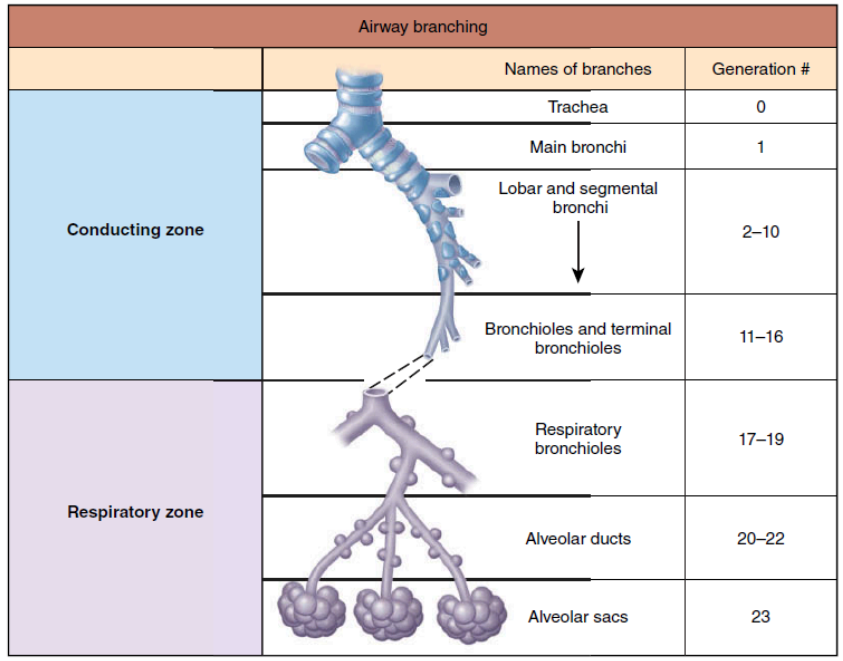
Conducting Zone (trachea to terminal bronchioles) → Respiratory Zone (respiratory bronchioles to alveolar sacs)
*Conduction Zone: TMLSBT; Respiratory Zone: RAA
overall airway branching:
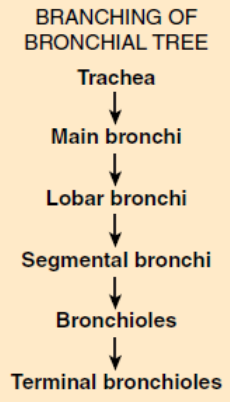
Trachea → Main Bronchi → Lobar Bronchi → Segmental Bronchi → Bronchioles → Terminal Bronchioles
branching of the bronchial tree
TRUE
TRUE or FALSE: the right main bronchus is more vertical, shorter, and wider than the left; thus, if a patient aspirates, the foreign object is most likely going to be in the right main bronchus
Bronchioles
these branch from the segmental bronchi and contain club (Clara) cells, which protect against the harmful effects of carcinogens
Terminal Bronchioles
these are the end of the conducting zone of the respiratory system
TRUE
TRUE or FALSE: the respiratory passages from the trachea to the alveolar ducts contain 23 generations of branching
Lungs
these are paired cone-shaped organs in the thoracic cavity
Mediastinum
aside from the heart, this structure also separates the two lungs
Pleural Membrane
the double-layered serous membrane that encloses and protects the lungs
Parietal Pleura - covers or lines the wall of the thoracic cavity
Visceral Pleura - covers the lung itself
the two layers of pleural membrane are:
Pleural Cavity
this is the space between the visceral and parietal pleura, which contains a lubricating fluid secreted by the membranes
TRUE
TRUE or FALSE: without pleura, there will be inflammation when respiration occurs because of friction
Bronchopulmonary Segment
the portion of the lung tissue that each segmental bronchus supplies
Lobules
small compartments in the bronchopulmonary segment of the lungs
Base (Broad) - posterior
Apex - superior
two parts of the lungs:
Costal - lines the ribs
Mediastinal - near the heart
Diaphragmatic - rests on top of the diaphragm
the surfaces of the lungs:
Lobes
the lungs are divided by fissured into sections called ___
Right Lung - has oblique and horizontal fissures
Left Lung - has only an oblique fissure
the fissures of the lungs are:
Alveolar Sac
the terminal dilation of the alveolar duct; this is where conduction ends and respiration occurs
Alveoli
the outpouching parts of the alveolar sacs; this structure is where gas exchange with the pulmonary capillaries occur
Type I Alveolar Cells - main site of gas exchange (simple squamous epithelial cells)
Type II Alveolar Cells - secrete alveolar fluid for lubrication (rounded/cuboidal epithelial cells)
each wall of the alveoli consists of two types of epithelial cells called:
Pulmonary Ventilation
this is simply known as “breathing”, which is the flow of air into and out of the lungs
TRUE
TRUE or FALSE: in pulmonary ventilation, air flows between the atmosphere and the alveoli of the lungs because of the alternating pressures created by contraction and relaxation of the respiratory muscles
Boyle’s Law
states that the pressure of a gas increases as its volume decreases, assuming constant mass and temperature
P1 V1 = P2 V2
the formula for Boyle’s Law
TRUE
TRUE or FALSE: before each inhalation, the air pressure in the lungs is equal to 1 atmospheric pressure (1 atm), and exhalation occurs because of a pressure gradient
Diaphragm
Intercostal Muscles (external [inspiration] and internal [expiration])
Accessory Muscles (forced breathing)
the muscles of respiration are:
Diaphragm
this is the main muscle of breathing; it is a dome-shaped skeletal muscle located in the trunk
Intercostal Muscles
these muscles connect each rib to neighboring structures and are a part of the thoracic wall
External Intercostal Muscles
these muscles flex your ribcage by contracting using two different movements called the “bucket handle movement” and the “pump handle movement”
TRUE
TRUE or FALSE: the bucket handle movement elevates the rib cage, making it flare out side-to-side, which increases the thoracic cavity volume
TRUE
TRUE or FALSE: the pump handle movement raises the sternum forward and upward
Internal Intercostal Muscles
these muscles depress the thoracic cavity, reducing thoracic cavity volume during expiration
TRUE
TRUE or FALSE: during quiet (unlabored) breathing, we use only the diaphragm and intercostal muscles, but during forced (labored) breathing, we also employ our accessory muscles
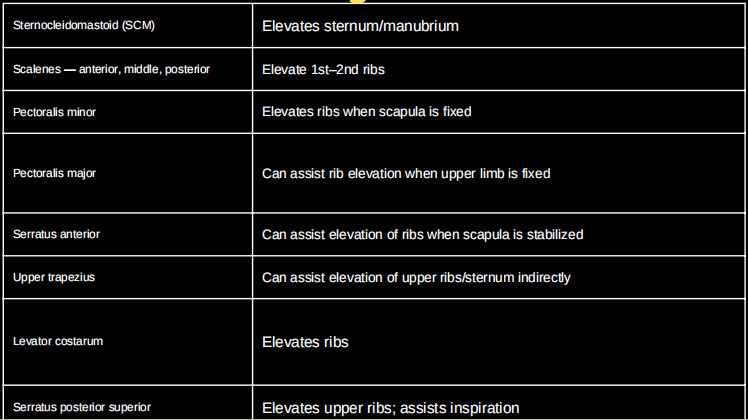
(SSPPUSL)
the different accessory muscles:
TRUE
TRUE or FALSE: we use the same muscles for inspiration and expiration—the difference being that during inspiration, these muscles contract, but during expiration, these muscles relax
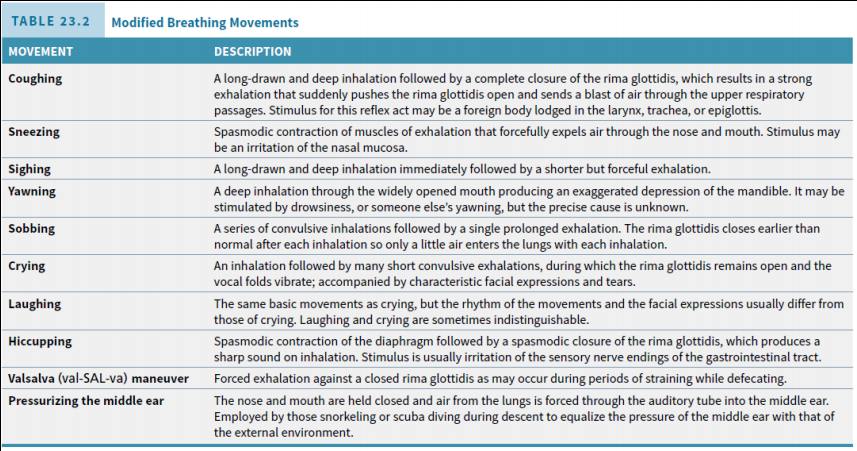
the different modified breathing movements: