MOTION IN A PLANE
 Call Kai
 Learn
Learn Practice Test
 Spaced Repetition
 Match
Match Flashcards
 Knowt Play
1/12

There's no tags or description
Looks like no tags are added yet.
Name | Mastery | Learn | Test | Matching | Spaced | Call with Kai | Chat |
|---|
No analytics yet
Send a link to your students to track their progress
13 Terms
When a particle is said to be in 1d motion and when 8n 2d motion
1d motion is when the angle between velocity and acceleration of particle is 0 degree ( parallel) and 180 degree ( anti parallel )
2d when the angle between v and a is neither 0 degree nor 180 degree
What do you understand by a projectile motion
When there is only gravitational force acting on a body
Body is said as projectile
Motion is known as projectile motion
Pathr is known as trajectory
Uniformly accelerated motion
Assumptions are like no air g remains constant and the ground is flat
Ground to ground ( obliqurpe projectile )
Oblique means kisi angle par
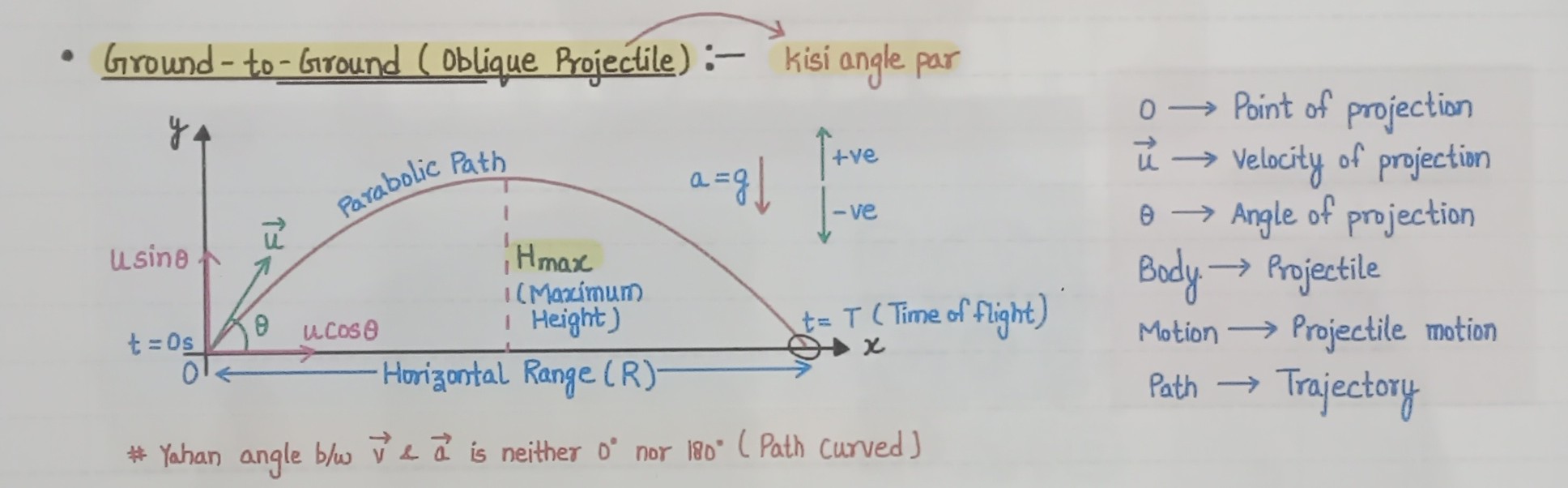
Soul of motionin 2d and just write down the formula of time of flight and maximum height and horizontal range
Cause there is no air so there will be no force in x direction but there is velocity then there will be force in y direction and this means no accln in x direction so the Vx will remain constant only the y direction velocity will change

The formula you have written before write it in terms of uy and ux and g
#keypoint1#

Some chirkut key points # keypoint 2 to 4
When is range max
Hmax when range is max
Angle of projection to make hmax equals to range
1 at 45 degree
Remember the range for ula it will be max when sin 2theta is at max and sin value is max at 90 so thetha should be 45
2 Rmax by 4
Remember the Hmax formula when you will put the value of sin at which range is max you will get it Rmax by 4
3 Thetha means the angle of projection should be tan inverse 4 which is 76 degree
Just equate the formula of Rmax and hmax
Complementary angle projections funda
Things we can derive just by knowing there range is going to be same
Projectile thrown at angle of thetha and other at 90 minus thetha at ( condition is that with same speed) then the range will be the same for both

Relation between max height and range
Max area that can be covered by a falling bullets
4Hmax = R tan (tetha)
To find it just get to know the maximum range the bullet can go which will be considered as it max radius then apply the area formula of circle
Write down the observation a person can note down when he or she observe the projectile motion on 15 degree 30 degree 45 degree 60 degree and 75 degree one by one
Hmax and time of flight both will increase as we increase the thetha
But in case of range first it will increase and become max at 45 degree anthen decrease
And you know it already that complementary angles have same same range
Relation between time of flight and maximum height
T = √ 8 Hmax by g
