34 Diseases of the Equine Respiratory Tract 1
 Call Kai
 Learn
Learn Practice Test
 Spaced Repetition
 Match
Match Flashcards
 Knowt Play
1/61

There's no tags or description
Looks like no tags are added yet.
Name | Mastery | Learn | Test | Matching | Spaced | Call with Kai | Chat |
|---|
No analytics yet
Send a link to your students to track their progress
62 Terms
Congenital
Cleft palate is a/n *congenital or acquired* defect
Cleft palate
A foal has milk draining from its' nose after nursing and coughing from milk dribbling into the trachea. The mouth looks like this. Thoughts?
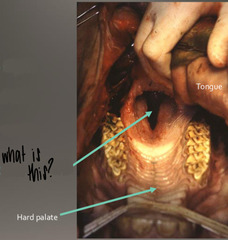
Dorsal displacement of the soft palate
This is intermittent or persistent malpositioning of the caudal edge of the soft palate dorsal to the epiglottis
Ventral to the epiglottis at rest (the only time this is different is when swallowing)
In health, where SHOULD the soft palate be?
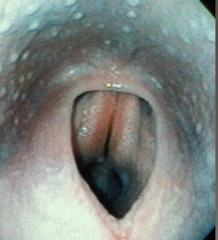
Dorsal displacement of the soft palate
What is this?
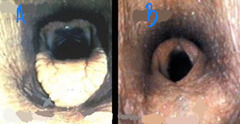
A = normal
B = dorsal displacement of soft palate
Which of these images is normal? Which has an abnormality and what is it?
Dorsal displacement of soft palate
You watch a racehorse "choke down" or falter at the end of a race. His cheeks bulge and he is coughing. The owner is mad because the horse has *expiratory* noise and feels like this is limiting the horses performance. What is happening?
Inflammation (upper resp. tract infection) that affects the nerve for palate stability (pharyngeal branch of vagus nerve)
May also be due to hypoplastic epiglottis
What etiology commonly causes dorsal displacement of the soft palate?
Dynamic endoscopy
What is most likely the best way to diagnose dorsal displacement of the soft palate?
Make the horse swallow either by pushing on larynx or flushing water thru a scope
What "epiglottis trick" should get the horse's soft palate to move back to its' normal position under the epiglottis with dorsal displacement of the soft palate?
To see how long it takes them to replace the palate
You can manually dorsally displace the epiglottis in a horse with dorsal displacement of the soft palate by holding the nostrils shut and flexing their head. Why would you want to do this?
Ulceration of the soft palate (may cause chronic displacement)
What other endoscopic findings will be present with dorsal displacement of the soft palate?
Treat the underlying cause
Anti-inflammatory therapies like throat spray and steroids are often reached for to treat horses with dorsal displacement of the soft palate. What should you attempt to do BEFORE you reach for these?
Palatoplasty
This treatment of dorsal displacement of the soft palate involves creating scar tissue to make the palate more stiff, such as with a laser or thermocautery
Staphylectomy
This treatment of dorsal displacement of the soft palate involves resecting the caudal margin of the soft palate
TIE FORWARD
Which surgical treatment of dorsal displacement of the soft palate has the *BEST PROGNOSIS* in the literature, with 80% success?
Tie forward procedure
This treatment of dorsal displacement of the soft palate involves pulling the larynx forward to allow the epiglottis to engage with the palate by passing suture from the *thyroid cartilage to the basihyoid bone*
Strap muscle myectomy
This treatment of dorsal displacement of the soft palate involves cutting and removing the sternohyoideus muscle and sternothyroideus muscle to prevent the larynx from falling back
Llewelyn procedure
note: the idea is the same as the strap muscle myectomy, only the tendons are cut instead of a hunk of muscle
This treatment of dorsal displacement of the soft palate involves transecting the TENDON of the sternothyroideus tendon at the insertion on the thyroid cartilage
Reduce caudal retraction of the larynx
The goal of both strap muscle myectomy and Llewelyn procedure to fix dorsal displacement of the soft palate is what?
Post Myectomy to fix dorsal displacement of the soft palate
What post-op presentation is this? What did it fix?
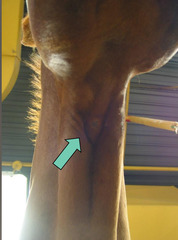
Inspiratory noise
Where in the respiratory cycle will there be noise with dynamic pharyngeal collapse?
Dynamic pharyngeal collapse
What problem does rostral displacement of the palatopharyngeal arch cause in horses?
CN IX (glossopharyngeal) and X (vagus)
What nerves innervate the muscles of the pharynx?
Dynamic endoscopy
What is the best diagnostic test for dynamic pharyngeal collapse?
Conduit between the pharynx and trachea
Where is the larynx located?
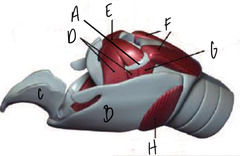
Muscular process
What is A?
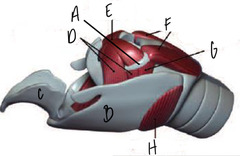
Thyroid cartilage
What is B?
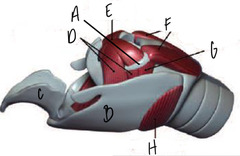
Epiglottis cartilage
What is C?
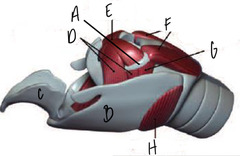
Thyroarytenoideus muscle
What is D?
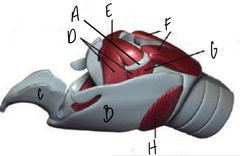
Arytenoideus transversus muscle
What is E?
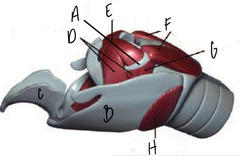
Cricoarytenoideus dorsalis muscle
What is F?
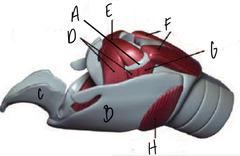
Cricoarytenoideus lateralis muscle
What is G?
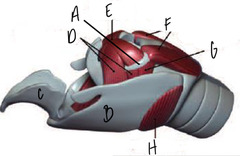
Cricothyroideus muscle
What is H?
Cricoarytenoideus dorsalis muscle
What is the only muscle of the larynx that abducts?
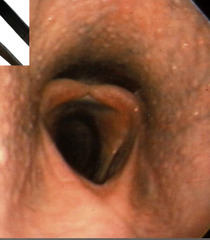
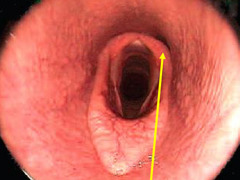
The arrow is pointing to the NORMAL side. This is unilateral laryngeal hemiplegia
Is this normal or abnormal? What is happening?
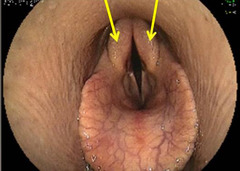
ABNORMAL = bilateral laryngeal hemiplegia
Is this normal or abnormal? What is happening?
Left (esp. problems with left recurrent laryngeal nerve)
Is it more common to have *right or left* laryngeal hemiplegia?
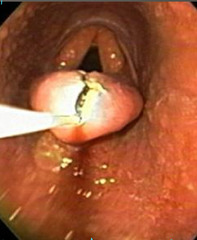
This shows cutting of the aryepiglottic fold with a guarded hook for aryepiglottic fold entrapment
What is this treatment for?
Draft breeds
Left sided laryngeal hemiplegia (although the more common side overall), typically affects what breed of horse?
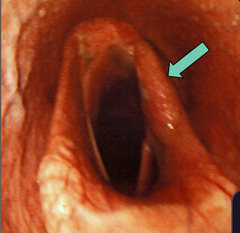
Left laryngeal hemiplegia
A draft horse presents with inspiratory whistling and *roaring* during exertion. This horse has exercise intolerance and decreased athletic performance. On endoscopy you see this. Thoughts?
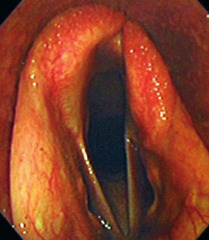
Inspiratory whistle and ROARING on exertion
Increased resistance causes turbulence to make what sounds in horses with left laryngeal hemiplegia?
Atrophy of cricoarytenoideus dorsalis muscle
What muscle can you feel that might be atrophied with left laryngeal hemiplegia in horses, allowing you to palpate the muscular process of the arytenoid cartilage?
FALSE = DO NOT USE SEDATION
TRUE OR FALSE: If you do endoscopy in a horse to see left laryngeal hemiplegia at rest, you should use sedation to prevent them biting off your endoscope.
Progressive
Left laryngeal hemiplegia is a *progressive or static* disease
Grade 1 - Grade 4
1. synchronous full abduction
2. asynchronous full abduction
3. asynchronous partial abduction
4. no abduction
What are the grades of left laryngeal hemiplegia?
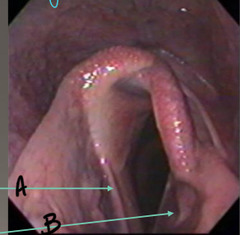
A. vocal cords
B. saccule/ventricule
What are these?
Prosthetic laryngoplasty (aka tie back)
What is the TREATMENT OF CHOICE for left laryngeal hemiplegia?
Ventriculectomy, chordectomy (vocal cords), ventriculocordectomy (combo of the previous two)
Prosthetic laryngoplasty is the treatment of choice for left laryngeal hemiplegia, the only one that actually improves performance. However, what other procedures should you do that are STRICTLY FOR NOISE REDUCTION, but should be done to make the owner happy?
DONT OPEN TOO MUCH = aspiration
What do you need to be careful of when performing a prosthetic laryngoplasty on a horse?
Cordectomy (for noise reduction ONLY)
What is this procedure for laryngeal hemiplegia?
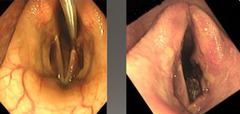
Arytenoid chondritis
What is this?
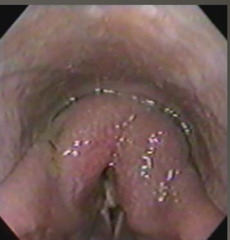
Arytenoid chondritis
This is inflammation of the arytenoid cartilage that causes roaring in horses
Granulation tissue
What is this, causing arytenoid chondritis?
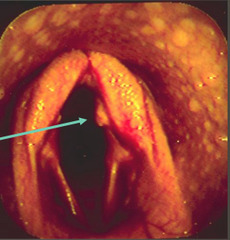
Distorted corniculate process
What is this, causing arytenoid chondritis?
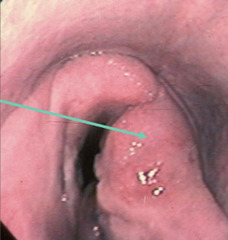
Rostral displacement of the palatopharyngeal arch
What is this, causing arytenoid chondritis?
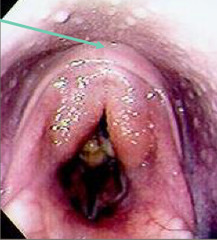
Coughing, dysphagia, dyspnea, webbing granulation tissue, cartilage mineralization
What are the COMMON COMPLICATIONS of a partial arytenoidectomy for arytenoid chondritis treatment?
Aryepiglottic fold entrapment
What is this?
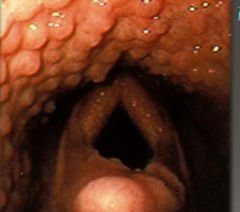
Aryepiglottic fold entrapment
This occurs when the epiglottis is entrapped by the aryepiglottic fold, where clinical signs are often secondary to dorsal displacement of the soft palate (gurgling, expiratory noise)
Dorsal displacement of the soft palate, especially if the animal has hypoplastic epiglottis
What other abnormality is aryepiglottic fold entrapment associated with?
Ulceration at the tip of the epiglottis from aryepiglottic fold entrapment
What is this?
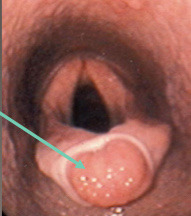
1. BEST: dorsal displacement of the soft palate
2. left laryngeal hemiplegia
3. WORST: arytenoid chondritis
Order these from best to worst prognosis with each gold standard treatment:
1. arytenoid chondritis
2. dorsal displacement of the soft palate
3. left laryngeal hemiplegia