C) LECTURE CH3 CARDS
 Call Kai
 Learn
Learn Practice Test
 Spaced Repetition
 Match
Match Flashcards
 Knowt Play
 Podcast
1/93

Earn XP
Description and Tags
A complete set of 80 vocabulary flashcards covering cell structure, transport mechanisms, organelles, gene expression, and cell division based on the lecture transcripts.
Name | Mastery | Learn | Test | Matching | Spaced | Call with Kai | Chat |
|---|
No analytics yet
Send a link to your students to track their progress
94 Terms

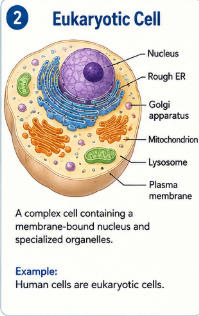
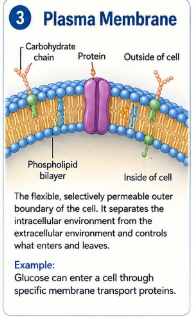
Plasma Membrane
The flexible selectively permeable outer boundary of the cell. It separates the intracellular environment from the extracellular environment and controls what enters and leaves.
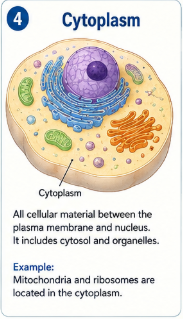
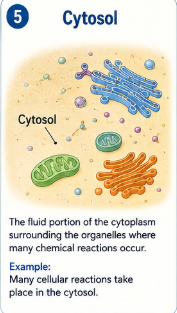
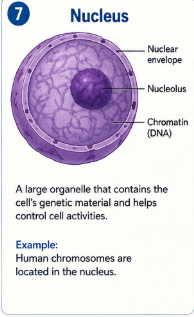
Nucleus
A large organelle that contains the cell's genetic material and helps control cell activities.
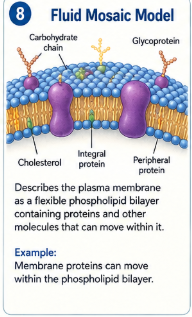
Fluid Mosaic Model
A model describing the plasma membrane as a flexible phospholipid bilayer containing proteins and other molecules that can move within it.
Phospholipid Bilayer
The double layer of phospholipids that forms the basic structure of the plasma membrane. Cholesterol and glycolipids are also present.

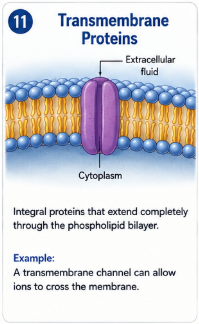
Integral Proteins
Proteins embedded within the lipid bilayer.

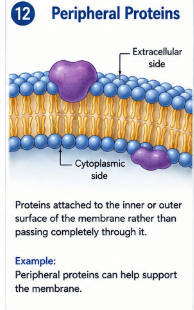
Peripheral Proteins
Proteins attached to the inner or outer surface of the membrane rather than passing completely through it.
Selective Permeability
The ability of the plasma membrane to allow some substances to cross while restricting others.

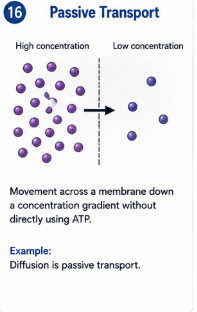
Passive Transport
Movement across a membrane down a concentration gradient without directly using ATP.

Concentration Gradient
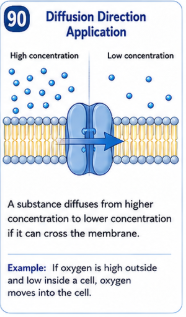
A difference in the concentration of a substance between two areas. Example: If oxygen is higher outside a cell than inside an oxygen concentration gradient exists.

Simple Diffusion
Passive movement of small or lipid soluble molecules directly through the membrane from high concentration to low concentration. Example:

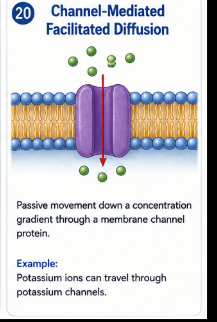
Channel Mediated Facilitated Diffusion
Passive movement down a concentration gradient through a membrane channel protein.
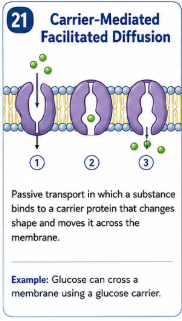
Carrier Mediated Facilitated Diffusion
Passive transport in which a substance binds to a carrier protein that changes shape and moves it across the membrane.
Aquaporins
Membrane proteins that form specialized channels for water.

Isotonic Solution
A solution with approximately equal effective solute concentration compared with the cell. There is no net movement of water and cell size stays about the same.


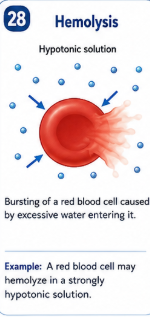
Hemolysis
Bursting of a red blood cell caused by excessive water entering it.
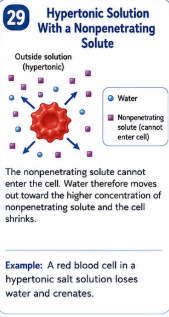
Hypertonic Solution With a Nonpenetrating Solute
The nonpenetrating solute cannot enter the cell. Water therefore moves out toward the higher concentration of nonpenetrating solute and the cell shrinks.
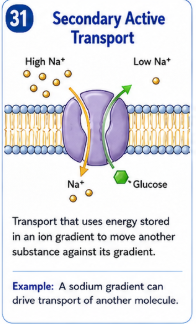
Secondary Active Transport
Transport that uses energy stored in an ion gradient to move another substance against its concentration gradient.

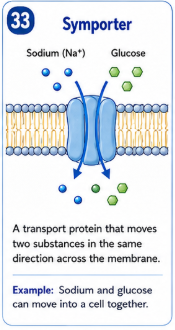
Symporter
A transport protein that moves two substances in the same direction across the membrane.
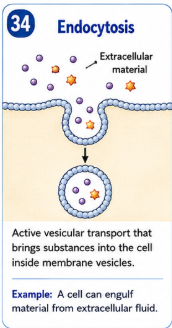
Endocytosis
Active vesicular transport that brings substances into the cell inside membrane vesicles.
Example: the cell literally opens a mouth and eats a particle because its too big to pass through the membrane.
Exocytosis
A process in which vesicles fuse with the plasma membrane and release their contents outside the cell.

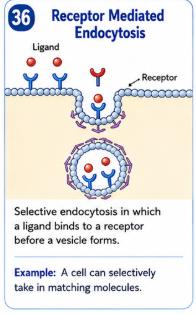
Receptor Mediated Endocytosis
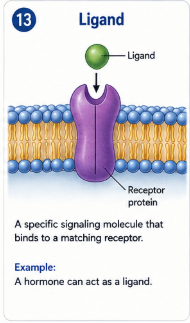
Selective endocytosis in which a ligand first binds to a specific membrane receptor before a vesicle forms.
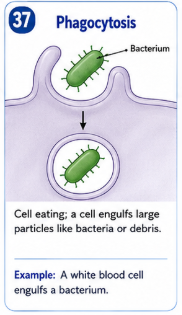
Phagocytosis
Cell eating. A cell surrounds and brings in large particles such as bacteria or cellular debris.
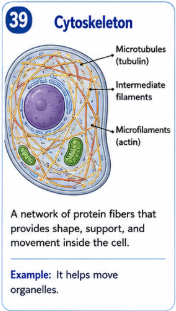
Cytoskeleton
A network of protein fibers that provides cell shape and support and helps move cellular components. Its major parts are microfilaments intermediate filaments and microtubules.
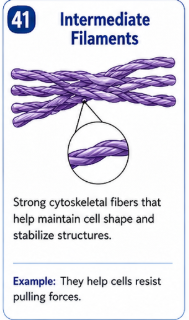
Intermediate Filaments
Strong cytoskeletal fibers that help maintain cell shape and stabilize cellular structures.
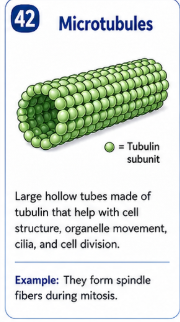
Microtubules
Large hollow tubes made of tubulin that help with cell structure organelle movement cilia and cell division.
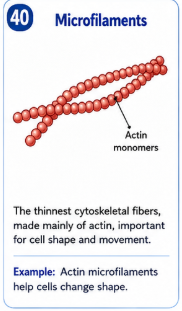
Microfilaments vs Intermediate Filaments vs Microtubules
Microfilaments are thin actin fibers involved in shape and movement. Intermediate filaments provide strength and stability. Microtubules are large hollow tubes involved in transport cilia and chromosome movement.

Centrosome
The main microtubule organizing center near the nucleus. It contains two centrioles.

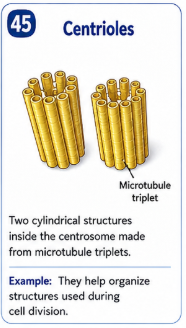
Centrioles
Two cylindrical structures inside the centrosome made from microtubule triplets.
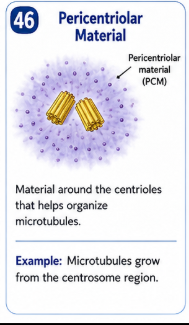
Pericentriolar Material
Material surrounding the centrioles ,organizes microtubules.
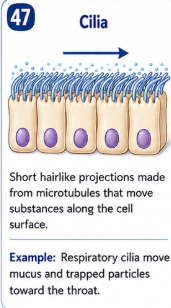
Cilia
Short hairlike projections made from microtubules that move substances along the cell surface.
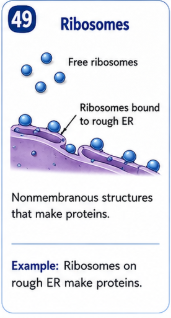
Ribosomes
Nonmembranous structures that make proteins.
Rough Endoplasmic Reticulum
A membrane network covered with ribosomes that helps make and process proteins.

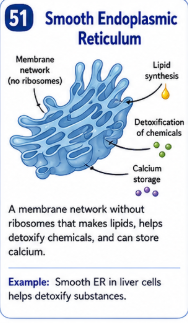
Smooth Endoplasmic Reticulum
A membrane network has no ribosomes. makes lipids, helps detoxify chemicals , and can store calcium.
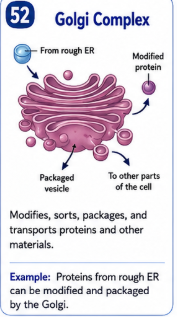
Golgi Complex
An organelle that modifies sorts packages and transports proteins and other materials.
Cisternae
Flattened curved membrane sacs that make up the Golgi complex.


Proteasomes
Protein complexes that destroy damaged faulty or unneeded proteins.

Mitochondria
Organelles that produce most of the cell's ATP through cellular respiration.
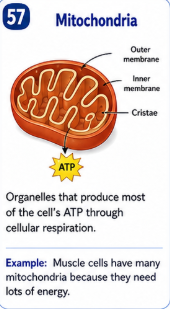
Cristae
Folds of the inner mitochondrial membrane that increase surface area for ATP producing reactions.

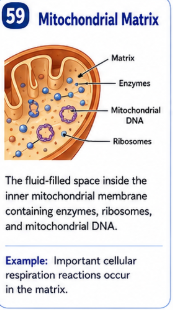
Mitochondrial Matrix
The fluid filled space inside the inner mitochondrial membrane containing enzymes ribosomes and mitochondrial DNA.
Nuclear Envelope
A double membrane containing nuclear pores that separates the nucleus from the cytoplasm.

Nucleolus
A structure inside the nucleus that produces ribosomal subunits.

Chromatin
Uncoiled DNA and associated proteins found in the nucleus during interphase.

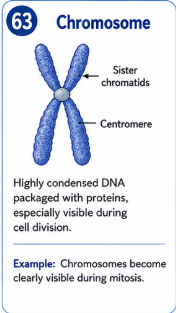
Chromosome
Highly condensed DNA \, packaged with proteins and especially visible during cell division. .
Histones
Proteins that DNA wraps around to help package and organize genetic material.

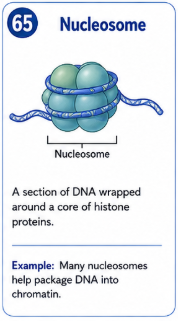
Nucleosome
A section of DNA wrapped around a core of histone proteins.
Gene
A segment of DNA containing instructions for making a functional product often a protein.

Central Dogma
The general flow of genetic information from DNA to RNA to protein.

Transcription
The process of copying information from DNA into RNA

Translation
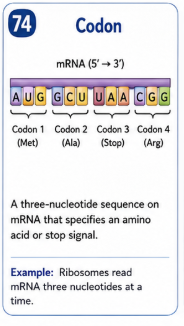
The process in which ribosomes read mRNA instructions and assemble amino acids into a protein

Promoter
A DNA sequence where RNA polymerase binds to begin transcription.

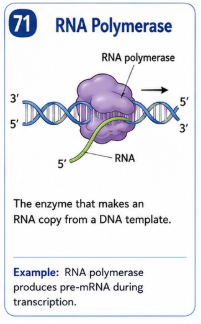
RNA Polymerase
The enzyme that makes an RNA copy from a DNA template.
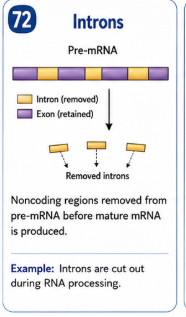
Introns
Noncoding regions removed from pre mRNA before mature mRNA is produced.
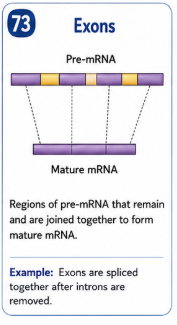
Exons
Regions of pre mRNA that remain and are joined together to form mature mRNA.
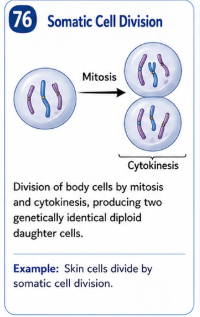
Somatic Cell Division
Division of body cells by mitosis and cytokinesis that produces two genetically identical diploid daughter cells.
Homologous Chromosomes
Matching chromosome pairs that carry genes for the same types of traits.

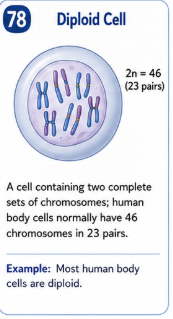
Diploid Cell
A cell containing two complete sets of chromosomes. Human somatic cells normally contain 46 chromosomes arranged in 23 pairs.
Interphase
The portion of the cell cycle containing G1 S and G2. The cell grows performs normal functions copies DNA and prepares for division.

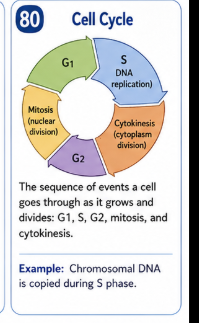
Cell Cycle
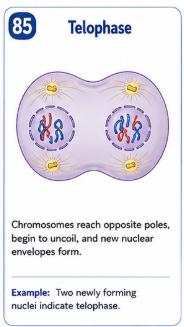
The sequence of events a cell goes through as it grows and divides. G1 is growth and normal function. S is DNA replication. G2 prepares for division. Mitosis divides the nucleus. Cytokinesis divides the cytoplasm.
Mitosis
Division of the nucleus that separates duplicated chromosomes into two identical sets. Its major stages are prophase metaphase anaphase and telophase.

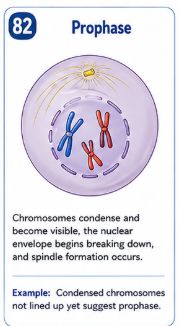
Prophase
Chromosomes condense and become visible. The nuclear envelope begins breaking down and the mitotic spindle forms.
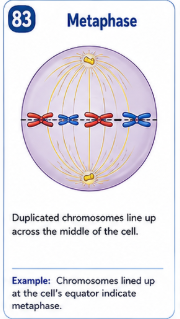
Metaphase
Duplicated chromosomes line up across the middle or equator of the cell.

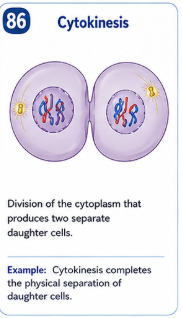
Cleavage Furrow
An indentation of the plasma membrane that forms around the equator of an animal cell during cytokinesis.

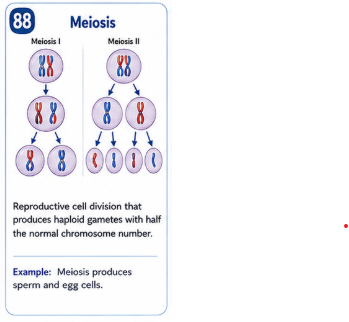
Meiosis
Reproductive cell division that produces haploid gametes with half the normal chromosome number.
Passive vs Active Transport Application
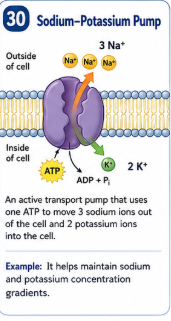
Passive transport moves substances down a concentration gradient without directly using ATP. Active transport uses cellular energy and can move substances against a concentration gradient.

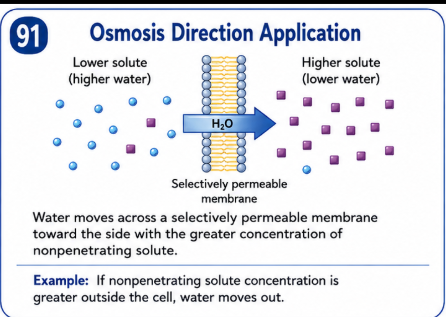
Osmosis Direction Application
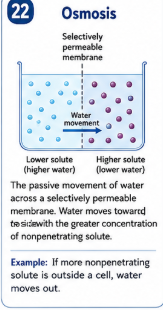
Water moves across a selectively permeable membrane toward the side containing the greater concentration of nonpenetrating solute.
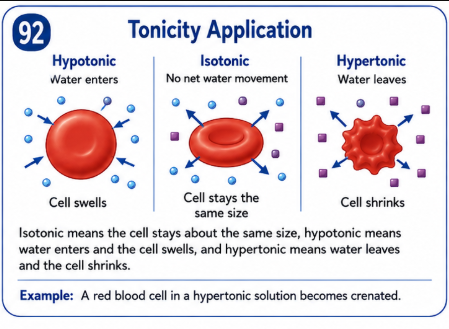
Tonicity Application
Isotonic means the cell stays about the same size. Hypotonic means water enters and the cell swells. Hypertonic means water leaves and the cell shrinks.
Transport Protein Types
Channels form openings through the membrane. Carriers bind substances and change shape. Pumps use energy to move substances against gradients.

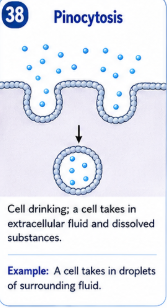
Phagocytosis vs Pinocytosis
Phagocytosis is cell eating and brings in large particles. Pinocytosis is cell drinking and brings in extracellular fluid and dissolved substances. Both are forms of endocytosis. .
