Intro to Human Development [ PSYC2101 ]
 Call Kai
 Learn
Learn Practice Test
 Spaced Repetition
 Match
Match Flashcards
 Knowt Play
1/120

There's no tags or description
Looks like no tags are added yet.
Name | Mastery | Learn | Test | Matching | Spaced | Call with Kai | Chat |
|---|
No analytics yet
Send a link to your students to track their progress
121 Terms
Paradox of Progress
despite our progress, we are not healthier nor happier
The abundance of life choices is increasing rapidly which can cause…
unexpected costs and choice overload
Because modern technology causes an economic abundance, there is a
possession overload
How can you explain the paradox of progress?
mental demands of modern life now complex and confusing
obsession w/ self-improvement undermines sense of security and satisfaction w/ one’s identity
overwhelmed by information overload
more time w/ technology & less time w/ ppl results in intimacy deficit
affluenza undermines physical health and emotional well-being
What are the 3 basic challenges of modern life?
sense of purpose
significance
coherence
Can anyone write a self-help book?
yes
Ineffective self-help books…
not based on solid, scientific research
do not provide explicit directions for changing behavior
encourage a narcissistic approach to life
Psychobabble
messages too vague to be useful in self-help books
ex. be your best you!
Effective self-help books…
realistic, don’t promise too much change too soon
by authors w/ good credentials
have basis in theory/research
provide detailed directions for altering behavior
focus on a particular kind of problem or behavior
Psychology
the science that studies behavior and the physiological and mental processes that underlie it
What do professions in psychology do?
applies knowledge of science to practical problems
ex. behavioral and clinical psychology
Behavior
measurable response or activity, can be observable physically but also is mental
Clinical psychology
branch of psychology concerned w/ diagnosis and treatment of psychological problems & disorders
Adjustment
psychological processes thru which ppl manage or cope w/ demands & challenges of everyday life
With a scientific approach, psychology aims to…
explain behavior empirically
dependent on experimental research using scientific method
Empiricism
premise that knowledge should be acquired thru observation
conclusions are based on systemic observation rather than speculation, traditional beliefs, or common sense
Experiment
investigators manipulate an independent variable under controlled conditions & observe whether any changes occur in a dependent variable
Independent variable
condition or event that an experimenter varies in order to see its impact on another variable; the manipulated variable
Dependent variable
variable that is thought to be affected by the manipulation of the independent variable
Experimental group
subjects who receive some special treatment in regard to the independent variable
Control group
subjects who do not receive the special treatment given to the experimental group
Correlation
exists when 2 variables are related to eachother
Correlation coefficient
numerical index of the degree of relationship that exist b/t 2 variables
provides 2 pieces of info
strength of relation
direction of relation (+/-)
ranges from 0 to +1.00 (direct)
also ranges from 0 to -1.00 (indirect)
coefficients near 0 have no association b/t variables
Positive correlation
indicates that two variables covary in the same direction
Negative correlation
indicates that two variables covary in the opposite direction
Correlations do not have to be related at all
true
Naturalistic observation
careful observation of behavior without intervening with subjects
Case studies
in-depth investigation of individual participants
Surveys
structured questionnaires designed to solicit information about aspects of participants’ behaviors, attitudes, and beliefs
cooperation with surveys appears to have declined in recent decades due to concerns about privacy and identity theft
Can you determine cause and effect from correlations alone?
No, you cannot (CORRELATION DOES NOT EQUAL CAUSATION!)
Disadvantage of correlations
only tell us that two variables are related, not how the two variables are related
List the unimportant things that relate to happiness
money – the correlation between income and happiness is very weak in the U.S. (between .12 and .20)
age – unrelated to global estimates of happiness
gender – little impact on subjective well-being
parenthood – good and bad aspects of parenthood balance each
other outintelligence – no association between IQ and happiness
physical attractiveness – attractive people enjoy many
advantages in society, but relationship with happiness is very
weak
What is somewhat important in relation to happiness?
health and happiness have positive correlation of .32
social relations – people satisfied with their friendships and
socially active report above-average levels of happinessreligious beliefs – people with sincere religious convictions more
likely to be happyculture – more affluent nations are more likely to be happy
What is most important to the relation of happiness?
relationship satisfaction – for men and women across cultures, married people are happier than people who are single or divorced
work – job satisfaction is strongly related to happiness
genetics and personality
extraversion is a strong predictor of happiness
neuroticism is negatively correlated with happiness
genetic predispositions account for a substantial portion of the variance in
happiness
What is more important than objective measures in happiness?
the subjective feeling of happiness
How is happiness relative?
we evaluate our happiness relative to what others around us have
we evaluate our happiness relative to our own expectations
How do people adapt to their own circumstances in happiness?
happiness affected by hedonic adaptation
occurs when the mental scale that people use to judge the pleasantness/unpleasantness of their experiences shifts so that their neutral point, or baseline for comparison, is changed
What Is Personality?
Personality is an individual’s unique constellation of
consistent behavioral traitsA personality trait is “a durable disposition to behave in a particular way in a variety of situations.
What is the big 5?
extraversion
neuroticism
openness to experience
agreeableness
conscientiousness
Psychodynamic theories
focus on unconscious mental forces that shape our personalities; include a variety of theoretical models derived from the work of Sigmund Freud
3 Well-known psychodynamic theorists
Freud
Jung
Adler
Freud’s Psychoanalytic Theory of Personality
Personality is governed by unconscious forces that we cannot control
Childhood experiences play a significant role in determining adult personality
Personalities are shaped by the manner in which individuals cope with sexual urges
Freud’s Structural Theory (divided into 3 structures)
The id is “the primitive, instinctive component of personality that operates according to the pleasure principle.”
The ego is “the decision-making component of personality that operates according to the reality principle.
The superego is “the moral component of personality that incorporates social standards about what represents right and wrong.”
Freud’s Theory of the Conscious and Unconscious
The id, ego, and superego are distributed across three layers of awareness:
The conscious – material “one is aware of at a particular point in time.”
The preconscious – “material just beneath the surface of awareness that can be easily retrieved.”
The unconscious – material “well below the surface of conscious awareness but that nonetheless exerts great influence on one’s behavior.”
What is the conflict in Freud’s Psychoanalytic Theory?
Freud believed that behavior is the result of ongoing internal conflict among the id, ego, and superego
Conflicts stemming from sexual and aggressive urges are especially significant
Such conflicts arouse anxiety, so we use defense mechanisms – “largely unconscious reactions that protect a person from painful emotions such as anxiety and guilt.
Examples of recent evidence for psychoanalytic theory
Reliance on defense mechanisms increases when people experience stress or a threat to their sense of self
Defense mechanisms serve a protective function by
shielding individuals from emotional distressExcessive dependence on defenses is associated with impairments in mental health (Cramer, 2015)
Repressors have an impoverished memory for events that are likely to trigger unpleasant emotions (Alston et al., 2013)
Psychoanalytic Theory of Personality Development
Freud believed that the basic elements of adult personality are in place by age 5 and result from the outcome of five psychosexual stages
In each stage, children must cope with distinct immature sexual urges that influence adult personality
Fixation results if the child fails to move forward from one stage to another and is usually caused by excessive gratification or excessive frustration of needs at a particular stage
Jung’s Analytical Psychology
focused on the role of the unconscious
argued that the unconscious is comprised of two layers
The personal unconscious, which is similar to Freud’s
unconscious layerThe collective unconscious, “a storehouse of latent memory traces inherited from people’s ancestral past that is shared with the entire human race.”
Jung’s Analytical Psychology: Collective Unconscious
The collective unconscious does not contain memories of distinct, personal experiences
Rather, it contains archetypes – “emotionally charged images and thought forms that have universal meaning.
These archetypal images and ideas show up frequently in
dreams and are often manifested in a culture’s use of symbols in art, literature, and religion
Adler’s Individual Psychology
Believed that our most important drive is not sexuality, but our striving for superiority
Stated that we use compensation — “efforts to overcome imagined or real inferiorities by developing one’s abilities.”
If we are unsuccessful, we may develop an inferiority
complex — “exaggerated feelings of weakness and
inadequacy.”Some people may overcompensate for perceived
inferiorities.
An Application of Adler’s Individual Psychology
Adler’s theory has been used to analyze the tragic life of Marilyn Monroe (Ansbacher, 1970)
During her childhood, Monroe suffered from parental neglect that left her with feelings of inferiority
Her inferiority feelings led her to overcompensate by flaunting her beauty, marrying celebrities, keeping film crews waiting for hours, and seeking the adoration of her fans
Modern Dynamic Personality Theories: Personality Organization
healthy
neurotic
borderline
psychotic
Modern Dynamic Personality Theories: Personality Style/Syndromes
depressive, dependent, anxious-avoidant & phobic, obsessive compulsive, schizoid, somatizing, hysteric-histrionic, narcissistic, paranoid, psychopathic, sadistic, borderline
Psychodynamic theories contributed many important insights such as…
Unconscious forces can influence behavior.
Internal conflict may play a key role in psychological distress
Early childhood experiences can influence adult personality
People do rely on defense mechanisms to reduce unpleasant emotions
Psychodynamic theory criticisms include…
Poor testability – too vague, difficult to measure
Depend too heavily on clinical case studies
Many central hypotheses have been challenged by empirical evidence
Male-centered, even sexist, view of personality
Behaviorism (Learning Theory)
“a theoretical orientation based on the
premise that scientific psychology should study
observable behavior.”
How do behavioral theorists view personality?
As a collection of response tendencies that are tied to various stimulus situations
They focus on personality development, and how
children’s response tendencies are shaped by classical
conditioning, operant conditioning, and observational
learning
Pavlov’s classical conditioning
a type of learning in which a neutral stimulus acquires the capacity to evoke a response that was originally evoked by another stimulus
What conditioning can be associated with how people acquire
particular emotional responses such as anxiety or phobias?
classical conditioning
Extinction
the gradual weakening and disappearance of a conditioned response tendency
Skinner’s operant conditioning
a form of learning in which voluntary responses come to be controlled by their consequences; organisms tend to repeat those responses that are followed by favorable consequences— organisms tend not to repeat those responses that are followed by neutral or unfavorable consequences
Positive reinforcement
occurs when a response is strengthened (increases in frequency) because it is followed by the arrival of a pleasant stimulus
Negative reinforcement
occurs when a response is strengthened (increases in frequency) because it is followed by the removal of an unpleasant stimulus
Punishment
occurs when a response is weakened (decreases in frequency) because it is followed by the arrival of an unpleasant stimulus
Bandura’s Social Cognitive Theory
Stressed the importance of self-efficacy – “one’s belief about one’s ability to perform behaviors that should lead to expected outcomes.”
High self-efficacy is associated with confidence, whereas
low self-efficacy creates doubt in one’s abilitiesPerceptions of self-efficacy can influence which
challenges people tackle and how well they perform
Behavioral perspectives have been credited for…
Being rooted in empirical research rather than clinical intuition
Providing the most thorough account of why people are only moderately consistent in their behavior
Behavioral perspectives have been criticized for…
Not being very behavioral anymore (with the rise of Social Cognitive Theory)
Being overly dependent on animal research
Humanism
a theoretical orientation that emphasizes the unique qualities of humans, especially their free will and their potential for personal growth
Humanistic Theories
Humans have an innate drive toward personal growth
Humans exercise free will over their actions; they are not
pawns of their environmentHumans are conscious and rational beings who aren’t
dominated by unconscious needs
Rogers’s Person-Centered Theory
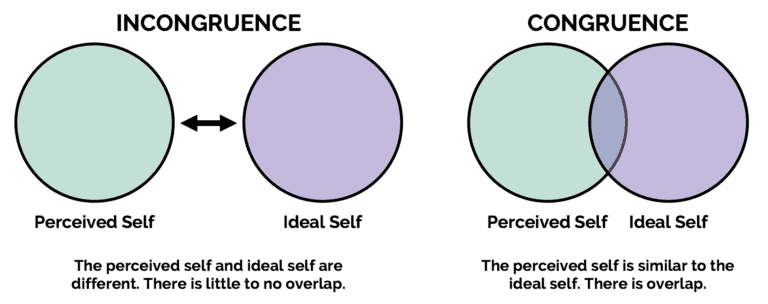
Personality contains only one construct, the self, or self-concept – “a collection of beliefs about one’s own nature, unique qualities, and typical behavior.”
If our ideas about ourselves match our actual experiences,
our self-concept is congruent with realityHowever, if our ideas about ourselves do not match reality, this disparity is called incongruence, which undermines our well-being
Rogers’s PCT: Self-Concept and Development
All humans have a need for affection, love, and acceptance, and experiences early in life are key.
If parents make their affection conditional (given only if the
child’s behavior meets their expectations), children do not feel worthy of love and develop an incongruent self-conceptIf parents give affection unconditionally, children feel worthy
of affection no matter what and develop congruent self-
concepts
According to Rogers, when our self-concept is threatened…
it creates anxiety
Individuals with highly incongruent self-concepts, therefore, experience…
more recurrent anxiety
Maslow’s Theory of Self-Actualization
Human motives are organized into a hierarchy of needs – “a systematic arrangement of needs, according to priority, in which basic needs must be met before less basic needs are aroused.”
Humans have an innate drive toward personal growth and the highest need is the need for self-actualization – the fulfillment of one’s potential.

Maslow called people with extremely healthy
personalities “self-actualizing persons” because of their…
commitment to continued personal growth
Characteristics of self-actualizing people
Accurately tuned in to reality
Open, spontaneous, appreciative
Enjoy rewarding relationships
Thrive on their work and enjoy their sense of humor
Have more “peak experiences”
Balanced personality
Humanistic theory is credited with:
Identifying the self- concept as a key element of personality
Highlighting the importance of psychological health
Laying the foundation for positive psychology
Humanistic theory is criticized for:
Poor testability
An unrealistic view of human nature
an overly positive view on humanism
Inadequate evidence
not properly tested
Biological Perspectives: Eysenck’s Theory
Personality as a hierarchy of traits
Suggests that personality is a function of genetic
differences in “conditionability.”Special interest in explaining variations in extraversion-introversion
Proposed that introverts are more easily aroused by events, which make them more easily conditioned than extraverts
Recent Research in Behavioral Genetics
support for genetic influence on personality provided by twin studies, in which researchers assess hereditary influence by comparing the resemblance of identical twins and fraternal twins on a trait
Heritability ratio
an estimate of the proportion of trait variability in a population that is determined by variations in genetic inheritance
Evolutionary Psychology
examines behavioral processes in terms of their adaptive value for members of a species over the course of many generations
David Buss (1991, 1995)
maintains that the Big Five traits are present across a variety of cultures because they had significant adaptive value for humans
Daniel Nettle (2006)
argues that the traits themselves are products of evolution that were adaptive in ancestral environments.
Biological perspective has been criticized on the following grounds:
There are statistical problems with the estimation of
hereditary influence.Problems with hindsight bias, the common tendency to mold one’s interpretation of the past to fit how events actually turned out
Narcissism
a personality trait marked by an inflated sense of importance, a need for attention and admiration, and a sense of entitlement
Studies have shown that narcissists have highly positive but easily threatened self-concepts, and their behavior is driven by a need to maintain their fragile self-esteem.
Terror Management Theory is based on the following assumptions:
Human cognition is unique in that it allows us to be aware of our own mortality
This creates great anxiety, which can be reduced by cultural worldviews that promote self-esteem and faith
These constructs give people a sense of order, context, and meaning
Reminding people of their mortality (mortality salience) leads to increased self-esteem as an anxiety buffer
Individualism
involves putting personal goals ahead of group goals and defining one’s identity in terms of personal attributes rather than group memberships
Collectivism
involves putting group goals ahead of personal goals and defining one’s identity in terms of the groups to which one belongs
Individualism and collectivism foster cultural disparities
in self-enhancement, which involves…
Focusing on positive feedback from others, exaggerating one’s strengths, and seeing oneself as above average
These tendencies tend to be pervasive in individualistic
cultures but less common in collectivist cultures, where
the norm is to reflect on one’s shortcomings
Holier than thou phenomenon
Tendency for people to claim that they are more likely to engage in socially desirable behaviors than their peers are
Balcetis and colleagues (2008) concluded that
collectivism may promote greater self-insight than
individualism, at least when people contemplate
whether they will engage in socially desirable behaviors
Stress
any circumstances that threaten or are perceived to threaten one’s well-being and thereby tax one’s coping abilities; complex concept; common, everyday event; major and minor problems can cause stress; stressful events can have a cumulative or additive impact
Is stress subjective or objective?
subjective
Primary appraisal of stress
initial evaluation of the relevance, level of threat, and degree of stress the event brings

Secondary appraisal
an evaluation of our ability to cope

Can stress be embedded within an environment?
yes
Ambient stress
chronic negative conditions embedded in the environment
Types of environmental stress
excessive noise
crowding
poverty (biggest stressor)
associated w/ elevated stress hormones
Stress is influenced by… (starts with c)
culture
Cultural stressors
Racial discrimination negatively affects the mental health and well-being for targets of racism
For immigrants, acculturation is a major source of stress
related to reduced well-being