APUSH AMSCO Chapter 1 Summary & Notes
 Call Kai
 Learn
Learn Practice Test
 Spaced Repetition
 Match
Match Flashcards
 Knowt Play
1/78

There's no tags or description
Looks like no tags are added yet.
Name | Mastery | Learn | Test | Matching | Spaced | Call with Kai | Chat |
|---|
No analytics yet
Send a link to your students to track their progress
79 Terms
How Native Americans got to the Americas
*migrants from Asia crossed a land bridge that once connect Siberia and Alaska in Bering Sea,
migrated south from Arctic Circle to South America
3 highly developed civilizations
Mayans, Aztecs, Incas
Mayan Civilization (300-800 AD)
*remarkable cities in rain forests of Yucatan Peninsula (present-day Guatemala, Belize, southern Mexico)
*cultivated corn/maize
Aztec Empire
*powerful empire in central Mexico
*Capital in Tenochtitlan
*population ~200k
*planted corn/maize
(200 yrs after decline of Mayan Empire)
Inca Empire
*Peru/Andes Mnt (South America)
*cultivated da potato
similarities between Mayas, Incas, Aztecs
*highly organized (and large) societies
*extensive trade
*created accurate & scientific calendars
*planted crops
the significant difference between Central/South American and North American Native America Tribes
North American Native Americans were smaller/separate tribes (as opposed to a big empire),
*less sophisticated
Similarities between Central/South American and North American Tribes
established farming systems, language
similarities between North American native cultures
*semi-permanent settlements in small groups
*men: made tools, hunted game
*women: gathered plants/nuts or grew crops like corn/maize, beans, tobacco
*animism
language of Native Americans
very diverse, more than 20 language families & 400 distinct languages
*larges are Algoquian of Northeast, Siouan in Great Plains, Athabaskan in Southwest
Relationship between resource availability and cultural lifestyle (in general)
*great concentration of resources also created rigidly stratified class structures throughout the West
*In areas with sparse natural resources, groups were more nomadic and less connected to others.
Southwest Settlements (present day New Mexico & Arizona)
*groups like Hokokam, Anasazi, Pueblos
*farming with irrigation systems (corn; irrigation allowed Pueblos to plant beans and squash in addition to corn)
*lived in caves, under cliffs, multistoried buildings
*stone/masonary homes
*drought between 1200-1300 disastrous, caused ancestral Pueblos to flee area
Northwest Settlements (present day Alaska-northern California)
*Pacific Coast
*permanent longhouses/plank houses
*hunting, fishing; gathering nuts (acorns to make into flower!!!)/berries/roots
*get da salmon
*used totem poles to save stories, legends, myths
*generally identified with family-based bands called tribelets
longhouses
large buildings that were home to several families
Great Plains (nomadic hunters)
*principally survived on hunting (mainly buffalo)
*lived in tepees (frames of poles covered in animal skins that worked well with their nomadic lifestyles)
Great Plains (sedentary farming tribes)
*permanent earthen lodges often along rivers
*farmed corn, beans, squash
*traded with other tribes
*plains tribes merge/split with time as conditions change (especially after arrival of Europeans)
Midwest Settlements
*Woodland American Indians (east of Mississippi River, Ohio River valley)/Mississippian Indians
*hunt/fish/farm
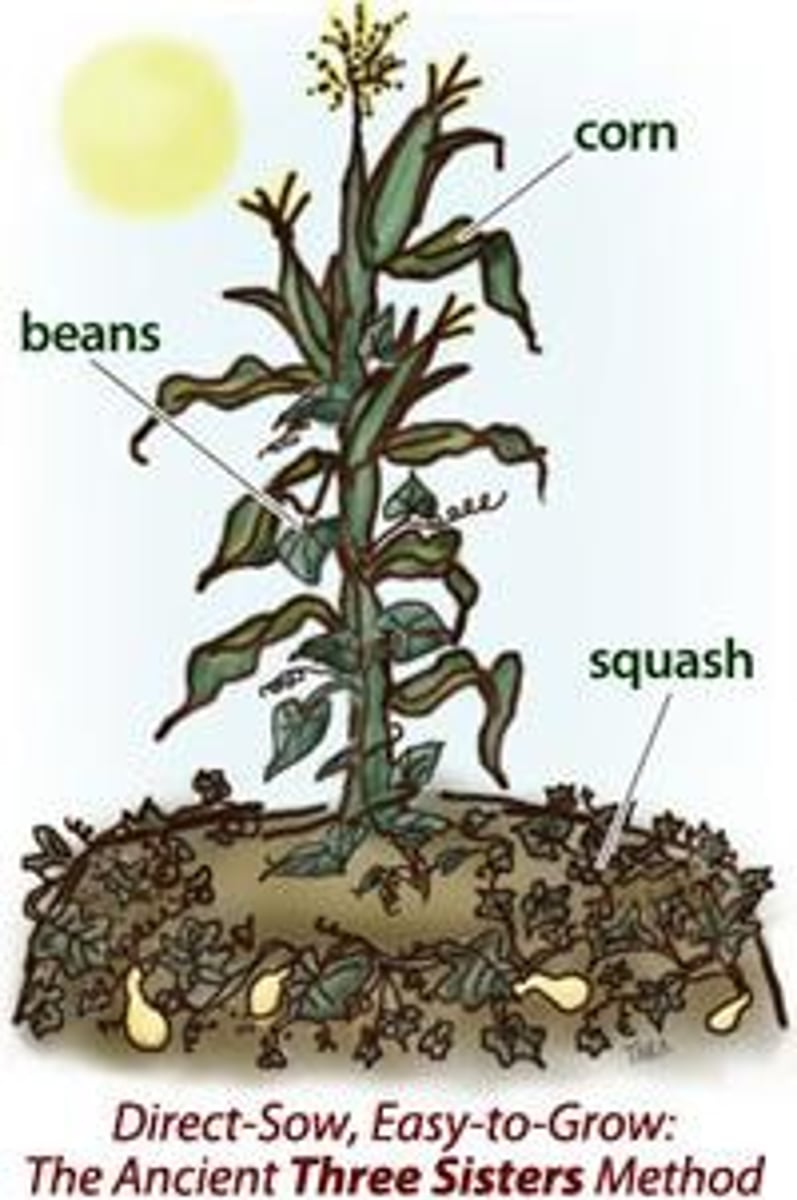
*have permanent settlements due to farming (practiced 3-Sister farming, planting corn/beans/squash together because all 3 plants benefited this way)
*Adena-Hopewell culture - present day Ohio, large earthen mounds
Northeast Settlements (New York area)
*descendants of Adena-Hopewell Culture (of midwest), spread from Ohio to New York
*hunting and farming (but farming techniques exhausted soil quickly so constantly on the move)
*3-sister farming
*longhouses
*Iroquois Confederation - political union of 5 independent tribes in Mohawk Valley, NY. Powerful, battle rival Native Americans & Europeans
*trade success of the Iroquois caused conflicts between them and Algonquians, so made a confederation
Atlantic Seaboard Settlements (NJ south to FL)
*Coastal Plains
*timber/bark lodgings along rivers
*Atlantic Ocean & rivers provide food source
Animism
belief that spirits exist in natural world (common/similar religion)
ways native peoples transform North American environment before European colonization
*architecture/housing
*agriculture/hunting/irrigation
*making tools/trading
*hunting
Viking Voyages 12th Century
Vikings from Scandinavia visit Greenland and North America around year 1000, but had no lasting impact (Europeans still have no lasting knowledge of the existence of the New World)
Improvements in Technology that allowed for Age of Exploration
Europeans made improvements on inventions of others
*use gunpowder made by Chinese
*sailing compass by Arab merchants (who got it from the Chinese)
*major improvements in shipbuilding (carracks, caravels), map-making
Reasons for European Exploration
*Renaissance inspired curiosity about the rest of the world and a spirit of adventure in many Europeans
*wanted new trade routes to Asia
*Technological advancements made this period of exploration possible
*spread religion
*god/gold/glory
"God" (Religious) aspect of Exploration
*Religious motivations can be traced all the way back to the crusades - 11th-15th centuries
*increased religious intolerance & forceful religious conversion
*Christians, especially in strongly Catholic nations (Spain/Portugal) looked to colonization as a way to continue religious conquests and sanctify Christian global dominance
Catholic Victory in Spain (1492) & Significance
Queen Isabella and King Ferdinand conquered territory (city of Granada) from Islamic invaders in Spain, were at the height of their power.
*funded Christopher Columbus this same year
Significance of Protestant & Catholic Religious Conflict on Age of Exploration
led religious motive for exploration and colonization.
*both Protestants and Catholics want to spread their own versions of Christianity to people in Africa, Asia, Americas
"Gold" aspect of Exploration
*Silk Road was used as a route between Europe and the East - 10th century
*but was slow, costly, unprofitable, unsafe
*Wanted to find a water passage to the wealthy cities of Asia, wanted exotic spices
*Lure of profit
cause for the search for sea trade routes to Asia
overland trade route (Silk Road) through Byzantine city of Constantinople was blocked by Ottoman Turks who took over in 1453.
So Europeans needed new route
what Europeans thought were 2 possible new sea routes to Asia
2 apparent options:
*sail south around West African coast east to China (Portuguese took advantage of this pathway through Prince Henry the Navigator)
*or sail west across the Atlantic to China (later became the search for the Northwest Passage)
"Glory" aspect of Exploration
*competition between Portuguese and Spanish motivated both nations to colonize quickly/aggressively
*Prince Henry the Navigator got Portugal started, spread empire down western coast of Africa to the Congo, along western coast of India, and Brazil and the Atlantic Islands. Portugal got big control of sea trade routes due to holding so may coastal territories
*Spain felt threatened by Portugal's "monopoly" on slave trade and Atlantic expansion, so threw in own expedition of Columbus in 1492
Vasco da Gama (of Portugal)
first European to reach India by sailing south around Africa's Cape of Good Hope and east to Asia, 1498
15th century Slave Trading & Sugar Plantations & Effects on the Americas
*Portuguese trade for slaves from West Africa
*used slaves to work sugar plantations on islands off African coast
*so profitable that Europeans copied this slave system in colonies in the Americas
Christopher Columbus
*believed he could sail west across Atlantic from Europe to reach Asia
*1492 - received support from Queen Isabella and Ferdinand at the height of their power (they had just conquered Granada from the Islamic)
*Got glory after landing on land Sept 6, but subsequent voyages disappointing (little gold/spices, no route to Asia)
Columbus's Legacy
*died in 1506 thinking he had found a Western Route to Asia.
*Later on people realized it was a "New World"
*brought permanent interaction between Europeans and the Americas (as well as Africa in the Columbian Exchange)
Columbian Exchange
transfer of plants, animals, germs from one side of Atlantic to the other for the first time
Impact of Columbian Exchange
*Europeans learned about many new plants/foods (beans, corn, sweet/white potato, tomato, tobacco). Got syphilis
*Europeans introduced to the Americas: sugarcane, bluegrasses, pigs, horses. Wheel, iron implements, guns
*most deadly - smallpox & measles. Native Americans had no immunity
significance of smallpox/measles
millions of native americans died
Line of Demarcation
*Spanish and Portuguese had disputes over territory, turned to pope
*Pope drew this vertical line and gave Spain all lands to the west of the line and Portugal all lands to the East
Treaty of Tordesillas (1494)
*based on the line of demarcation
*established Portugal's claim to Brazil
*Spain got the rest of the Americas
Conquistadors
Spanish peeps coming in, murdering Native Americans, and claiming land. (Spanish Conquerors)
Ferdinand Magellan (of Spain & Portugal)
first person to circumnavigate the globe (voyage done under Spain)
Hernan Cortes (of Spain)
conquistador, conquered Aztecs in Mexico
Francisco Pizarro (of Spain)
conquered Incas of Peru
Spain's initial supremacy in the Americas & Significance
*conquistadors sent shiploads of gold and silver home from Mexico and Brazil
*Spain became richest and most powerful nation in Europe
*Spain's success encouraged other nations to explore the Americas and get rich and powerful
Encomienda system
*agreement established by Spain, put natives into "serfdom"
*king gives grants of land and natives to individual Spaniards
*Native Americans farmed/worked in mines, Spanish profited off of them
*Spanish had to in turn "care" for the Native Americans
Asiento System
Spanish brought enslaved people from West Africa, but had to pay a tax to their king on each slave imported to the Americas under this system
(used this system in addition to the encomienda system because European disease and violence was decimating the native population)
John Cabot (of England)
*England's earliest claims to America territory (Cabot was an Italian sailing under contract of English)
*explored coast of Newfoundland 1497
*England did not follow up on Cabot's discoveries due to preoccupations of Protestant Reformation at the time :(
Sir Francis Drake (of England)
*challenged Spanish shipping in both the Atlantic and Pacific
*attacked Spanish ships and took the gold and silver they carried
*attacked Spanish settlements in Peru
Sir Walter Raleigh (of England)
*unlike other explorers looking for gold, believed in importance of settlement
*named Virginia after Queen Elizabeth
*Established the colony on Roanoke Island off NC coast 1587 (failed after conflicts with Native Americans)
Giovanni da Verazzano (of French)
*hoped to find Northwest Passage leading through the Americas to Asia
*explored part of North America's eastern coast, including NY harbor
Jacques Cartier (of France)
explored St Lawrence River
Both French and English slow to develop colonies in the New World due to this
religious conflict with Roman Catholic Church (protestant reformation)
Samuel de Champlain (of France)
*established first permanent French settlement in America (Quebec!!!)
*strong leadership => "Father of New France"
Louis Jolliet and Father Jacques Marquette (of France)
explored upper parts of Mississippi River (1682)
Robert de La Salle (of France)
explored Mississippi basin and named it Louisiana after French King
Henry Hudson (of the Netherlands)
*English sailor hired by Dutch
*looking for Northwest Passage
*sailed up Hudson River
*established Dutch claims in surrounding areas (New Amsterdam, and later New York)
Dutch West India Company
granted right to control Hudson River area for economic gain by the Dutch government
*Dutch were adamant about finding a new port city for maritime/sea trade
Northwest Passage
people thought there was a seaway through the Americas to Pacific Ocean and China (thought it was in the north, through Canada)
Spanish Settlements in North America
Florida, New Mexico, Texas, California
Florida (Spanish Settlement)
Spanish established St. Augustine (oldest city in North America founded by Europeans) 1565 after many failed attempts due to Native American resistance
New Mexico (Spanish Settlements)
*Santa Fe, capital, established in 1610
*harsh attempts to convert American Indians led to Pueblo revolt in 1680.
*Spanish driven from land until 1692
Texas (Spanish Settlement)
early 1700s, Spanish resist French efforts to explore lower Mississippi River
California (Spanish Settlement)
*in response to Russian exploration from Alaska
*establish permanent settlements at San Diego (1769) and San Francisco (1776)
*1784 - series of missions established by members of Franciscan order
European Treatment of Native Americans
*most looked down on Native Americans
*generally viewed them as inferior people who could be exploited for economic gain, converted to Christianity, or used as military allies
Spanish Treatment of Native Americans
*wiped them out with disease and used the rest as slaves for forced labor
*most Spanish explorers/conquerors were single young men, so intermarried with natives and African slaves
*rigid class system developed by Spanish colonies, with pure-blood Spanish at the top
*forced conversions
Chief features of the Spanish empire in America
*permanent settlement in central America & southwest North America
*Missions (catholic)
*forced labor of Native Americans
*conflicts and conquests
One major cause of Spanish settlement
competing interests/efforts of other European countries for neighboring land. Gold/riches/profit/power
Bartoleme de Las Casas
*Priest, European dissented from the views of most Europeans toward Native Americans
*advocated for better treatment for Indians
*persuaded king to institutde the New Laws of 1542
New Laws of 1542
*Spanish laws, ended Indian slavery, halted forced labor, began to end the encomienda system
*advocated for by Bartolome de Las Casas
*Conservative Spaniards who were eager to keep the encomienda system successfully pushed the king to repeal parts of the New Laws
Valladolid Debate
debate over the role for Native Americans in the Spanish colonies, 1550-1551
*Las Casas argued that natives are completely human/morally equal to Europeans, so enslaving them is wrong
*priest Juan Gines de Sepulveda was like no. Indians are not human >:(
English Treatment of Native Americans
*Settled in areas without large native empires
*colonists came in families, so intermarriage less common (more interested in permanent settlements)
*coexisted with Native Americans for short while (Native Americans taught English how to grow corn and hunt), traded furs for iron tools and weapons
*English occupied more and more land and forced the small, scattered tribes they encountered off their own land
Difference between English and Spanish treatment of Native Americans
English forced natives off of their land rather than conquering/enslaving them. Also did rarely intermarried with them, unlike the Spanish
French Treatment of Native Americans
*looked for furs and converts to Catholicism
*viewed American Indians as potential economic/military allies
*maintained good relations
*fur trade
*French weren't a big threat to the native population because they had fewer colonists/farms/towns
*helped Huron people fight their traditional enemy - the Iroquois
Native American Reaction to European Colonization/Exploration/Conquests
*saw themselves as groups distinct from each other, not as part of a larger body of Native Americans, so Europeans didn't really have to worry about a unified attack/resistance
*initially traded/drawn to Europeans bc of their copper pots/guns
*later on, learned new ways to survive
*some allied with one European power or another in hopes to gain enough support to survive
*others just migrated to new land to avoid Europeans
major consequences of European contact with American Indians
*spread of Christianity
*Disease/Conquest/Violence (mass death)
*harsh treatment/forced labor
*loss of land
effects of Europe's expanding trade in the 1400s
*slave trade/sugar plantation profits
*increased competition between European nation states - push for exploration
*new products
*development of capitalism
impact of European expansion on Native American society
*decimated them through disease/conquests
*enslaved
*land taken
*introduced horses, wheel, etc (tribes like the Sioux in the Great Plains gave up entirely on farming and used horses to easily follow buffalo across plains)
Beginning of the development of banking/capitalism as opposed to feudalism
-Colonization brought wealth to European imperial powers which resulted in political and economic innovations.
-Economic innovations like joint stock companies emerged and capitalism began to replace feudalism (gold and silver increased wealth of European countries, led to banking/capitalism)