2.2 Model Estimation and Inference
 Call Kai
 Learn
Learn Practice Test
 Spaced Repetition
 Match
Match Flashcards
 Knowt Play
1/23

Earn XP
Description and Tags
Section 2.2 of Exam MAS-II
Name | Mastery | Learn | Test | Matching | Spaced | Call with Kai | Chat |
|---|
No analytics yet
Send a link to your students to track their progress
24 Terms
MLE: If theta is known/unknown, Beta hat is the ____
Best Linear Unbiased Estimator (BLUE)
Empirical Best Linear Unbiased Estimator (EBLUE)
Restricted MLE
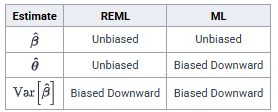
Adjusts for the loss of degrees of freedom from estimating the fixed effects to produce an unbiased estimate for theta
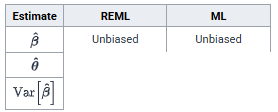
Biased?
Computational Algorithms: Expectation Maximization: Pro and Con
Pros: good at finding starting values for other algorithms
Cons: converges slowly and produces "optimistic" estimators
Computational Algorithms: Newton-Raphson: Pro and Con
Pros: converges in a small number of iterations and can be used to obtain an asymptotic covariance matrix for the covariance parameters in theta
Cons: each iteration takes a while
Computational Algorithms: Fisher Scoring: Pro and Con
Pros: less computationally intensive and more likely to converge
Cons: difficult to obtain the expected Hessian matrix, which is needed in order for the estimates to be accurate
Computational Algorithms: General Advice
In general, start with a few iterations of EM to generate starting values, finish with N-R, and avoid Fisher scoring.
Handling Computational Problems (If D does not converge)
Choose different starting values for the covariance parameters.
Rescale the covariates.
Remove potentially unnecessary random effects.
Fit the implied marginal model instead.
Fit the marginal model with an unstructured covariance matrix.
The ICC for level j of a two-level variance components model
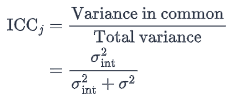
For a subject i in cluster j nested within group of k clusters, the Level 2 ICC is:
the level 3 ICC is:
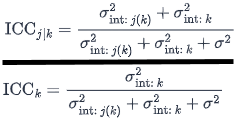
General intuition for ICC
In general, the ICC for a given level of clustering can be thought of as the proportion of the total observed variation due to the random effects at that level and higher levels. It must be positive.
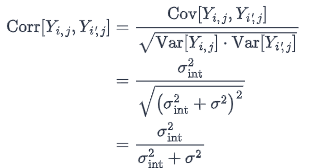
Marginal ICC: For the implied marginal model arising from a variance components model
The marginal correlation between two different observations within the same group
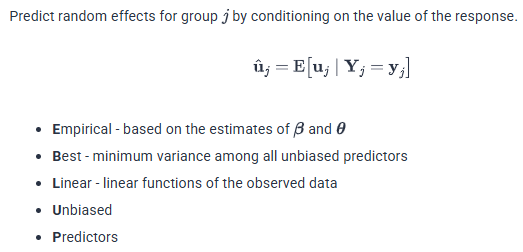
EBLUPs: Predict ____
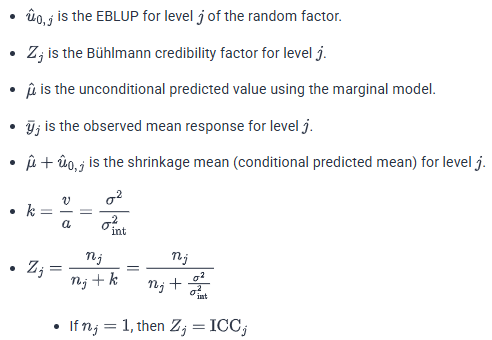
For a variance components model, we can use what to compute the shrinkage mean?
Buhlmann Credibility


Define the components of this equation
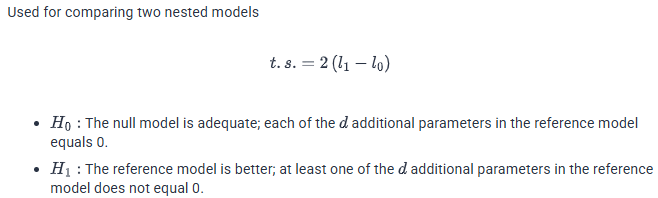
Likelihood Ratio Test Equation
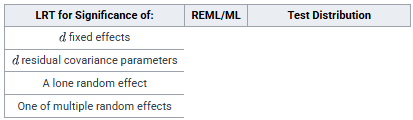
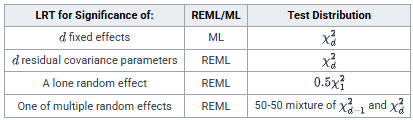
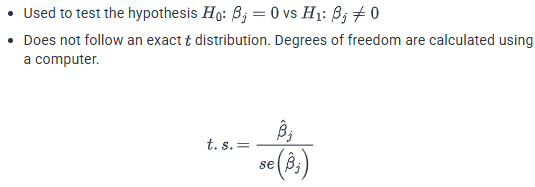
Alternative Tests: t-tests: What it tests and shortcoming
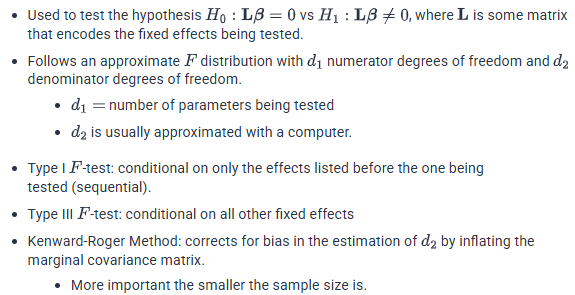
Alternative Tests: F-tests: What it tests, df, Type I and III, Kenward-Roger importance
Alternative Tests: Omnibus Wald Test: What it tests, shortcoming, distribution

Alternative Tests: Wald Test: What it tests, shortcoming

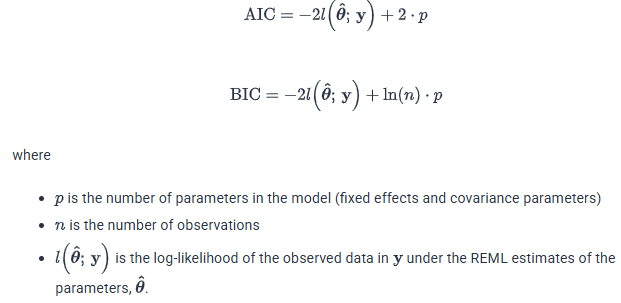
Information Criterion: AIC and BIC equations
Top Down Strategy
Start with a complex model and reduce it to a simpler model.
Build a model with a "loaded" mean structure
Select a structure for the random effects
Select a residual error covariance structure
Reduce the model by removing non-significant fixed effects
Step-Up Strategy
More commonly utilized for constructing models in hierarchical form. Start with a simple model and gradually add terms.
Build a "means-only" model
Check the random intercepts
Add the Level 1 covariates and related Level 2 random coefficients
Add the Level 2 covariates and related Level 3 random coefficients
Repeat Step 4 if necessary for any Level 3 covariates