Muscular System
 Call Kai
 Learn
Learn Practice Test
 Spaced Repetition
 Match
Match Flashcards
 Knowt Play
1/67

There's no tags or description
Looks like no tags are added yet.
Name | Mastery | Learn | Test | Matching | Spaced | Call with Kai | Chat |
|---|
No analytics yet
Send a link to your students to track their progress
68 Terms
What are the 3 main functions of the muscular system?
Movement
Posture
Bodily Functions (Or homeostasis)
What are muscles made out of?
Muscle Fibers
What happens when muscles contract?
When muscles contract, they shorten and pull on the bones they're attached to. This movement causes the bones to move, which in turn causes the body to move.
Muscles don’t not push. What do they do instead?
One side is pulling in one direction while another muscle relaxes
What do your muscles do while you are unconscious?
The muscles relax and maintain posture.
What is homeostasis?
The tendency of a living thing to maintain a stable internal state. It is the balance of conditions such as temperature and resources.
How does shivering relate to the muscle contractions?
When you shiver, the muscles contract, generating heat and raising one’s body temperature.
What are the 3 types of muscles?
Skeletal
Cardiac
Smooth
What type of muscle only performs voluntary movement?
Skeletal muscles
Do skeletal muscles perform voluntary or involuntary movement?
Voluntary
Where can skeletal muscles be found?
Attached to bones
Where are smooth muscles found?
They are found inside some organs, such as the intestines and the stomach.
What muscles are found inside organs, such as the intestines and the stomach?
Smooth muscles
What muscles perform involuntary movements?
Smooth and cardiac muscles
Do smooth muscles perform voluntary or involuntary movement?
Involuntary
Do cardiac muscles perform voluntary or involuntary movement?
Involuntary
What type of muscles line up one’s stomach wall and pushes food into the digestive system?
Smooth muscles
What do cardiac muscles make up?
The thick middle layer of the heart
What muscles has a striated appearance?
Skeletal muscles and cardiac muscles
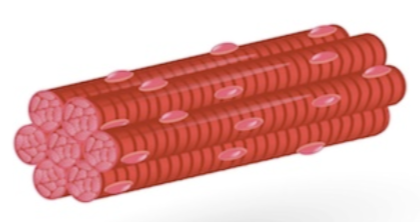
What type of muscle is this?
The skeletal muscle
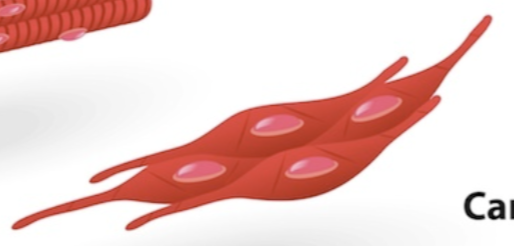
What type of muscle is this?
The smooth muscle
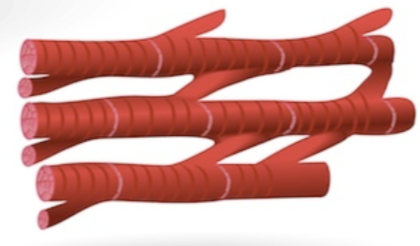
What type of muscle is this?
The cardiac muscle
What are the 3 types of muscle fibres?
Slow Twitch (Type I)
Fast Twitch (Type IIA)
Fast Twitch (Type IIB)
What do red fibres and white fibres refer to?
Red refers to slow
White refers to fast
What is the definition of aerobic?
Requires oxygen to function
What is the definition of anaerobic?
Doesn’t require oxygen to function
What is the contraction speed for IA?
Slow
What is the contraction speed for IIA and IIB?
Fast
What fatigues quickly? IIB or IA?
IIB
What are bigger? IA or IIA and IIB?
IIA and IIB
What is twitch IA main use?
They are used mostly for endurance activities as these muscles contract repeatedly for continuous activities.
What is the twitch IIA main use?
Fatigue resistance (but used less than twitch IA)
Are faster twitches bigger or smaller?
Bigger
What is the twitch IIB main use?
Speed, strength and power-based activities
Where does IA twitches get its energy from?
Aerobic energy system
Is the IA twitch aerobic or anaerobic?
Aerobic
Is the IIA twitch aerobic or anaerobic?
Partially both
Is the IIB twitch aerobic or anaerobic?
Anaerobic
What type of twitch are mainly used by a marathon runner or endurance cyclist?
IA
What type of twitch are mainly used by a person doing a speed endurance-based activity (400m, 800m)
IIA
What type of twitch is mainly used for 100m, 200m sprint, field events like throws/jumps, 50m swimming freestyle?
IIB
What is the force available with the fast twitch compared to the slow twitch?
Fast twitch has maximal force available while a slow twitch has low maximal force available.
What is the oxygen supply with the fast twitch compared with the slow twitch?
The fast twitch has limited oxygen supply while the slow twitch has plentiful.
What is the fatiguability for the fast twitch compared with the slow twitch?
The fast twitch has high fatiguability but the slow twitch has low fatiguability.
What is the blood supply for the fast twitch compared with the slow twitch?
The fast twitch has low blood supply but the slow twitch has high blood supply.
What is the stores of fat compared with the fast twitch and the slow twitch?
The fast twitch has low stores of fat, however the slow twitch has high stores of fat.
What is the capillary density with the fast twitch compared to the slow twitch?
The fast twitch has low capillary density while the slow twitch has high capillary density.
What are tendons?
Tendons are soft tissues that usually attach muscles to bones. They cross a joint and attach itself to 1 or more joints.
What are ligaments?
A fibrous connective tissue that attaches bone to bone.
What is the purpose of the ligament?
They provide stability at the joint.
What is a cartilage?
A smooth, slightly elastic tissue. Its functions include friction reduction across joints, reduced damage to joints, shock absorber, body protection, support and shape.
What are the cartilage functions?
Its functions include friction reduction across joints, reduced damage to joints, shock absorber, body protection, support and shape.
What is the speed of contraction with the fast twitch compared with the slow twitch?
The slow twitch contracts slowly while the fast twitch contracts quickly.
How do muscles help us move?
Muscles called agonists can pull on bones or change joint angles. Muscles called antagonists then revert the bone to its original position. Muscles work in pairs.
What is an agonist and an antagonist?
The agonist is responsible for the movement by contracting, and the antagonist relaxes to allow the movement to occur.
What happens when an elbow joint is flexed?
Flexor muscles contract. Extensor muscles relax.
What happens when elbow joints extend?
Extensor muscles contract. Flexor muscles relax.
What are the agonist and antagonist during bicep curls?
The biceps are the agonist and the triceps are the antagonist.
What are the agonist and antagonist during tricepsextension?
The triceps are the agonist and the biceps are the antagonist.
Describe fast twitch muscle fibres.
Fast twitch muscle fibers are a type of muscle fiber that contracts quickly and powerfully. They are responsible for generating a lot of force, but they also fatigue quickly. This means that they are best suited for short bursts of activity, such as sprinting or weightlifting.
Contrast fast and slow twitch muscle fibres.
Fast-twitch muscle fibres contract quickly and powerfully, but they fatigue easily. However slow twitch muscle fibres contract slowly and with less force, but they can sustain activity for longer periods of time. Fast twitch muscle fibres are used for activities that require short bursts of speed and power, such as sprinting and jumping. However slow twitch muscle fibres are used for activities that require endurance, such as long-distance running and swimming.
What is reciprocal inhibition?
A process where the contraction of one muscle group (agonist) triggers the relaxation of its opposing muscle group (antagonist), causing movement of a bone.
Explain the function of movement of the muscular system
The muscles move limbs and bones in the body.
Explain the function of posture of the muscular system.
The muscles maintain posture by relaxing and balancing as the different muscles contract and relax.
Explain the function of Bodily Functions (Or homeostasis) of the muscular system by focusing specifically on body temperature
Processes within the body require certain conditions, such as temperature and the right amount of water. The balance of conditions is called homeostasis. One of the functions is to maintain body temperature. When muscles shiver, they contract which releases heat.
Names some examples of skeletal muscles
Biceps, triceps, quadriceps, hamstrings, gastrocnemius, gluteus maximus, abdominals
Names some examples of smooth muscles
Intestine, stomach, bladder, eye, lungs
Name some examples of cardiac muscles
The heart