Measuring Perception
 Call Kai
 Learn
Learn Practice Test
 Spaced Repetition
 Match
Match Flashcards
 Knowt Play
1/8

There's no tags or description
Looks like no tags are added yet.
Name | Mastery | Learn | Test | Matching | Spaced | Call with Kai | Chat |
|---|
No analytics yet
Send a link to your students to track their progress
9 Terms
First Step of Scientific Investigation - Operationally define the constructs
Finding a way to measure the WHAT variables in WHAT.
First Step of Scientific Investigation - Operationally define the constructs
Finding a way to measure the DEPENDENT variables in NUMBERS.

What are the five techniques to measuring perception above the threshold
WHAT
WHAT
WHAT
WHAT
WHAT
Note: Sometimes there are WHAT among the techniques (you can categorize a measure into more than one technique)
What are the five techniques to measuring perception above the threshold
Magnitude estimation (used by S.S. Stevens to demonstrate the power law)
Recognition testing
Reaction time
Phenomenological report
Physical tasks and judgements
Note: Sometimes there are OVERLAPS among the techniques (you can categorize a measure into more than one technique)
Magnitude Estimation (S. S. Stevens)
Stimuli with various WHAT are presented several times, in WHAT order
Observer assigns WHAT to each stimulus
The first stimulus is assigned an WHAT number
Further stimuli are assigned numbers representing the WHAT
No WHAT on the scale
Magnitude Estimation (S. S. Stevens)
Stimuli with various INTENSITIES are presented several times, in RANDOMIZED order
Observer assigns NUMBERS to each stimulus
The first stimulus is assigned an ARBITRARY number
Further stimuli are assigned numbers representing the SUBJECTIVE IMPRESSION
No LIMIT on the scale

Recognition Testing (picture)
A WHAT is flashed very briefly
Participants report what they WHAT
Recognition Testing (picture)
A PICTURE is flashed very briefly
Participants report what they SEE
Recognition Testing (word)
Subjects were shown a WHAT on a computer screen very briefly (35ms) and their task was to WHAT the word.
Some of the words had appeared WHAT in a study phase, some had not.
WHAT was measured.
Recognition Testing (word)
Subjects were shown a WORD on a computer screen very briefly (35ms) and their task was to REPORT the word.
Some of the words had appeared EARLIER in a study phase, some had not.
RECOGNITION ACCURACY was measured.
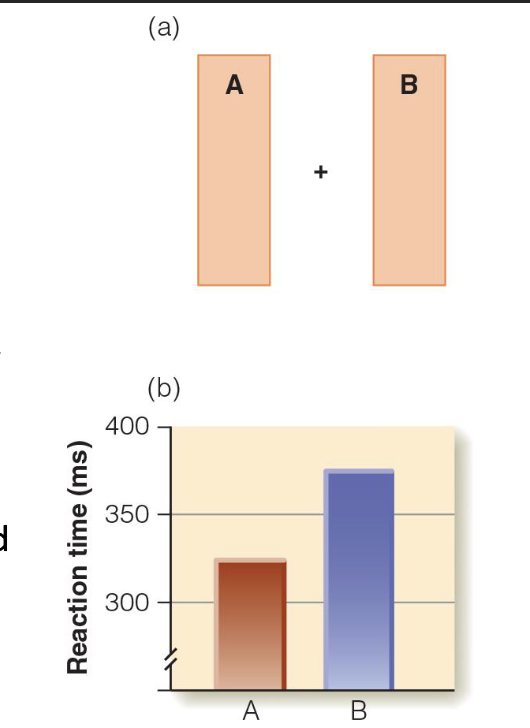
Reaction Time
Participants fixate their eyes at the “+” sign at the center of a screen but pay covert attention to WHAT.
A target appears anywhere on the display and the participants press a button when they WHAT the target.
Reaction time was shorter (i.e., faster) when the target appeared at WHAT (compared to at WHAT), the location where the participants were WHAT.
Reaction Time
Participants fixate their eyes at the “+” sign at the center of a screen but pay covert attention to A.
A target appears anywhere on the display and the participants press a button when they DETECT the target.
Reaction time was shorter (i.e., faster) when the target appeared at A (compared to at B), the location where the participants were ATTENDING.
Phenomenological Report
In a phenomenological report, the participants describe what WHAT
For example, WHAT
In this task, the child first describes what he/she WHAT and then describes what another person WHAT
Phenomenological Report
In a phenomenological report, the participants describe what THEY SEE.
For example, Piaget’s Three- Mountain Task.
In this task, the child first describes what he/she SEES and then describes what another person SEES

Physical Tasks
Navigating through a WHAT (measuring WHAT required to reach a WHAT or # of WHAT made)
Driving a WHAT (tracking what the driver WHAT at)
Physical Tasks
Navigating through a MAZE (measuring TIME required to reach a DESTINATION or # of ERRORS made)
Driving a CAR (tracking what the driver LOOKS at)
Judgements
Answering questions like:
“are they the WHAT or not the same?”
“what is the WHAT of the lines?”
“how WHAT is an object from you?”
“how much WHAT has elapsed?”
Judgements
Answering questions like:
“are they the SAME or not the same?”
“what is the ORIENTATION of the lines?”
“how FAR is an object from you?”
“how much TIME has elapsed?”