Psych unit 4 AOS 1
 Call Kai
 Learn
Learn Practice Test
 Spaced Repetition
 Match
Match Flashcards
 Knowt Play
1/92

There's no tags or description
Looks like no tags are added yet.
Name | Mastery | Learn | Test | Matching | Spaced | Call with Kai | Chat |
|---|
No analytics yet
Send a link to your students to track their progress
93 Terms
Psychological constructs
An agreed upon description and understanding of psychological phenomena
that cannot be overtly measured or observed
What are psychological constructs used for?
To understand or explain things that we believe exist but cannot
see,
touch,
or measure in any way.
Researchers rely on
info provided by the individual,
behaviour that is shown
physiological changes
Normal waking consciousness (NWC)
The ability to be aware of our internal and external stimuli
The ability to voluntarily direct our awareness and attention
Altered states of consciousness (ASC)
Any state of consciousness that deviates from normal waking consciousness, in terms of marked differences in the levels of:
awareness
thinking
sense of time, etc
Naturally occurring altered state of consciousness
A type of altered state of consciousness that occurs without intervention
e.g. sleep
Induced altered state of consciousness
A type of altered state of consciousness that occurs due to a purposeful action or aid
e.g. meditation
What is sleep?
A regular and naturally occurring altered state of consciousness
involves a loss of awareness and disengagement with internal and external stimuli.
Sleep episode
The full duration of time spent asleep
Sleep cycle
A proportion of the sleep episode in which the sleeper progresses through stages of REM and NREM sleep
on average: 90mins
Eye movements: REM vs NREM
NREM: Non-rapid eye movements
REM: Rapid, jerky eye movements
Brainwaves REM vs NREM
NREM: high amplitude, low frequency
REM: high frequency, low amplitude
Physiological arousal REM vs NREM
NREM: Decreases (heart rate, breathing)
REM: Increases (heart rate, breathing)
Muscles REM vs NREM
NREM: Some movement
REM: State of paralysis (muscle atonia)
Dreams REM vs NREM
NREM:
Short lived
Not likely to be vivid or recalled
REM: Common and likely to be recalled
Duration REM vs NREM
NREM:
Approx. 80% of the night’s sleep
decreases in proportion as the night progresses
REM:
Approx. 20% of the night’s sleep
increases in proportion as the night progresses
Purpose NREM vs REM
NREM: Physical restoration and memory consolidation
REM: Optimising neural pathways & emotional processing
NREM sleep definition
A period of sleep subdivided into three different stages
the sleeper does not experience any rapid eye movement.
REM sleep definition
A period of sleep where the sleeper experiences rapid eye movement beneath closed eyelids.
NREM stage 1
light stage of sleep
easily awakened: low arousal threshold
lower levels of bodily arousal, decrease in:
heart rate
respiration
body temperature
NREM stage 2
truly asleep
more intense stimuli than stage 1 to awaken: higher arousal threshold
Physiological changes:
Fewer body movements
eye movements stop
breathing→more regular
heart rate → slower
NREM stage 3
deepest stage of sleep- highest arousal threshold
Muscles→ completely relaxed
No eye movement
Heart rate, blood pressure and body temperature → lowest and most regular
Physiological sleep measures
electroencephalograph (EEG)
electromyograph (EMG)
electro-oculograph (EOG)
Subjective sleep measures
sleep diaries
video monitoring
Electroencephalograph (EEG)
a device that detects, amplifies, and records the electrical activity of the brain.
Electrodes placed onto scalp- picks up signals & represent them in brain wave patterns.
Brain waves & consciousness
The frequency and amplitude of brain waves can indicate what state of consciousness an individual is experiencing.
Frequency- rate
Amplitude- height
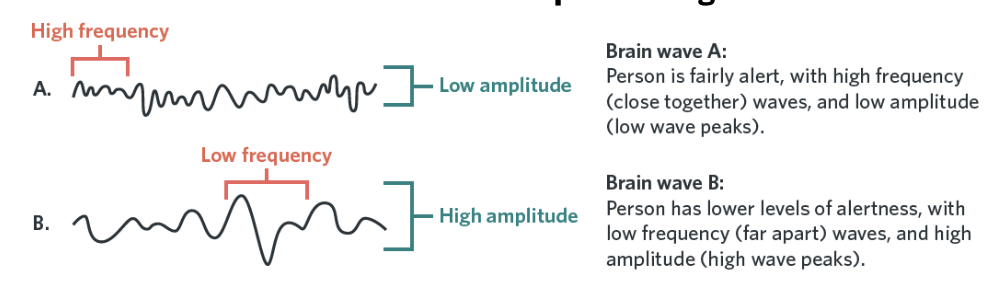
Electromyograph (EMG)
A device that detects, amplifies and records the electrical activity of muscles.
Higher level of muscular activity - more alert
Electro-occulargraph (EOG)
A device that detects, amplifies, and records the electrical activity of the muscles that move the eyes.
Electrodes- attached to areas around the eyes.
Used for REM/NREM measure.
DARE acronym- used for physiological sleep measures
Detects
Amplifies
Records
Electrical activity
Sleep diaries
A record containing self-reported descriptions from an individual about their sleeping periods
recorded over a period of time
includes:
duration of sleep
quality of sleep
number of sleep disruptions, etc
Video monitoring
The use of camera and audio technologies to record an individual as they sleep
Usually paired with physiological measures
gives validity to a phenomenon
Circadian rhythm
Biological and behavioural changes that occur as part of a cycle that lasts around 24 hours.
e.g. sleep wake cycle
Ultradian Rhythm
Biological and behavioural changes that occur in a cycle that lasts less than 24 hours.
e.g. REM and NREM sleep cycles
The Suprachiasmatic Nucleus (SCN)
An area of the hypothalamus that is responsible for regulating an individual’s sleep-wake patterns.
Where does the SCN receive information from?
External cues: info from environment
e.g presence or absence of light
Internal cues: info that originates within the body
e.g. expression or suppression of clock genes
SCN’s role in melatonin release
SCN receives external cues (lights off) and internal cues (clock genes).
SCN sends neural messages to the pineal gland
Pineal gland produces and releases melatonin into bloodstream
Promotes feelings of calm and relaxation- therefore promotes sleep.
Melatonin
A hormone released by the pineal gland typically at night-time to induce sleep as part of the sleep-wake cycle.
Cortisol’s Role in the Sleep Wake-Cycle
A hormone released by the adrenal glands in the morning to increase alertness, wakefulness and maintain heightened arousal, thereby regulating the sleep-wake cycle.
High levels in the morning and low levels at night
What is the sleep wake cycle regulated by?
biological mechanisms:
Circadian rhythms
ultradian rhythms
the SCN
melatonin
Sleep Wake Cycle
A type of circadian rhythm – 24-hour-cycle made up of time spent sleeping and time being awake and alert.
neonatal period characteristics of sleep (1-15 days)
Sleep duration ~ 16 hrs.
Sleep episode ~50% REM, ~50% NREM.
brief awakenings during the sleep episode
infancy period characteristics of sleep (3-24 months)
Sleep duration: ~13.5 hrs.
Sleep episode: ~35% REM, ~65% NREM.
Compared to adults
brief awakenings
< amount of sleep cycles
Shorter sleep cycles
Childhood characteristics of sleep (2-14 years)
Sleep duration: ~11 hrs.
Sleep episode: ~20% REM, ~80% NREM.
Adolescence characteristics of sleep (14-18 years)
Sleep duration: ~9 hrs.
Sleep episode: 20% REM, 80% NREM.
- DSPD: biological delayed sleep onset:
melatonin released 1–2 hrs later
Adulthood characteristics of sleep (18-75 years)
Sleep duration: ~7-8 hrs.
Sleep episode: 20% REM, 80% NREM.
Compared to infants
more likely to experience one full sleep episode- less wakeups
less sleep cycles
longer sleep cycles
Old age characteristics of sleep (75+ years)
Sleep duration: ~6 hrs.
Sleep episode: 20% REM, 80% NREM.
ASPD: biological shift forward in sleep-wake cycle.
Wake up more frequently throughout the night.
NREM3 sleep→ decreases, replaced mostly by NREM2 sleep.
Explanations for Notable Differences in Sleep Across the Lifespan
Sleep requirements change because physical and cognitive needs change over time.
REM = important for brain and cognitive development and rest.
NREM = important for physiological rest and development.
Neonatal period and infancy- explanation for sleep characteristics
No established circadian rhythm – sleep distributed across the full 24 hour day.
Significant time spent in REM sleep due to rapid brain development.
Infancy
Growth, development, rapid physiological changes- begin to have a fairly consistent circadian rhythm.
Childhood- explanation for sleep characteristics
Time spent in REM sleep starts to reduce as the pace of brain development steadies.
Adolescence- explanation for sleep characteristics
Social factors decrease proportion of sleep – waking up early for school, social commitments during the nighttime.
Adulthood and old age- explanation for sleep characteristics
Lower levels of sleep due to:
- Ill health and increase prevalence of sleep disorders.
- Reduced amount of cognitive and physical growth.
Partial sleep deprivation
inadequate sleep based on an individual’s needs (quantity/quality)
Total sleep deprivation
when an individual has no sleep within a 24-hour period
Effects of partial sleep deprivation
Affective effects
Behavioural effects
Cognitive effects
Affective effects of sleep deprivation
Amplified emotional responses
Increased irritability
Depressed mood
Heightened anxiety
Decreased motivation
Behavioural effects of sleep deprivation
Observable actions
reduced motor control
reduced spatial awareness
slower reaction times
microsleeps
Cognitive effects of sleep deprivation
internal mental process
decreased ability to concentrate and direct attention
poorer performance on tasks involving problem solving or logical reasoning
Increased forgetfulness
Partial Sleep deprivation compared to BAC
The effects of a BAC level of 0.05 are roughly equivalent to 17 hours of sleep deprivation.
Total Sleep deprivation compared to BAC
The effects of a BAC level of 0.10 are roughly equivalent to 24 hours of sleep deprivation
Affective effects of sleep deprivation compared to blood alcohol concentration
Can both impact a person’s affective functioning
Sleep deprivation: negative effects
Alcohol: range of effects
happy
excited
angry
sad
Cognitive effects of sleep deprivation compared to blood alcohol concentration
Both have cognitive impairments that include:
reduced speed in processing and understanding information
decreased ability to reason and problem solve
greater difficulty making sense of the world
Circadian Rhythm Sleep Disorders definition
Sleep disorders that interfere with the typical regulation of the circadian rhythm of sleep
leads to a change in the sleep-wake cycle.
Circadian Rhythm Sleep Disorders features
SCN may receive external and internal cues at abnormal times.
Misalignment b/w circadian rhythm and sleep-wake cycle
Disruption to typical sleep-wake cycle:
biological issues e.g. shift later for adolescents
lifestyle changes e.g. shift work.
Bright light therapy
A treatment for sleep-related problems used to adjust a person’s misaligned circadian rhythm through exposure to a high-intensity light source.
Bright Light Therapy and the SCN
Exposure to bright light source.
SCN receives this as an external cue.
Triggers pineal gland to inhibit the release of melatonin→ promoting wakefulness (for DSPS- release melatonin earlier at night)
Readjusts the circadian rhythm so that the individual is sleeping and waking at desired time.
Factors Essential to Successful Bright Light Therapy
Appropriate timing of exposure sessions: when a person is feeling tired
The right amount of light: min. 15 minutes + min of 2 weeks
Safe exposure: a person should not look directly at the light
Delayed Sleep Phase Syndrome (DSPS)
A type of circadian rhythm sleep disorder in which sleep and waking occur later than typical.
occurs during adolescence
involves delayed melatonin secretion.
Causes of Delayed Sleep Phase Syndrome (DSPS)
A misalignment between internal and external cues that regulate a circadian rhythm
external cues are received at appropriate time
internal cues are not
(melatonin release later than usual).
Bright Light Therapy for DSPS
Morning at appropriate waking time
external cue to SCN→ promotes wakefulness by sending signals to pineal gland to inhibit melatonin release
promotes melatonin release earlier in the night → reset circadian rhythm, promoting sleep.
Advanced Sleep Phase Disorder (ASPD)
type of circadian rhythm sleep disorder in which sleep and waking occur earlier than typical, due to a misalignment of internal and external cues
Advanced Sleep Phase Disorder (ASPD) causes
Problems with internal cues resulting in a misalignment between external and internal cues that regulate the circadian rhythm
- Melatonin secretion occurs earlier = sleep and wake earlier.
Bright Light Therapy for ASPD
Evening when feeling sleepy
external cue to SCN→ promotes wakefulness.
Helps SCN send signals for later melatonin release→ delayed onset of sleep
Shift Work
An occupation that involves working at unusual hours, including overnight.
Cause of circadian rhythm sleep disorders rather than being a sleep disorder itself.
Shift Work causes
External cues→ individual is required to be awake when dark and sleep when it's light→ unusual sleep times.
Why does shift work result in poor sleep
Work hours out of sync with internal cues
Sleeping during daylight reduces melatonin→ poor sleep quality and daytime fatigue.
Working at night→ increases zeitgebers which make it more difficult to stay awake
Impacts of shift work on sleep
Poor sleep quantity and quality→ sleep debt
Insomnia
Fragmented sleep
Bright Light Therapy for shift work
Before beginning of shift
promote wakefulness when they need to be awake and alert.
Promote sleepiness at a later, more suitable time
Sleep Hygiene
The practices and habits that promote an individual’s sleep patterns
Makes it easier to fall asleep at appropriate times
Improves sleep quality and quantity.
What to avoid to promote sleep hygiene?
Activities other than sleeping in bed (studying or watching TV)→ weakens association of bed and sleep.
Exercise close to sleep time
Actions to promote sleep hygiene
Sleeping and waking at a consistent time each day
Sleeping in a quiet place.
Sleeping in a comfortable space.
Mental wellbeing
an individual’s psychological state, involving their ability to think, process information, and regulate emotions
How can sleep hygiene improve mental wellbeing
Adequate quality and quantity of sleep- important for good mental wellbeing→ link b/w poor sleep and mental illness
sleep hygiene enables an adequate quality and quantity of sleep→ therefore improves mental wellbeing
Zeitgebers
External cues from the environment that influence the circadian rhythm
light
temperature
eating and drinking patterns
exercise.
Used by SCN to adjust circadian rhythms.
Blue light as a Zeitgeber
A type of light that can be emitted both
naturally: daylight
artificially: technology
Daylight as a Zeitgeber
The typical light an individual is exposed to during the day, and is mostly natural blue light.
How does light regulate the sleep wake cycle?
By signalling to SCN to cease melatonin production and promote wakefulness
Exposure to light at night→ reduces sleepiness
Temperature as a Zeitgeber
The degree of external heat in the environment that can influence the quality and quantity of sleep.
link between having a cool room temperature and improved quantity and quality of sleep
Timing of meals as a zeitgeber
Eating too close to sleep time→ harder to fall asleep
due to stimulation of the digestive system→ reduced quality and quantity of sleep
meals should be consumed a couple hours before sleep
Volume of meals as a zeitgeber
Going to sleep hungry = poorer sleep quality and quantity.
Large meals close to sleep = impair sleep patterns.
Effect of caffeine on sleep
A stimulant that increases the activity of the NS, promoting wakefulness.
Blocks sleep-promoting neurotransmitters.
Effect of Alcohol on sleep
a depressant that increases feelings of tiredness making it easier to fall asleep
negatively impacts quality of sleep.
Effect of spicy foods on sleep
increase body temp, impairing sleep as cooler body temps promote sleep.
can stimulate metabolic processes→ more difficult to fall asleep.
Effect of high sugar high-fat foods on sleep
negatively impact quality and quantity of sleep.
What is the relationship b/w sleep and mental wellbeing?
Bidirectional relationship→ influence each other
Poor sleep→ can negatively affect wellbeing→ irritability, low mood, difficulty managing emotions.
Poor wellbeing→can negatively affect sleep→stress or anxiety making it difficult to fall asleep or stay asleep + impact of cortisol