Exam 3 - Development Anatomy Lab
 Call Kai
 Learn
Learn Practice Test
 Spaced Repetition
 Match
Match Flashcards
 Knowt Play
1/29

There's no tags or description
Looks like no tags are added yet.
Name | Mastery | Learn | Test | Matching | Spaced | Call with Kai | Chat |
|---|
No analytics yet
Send a link to your students to track their progress
30 Terms
Main stages of development
Fertilization → Cleavage → Blastulation → Gastrulation → Neurulation → Organogenesis.
Primitive streak vs. dorsal lip
Chicks and pigs form a primitive streak; frogs form the dorsal lip of the blastopore. Both start gastrulation.
Chick yolk & cleavage
dense yolk concentrated at one end with partial division.
Telolecithal yolk; meroblastic (partial) cleavage.
Frog yolk & cleavage
moderate amount of yolk that unevenly distributed (heavy on vegetal pole), the entire egg completely develops but the yolk slows down the furrow
Mesolecithal yolk; holoblastic (complete) cleavage.
Pig yolk & cleavage
very little yolk and complete whole cleavage
Microlecithal yolk; holoblastic cleavage.
Blastodisc
A disc of cells on top of the yolk where the chick embryo develops.
Research models
Chicks, frogs, and pigs are all good models because they develop quickly and are similar to humans in key ways.
Neurulation structures
Neural plate, notochord, and neural folds.
Notochord
Signals neural plate formation and helps form the body axis.
Neural plate
Becomes the brain and spinal cord.
Neural folds
Fold together to form the neural tube.
Gastrulation
Forms the three germ layers: ectoderm, mesoderm, and endoderm.
Purpose of gastrulation
Prepares the embryo for organ development.
Development types
Chick = external/direct; Frog = external/indirect; Pig = internal/direct.
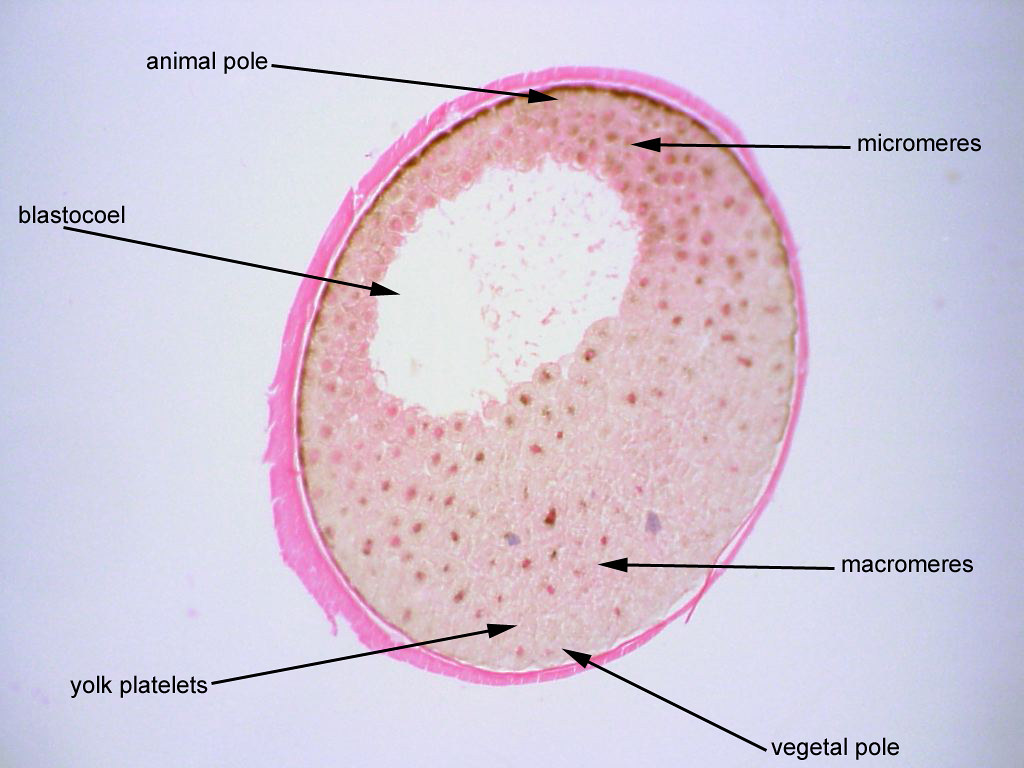
Animal pole
Upper part of the egg; less yolk; cells divide faster.
Vegetal pole
Lower part of the egg; more yolk; cells divide slower.
Frog blastula
Know the blastocoel, animal pole, and vegetal pole.
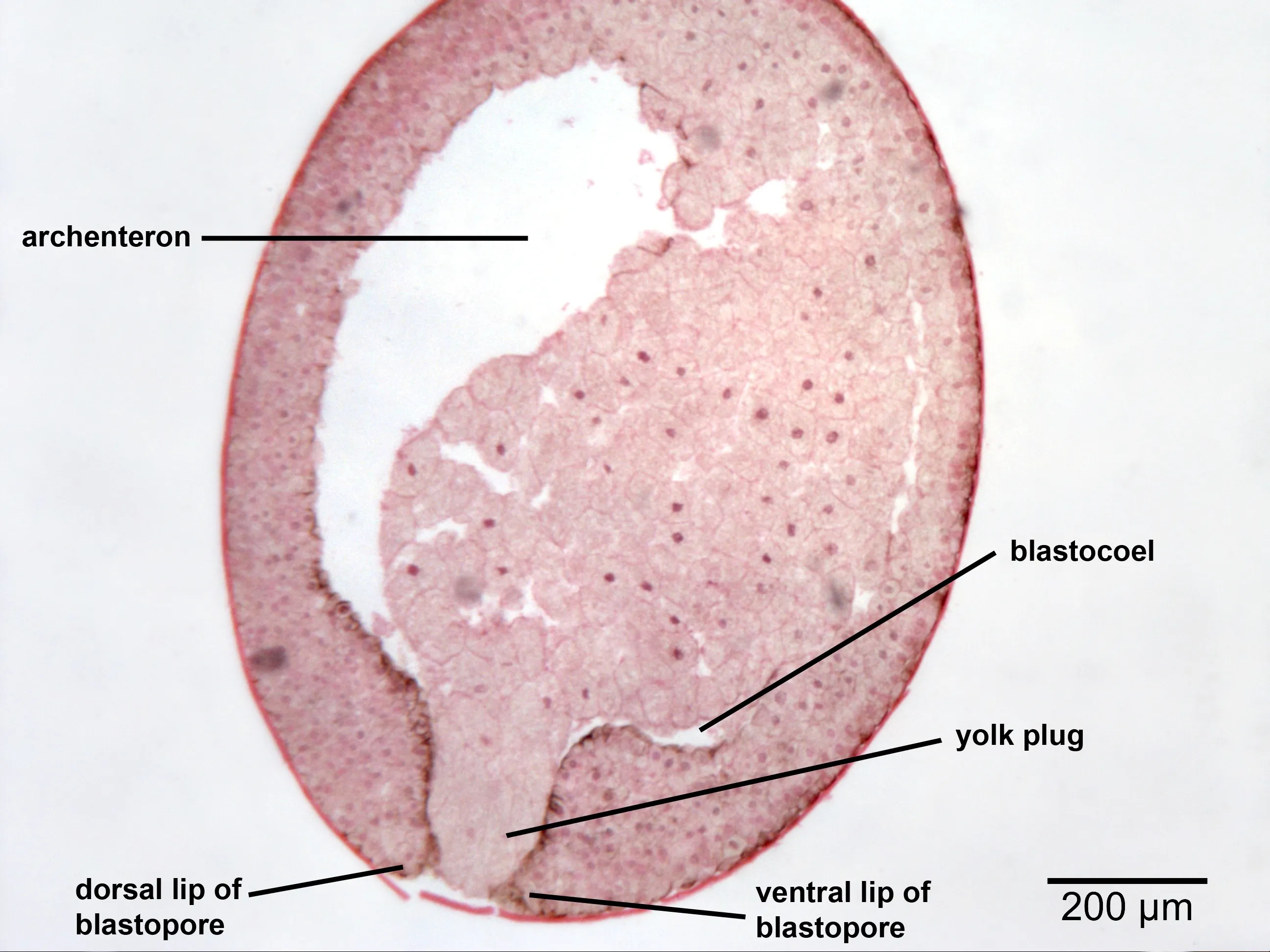
Frog gastrula
Know the blastopore, archenteron, and yolk plug.
Organogenesis
Formation of organs from the three germ layers.
Stage before organogenesis
Gastrulation.
Coelom
forms main body cavity.
Frog notochord
Forms the body axis and helps develop the nervous system.
Germ layer for nervous system
Ectoderm.
Neural tube
Develops into the brain and spinal cord.
Chick advantages
Easy to observe, develops outside the mother, similar early development to mammals.
Frog advantages
Many eggs, develops externally, easy to manipulate.
Pig advantages
Very similar to humans in genes, organs, and physiology.
Pig disadvantages
Expensive, need special housing, reproduce slowly.
Why pigs are good for transplants
Organs are similar in size and function to human organs.
Prevent pig organ rejection
Genetically modify pigs to reduce immune rejection.