Synaptic Changes and Learning Mechanisms - 1.3
 Call Kai
 Learn
Learn Practice Test
 Spaced Repetition
 Match
Match Flashcards
 Knowt Play
1/21

There's no tags or description
Looks like no tags are added yet.
Name | Mastery | Learn | Test | Matching | Spaced | Call with Kai | Chat |
|---|
No analytics yet
Send a link to your students to track their progress
22 Terms
What is Hebb's key finding regarding learning?
Associative/Hebbian learning: repeated learning causes long-term synaptic changes, such as strengthened synapses.
What is Long-Term Potentiation (LTP)?
A long-lasting strengthening of connections between neurons after high-frequency stimulation.
Who investigated the nervous system of sea slugs to study memory?
Eric Kandel.
What reflex did Eric Kandel study in Aplysia?
The gill withdrawal reflex, which is defensive and modifiable by experience.
What is neuroscience?
The study of the nervous system. Includes the brain, the spinal cord, and networks of nerve cells.
How does the behavior of Aplysia compare to humans in terms of memory?
Aplysia has a simple nervous system with a few hundred neurons, while humans have a more complex brain with more neurons and interactions.
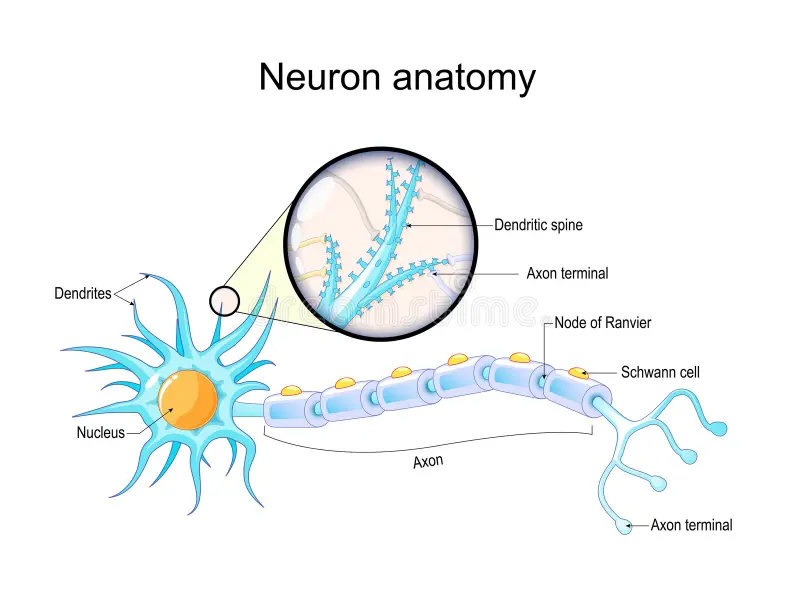
What role do dendritic spines play in memory?
They have receptors for neurotransmitters and help strengthen neural connections needed for long-term memory.
What is the Neuron Doctrine?
The concept that the brain is made of discrete cells that communicate via synapses.
What is synapse plasticity?
The hypothesis that a synapse can be modified by experience.
What is habituation in the context of memory?
A decrease in activity given repeated exposure to a stimulus.
What is sensitization in memory processes?
An increased activity given repeated exposure to a stimulus.
What is classical conditioning in relation to neurons?
A neuron responds to a conditioned stimulus, not just to the unconditioned stimulus.
What did Donald Olding Hebb hypothesize about memory?
Memories are represented in groups of cells and patterns of activity.
Who established that single genes can affect behavior?
Seymour Benzer
Mouse Knockout Experiement
Allowed researchers to eliminate specific genes in mice, and test the effects on learning and memory.
What did rodent studies using the Morris Water Maze demonstrate?
They showed that LTP can be blocked, yet some learning still occurs, indicating complex mechanisms of memory.
What are the key components involved in memory according to the take-home messages?
Memory involves molecular cascades (neurotransmitters, receptors, ion channels) and post-synaptic changes.
What is the role of the axon terminal in synaptic transmission?
It is where the action potential arrives and triggers the release of neurotransmitters.
What happened in the Morris Water Maze?
Measured data on spatial learning and memory in animals like rats or mice. Blocked long-term potential, but learning still occurred.
What is the function of the myelin sheath?
It insulates the axon and speeds up the transmission of electrical signals.
What is PSP?
Stands for post-synaptic potential; the likelihood that the post-synaptic neuron will fire.
What is the relationship between synaptic strength and memory?
Changes in synaptic strength between groups of neurons can represent information and experiences.