Prions and other Nonviral infectious particles
 Call Kai
 Learn
Learn Practice Test
 Spaced Repetition
 Match
Match Flashcards
 Knowt Play
1/21

There's no tags or description
Looks like no tags are added yet.
Name | Mastery | Learn | Test | Matching | Spaced | Call with Kai | Chat |
|---|
No analytics yet
Send a link to your students to track their progress
22 Terms
Prions
Infectious proteins whose extracellular form contains only protein, no nucleic acid
Known to cause disease in animals → class of infectious diseases called transmissible spongiform encephalopathies
(TSEs)
• No plant prion diseases discovered yetNoncellular infectious agents
• NOT VIRUSES! → May be own unique category
The exact mode of infection for prions is ___________.
still being investigated
Until their discovery it was considered impossible that an agent lacking genetic material could be infectious or transmissible
Inherited and transmissible by ingestion, transplant, and surgical instruments
Prion infection cycle
The host contains a gene, Prnp (Prion protein), is primarily found in neurons (especially the brain)
Native form of the prion PrPC (prion protein Cellular)
Pathogenic form of the prion protein is PrPSc (prion protein Scrapie)
• Identical amino acid sequence to native form, but has a different conformation
• The pathogenic prion “replicates” by converting preexisting native prions into the pathogenic form.
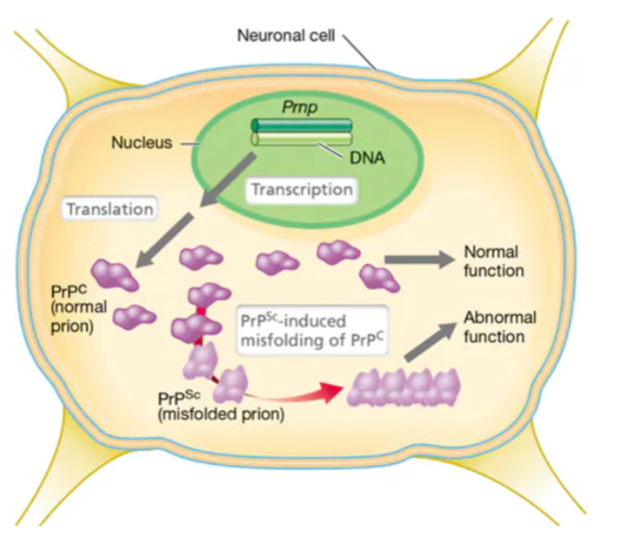
Prion Infection Cycle (cont.)
As the pathogenic prions accumulate and aggregate, they form insoluble crystalline fibers referred to as amyloid plaques in neural
cellsPlaques are used for postmortem diagnosis, but they don’t appear to be the direct cause of cell damage
Besides the transmissible spongiform encephalopathies, amyloids are also associated with __________.
debilitating human diseases such as
Alzheimer’s, Huntington’s, Parkinson’s, and type 2 diabetes.
The possibility remains that these diseases are manifestations of prion infection, but no direct link has currently been made.
Human Prion Diseases
1. Creutzfeldt-Jakob Disease (CJD)
2. Variant Creutzfeldt-Jakob Disease (vCJD)
3. Gerstmann-Straussler-Scheinker Syndrome
4. Fatal Familial Insomnia
5. Kuru
Animal Prion Diseases
1. Bovine Spongiform Encephalopathy (BSE)
2. Chronic Wasting Disease (CWD)
3. Scrapie
4. Transmissible mink encephalopathy
5. Feline spongiform encephalopathy
6. Exotic ungulate spongiform encephalopathy
Creutzfeldt-Jakob Disease (CJD) - Classical
Neurodegenerative disorder → rapidly
progressive → 100% mortality rate
• not related to “mad cow” diseaseIn most patients (85%) CJD occurs sporadically
• Minority of patients develop CJD due to
inherited mutations of the prion protein gene
• Inherited forms include: Gerstmann-
Straussler-Scheinker syndrome and fatal
familial insomnia
Kuru
Epidemic occurrence in the 1950s-60s
among the Fore people of Papa New
GuineaResult of ritualistic cannibalism
Government discouragement of the
practice of cannibalism led to a continuing decline in the disease, which has now mostly disappeared.
Bovine Spongiform Encephalopathy (BSE)
Neurodegenerative disorder → rapidly progressive → 100% mortality rate
Organism: Cattle
• First infections occurred in the 1970s (identified in 1986)
• Cases in UK have dropped sharply (>14K in 1995 to 2 in 2015)Possibly originated as a result of feeding cattle meat-and-bone meal that contained BSE-infected products from a spontaneously occurring case of BSE or scrapie-infected sheep products
Laws in developed countries now ban the use of rendered ruminant proteins in ruminant feed as a precaution against the spread of prion infection in cattle and other ruminants.
Creutzfeldt-Jakob Disease (vCJD) - Variant
First described in 1996 in the United Kingdom
Strong evidence that agent responsible for vCJD in humans is the same agent responsible for BSE in cows
Different clinical and pathologic characteristics from classic CJD
Each disease has unique genetic profile of the prion protein gene
Chronic Wasting Disease (CWD)
Affects deer, elk, reindeer, sika deer and
moose
• No reported cases in humans,
though it may pose a risk to
certain non-human primates
• Spread by saliva, blood, urine, feces.
Possibly soil, water and food
• Found in Canada, United States,
Norway, Finland, Sweden, and South
KoreaFatal to animals and there are no
treatments or vaccines
• does not appear to naturally infect
cattle or other domesticated animals.
Satellites: Viruses & Nucleic Acids
subviral particles
No common phylogeny → Grouped on common characteristics
• Dependent on other viruses for replication
Satellite Virus vs Satellite Nucleic Acid
Satellite virus → Encode their own capsid protein
Satellite Nucleic Acid → No capsid protein
Hepatitis D
Requires viral particles from hepatitis B virus (HBV) to replicate
Worsens the severity of liver damage
Found globally → predominantly in Africa, Middle East, and southern Italy
Has the highest fatality rate of all the hepatitis infections, at 20%
Hepatitis is a liver inflammation, commonly caused by an infectious agent. Hepatitis sometimes results in _________.
acute illness followed by destruction of functional liver anatomy and cells, a condition known as cirrhosis.
Hepatitis due to infection can cause chronic or acute disease, and some forms lead to liver cancer.
The vaccine for hepatitis B protects against hepatitis D virus because of the ____________.
latter's dependence on the presence of hepatitis B virus for it to replicate.
Viroids
Virus-like agents that parasitize plants
• Enters through a plant wound
• About one-tenth the size of an average virusComposed of naked strands of RNA, lacking a
capsid or any other type of coatingSignificant pathogens in economically important plants: tomatoes, potatoes, cucumbers, citrus trees, chrysanthemums
Which of the following is a human prion disease?
Creutzfeldt-Jakob Disease
Variant Creutzfeldt-Jakob Disease (vCJD) is linked to:
Bovine Spongiform Encephalopathy (BSE)
The satellite virus hepatitis D relies on which virus for replication?
Hepatitis B
Viroids are infectious agents that:
Parasitize plants