7 - Expressions of Concentration
 Call Kai
 Learn
Learn Practice Test
 Spaced Repetition
 Match
Match Flashcards
 Knowt Play
1/56

There's no tags or description
Looks like no tags are added yet.
Name | Mastery | Learn | Test | Matching | Spaced | Call with Kai | Chat |
|---|
No analytics yet
Send a link to your students to track their progress
57 Terms
a. Concentration
An expression of the ratio of the amount of an ingredient (solute) to the amount of product (solution)
a. Concentration
b. Dilution
c. Strength
d. Potency
Amount strength (1g/100g)
Ratio strength (1:100)
Percentage strength (1%)
Parts per million (10,000 ppm )
[Concentration Terms]
Concentration can be expressed in many ways such as _____ [3]
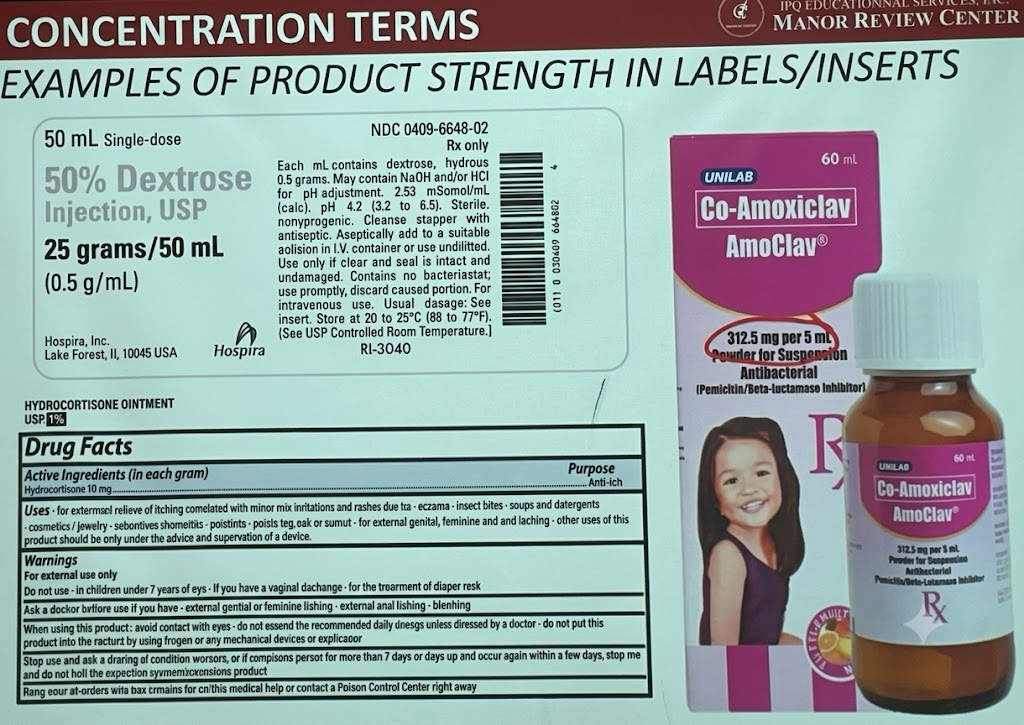
[Concentration Terms]
Example of Product Strength in Labels / Inserts:
c. Parts per hundred
Percentage (%) is defined as
a. Parts per thousand
b. Parts per million
c. Parts per hundred
d. Parts per billion
d. Solids or semisolid dosage forms:
Ointment
Creams
Gels
[Percentage]
% w/w concentration is used for these dosage forms
a. Solutions (liquid in liquid): aromatic waters, spirits, emulsions
b. Biologic concentrations: BUN, Crea, blood sugar, lipid profile
c. Solutions (solid in liquid): suspensions, lotions, LVP
d. Solids or semisolid dosage forms: ointment, creams, gels
d. Solutions (liquid in liquid)
Aromatic waters
Spirits
Emulsions
[Percentage]
% v/v concentration is used for these dosage forms
a. Solids or semisolids: ointment, creams, gels
b. Biologic concentrations: BUN, Crea, blood sugar
c. Solutions (solid in liquid): suspensions, lotions, LVP
d. Solutions (liquid in liquid): aromatic waters, spirits, emulsions
c. Solutions (solid in liquid):
Suspensions
Lotions
LVP [eg. NSS (0.9%), D5W]
[Percentage]
% w/v concentration is used for these dosage forms; examples include
a. Solids or semisolids: ointment, creams, gels
b. Solutions (liquid in liquid): aromatic waters, spirits, emulsions
c. Solutions (solid in liquid): suspensions, lotions, LVP; eg. NSS (0.9%), D5W
d. Biologic concentrations: BUN, Crea, blood sugar, lipid profile
BUN
Creatinine
Blood sugar
Lipid profile
[Percentage]
mg% concentration is used for these biologic concentrations in serum chemistry
a. Suspensions, lotions, LVP
b. Aromatic waters, spirits, emulsions
c. BUN, Crea, blood sugar, lipid profile
d. Ointment, creams, gels
c. 66.7% w/v syrup
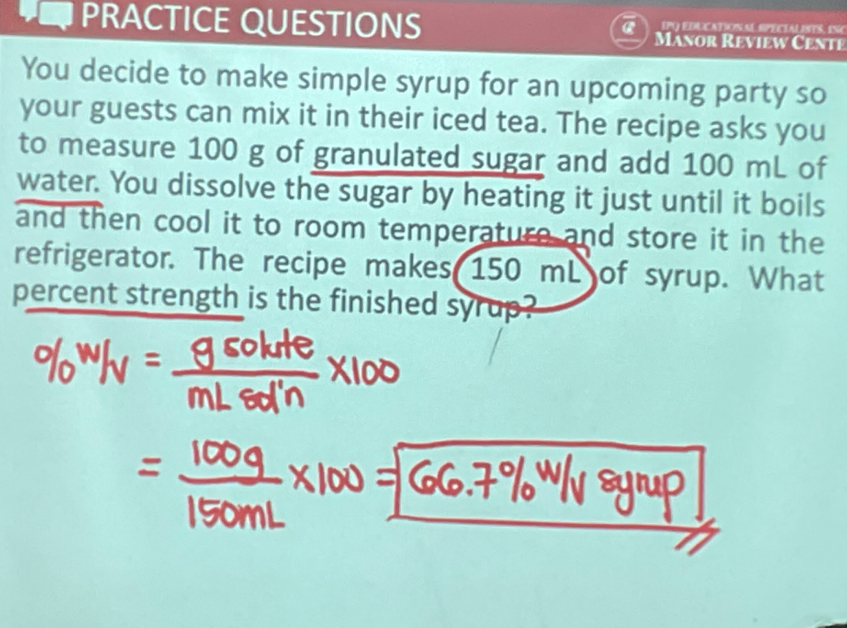
[Percentage]
PRACTICE PROBLEM:
You decide to make simple syrup for an upcoming party so your guests can mix it in their iced tea. The recipe asks you to measure 100 g of granulated sugar and add 100 mL of water. You dissolve the sugar by heating it just until it boils and then cool it to room temperature and store it in the refrigerator. The recipe makes 150 mL of syrup. What percent strength is the finished syrup?
a. 50.0% w/v syrup
b. 60.0% w/v syrup
c. 66.7% w/v syrup
d. 75.0% w/v syrup
c. Percentage
__________ is used in determining the quantity of a component to use (active) when the percentage strength is given
a. Alligation
b. Dilution
c. Percentage
d. Ratio and proportion
c. g or mL
[Percentage]
Unit of measurement for amount of active component in grams or milliliters expressed as:
a. g or L
b. mg or mL
c. g or mL
d. kg or mL
d. Expressed decimally
[Percentage]
How percentage strength must be expressed when using the formula Total Quantity x % str = Amount of Active.
a. As a fraction
b. As a whole number
c. As a ratio
d. Expressed decimally
d. 0.15 g HC
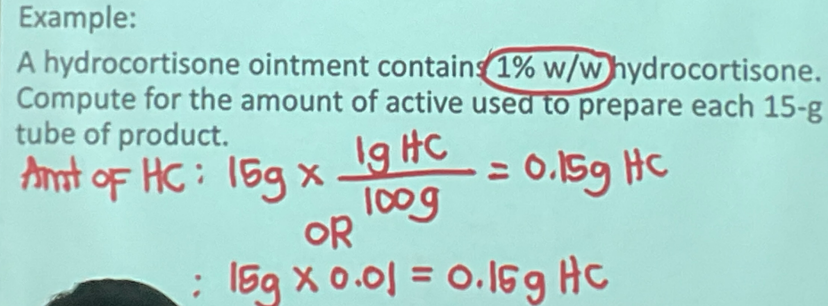
[Percentage]
PRACTICE PROBLEM:
A hydrocortisone ointment contains 1% w/w hydrocortisone. Compute for the amount of active used to prepare each 15-g tube of product.
a. 0.05 g HC
b. 0.10 g HC
c. 0.12 g HC
d. 0.15 g HC
b. 0.0625% w/w triamcinolone
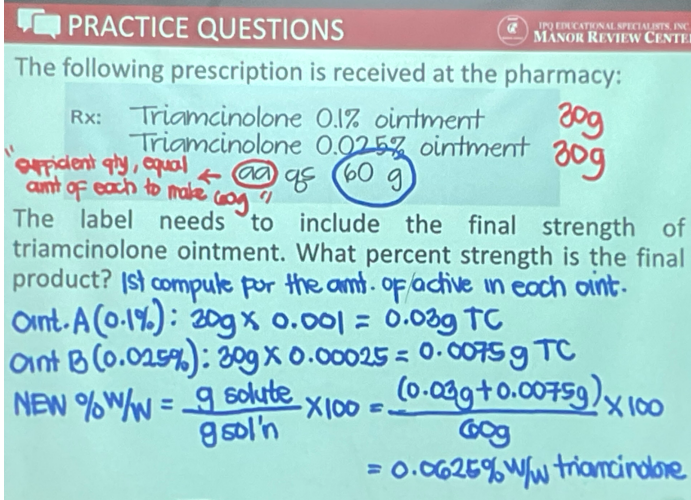
[Percentage]
PRACTICE PROBLEM:
The following prescription is received at the pharmacy:
Rx: Triamcinolone 0.1% ointment
Triamcinolone 0.025% ointment
aa qs 60 g
The label needs to include the final strength of triamcinolone ointment. What percent strength is the final product?
a. 0.0500% w/w triamcinolone
b. 0.0625% w/w triamcinolone
c. 0.0750% w/w triamcinolone
d. 0.0875% w/w triamcinolone
c. Ratio strength (RS)
________ is an alternative way to express percent strength for weak (dilute) solutions
a. Percent strength (PS)
b. Molarity
c. Ratio strength (RS)
d. Molality
a. 1
The preferable style of ratio strength is to have the numeric value of solute as
a. 1
b. 0
c. 10
d. 100
c. 0.2% w/v KMnO4
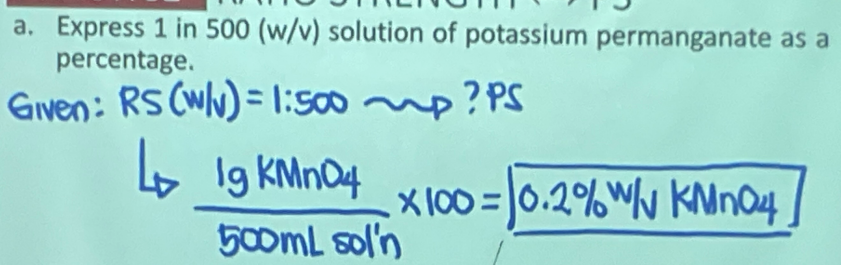
[Ratio Strength and Percentage Strength]
Express 1 in 500 (w/v) solution of potassium permanganate as a percentage.
a. 0.1% w/v KMnO4
b. 0.15% w/v KMnO4
c. 0.2% w/v KMnO4
d. 0.25% w/v KMnO4
b. 1:20
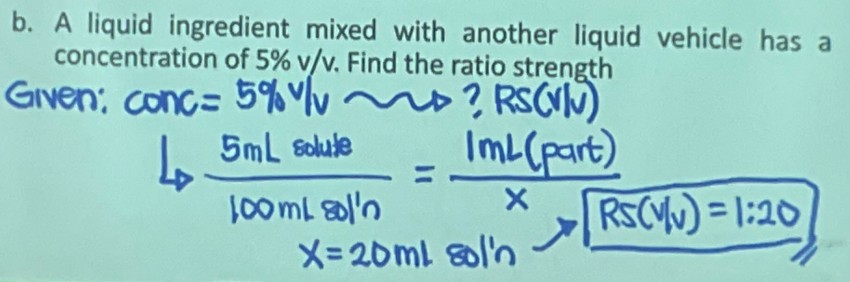
[Ratio Strength and Percentage Strength]
A liquid ingredient mixed with another liquid vehicle has a concentration of 5% v/v. Find the ratio strength.
a. 1:10
b. 1:20
c. 1:30
d. 1:40
a. Parts per million (ppm)
_________ is used for dilute solutions and environmental contaminants
a. Parts per million (ppm)
b. Parts per billion (ppb)
c. Ratio strength (RS)
d. Percentage strength (PS)
Fluoridation of water
Heavy metal in soil
Particulate matter in the air (air quality)
[Parts per million]
Examples of applications for parts per million
a. Fluoridation of water, heavy metal in soil, particulate matter in the air (air quality)
b. Fluoridation of water only
c. Heavy metal in soil only
d. Particulate matter in the air only
a. ppm = mg/L or mg/kg
[Parts per million]
The relationship of ppm to other concentration terms
a. ppm = mg/L or mg/kg
b. ppm = g/L or g/kg
c. ppm = mg/mL or mg/g
d. ppm = g/mL or g/g
a. PS = 0.0005% ; RS = 1:200,000
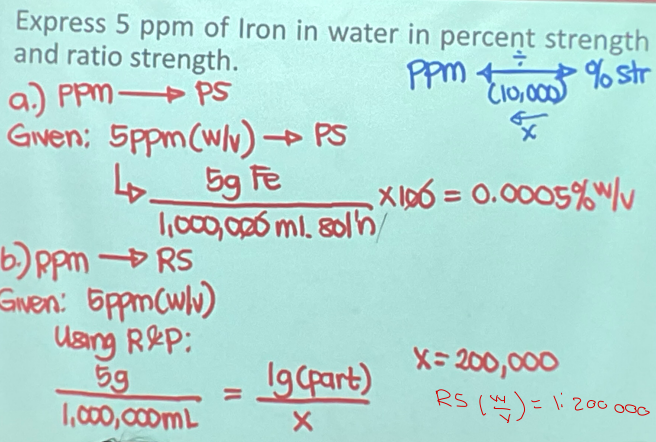
[Parts per million]
PRACTICE PROBLEM:
Express 5 ppm of Iron in water in percent strength and ratio strength
a. PS = 0.0005% ; RS = 1:200,000
b. PS = 0.001% ; RS = 1:100,000
c. PS = 0.0005% ; RS = 1:100,000
d. PS = 0.001% ; RS = 1:200,000
a. Milliequivalents (mEq)
_________ are used to express the concentration of electrolytes in solution
a. Milliequivalents (mEq)
b. Millimoles (mmol)
c. Milliosmoles (mOsm)
d. Milligrams (mg)
a. Equivalence factor
Reactivity factor (f) is also known as
a. Equivalence factor
b. Conversion factor
c. Neutralization factor
d. Ionization factor
a. Replaceable hydrogens (H⁺)
For acids, the reactivity factor (f) is the number of
a. Replaceable hydrogens (H⁺)
b. Replaceable hydroxides (OH⁻)
c. Total positive charges
d. Total negative charges
b. Replaceable hydroxides (OH⁻)
For bases, the reactivity factor (f) is the number of
a. Replaceable hydrogens (H⁺)
b. Replaceable hydroxides (OH⁻)
c. Total positive charges
d. Total negative charges
a. Total positive charges OR total negative charges
For salts, the reactivity factor (f) is the
a. Total positive charges OR total negative charges
b. Replaceable hydrogens (H⁺)
c. Replaceable hydroxides (OH⁻)
d. Total molecular weight
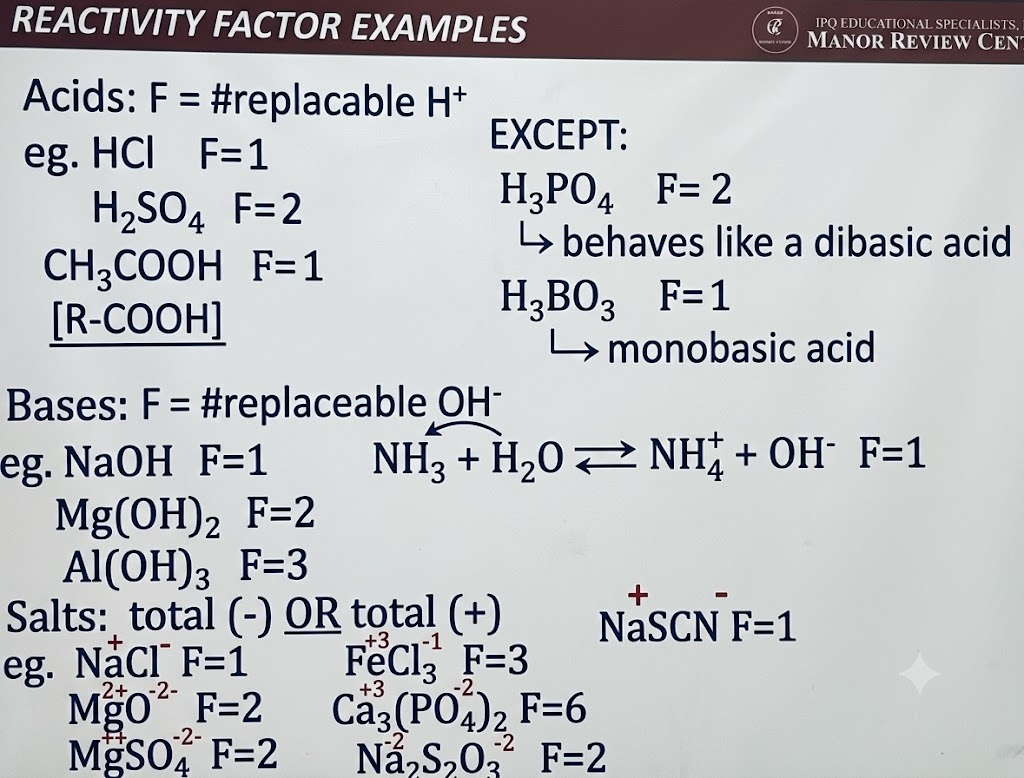
Reactivity Factor Examples:
c. 4.2 g NaHCO₃
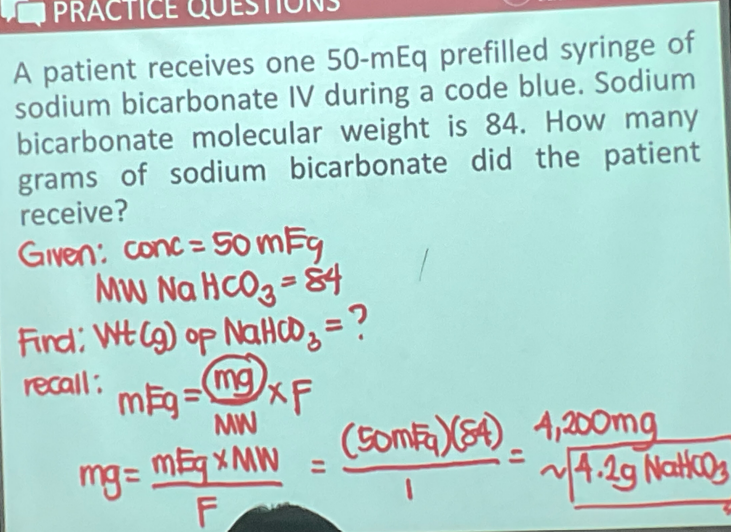
[Milliequivalents]
PRACTICE PROBLEM:
A patient receives one 50-mEq prefilled syringe of sodium bicarbonate IV during a code blue. Sodium bicarbonate molecular weight is 84. How many grams of sodium bicarbonate did the patient receive?
a. 3.5 g NaHCO₃
b. 4.0 g NaHCO₃
c. 4.2 g NaHCO₃
d. 5.0 g NaHCO₃
c. mOsm/L sol'n
[Osmolarity]
Unit of measurement for osmolarity.
a. mEq/L
b. mg/dL
c. mOsm/L sol'n
d. mmol/L
b. Osmolarity
[Osmolarity]
Total osmotic concentration of all solutes in a solution.
a. Molarity
b. Osmolarity
c. Molality
d. Normality
b. Number of species
[Osmolarity]
Van't Hoff factor (i) represents:
a. Number of moles
b. Number of species
c. Number of charges
d. Number of grams
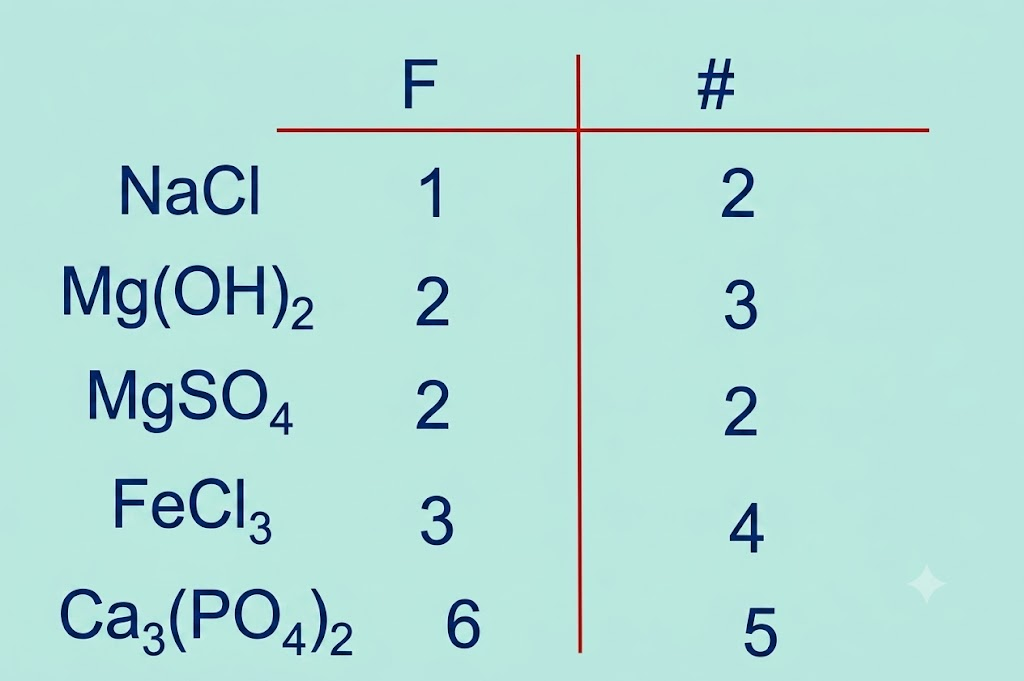
[Osmolarity]
Common Examples for Reactivity Factor (F) and Number of Species (#) :
d. Nonelectrolyte
[Osmolarity]
Type of solute that does not dissociate
a. Strong electrolyte
b. Weak electrolyte
c. Salt
d. Nonelectrolyte
a. 1.0
[Osmolarity]
For nonelectrolytes, the Van't Hoff factor (i) is
a. 1.0
b. 2.0
c. 3.0
d. 4.0
Glucose
Urea
Sucrose
[Osmolarity]
Examples of nonelectrolytes include
a. Glucose, urea, sucrose
b. NaCl, HCl, MgSO₄
c. Strong acids and strong bases
d. Salts
c. Strong electrolyte
[Osmolarity]
Type of solute that undergoes 100% or complete dissociation.
a. Nonelectrolyte
b. Weak electrolyte
c. Strong electrolyte
d. Organic compound
Strong acids
Strong bases
Salts (at low concentration)
[Osmolarity]
Examples of strong electrolytes include
a. Strong acids and strong bases, salts (at low concentration)
b. Organic compounds
c. Glucose, urea, sucrose
d. Nonelectrolytes
d. 2

[Osmolarity]
Number of ions produced when HCl dissociates completely.
a. 1
b. 3
c. 4
d. 2
c. Weak electrolyte
[Osmolarity]
Type of electrolyte with less than 100% dissociation (partial/incomplete).
a. Strong electrolyte
b. Nonelectrolyte
c. Weak electrolyte
d. Salt at low concentration
Weak acids
Weak bases
Salts at high concentration
Slightly soluble salts
[Osmolarity]
Examples of weak electrolytes.
a. Strong acids and strong bases
b. Glucose, urea, sucrose
c. Weak acids or weak bases, salts at high concentration, slightly soluble salts
d. NaCl, HCl, MgSO4
d. 80%
[Osmolarity]
Assumed percentage of dissociation for weak electrolytes.
a. 100%
b. 60%
c. 70%
d. 80%
c. Partially ionized
[Osmolarity]
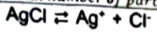
AgCl is an example of an electrolyte that is:
a. Fully ionized
b. Non-ionized
c. Partially ionized
d. Not ionized
d. 1.8
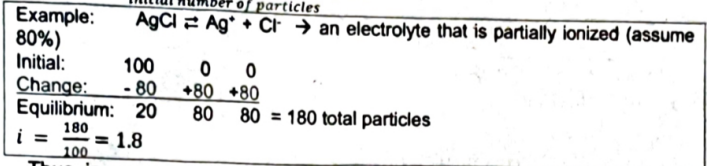
[Osmolarity]
Van't Hoff factor (i) of AgCl assuming 80% dissociation.
a. 1.0
b. 1.6
c. 2.0
d. 1.8
c. 1.0
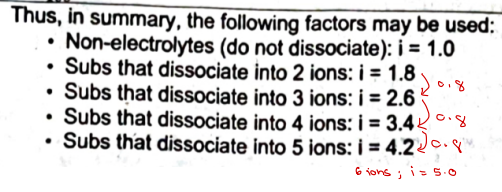
[Osmolarity]
Van't Hoff factor (i) of non-electrolytes that do not dissociate.
a. 1.8
b. 2.6
c. 1.0
d. 3.4
b. 1.8
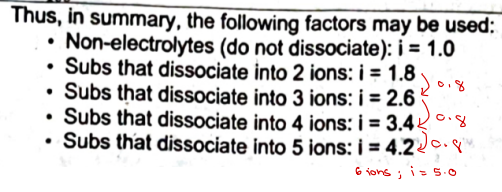
[Osmolarity]
Van't Hoff factor (i) of substances that dissociate into 2 ions.
a. 1.0
b. 1.8
c. 2.6
d. 3.4
c. 2.6
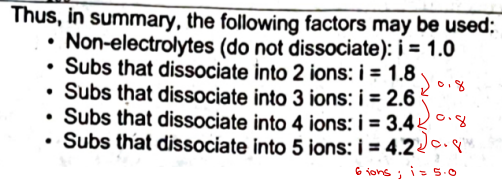
[Osmolarity]
Van't Hoff factor (i) of substances that dissociate into 3 ions.
a. 1.0
b. 1.8
c. 2.6
d. 3.4
c. 3.4
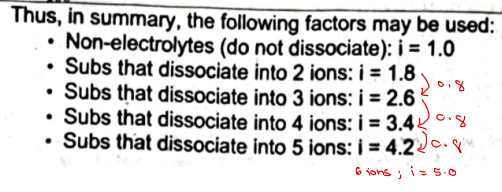
[Osmolarity]
Van't Hoff factor (i) of substances that dissociate into 4 ions.
a. 1.8
b. 2.6
c. 3.4
d. 4.2
c. 4.2
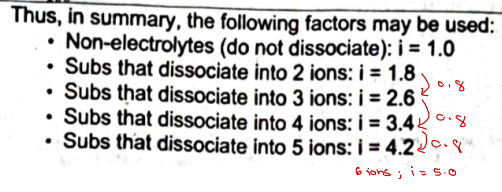
[Osmolarity]
Van't Hoff factor (i) of substances that dissociate into 5 ions.
a. 2.6
b. 3.4
c. 4.2
d. 5.0
c. 5.0
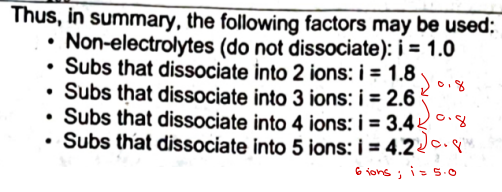
[Osmolarity]
Van't Hoff factor (i) of substances that dissociate into 6 ions.
a. 3.4
b. 4.2
c. 5.0
d. 6.0
c. Osmolality
Milliosmole of solute per kg solvent.
a. Osmolarity
b. Molarity
c. Osmolality
d. Molality
d. mOsm/kg
[Osmolality]
Unit of measurement for osmolality.
a. mOsm/L
b. mEq/L
c. mmol/L
d. mOsm/kg
b. Osmolality is independent of temperature
[Osmolality]
Reason osmolality is used in clinical practice instead of osmolarity.
a. Osmolality is dependent on temperature
b. Osmolality is independent of temperature
c. Osmolality is easier to calculate
d. Osmolality uses liters instead of kilograms
c. Osmolarity and osmolality are similar
[Osmolality]
Relationship between osmolarity and osmolality when solute concentrations are very low.
a. Osmolarity is higher than osmolality
b. Osmolarity and osmolality are dissimilar
c. Osmolarity and osmolality are similar
d. Osmolality is higher than osmolarity
b. Osmolarity and osmolality are dissimilar
[Osmolality]
Relationship between osmolarity and osmolality when solute concentrations are concentrated
a. Osmolarity is higher than osmolality
b. Osmolarity and osmolality are dissimilar
c. Osmolarity and osmolality are similar
d. Osmolality is higher than osmolarity
b. 275-300 mOsmol/kg
[Osmolality]
Normal serum osmolality range.
a. 250-275 mOsmol/kg
b. 275-300 mOsmol/kg
c. 300-325 mOsmol/kg
d. 325-350 mOsmol/kg
b. Abnormal blood osmolality
[Osmolality]
Condition that can occur in association with:
Shock
Trauma
Burns
Water intoxication (overload)
Electrolyte imbalance
Hyperglycemia
Renal failure
a. Normal serum osmolality
b. Abnormal blood osmolality
c. Normal blood pressure
d. Abnormal serum electrolytes