6.2-6.3 Mitosis and Meiosis
 Call Kai
 Learn
Learn Practice Test
 Spaced Repetition
 Match
Match Flashcards
 Knowt Play
1/38

There's no tags or description
Looks like no tags are added yet.
Name | Mastery | Learn | Test | Matching | Spaced | Call with Kai |
|---|
No analytics yet
Send a link to your students to track their progress
39 Terms
Fill in the blanks: mitosis is the process of ___ division by which ___ (number) ___ ___ (describes genetic material) ___ nuclei are produced from a ___ cell
nuclear, 2, genetically identical, daughter, parent
Why do all living organisms need to produce cells by mitosis?
growth, repair and for some organisms asexual reproduction
Fill in the blanks: during interphase, DNA is in the form of ___, which appears as a dark mass in the nucleus, before it is replicated into __ ____ ____, held together by a ____
chromatin, 2 sister chromatids, centromere
Describe in detail what happens in prophase?
the chromatin fibres (made of proteins, RNA and DNA) begin to coil and condense into chromosomes. The centrioles move to opposite poles of the cell and begin to organise the formation of microtubules that will from the spindle. The nuclear envelope begins to break down into vesicles and the nucleolus disappears
Fill in the blanks: spindle fibres develop from the ____ and are made from ___ threads that are formed in the ___
centrioles, tublin, cytoplasm
Why does the nuclear envelope break down in prophase and what does it break down into?
it breaks down into vesicles so that it is easier to move the chromosomes
Fill in the blanks: in metaphase, ____ of the spindle fibres attach to the ____ from either side and pull in _____ direction. This causes the chromatids to line up at the equator of the cell, often called the ____ ___.
microtubules, centromeres, opposite, metaphase plate
What happens during anaphase?
the centromere of each pair of chromatids splits as the spindle fibres contract and pull the individual chromatids apart and towards opposite poles, which create a V-shape
How do the spindle fibres contract during anaphase?
motor proteins ‘walk’ along the tubulin threads
How do the spindle fibres get their energy to contract?
the energy comes from ATP (from aerobic respiration) in mitochondria which gather around the fibres
What happens in telophase?
The separated chromosomes reach opposite poles and new nuclear membranes from around them, as well as new nucleolus. The chromosomes begin to decondense and uncoil, and the spindle fibres break down.
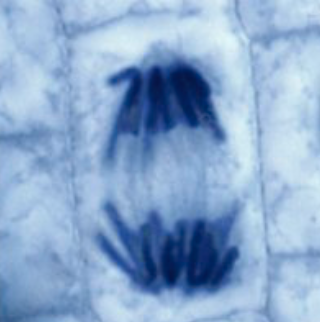
What stage of mitosis does this image show?
anaphase
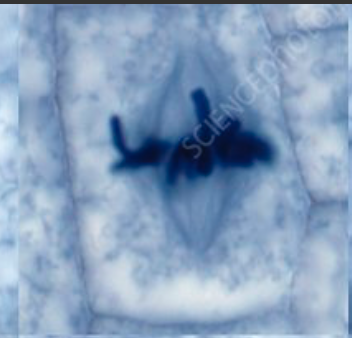
What stage of mitosis does this image show?
metaphase
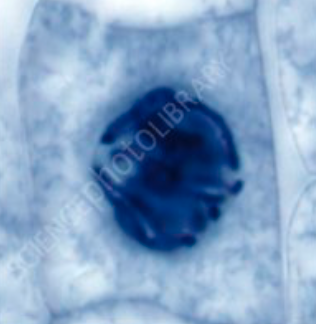
What stage of mitosis does this image show?
prophase
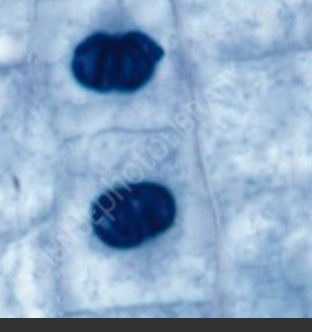
What stage of mitosis does this image show?
telophase
What is cytokinesis?
the division of the cytoplasm to create two daughter cells
Describe the process of cytokinesis in animal cells
Fill in the blanks: a ____ ____ forms in the middle of the cell as the ___ ___ is pulled inwards by the cytoplasm. When the plasma membranes from each side of the cell are in close proximity they fuse. Contractile proteins called ____ are found along the equator of the cell which cause the membranes to separate.
cleavage furrow, cell-surface/plasma membrane, actins
Why can’t cytokinesis in plant cells happen the same way it does in animal cells?
as plants have cell walls, a cleavage furrow cannot be formed
Describe the process of cytokinesis in animal cells
Fill in the blanks: ___ assemble along the ___ and fuse with each other, forming connecting channels - ____ - which fuse with the plasma membrane, dividing the cells into two. New section of cell __ form along the new membrane.
vesicles, equator, plasmodesmata, wall
Give 3 advantages of asexual reproduction
only 1 parent required (saves time + energy)
genetically identical offspring (successful adaptations passed on)
quick dispersal and spread/colonisation
rapid multiplication
What is the main disadvantage of asexual reproduction?
the lack of genetic variation in offspring (unless mutations occur) so evolution by natural selection cannot happen and organisms cannot adapt to changing environments
Fill in the blanks: meiosis is a form of ___ cell division in which _ (number) genetically ___ daughter cells are produced through _ (number) divisions
nuclear, 4, different, 2
What is mean by a pair of homologous chromosomes?
A pair of chromosomes, one maternal and one paternal, that contain that same genes at the same loci, but may contain different alleles
What is a karyotype and what are they used for?
a visual map of the complete set of chromosomes in an organism, which can be used to detect genetic conditions by spotting abnormalities in chromosome count or arrangement
Describe what happens in prophase I of meiosis
chromosomes condense and coil
nuclear envelope breaks down
spindle fibres begin forming from the centriole
chromosomes pair up in their homologous pairs, forming bivalents
crossing over of non-sister chromatids may occur - this point is called the chiasma
Describe what happens in metaphase I of meiosis
the bivalents randomly line up along the equator/metaphase plate (independent assortment)
spindle fibres attach to the centromeres
Describe what happens in anaphase I of meiosis
each pair of homologous chromosomes is pulled apart
the crossed over areas of DNA separate forming recombinant chromatids
Describe what happens in telophase I of meiosis
chromosomes assemble at each pole and uncoil, and the nuclear envelope reforms
cell undergoes cytokinesis
After meiosis I, are the daughter cells produced haploid or diploid?
haploid
True or false? Telophase I of meiosis doesn't occur in plant cells
true
Describe what happens in prophase II of meiosis
chromosomes coil and condense
nuclear envelope breaks down
spindle formation begins but at a right angle to the previous formation
Describe what happens in metaphase II of meiosis
chromosomes arrange randomly on the metaphase plate (independent assortment)
chromosomes may cross over again
Describe what happens in anaphase II of meiosis
centromeres divide and the individual chromatids are pulled to opposite poles
Describe what happens in telophase II of meiosis
nuclear envelopes from around each of the 4 haploid nuclei as the chromosomes uncoil
the two cells divide by cytokinesis to form 4 haploid cells
State 4 ways that genetic diversity is created during meiosis
crossing over, independent assortment, random fertilisation, mutations
Describe the process of crossing over
in prophase I non-sister chromatids of homologous chromosomes can become entangled so that portions break off and region the other chromatid, exchanging alleles
the point of contact is the chiasma (plural: chiasmata)
this forms recombinant chromosomes
What is independent assortment and how does it happen?
the production of different combinations of alleles in daughter cells due to the random alignment of homologous pairs along the equator of the spindle during metaphase I and II
How do you calculate the number of possible chromosome combinations?
2n (where n is the number of chromosomes in a haploid cell)
How does random fertilisation increase genetic diversity?
each gamete carries genetically different alleles and any random male gamete can fuse with a random female gamete