BIOL 191: Chapter 23 (Part 1)
 Call Kai
 Learn
Learn Practice Test
 Spaced Repetition
 Match
Match Flashcards
 Knowt Play
1/122

There's no tags or description
Looks like no tags are added yet.
Name | Mastery | Learn | Test | Matching | Spaced | Call with Kai | Chat |
|---|
No analytics yet
Send a link to your students to track their progress
123 Terms
Eukarya
The highly diverse phyla of protists is classified in the Domain
most ancient; 3.4 billion years ago
Among living organisms, bacteria and archaea are the ______, having originated more than ______.
Protista
A diverse group of eukaryotic organisms cannot be classified into the Kingdoms Fungi, Plantae, or Animalia. These organisms are called
-most produce cell walls containing chitin
-not photosynthetic
-eukaryotic
Which of the following are characteristics of fungi?
horizontal;vertical
The process in which an organism receives genetic material from another organism without being the offspring of that organism is called________ gene transfer, while ______gene transfer occurs from parent to offspring.
animals, plants, fungi
The diverse phyla of protists are classifed in the domain Eukarya, together with
Histone
The DNA of eukaryotes and archaea, but not bacteria, are associated with______ proteins.
most ancient organisms.
Bacteria and archaea are the Earth's:
salinity
temperature
acidity
The extreme habitats that the Archaea exploit include those with a high value of which characteristic?
diverse; cannot
Protists are ______ eukaryotic organisms that _____ be classified into the Kingdoms Fungi, Plantae, or Animalia.
-Korarchaeota
-Thaumarchaeota
-Euryarchaeota
-Crenarchaeota
Which of the following are four well-known phyla in the Domain Archaea?
fungi.
Small eukaryotic organisms that are not photosynthetic, sometimes occur as hyphae, and that often produce cell walls containing chitin are called:
harsh environments.
The resistance of ether-linked membranes to damage is related to the ability of archaea to live in:harsh environments.
from organism to organism; from parent to progeny
Horizontal gene transfer occurs______, while vertical gene transfer occurs ______
100
Data from molecular studies suggest that Domain Bacteria contains about ______ phyla
histones
Archaea and Eukarya, but not Bacteria, both use the important proteins associated with DNA, these are called
oxygen
Unlike other bacteria, the cyanobacteria are capable of producing______ as a product of photosynthesis.
extremophiles
Archaea that can occupy habitats with very high salt content, acidity, methane levels, or temperatures that would kill most other organisms are called
Cyanobacteria
Productions of atmospheric oxygen and nitrogen-fixation are functions of ______ that provide important benefits to humans and other organisms.
nitrogen
Thaumarchaeota species of Archaea that oxidize ammonia are important in the global cycling of
-filaments
-colonies held together with mucilage
-unicells
What types of body forms are seen in the cyanobacteria?
ether
It is thought that archaea can live in extremely harsh environments due in part to the __________bonds present in the lipids of their membranes.
mitochondria
Modern Proteobacteria are closely related to ancient bacteria that evolved into the _________organelles.
100
Molecular studies suggest the existence of nearly _______bacterial phyla, though many are poorly known.
Cyanobacteria
What are the only bacteria known to generate oxygen as a product of photosynthesis?
reproduction
Binary fission is the term used to describe the main mode of what process in bacteria?
oxygen, fixation
Cyanobacteria have the ability to produce atmospheric _______and the ability to convert inert nitrogen gas into ammonia in a process called nitrogen_______
-intercellular chemical communication
-specialized cells
-cellular attachment
-programmed cell death
What characteristics of multicellularity are demonstrated by some of the filamentous cyanobacteria?
proteobacteria
The ancient bacteria that evolved into mitochondria were closely related to current members of the phylum
akinetes, endospores
Some bacteria survive harsh conditions in a dormant state, existing in structures called______or________
binary fission
The process whereby a single cell splits into two identical cells is a bacterial reproductive process known as
endospores
Structures with tough protein coats that are produced inside bacterial cells in response to environmental stress, are called
Thylakoids and magentosomes
Nucleus-like bodies are bacterial adaptations to plasma membrane ingrowth. Which of the following are similar adaptations?
vibrios, spirochaetes, spirilli
Bacterial cells occur in five common shapes. These include: 1. cocci (spheres); 2. bacilli (elongated rods); 3. ________(comma-shaped cells); 4. _________(flexible spiral-shaped cells); and 5. ___________ (rigid spiral-shaped cells).
having a rigid cell wall
Maintenance of cell shape, protection from pathogens, and prevention of lysing are all benefits of what?
akinetes
endospores
A few species of bacteria respond to harsh conditions by entering a dormant state. Which structures can these bacteria persist as?
most bacteria
Peptidoglycan is an important component of the cell walls of which microbes?
endospores
What are bacterial cells with unusually tough protein coats that are released upon the death of their parent cell?
cell wall structure.
The Gram-stain procedure divides bacteria into two main types based on:
-thylakoids
-magnetosomes
-nucleus-like bodies
Membrane ingrowths have resulted in which of the following bacterial structures?
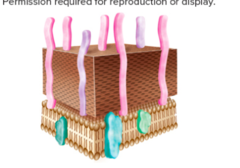
Gram-positive bacteria
The cell wall diagram shown here is typical of which type of bacteria?
cocci - sphere
bacilli - elongated rod
vibrios - comma
spirilli - rigid spiral
spirochaetes - flexible spiral-shaped
Match the name of the prokaryote shape with the description.
1. cocci
2. bacilli
3. vibrios
4. spirochaetes
5. spirilli
-help prevent lysing in watery conditions
-maintain cell shape
-help protect against pathogenic microbes
Which of the following are benefits of possessing a rigid cell wall?
-acts as the "glue" of colonial microbes
-binds mineral nutrients for absorption
Which of the following are benefits of mucilage?
peptidoglycan
The cell walls of most bacteria are composed of___________ , which is not present in archaea.
motility, locomotion, or flagella
Bacterial cells position themselves to the most favorable conditions within light, gas or nutrient gradients by using
Gram-stain
What is the process that distinguishes between two types of bacteria based on the chemical structure of their cell wall?
autotrophs; heterotrophs
Organisms that are able to produce their own organic compounds from inorganic sources are called ______, while organisms that must take in organic compounds from their environment are called ______.
negative
This diagram depicts the cell wall structure of a Gram-_________ bacterium

photoautotrophs, chemolithoautotrophs
There are two main types of autotrophic bacteria: __________utilize light as an energy source, whereas __________derive energy by oxidizing inorganic compounds.
-energy source = light; carbon source = organic compounds
-energy source = organic compounds; carbon source = organic compounds
Match the energy source and carbon source to the type of heterotroph
photoheterotroph
chemoheterotroph
glycocalyx
Binding for cell communication, aid in floating, and immune system avoidance are just some of the many benefits of the___________ structure for many bacteria.
motility
Bacteria can respond to chemical signals, as well as light, nutrients, and/or gas gradients using
organic molecules
Heterotrophs obtain carbon from
Obligate aerobes require O2 for survival, while obligate anaerobes are poisoned by O2.
Which of the following statements about bacterial responses to oxygen is TRUE?
-light
-inorganic compounds
Match each type of autotroph below with its main source of energy.
photoautotroph
chemolithoautotroph
photoheterotrophs, chemoheterotrophs
Organic compounds are the carbon source for ________, whose energy comes from light. Organic compounds are the source of both carbon and energy for ________
-It helps to evade the immune reactions of their hosts.
-It repels predators.
-It helps aquatic species float.
Identify the ways that mucilage helps bacteria.
Aerotolerant anaerobes do not use O2 while facultative anaerobes do.
Which of the following statements about aerotolerant anaerobes and facultative anaerobes is TRUE?
aerobes, anaerobes
Oxygen is required for survival by obligate _________, whereas obligate _________are poisoned by the presence of oxygen.
photoautotrophs, chemolithoautotrophs
There are two main types of autotrophic bacteria: ________utilize light as an energy source, whereas _________derive energy by oxidizing inorganic compounds.
Photoheterotrophs; chemoheterotrophs
______ use organic compounds as a carbon source, but Blank______ utilize organic compounds for both an energy and a carbon source.
aerotolerant; facultative
______ anaerobes do not use oxygen, while Blank______ anaerobes sometimes use it depending upon environmental conditions.
light; inorganic
Photoautotrophs synthesize organic compounds using energy from Blank______, and chemolithotrophs get their energy from modifying Blank______ compounds
-do not use oxygen but are not poisoned by it
-can use oxygen in aerobic respiration, but also get energy from anaerobic fermentation
Match the microbe type with the description that best fits their relationship with the presence of oxygen.
aerotolerant anaerobes
facultative anaerobes
-3.5 billion years ago
The oldest known fossils of prokaryotes is said to have lived (or formed)

-Microorganisms (microbes) are typically so small that they can only be seen with the use of a microscope
-Microbes are incredibly diverse and include organisms from:
the prokaryotic domains: Archaea & Bacteria
&
-within the Domain Eukarya, only the phyla of protists & fungi
What are microorganisms? How small are they? What organisms do microbes include?

-Cell membranes and ribosomes
-Common metabolic pathways (e.g., glycolysis)
-Semiconservative DNA replication
-DNA that encodes proteins
Shared features indicate that all life is related, but major differences have also evolved
All organisms have what? (4 things)
lack membrane-bound organelles
Prokaryotic cells
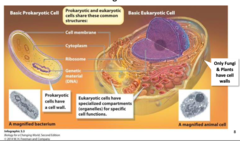
have membrane-bound organelles, including a nucleus
Eukaryotic cells

-Most abundant organisms
-Unicellular, small,1-10microns
-some form colonies/are Multicellular
-DNA is often circular, not contained -within a nucleus
-Do not divide by mitosis, instead use binary fission
What are the prokaryotes? What are some of their key characteristics?

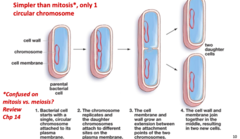
-Binary fission: rapid (minutes to hours)
-Simpler than mitosis only 1 circular chromosome
1. Bacterial cell starts with a single, circular chromosome attaches to is plasma membrane
2. The chromosome replicates and the daughter chromosomes attach to different sites on the plasma membrane
3. The cell membrane and wall grow an extension between the attachment points of the two chromosomes
4. The cell wall and membrane join together in the middl, resulting in two new cells
How do prokaryotes reproduce? Describe this process
-Small rings of DNA
with supplemental genes
-replicate independently; can be transferred cell to cell
-R plasmids carry genes conferring antibiotic resistance.
What are plasmids?

horizontal transfer of genes
Rapid evolutionary rate is facilitated by
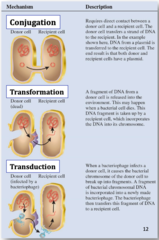
Conjugation: Requires direct contact between a donor cell and a recipient cell. The donor cell transfers a strand of DNA to the recipient. In the example shown here, DNA from a plasmid is transferred to the recipient cell. The end result is that both donor and recipient cells have a plasmid
Transformation: A fragment of DNA from a donor cell is released into the environment. This may happen when a bacterial cell dies. This DNA fragment is taken up by a recipient cell, which incorporates the DNA into its chromosome
Transduction: When a bacteriophage infects a donor cell, it causes the bacterial chromosome of the donor cell to break up into fragments. A fragment of bacterial chromosomal DNA is incorporated into a newly made bacteriophage. The bacteriophage then transfers this fragment of DNA to a recipient cell.
Describe conjugation, transformation, transduction

-occurs when an organism receives genetic material from another organism without being the offspring of that organism
-HGT is particularly common among archaea and bacteria E.g., at least 17% of the genes present in E. coli came from other bacteria
When does horizontal gene transfer occur? What domain is it mostly common in?
-Lateral gene transfer (HGT) complicates phylogenetic
relationships
-Whole genome sequencing has revealed a stable core of crucial genes. Gene trees based on these reveal the organismal phylogeny more accurately.
Horizontal gene complicates what? What has whole genome sequencing revealed about genes?

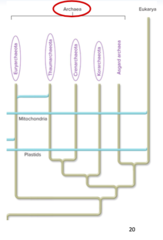
-The domain Archaea includes >20 phyla, such as:
-Thaumarchaeota: species that oxidize ammonia are important in global nitrogen cycling
-Euryarchaeota: include hyperthermophiles, diverse methane producers, and extreme halophiles
-And a superphylum informally known as:
-Asgard archaea: have a particularly close evolutionary relationship to Eukarya
How many phyla does the domain Archaea have? What are they? What are Thaumarchaeotas? What are Euryarchaeotas? What is Asgard Archaea?
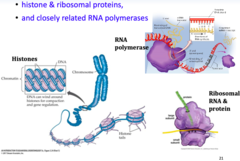
-histone & ribosomal proteins,
-and closely related RNA polymerases
What features do Archaea share with eukaryotes?
-Many are "Extremophiles" An extremophile is an organism that thrives in extreme environments.
- hyperthermophiles: Grows at extremely high temperatures (80C-100C) as in the volcanic Grand Prismatic Spring, Yellowstone National Park
-methanogens: lives in ocean hydrothermal vents. Produces methane as a by-product of its energy converting metabolic pathways
-halophiles: Lives inplaces with high salt concentration such as the San Francisco Bay evaporation ponds
-lack peptidoglycan in cell walls, peptidoglycan is unique to bacteria
-Are 'never' pathogenic
→ Do not form spores
How are archaea different from bacteria? What are extremophiles. Describe them (3)

-Archaea have certain features that enable them to grow in extreme conditions: useful for understanding the origins of life
-Archaea possess distinctive membrane lipids formed with ether bonds (in contrast to bacteria and eukaryotes that use ester bonds)
-Ether-bonded membranes are resistant to damage by heat and other extreme conditions
-Archaean membranes are built with isoprene chains (not fatty acid chains)
What features do Archaea possess in order to thrive in extreme environments?

-Live in every imaginable environment,
-Autotrophs (e.g. Cyanobacteria) & Heterotrophs
Where do bacteria live? How can they be classified?
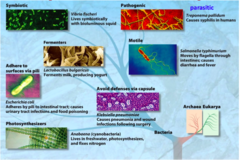
-There are ~100 bacterial phyla; many phyla are poorly characterized
• Most bacteria live in moderate conditions, though some are extremophiles
-Cyanobacteria and Proteobacteria are diverse and relevant to eukaryotic cell evolution, global ecology, and human affairs
Cyanobacteria: The oxygen-producing photosynthetic bacteria. Photosynthetic pigments include chlorophyll a and blue-green or red accessory pigments. Cyanobacteria occur as unicells, colonies, unbranched filaments, and branched filaments. Many of the filamentous species produce specialized cells: dormant akinetes and heterocytes in which nitrogen fixation occurs. In waters having excess nutrients, cyanobacteria produce blooms and may release toxins harmful to the health of humans and wild and domesticated animals.
Proteobacteria: A very large group of Gram-negative bacteria, collectively having high metabolic diversity. Proteobacteria includes many species important in medicine,
agriculture, and industry.
How many bacterial phyla are there? Where do most bacteria live? What are Cyanobacteria and Proteobacteria?
-Named for blue-green or cyan color (photosynthetic pigments)
-The only prokaryotes known to generate oxygen as a product of photosynthesis
-Photosynthesis is the same as in eukaryotes; carried out on an internal membrane system called photosynthetic lamellae.
-Chloroplasts of eukaryotes are derived from an endosymbiotic cyanobacterium through HGT, gave rise to the chloroplasts in algae & plants
Describe cyanobacteria. How were they named? What do they produce and how? What have they contributed to plants and algae?

-abundant in fresh water, oceans, wetlands, and the surfaces of arid soils
-They also fix nitrogen into ammonia, a form of N that can be used by algae and plants to synthesize amino acids and proteins
-Nitrogen fixation enriches nutrient poor soils
- In phosphorus-rich water, cyanobacteria can form toxic blooms
Eutrophication is a natural process that results from accumulation of nutrients in lakes or other bodies of water.
Where are cyanobacteria abundant? What do they "fix"? How does this help the environment? What can they also form?

-Unicells are single-celled bodies
-Colonies are groups of cells held together by a thick substance
called mucilage
- Filaments are cells attached end-to-end; can be unbranched or
branched
-Some filamentous cyanobacteria display hallmarks of multicellularity: cell-to cell attachment, specialized cells, intercellular chemical
communication, and programmed cell death
What forms can cyanobacteria take on? Explain them. What do cyanobacteria illustrate when it comes to bacterial phyla?

Proteobacteria
What is the largest group of bacteria?
1. Alphaproteobacteria
- Related to ancestors of mitochondria
- Nitrogen-fixing bacteria help plants grow, and some species consume methane (reducing impact of this greenhouse gas)
2. Betaproteobacteria
-Important for the global nitrogen cycle
3. Gammaproteobacteria
-Some species destroy methane
-Some species are human pathogens e.g., E. coli strains
Yersinia pestis (bubonic plague). Vibrio cholerae (cholera)Salmonella typhimurium (gastrointestinal disease)
What are the 5 major classes of proteobacteria? (First 3)

4. Deltaproteobacteria
-Includes colony forming myxobacteria
-Includes some sulfate-reducing bacteria
-Includes bdellovibrios which are parasites of other bacteria
5. Epsilonproteobacteria
-Some species important for the global sulfur cycle
-Some species affect human health e.g., Helicobacter pylori (ulcers, stomach cancer)
What are the 5 major classes of proteobacteria? (Last 2)

-Some bacteria produce thick-walled cells, able to survive harsh conditions in a dormant state; then later germinate into metabolically active cells when conditions improve
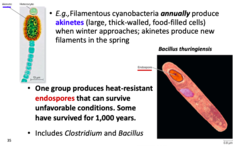
-E.g.,Filamentous cyanobacteria annually produce akinetes (large, thick-walled, food-filled cells) when winter approaches; akinetes produce new filaments in the spring
One group produces heat-resistant endospores that can survive unfavorable conditions. Some have survived for 1,000 years.
• Includes Clostridium and Bacillus
How do some bacteria survive harsh conditions? How do cyanobacteria do this? What are endospores?
What features of cyanobacteria are ecologically important?
Some evolved into mitochondria
What essential role did early alphaproteobacteria play in the origin of eukaryotic cells?
Akinetes are large, thick-walled, food-filled cells that allow a cell to survive unfavorable environmental conditions. Endospores is a cell with a tough coat produced by some bacteria allowing them to survive unfavorable conditions
. E.g.,Filamentous cyanobacteria annually produce akinetes (large, thick-walled, food-filled cells) when winter approaches; akinetes produce new filaments in the spring. It serves as a survival structure. It is a resting cell of cyanobacteria and unicellular and filamentous green algae
One group produces heat-resistant endospores that can survive unfavorable conditions. Some have survived for 1,000 years.
• Includes Clostridium and Bacillus
How do endospores influence the ability of some bacteria to cause disease? How are they different from akinetes?

-photosynthetic bacteria contain thylakoids (flattened, tubular membranes that grow inward from the plasma membrane); chlorophyll and other components are associated with these membranes
-Magnetosomes are tiny mineral crystals surrounded by membrane; magnetosomes allow cells to orient themselves in space in relation to the Earth's magnetic field
-Plasma membrane ingrowths may surround DNA, producing nucleus-like structures
Explain how some bacteria have complex intracellular structures similar to the organelles of eukaryotes. What are these structures?

• Cocci: spheres
- Bacilli: elongate rods
-Vibrios: comma-shaped cells
-Spirochaetes: flexible spiral-shaped cells
- Spirilli: rigid spiral-shaped cells
-Cytoskeletal proteins control these cell shapes
What are the 5 common shapes that bacteria display? What controls these cell shapes?
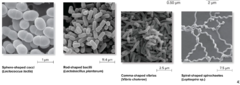
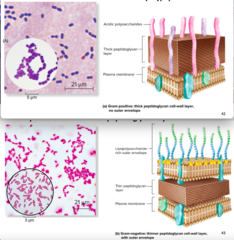
-Prokaryotes have different types of cell walls
-Gram-positive bacteria: cell wall retains the Gram stain (blue/purple)
-Peptidoglycan: sugar- polymer cross-linked by polypeptides
-Gram-negative bacteria: thin peptidoglycan surrounded by lipid membrane. Does not retain the Gram stain (red). Penicillin cannot reach peptidoglycan layer
What cell walls do prokaryotes have?
-Many bacteria exude a coat of slimy mucilage (also called a capsule, glycocalyx, or extracellular polymeric substance)
What do many bacteria exude? What are they also called?
-cells bind to a solid surface and secrete a sticky polysaccharide matrix that traps other cells.
-Functions: evade host defenses, protection from UV light & antibiotics, binds cells together & to surfaces
-Can form on any surface, including contact lenses, artificial joint replacements, metal pipes.
-Dental plaque and stromatolites are biofilms
What are biofilms? What is its function?
-movement (swim, glide, float) by flagella, pili, and gas vesicles).
-flagella not covered by a plasma membrane (unlike eukaryotic flagella).
-direction is random or governed by positive or negative taxis. e.g., chemotaxis or phototaxis
How do prokaryotes move? Describe prokaryotes motility and taxis.

Microbes Can be Grouped by:Type of Nutrition and Response to Oxygen
How can microbes be grouped?